Image source: wikiart.org
Introduction
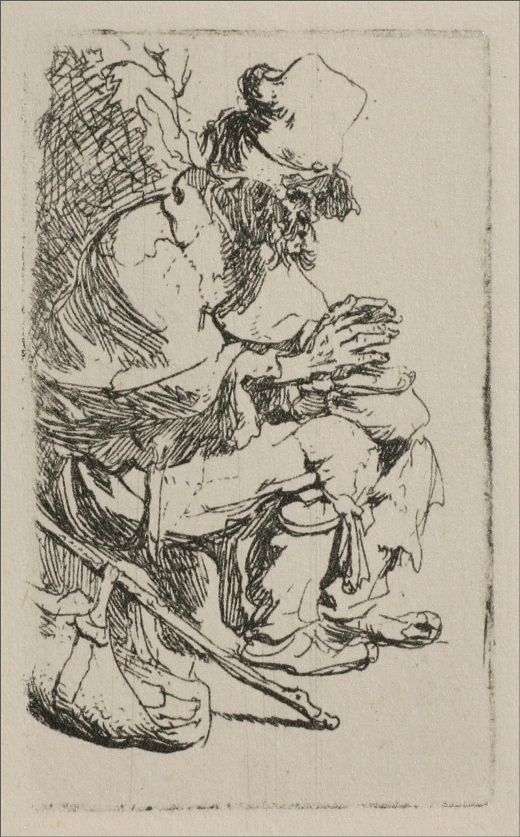
Rembrandt’s “A Beggar Warming his Hands over a Chafing Dish” from 1630 condenses human need, winter cold, and the dignity of endurance into a handful of etched lines. The figure crouches low, shoulders hunched, fingers spread toward a small brazier. The scene is almost nothing—no architecture, no anecdote, barely any setting—yet it communicates a world of sensation: the brittle snap of frost, the thin heat rising from coals, the ache of joints compressed by poverty and weather. In this small plate from his Leiden years, Rembrandt shows how etching can carry not only likeness but temperature and time. The work belongs to a cluster of early beggar prints in which the artist studies the body under strain and discovers a form of grandeur in survival.
Medium, Scale, and the Speed of Etching
The image is an etching, made by drawing through a wax ground on copper with a needle and then biting the exposed metal in acid so that it will hold ink. Etching translates the speed and pressure of drawing into printable line, preserving the musician’s tempo of the hand. Rembrandt uses that capacity to great effect here. The quick, fibrous hatching across the beggar’s cloak suggests coarse cloth; the lighter, broken strokes around the knees and hands imply the flicker of firelight; the thickened contour of the shoe plants the figure with weight on the ground. The scale is small—designed to be held and studied closely—yet the variety of marks generates an outsized sense of presence.
Composition as a Furnace of Attention
The composition compresses everything around the action of warming. The figure arcs forward in a crescent, from the drooping cap to the bearded chin to the outthrust hands. At the base of the arc lies the chafing dish, a humble source of heat that the artist barely draws and yet makes central through gesture. A diagonal staff, perhaps a walking stick, braces the lower left and propels the eye back toward the hands. The right side of the plate remains open, an unetched field that functions as air, allowing the gesture to read without clutter. Rembrandt designs the space like a furnace: empty walls forcing attention toward the glowing core of need.
Gesture, Hands, and the Theater of Necessity
The hands are the drama. The palms face the brazier, fingers splayed, the back knuckles catching the idea of warmth more than its reality. Rembrandt resists the temptation to describe each finger meticulously. He lays down a sequence of short, parallel strokes that build volume while maintaining the urgency of motion. The cluster of marks between wrist and palm reads as trembling. A viewer can almost feel the tiny convective currents crossing the fingers, as if the etching itself were exhaling heat. This attention to gesture transforms a “type” into a person: not a generic beggar but a particular man in the act of saving his hands from winter.
Clothing as Evidence and Emblem
The beggar’s cloak is a map of hardship. Rembrandt signals wear through ragged outlines, slits at seam lines, and an insistence on gravity pulling fabric to the floor. The cap slumps over the ear, not as a picturesque accessory but as a piece of equipment losing its fight against the elements. The shoes, oversized and heavy, are etched with a firmness that contrasts with the fluttering lines of the sleeves; they anchor the figure in reality. These clothes are not symbolic in a literary sense, but they symbolize through fact, recording the condition of life in every fray and fold.
Heat, Cold, and the Alchemy of White Paper
Because prints produce darkness with ink and preserve light by leaving paper untouched, Rembrandt leverages the white field to evoke temperature. The empty right half of the image becomes cold air. The unetched gaps between hatches within the cloak read as the glimmer of coals reflecting on cloth. The chafing dish itself is barely more than a contour; its heat is made visible by the way it organizes the marks around it. White space here is not absence. It is the breath of the scene.
Soundless Narrative and the Refusal of Anecdote
Many seventeenth-century images of the poor belong to narrative cycles—beggars importuning passersby, cheats and comic types parading through streets. Rembrandt’s print isolates the act of warming as a complete subject. There is no donor, no passerby, no punch line. We encounter a private moment in public view, but not as trespass. The beggar seems unaware of us; the image protects his privacy even as it records it. By refusing anecdote, the artist invites the viewer to linger on phenomena—pose, line, light—without reducing the figure to a moral lesson.
The Body in Compression
Crouching compresses muscles and joints. Rembrandt makes that compression visible with short hatching where the torso folds over the thighs and with the sharp angle of the bent knee. The nose points toward the hands; the beard trails like smoke over the forearm; the shoulders climb toward the ears. Every part of the body participates in the pursuit of heat. This clarity of purpose gives the figure a dignity that often escapes staged heroics. The heroism is practical: keeping fingers mobile enough to grasp the next coin, the next crust, the next day.
A Winter Piece Without Snow
Despite the title’s suggestion of warmth, this is a winter piece. There is no snow on the ground, no breath misting, no wind made visible by fluttering cloth. Yet the lines carry climate. The hard contour at the shoes implies frozen earth; the density of cross-hatching at the figure’s back reads as a shield against cold; the diagonal scoring behind the head hints at atmosphere without drawing it. Rembrandt understands that winter can be conjured not by representing weather but by depicting what weather makes bodies do.
Kinship with the Beggar Series and the Study of Types
The 1629–1630 beggar etchings compile a gallery of walkers, leaners, petitioners, and idlers. They function as tronies—studies of character types—but they also operate as manifestos for a broader vision of art. In them, Rembrandt declares that the lowly are worth regarding with the same attention given to scholars and saints. This plate extends that program with a new emphasis on action rather than mere posture. The warmth-seeking gesture becomes a type of its own, as legible as prayer, as telling as a soldier’s salute. It is a universal movement given particular voice through one man.
The Staff and the Geometry of Survival
The stick crossing the foreground is more than a compositional diagonal. It reading as a walking aid, a tool of balance, and a portable home base. It echoes the line of the shin and counterbalances the thrust of the hands, creating a triangular stabilizing frame: staff, shoe, brazier. This geometry serves both picture and person. For the print, it keeps the lower register from dissolving into a tangle. For the figure, it signals how survival depends on simple apparatus—a stick, a cap, a source of heat.
The Face as Weathered Landscape
Rembrandt resists detailing the beggar’s features. The beard, mustache, and shadows swallow the mouth and cheeks; the eye emerges only as a dark almond under the cap’s brim. Rather than starve the viewer, this reduction intensifies the sense of weathered topography. The head becomes a small landscape of drifts and trenches carved by time and cold. When Rembrandt later draws old men with lavish specificity, he will keep this lesson: that suggestion can sometimes convey age and feeling more directly than exact description.
Printing Variations and the Life of the Image
As with all etchings, impressions vary. Heavier inking might deepen the shadows around the back and stick, while a light plate tone could leave a translucent veil over the white field, like the gray of a cloudy day. Such variability aligns with the subject. The same man warming his hands today will warm them again tomorrow under slightly different conditions; the print’s life across impressions echoes his serial adaptation to the elements. Owning more than one impression, a collector in Rembrandt’s time could witness the image behave like weather itself.
Ethical Looking and the Refusal of Caricature
The history of representing the poor is littered with cruel caricatures. Rembrandt’s beggar prints avoid mockery by combining accuracy with restraint. He records torn cloth but not filth; he marks a large shoe but denies the comic overstatement of size; he honors the hands as instruments rather than instruments of begging alone. The tone is not sentimental, either. The artist neither pleads on behalf of the beggar nor condemns the world that produced him. He simply looks long enough for the viewer to recognize kinship.
Theological Whisper Without Didacticism
The print carries a quiet spiritual undertow common in Rembrandt’s work. The crouched figure, hands raised toward a modest fire, resembles traditional poses of prayer without invoking any altar. Heat stands in for grace. The man does not receive a miracle; he receives warmth sufficient for the moment. In this substitution lies a theology of the ordinary: small reliefs, attentiveness, and the sacredness of persistence.
Lessons for Draftsmanship and Design
Students of drawing can mine the plate for practical instruction. The cloak shows how long, directional strokes can ride the form, both describing volume and suggesting texture. The hands demonstrate how to model with broken contours rather than heavy outlines. The composition teaches restraint: reserve a broad area of paper to give action room to breathe. The staff exemplifies how a single diagonal can bind a figure to the ground and stabilize the eye. Perhaps the most important lesson is confidence in omission. The brazier’s glow is felt precisely because it is hardly drawn.
Relation to Daily Life in the Dutch Republic
Seventeenth-century Dutch society managed poverty through alms houses, churches, and civic charities, yet street survival remained visible. Small prints like this traveled easily, affordable to a growing middle class of collectors who prized scenes of everyday life. The sheet therefore participates in a larger culture of looking where the familiar becomes worthy of contemplation. It proves that art could address the social fabric not by grand allegory but by focusing sharply on a single human act.
Atmosphere, Silence, and the Space Around the Figure
The empty space to the right is not an oversight; it is silence. It allows us to hear the scene’s soft soundscape: the whisper of coals, the rasp of cloth, the creak of leather, the faint tap of stick on ground. The silence also offers room for the viewer’s breath, for that strange internal flinch that comes when one recognizes cold. In this way the unetched paper becomes empathetic space, making the print feel larger than its margins.
Endurance, Poise, and the Light of Small Fires
What lingers after looking is the beggar’s poise. The etching articulates not desperation but strategy. He knows where to place his hands, how to fold his body to conserve heat, how to brace with his staff. The print honors that knowledge. There is tenderness in the way Rembrandt lets the light of the small fire imagine itself on every surface, a set of minor illuminations scattered across the page. It is a philosophy in miniature: life is sustained by small fires, and art can make them visible.
Conclusion
“A Beggar Warming his Hands over a Chafing Dish” is a masterclass in concentration. With spare means, Rembrandt distills gesture, temperature, and time into an image that avoids spectacle without diminishing emotion. The crouched form gathers the viewer’s attention like a hearth; the staff and shoes anchor the situation; the clothing records a practical history of wear; the hands illuminate the humanity that remains fiercely present even in need. This is not a picture that asks for pity; it invites recognition. In a handful of lines, the artist demonstrates how seeing carefully is a way of honoring life, and how the smallest warmth can radiate across centuries.
