Image source: wikiart.org
Introduction
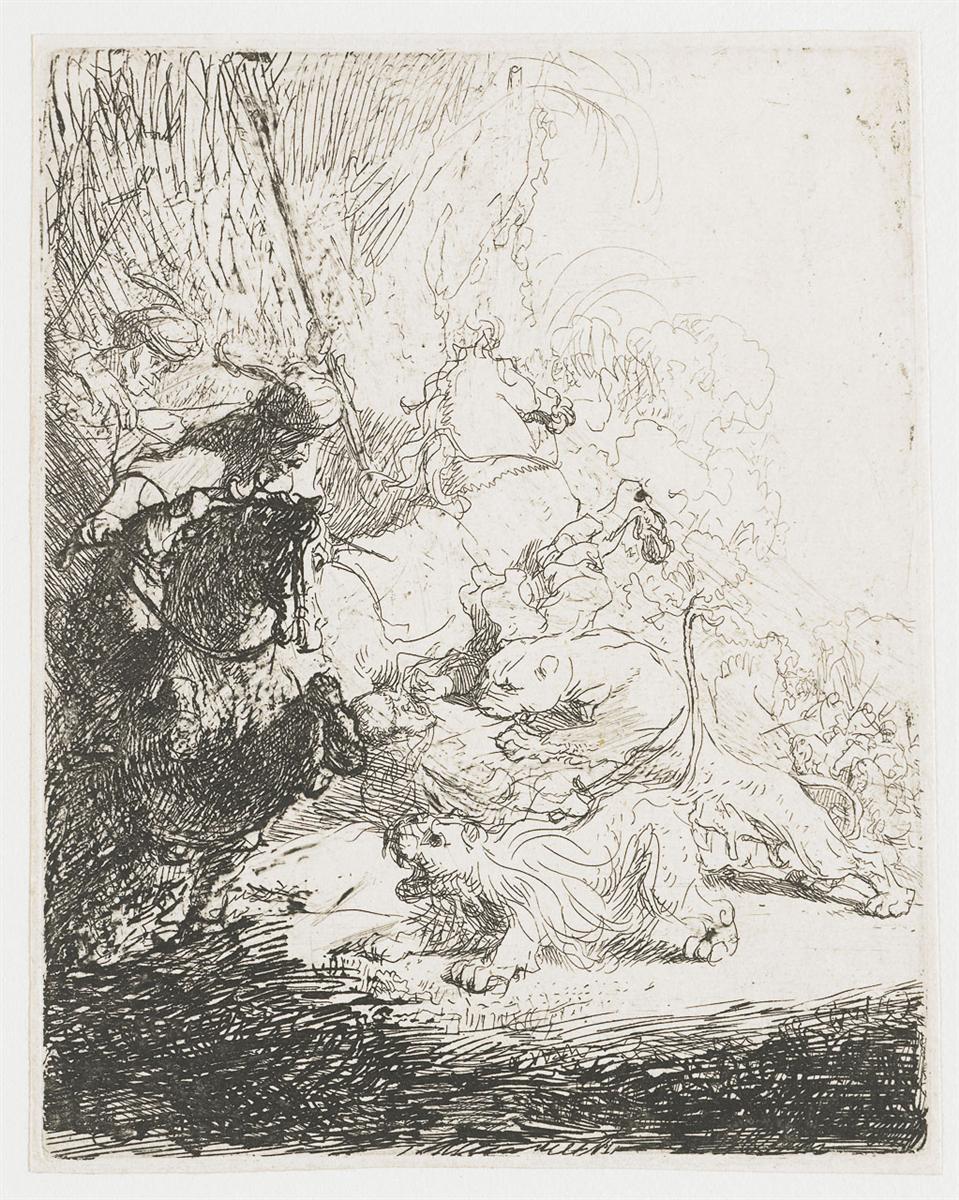
“The Small Lion Hunt with Two Lions” (1629) is a compact explosion of motion in copper. In this early etching, Rembrandt compresses the frenzy of a hunt into a shallow ravine where men on rearing horses collide with two lunging lions. The scene is sketched with lightning-quick lines, yet it feels fully inhabited: hooves skid, manes flare, and the cats’ bodies snake through brush toward vulnerable flanks. Rather than staging the hunt as a decorative pageant, Rembrandt renders it as a calculus of momentum and peril. Every stroke participates in the physics of impact, turning a small print into a large drama.
Leiden Years And The Taste For Action
The date places the work in Rembrandt’s Leiden period, when he was barely in his twenties and testing the narrative possibilities of etching. Dutch collectors loved scenes of chase and battle, and earlier masters—especially Rubens—had made the lion hunt into a grand Baroque spectacle. Rembrandt adopts the theme but miniaturizes it, swapping monumental color and rippling anatomy for speed, risk, and intimate proximity. The result reads less like a heroic mural and more like a field note from the edge of danger, made by an artist who prefers the truth of sudden gestures to the polish of studio choreography.
Composition As A Trap Of Diagonals
The design hinges on diagonals that drive the eye and entangle the riders. A dark wedge at the lower left anchors the composition; from that shadow a downward slant of lines and brush hatching pulls us into the struggle. The horses twist along crossing vectors—one plunging down, another rearing, a third pivoting—so that the forms tangle like ropes. Between these diagonals Rembrandt threads the lions: one bounds forward across the white of the paper, mouth open, paws extended; the other hugs the ground and claws upward. The diagonals do more than energize. They close in, making the entire page feel like a sprung trap.
The Choreography Of Bodies In Extremis
Rembrandt reduces horse and human to engines of torque. A rider leans forward in the saddle with his arm extended, weapon straining toward the cat; another turns with a violent twist at the waist; a third braces against the slide of his mount. The horses’ heads are drawn in sweeping arcs, nostrils flared, their necks roped with quick, parallel strokes that read as tendons under strain. The lions are equally economical: a thick, forward-thrust shoulder, a spine written as a single elastic curve, a tail that flicks like punctuation at the end of a sentence. Because each body is simplified to its most expressive lines, the whole scene reads at once—a burst of legibility that mirrors the instant it depicts.
Etching As A Medium For Speed
Etching allows the hand to move with pen-like freedom across the waxed plate, and Rembrandt exploits that freedom fully. Long, nervy lines draft the edges of horses and cats; tight crosshatching builds pockets of darkness that pin forms to ground; clouds of short, broken strokes make shrubs vibrate as if shaken by hooves. He resists overworking the copper: large passages of paper remain nearly bare, the blank acting as a flash of sun that silhouettes forms and heightens contrast. The restraint is strategic. By leaving some contours open and some spaces luminous, he keeps the scene breathing even as it compresses toward catastrophe.
Light, Shadow, And The White Heat Of Action
Although there is no single cast shadow that explains a light source, the print manages illumination through value contrasts. The left foreground is dense and dark, a thicket of strokes where the viewer can almost feel dust and trampled brush. Against that density the center and right open into paler air, and the lions’ lean bodies appear like flares against the ground. White paper becomes the most dramatic “light,” a raw radiance where the eye needs speed. The alternation between ink-saturated zones and open paper mimics how sight narrows and brightens under adrenaline.
Nature As Stage And Participant
The hunt plays out in a narrow, irregular clearing bordered by rushes and brush. These vegetal masses are not passive scenery; they push back. In the left wedge, slashed verticals of reed and branch lean into the riders like a hostile wall. To the right, rounded shrubs curl around the lions, echoing the cats’ crouch and spring, as if the land itself were shaping attack. This dialogue between creature and setting keeps the action grounded. The hunt is not a floating allegory; it is a collision with a place.
Psychology Without Faces
Few faces are explicit, yet emotion saturates the print. Fear reads in the horses’ reared heads and slashing hooves; determination registers in the stance of riders who lean beyond safety to strike; predatory focus concentrates in the lions’ narrowed silhouettes. Rembrandt understands that psychology can be carried by posture and vector rather than by facial detail. In this economy he is already the artist of later masterpieces, where a bent neck or a cupped hand can hold a narrative’s heart.
Echoes And Departures From Rubens
Rubens’s lion hunts, painted two decades earlier, are operas of anatomy and color: glossy pelts, polished lances, muscular torsos interlocked in a golden tumult. Rembrandt echoes the theme but shifts the register. His “small lion hunt” is not about splendor; it is about danger seen from close range. The palette of black and white trades sumptuousness for immediacy. The riders’ bodies are not heroic nudes but scumbled silhouettes; the lions are not monuments but bullets. The departure is not a rejection of Baroque drama but a redefinition of where drama lives—in the strike of a line, the snap of a diagonal, the white-hot gap between bodies.
Sound And Kinetic Atmosphere
The etched marks generate an imagined soundscape. You can hear the rasp of reeds against flanks, the skid of hooves on gravel, the breathy cough of a cat mid-leap, the shouted orders that vanish into the press of brush. Rembrandt implies this noise through clustered hatching that “buzzes,” through jagged contours that suggest tearing, and through smooth, uninked swathes where the silence before impact widens your breath. The print is therefore not merely seen; it is sensed as a storm of sound squeezed into a small rectangle.
The Ethics Of Violence
Hunting prints often glorified domination over nature. Rembrandt’s version is more ambivalent. The riders are not in secure control; they are precarious, one misstep from catastrophe. The lions, though lethal, are not demonized; they are sleek, purposeful, fully present as living beings. This balance does not sentimentalize predators or condemn hunters; it acknowledges risk as mutual and dignity as shared. The viewer is left less with triumph than with a heightened awareness of life under pressure.
Multiplicity And The Circulation Of Thrill
As an etching, the image could be pulled in multiple impressions and circulate widely. That multiplicity matters. The small print becomes a portable burst of adrenaline that could slip into portfolios, cabinets, and domestic albums, meeting eyes in intimate circumstances rather than on a palace wall. The democratized thrill suits Rembrandt’s vision. He excels at making grand themes personal, and here the cat’s leap feels close enough to quicken the pulse of anyone who handles the sheet.
The Geometry That Holds Chaos
Beneath the flurry of lines lies firm geometry. The dark left triangle anchors the page; a secondary triangle formed by the two lions and the rearing horse stabilizes the right. The diagonal thrusts intersect around a rough center where the cats converge, turning that spot into the narrative hinge. Curves of tails and manes soften these axes just enough to keep the eye moving. The geometry is felt rather than announced, which is why the print reads as spontaneous despite its structural intelligence.
Touch, Burr, And The Grain Of Energy
Rembrandt’s needle sometimes throws up a microscopic burr along the edge of a groove, which can hold extra ink and print as a velvet line. In energetic passages—around manes, tails, and reeds—this burr adds vibration, converting contour into pulse. He exploits such material accidents knowingly, letting the plate’s textures participate in the description of fur and speed. The craft choice becomes an expressive one: the very grain of the line conveys agitation.
The Viewer’s Vantage And Complicity
The viewpoint places us slightly above and behind the riders on the left, as if we have just pushed through the same wall of brush. That vantage implicates us. We are close enough to feel threatened by the cats’ momentum and to sense how unstable the ground is under hoof and boot. The scene does not grant the safe omniscience of a distant observer; it places us where decisions have to be made immediately, engaging eye and body together.
Relation To Rembrandt’s Broader Animal Studies
Throughout the 1620s and 1630s Rembrandt sketched dogs, horses, oxen, and the occasional exotic—often with the same alertness to posture over detail. The lions here share that approach. Musculature is suggested rather than diagrammed; expression is implied by stance and direction. This consistency shows that the hunt is not an anomaly but part of an ongoing attention to how animals move through space and time. Later biblical scenes—Daniel, Samson, or the prodigal’s beasts—benefit from this observational base.
The Role Of Negative Space
One of the print’s quiet triumphs is its use of untouched paper. The upper right opens into a pale, nearly empty sky that gives the cats room to leap and the viewer space to breathe. Without that negative space the page would choke on its own energy. With it, motion reads clearly, and the contrast sharpens the drama at the center. The emptiness is not absence; it is the medium through which the action flies.
Time Suspended At The Brink
This is the second before consequences. Lances have not yet landed, claws have just left the ground, and the nearest horse’s front legs are beginning to fold. Rembrandt specializes in such thresholds, choosing the interval where multiple outcomes remain possible. That choice invests the image with suspense—and with repeatability. Each time you return to the print, your eye can re-run the event and imagine a slightly different ending. The small hunt becomes inexhaustible because it never resolves on the plate.
Endurance Of A Small Masterwork
Despite its size, the etching stands with Rembrandt’s strongest early narrative works. It marries the freedom of drawing to the permanence of copper, the appetite for Baroque action to an intimate Dutch scale, and the accuracy of observation to a humane ambiguity about victory and peril. Its lines feel newly cut even centuries later, which is why the hunt still works on us—not as propaganda for conquest, but as a taut meditation on speed, intention, and the moment when living forces meet.
Conclusion
“The Small Lion Hunt with Two Lions” compresses a world of momentum into a pocket of paper. Diagonals trap the riders, negative space lets the lions fly, burr and hatch give fur and reed their nervous life, and the balance of light and dark makes the encounter read in a single glance. Rembrandt sidesteps grandiose spectacle to deliver immediacy: the breath before impact, the close scrape of survival, the recognition that hunter and hunted occupy the same perilous instant. This is action distilled to essence—an early proof that the young artist could bend line, space, and time to tell a story that still grips the eye and quickens the heart.
