Image source: wikiart.org
Introduction
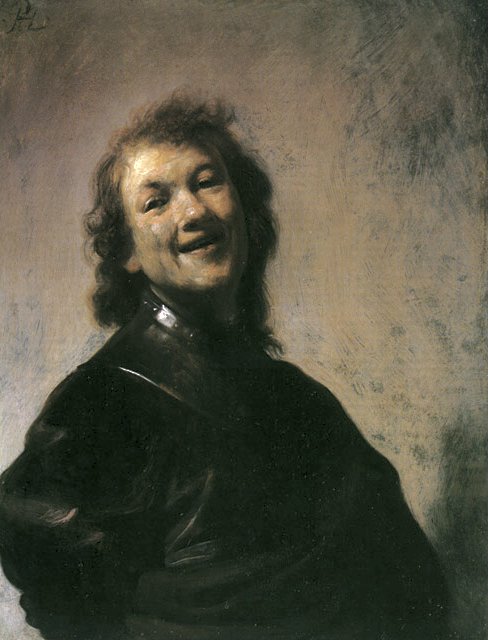
“The Young Rembrandt as Democritus the Laughing Philosopher” (1629) is one of the most audacious inventions of the artist’s Leiden years. Rather than presenting a sober, introspective likeness, Rembrandt stages himself as Democritus, the ancient Greek thinker famed for a worldview that preferred amusement to lamentation. The painting catches a spontaneous burst of laughter, the head cocked, the mouth open, the eyes creased with delight. The costume is dark and simple, the background a weathered field of warm light; everything exists to amplify the shock of expression. What could have been a mere studio jest becomes an early manifesto: philosophy and painting meet in the theatre of the face, and the young artist declares that human feeling—joy included—deserves the same dignity as solemnity.
Leiden Context And A Young Artist’s Program
The date places the picture at the end of Rembrandt’s formative Leiden period, when he experimented restlessly with tronies, expressive heads, and small-scale histories. These works were rarely portraits in the social sense; they were laboratories where he investigated light, texture, and the topography of emotion. Adopting the guise of Democritus situates the painting within a humanist culture that loved to revive antiquity through living performers. It also gives Rembrandt license to test the limits of decorum. In a century that prized measured gravity, an openly laughing face is a provocation. By choosing Democritus rather than his counterpart Heraclitus—the weeping philosopher—Rembrandt aligns his art with curiosity, play, and the belief that insight can arrive smiling.
Composition That Swings Like Laughter
The composition is built around a sweeping S-curve: shoulder to neck to tilted head, a rhythm that recalls the bodily mechanics of laughter itself. The torso turns three-quarters away, creating a dark mass from which the head suddenly blooms into light. This contrast intensifies the sensation that the laugh erupts, that it cannot be contained by posture. The head sits high in the frame, almost grazing the upper border, while the lower half is left to swelling darkness. That asymmetry is crucial. It draws the eye upward to the expression and lets the mouth’s bright crescent act as a small sun around which the other features orbit.
Chiaroscuro As A Living Pulse
Lighting arrives from the left and slightly above, a warm, supple beam that slides across cheek and brow before dissipating into the tousled hair. The opposite side of the face remains tenderly veiled so that the laugh’s openness does not become a caricatured grimace. Rembrandt’s chiaroscuro here is not theatrical spotlighting; it is breathing. The transitions between values are soft, as if skin were soaked in light from within. Highlights collect where laughter tightens muscle—the corners of the mouth, the ridge of the cheekbone, the wet inner lip—so that expression is not merely drawn but palpably felt.
The Mouth, Teeth, And The Courage To Show Imperfection
Depicting teeth was a perilous business for seventeenth-century painters: too much information quickly turned comic or grotesque. Rembrandt navigates the risk with restraint. The teeth are indicated by a few minute touches that sparkle and then retreat; we register brightness and moisture, not dental architecture. The upper lip lifts into a lively arc, and a narrow highlight along its edge tells of breath moving across it. This honesty about the mouth—its dampness, its asymmetries—signals a larger ethic. The painter refuses to iron out irregularities; he knows that likeness resides in the specific, and that liveliness is a sum of tiny, imperfect truths.
Hair, Skin, And The Pleasure Of Materiality
Hair erupts around the temples in airy, springing curls, their tips touched with quick, loaded strokes that catch the light like thistle down. The skin is rendered with layered, buttery mixtures that transmit warmth and blood. At the jawline and along the neck, darker glazes deepen the form and save the head from floating. The garment is an exercise in luxurious restraint: a single, satiny mass whose gleam curves around the shoulder like a crescent moon. By differentiating textures with such economy, Rembrandt makes the laugh more believable; matter behaves convincingly, so feeling can be trusted.
The Philosophy Inside The Joke
Democritus, according to tradition, mocked human vanities; he laughed at the world’s pretensions to permanence. Rembrandt translates that attitude into a painterly thesis. The picture treats laughter not as triviality but as insight, a flash of perspective that deflates ego and invites humility. The lack of props—no book, globe, or sculpted bust—strips the allegory to essentials. The only attribute is the expression itself. Philosophy becomes anatomy: wisdom is held in the lines beside the eyes, in the mouth’s upward sweep, in the loosened posture that follows release. The painting’s argument is clear and disarming: to understand humanity, one must be able to laugh at it, including at oneself.
Tronie, Self-Portrait, And The Theatre Of Identity
This canvas sits between tronie and self-portrait. As a tronie, it investigates a dramatic facial type; as a self-portrait, it offers Rembrandt’s own features. The hybrid gives creative freedom. He can exaggerate slightly, push the corners of the mouth higher, let the eyes gleam with merriment—moves that a commissioned portrait would have discouraged. Yet because the face is his, the study gains autobiographical voltage. Viewers encounter not an actor in a mask but a painter testing how far identity can stretch without breaking. The answer is generous: identity is elastic, and art can reveal its range.
Edge, Focus, And The Invention Of Space
Edges are manipulated to make the face breathe in air. Around the light-struck cheek the contour sharpens; along the jaw and hair it frays into soft, lost boundaries. The background is neither flat nor void; it is a porous envelope of warm gray, brushed in swirling motions that echo the joyous spin of the head. This handling creates atmospheric depth without any architectural anchor. The figure doesn’t stand in a room; he floats in a climate of feeling, and the viewer steps into that climate almost involuntarily.
Gesture As Narrative Without Props
The laugh itself provides the narrative arc. We can reconstruct, from posture and facial strain, the moments before and after. Before: a quip, a recognition, an absurdity glimpsed. After: the breath that empties the lungs, the relaxation that follows mirth’s crescendo, perhaps the return of composure. Because Rembrandt declines additional storytelling aids, the viewer’s imagination supplies them. The painting thereby becomes interactive without gimmickry; it invites each person to remember their own surprising burst of laughter.
A Counterweight To Melancholy
Seventeenth-century art abounds with vanitas—skulls, wilting flowers, hourglasses—symbols of transience accompanied by a sober mien. Rembrandt does not reject this tradition, but here he answers it. If all is fleeting, the painting suggests, then laughter is not a denial of mortality but a companion to it. The glint on the lip and the sheen on the garment will pass; the paint records them precisely because they pass. The image, then, is not frivolous. It is a moral defense of joy as a lucid way of being in time.
The Viewer’s Role As Co-Conspirator
Because the sitter looks slightly off to the side, not directly at us, we feel like witnesses surprised by genuine mirth rather than participants in a staged joke. Yet the openness of the expression draws us in. Viewers become accomplices to the moment, included in the space of humor without being its object. The intimacy, at arm’s length, reduces the social distance typical of formal portraiture. We are with the painter, not merely in front of him.
Technique Serving Expression
Technically, the painting is an object lesson in how to let expression lead every decision. Brushwork is elastic and responsive: small, loaded touches at the eyelids; smooth transitions along the cheeks; broader, confident sweeps in the garment and background. The palette is restrained—earths, warm grays, a suggestion of rose—so that value changes carry the drama. Highlights are sparing but decisive. A single bright stroke on the collarbone, another along the collar, and the whole figure turns in space. This economy keeps attention fixed on the moving target of laughter.
Relationship To Other Early Self-Studies
Juxtaposed with Rembrandt’s contemporaneous self-portraits—some with parted lips, some in fancy hats—this canvas is the most unabashedly extroverted. It shares their warm chiaroscuro and tactile realism, but it replaces the poised, exploring gaze with an eruption of feeling. Together these works read like an atlas of the self: curiosity, ambition, vulnerability, amusement. The “Democritus” panel adds a cardinal point to that map, proving that the same face capable of grave attention is also capable of delighted surrender.
The Courage Of Youth And The Seeds Of Maturity
There is a youthful boldness to the picture—its willingness to risk inelegance for life—that foretells Rembrandt’s later fearlessness. As he ages, the expressions in his self-portraits will sober, yet he will never lose the conviction that truth outranks prettiness. The seeds are already visible in 1629: the candid handling of skin, the refusal to polish away vitality, the trust that a face, honestly seen, is ample subject matter. This laughing philosopher is therefore not just an experiment; he is a prophecy of the artist’s lifelong priorities.
The Face As A Place Of Knowledge
To paint laughter well is to understand muscle and light, but also to understand mind. The brightening of the eyes, the tiny asymmetry between the two sides of the smile, the slackening at the base of the nose as the cheeks lift—these are observations a painter makes only by watching people with affection. Democritus’s philosophy of cheerfulness emerges here as a method of attention. Joy sharpens the eye, and painting becomes a way of knowing what joy looks like.
Why The Painting Still Feels Fresh
Modern viewers find the image startlingly contemporary because it takes a risk common to photography but rare in old master painting: catching a transient, unguarded expression. While many historic portraits manage gravitas, very few manage humor without folly. Rembrandt does, and he does so without sacrificing depth. The painting’s freshness lies in its double truth: laughter is ephemeral and yet revealing; it breaks composure and yet builds connection. The viewer recognizes themselves and, for a second, becomes the philosopher’s student.
Conclusion
“The Young Rembrandt as Democritus the Laughing Philosopher” transforms a studio experiment into a declaration that joy can be as serious a subject as sorrow. Composition sweeps like a laugh; chiaroscuro glows like living skin; texture persuades the senses; and the mouth opens just enough to let breath become visible. By choosing Democritus, Rembrandt claims an artistic philosophy grounded in curiosity, play, and the courage to embrace imperfection. Nearly four centuries later, the panel still charms and instructs. It reminds us that looking closely at another’s happiness is itself a humane act—and that painting, at its best, can make that happiness durable without pinning it down.