Image source: wikiart.org
Introduction
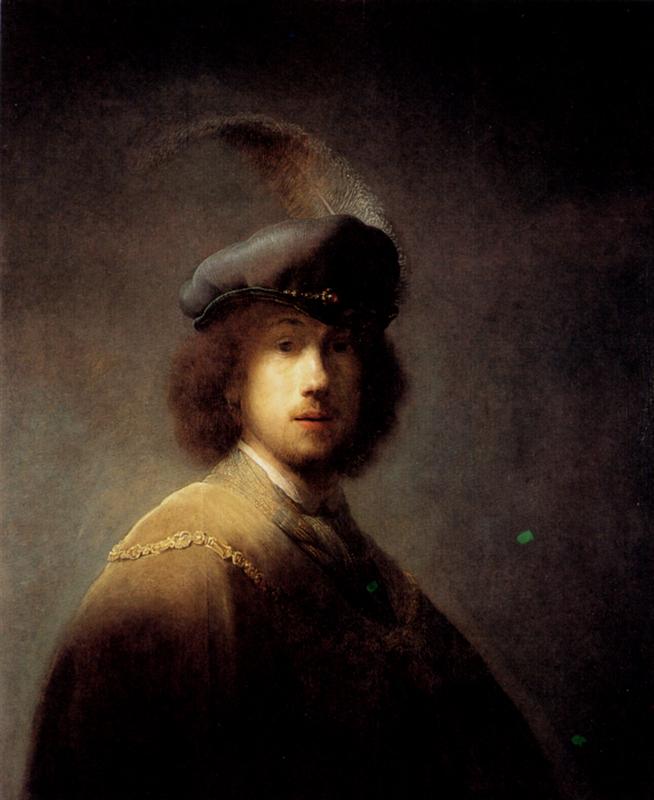
“Self-Portrait in a Plumed Hat” (1629) presents the young Rembrandt as both painter and actor, using costume and light to test how identity can be staged without losing psychological truth. The soft beret crowned by a long, airy plume, the heavy mantle clasped with a gilded chain, and the three-quarter turn against a dusk-toned background announce a figure who knows the power of appearance. Yet the painting is not merely a display of finery. The face, lit as if by a small lamp that slides across the brow and cheek, retains the candor of Rembrandt’s earliest self-studies. In this small but resonant experiment from his Leiden years, he converts studio play into a portrait of ambition, possibility, and the theatrical nature of becoming an artist.
Leiden Context And The Young Artist’s Stage
In 1629 Rembrandt was still in Leiden, forming his style through compact dramas and expressive tronies. The “plumed hat” belongs to this culture of role-play. Painters in the Dutch Republic often used exotic headgear and props to create timeless images, free from the constraints of contemporary costume. For a young artist, such dress-ups were both marketing and method: they demonstrated skill with luxurious textures and allowed the painter to explore historicizing light without the obligations of a commission. Rembrandt’s version stands out because the performance never overrides the person. Even in feathered costume, he refuses to mute the complexity of his own gaze. The picture becomes a rehearsal for the larger theaters of Amsterdam while remaining rooted in a quiet Leiden room.
Composition That Anchors Drama In Stillness
The composition is a classic three-quarter portrait. Rembrandt sets the head high and slightly left of center, letting the plume arc across the upper register like a drawn bow. The body turns to the right while the face pivots back toward us, establishing a cross-motif of diagonals that animate the otherwise placid pose. A triangular wedge of illuminated shoulder leads the eye upward, where the chain’s highlights flicker like small stars along a constellation of brown and gold. The background is an ambiguous darkness, warm rather than black, breathing with the oil’s transparency. That atmosphere prevents the figure from feeling cut out; the hat’s shadow blends gradually into the field, as if the sitter were stepping forward from backstage into the soft hush of footlights.
Chiaroscuro As An Instrument Of Character
Light arrives from the left and slightly above, traveling across the beret’s rounded crown, catching on the plume’s barbs, washing down the forehead, and pooling gently on cheek and upper lip. The other side of the face retreats into warm shadow, but never to extinction; a faint glimmer shapes the far eye and suggests the roundness of the skull. This lighting is theatrical yet persuasive. It invents a space where the figure can think. The light does not expose so much as converse with the face, listening for textures it can reveal: the soft nap of the hat, the down along the jaw, the gleam of the chain’s links. Through this chiaroscuro, Rembrandt shows how appearance becomes expressive—the feather not merely a decoration but a conductor’s baton that guides the eye through the score of values.
The Feather As A Line Of Motion
The plume is swift and delicate, painted as if the brush itself were a feather. It lifts from the hatband with a gentle s-curve and dissolves into the background like breath in air. Its root is set by a compact jewel or clasp, a tiny knot of brilliance that punctuates the brow. The feather’s function is compositional and psychological. Compositional, because it arcs into the empty upper space, filling the canvas’s silence with a graceful gesture. Psychological, because it suggests a mind reaching beyond the present—playful, ambitious, curious about roles and histories. Feathers were emblems of dashing soldiers and cavaliers; here they crown a painter who is testing whether he can inhabit such charisma without falsifying himself.
Costume, Texture, And The Tactile Persuasion Of Paint
Rembrandt uses costume as a feast of textures. The soft, suede-like beret, the airy plume, the velvet mantle, and the gold chain demand different handling, and the artist answers each. He sets low, buttery highlights along the beret’s rim, drags thin translucent glazes over the shoulder to suggest pile crushed by light, and dabs impasted points on the chain so that each link catches like a spark. The variety persuades the eye that these materials exist—not through the cataloging of detail but through the felt logic of paint. Even in this early work, Rembrandt understands that realism in oil is not a matter of exact edges but of how light behaves on different surfaces. His paint, therefore, is not simply descriptive; it is a physics we can feel.
The Face That Resists The Mask
Under the plume, the face remains remarkably untheatrical. The lips part slightly, as in many early self-portraits, signaling a breath caught mid-thought. The near eye is sharply aware; the far eye is gentler, an echo across shadow. There is no smile, no courtly flattery. Instead, Rembrandt gives us the sober attention of someone observing himself as he plays a role. This tension—the actor watching the character—creates psychological depth. We see a young man test the boundaries between image and self, and we sense that he already understands the temptations of performance. The painting admits the seduction of splendor without surrendering to it.
The Chain And The Question Of Status
The gold chain draped across the shoulder has long prompted debate. Is it a painter’s chain of office, an imagined honor, or simply a studio prop? Whatever its factual source, in the picture it becomes a question rather than an answer. It glows, yes, but it does not dominate. Its course is partly hidden by shadow; some links are suggested more than drawn, their edges vanishing into the velvet. The chain functions as a line of rhythm leading from the mantle’s fold to the face, emphasizing the diagonal that carries our attention to the eyes. In wearing the chain, Rembrandt asks what it means to claim a professional identity. The painting suggests that status, like light, is transient and that true authority resides in the steadiness of the gaze.
Palette And Atmosphere
The palette is a harmony of earths and warm grays, with restrained accents of gold and the faintest carmine in the lips. These limited means create a unified atmosphere in which small shifts of value do extraordinary work. The background’s brownish haze, built from transparent layers, envelops the sitter and provides the “air” through which the feather fades. The overall tonality leans warm, reinforcing a mood of inwardness rather than bravado. Even the brightest passages—the chain and shoulder—are warmed by surrounding brown, so that light seems to emanate from within the material instead of resting on top of it. This inward light is one of Rembrandt’s enduring signatures.
Edge, Focus, And The Invention Of Space
Edges in the painting are carefully edited. The near cheek and the lower lip possess the crispness of focus, while the jawline on the shadowed side dissolves, allowing face and background to intermingle. The plume’s rim is almost unpainted in places, a constellation of soft touches that suspend it in air. Along the shoulder, a firm highlight snaps the figure forward before melting into the mantle’s softness. This alternating sharpness and blur constructs space without a single explicit cast shadow on the wall. The viewer senses distance and atmosphere because the eye is guided to move and to settle in certain zones, replicating the act of looking in real life.
The Self As Tronie And Portrait
Works like this sit at the edge between tronie—a study of character types in fancy costume—and portrait, a likeness tied to a specific person. Rembrandt merges the two. The costume releases him from the obligations of social portraiture, but the fidelity of the features and the introspective gaze anchor the image in autobiography. He is both someone and anyone, a young painter exploring the universal grammar of human presence while recording his own appearance. This fusion will power the long sequence of self-portraits: the face becomes a stage where art’s questions can be asked without recourse to narrative.
The Subtle Theater Of Gesture
The body’s pose is calm but charged. The head tilts slightly upward; the neck emerges firmly from the collar; the shoulders carry the weight of garments with ease. The mantle’s fold creates a modest V that frames the throat and accentuates the vertical lift of the face. There is no overt gesture—no hand, no prop held forward—yet the overall bearing communicates readiness. The sitter appears as someone about to speak or to step from shadow into fuller light, a theatrical entrance postponed so that the viewer can savor the interval. Rembrandt specializes in such thresholds; he lets time thicken just before action, making potential the true spectacle.
Material Presence And The Pleasure Of Looking
An almost sensual pleasure runs through the painting—the pleasure of seeing surfaces respond to light. The beret has a bloom like ripe fruit; the plume is dusty-soft; the chain is cool; the velvet mantle drinks the glow then breathes it back. Rembrandt aligns this sensory richness with the viewer’s curiosity. He knows that attention deepens when the eye meets convincing material behavior. By satisfying that tactile desire, he earns trust for the portrait’s quieter ambitions, which are philosophical: to reflect on who the sitter is when costumes are removed and the lights go down.
Comparisons Within The 1629 Self-Portraits
Seen beside his other self-portraits from the same year, this work is the extrovert in a thoughtful family. The close-cropped heads with parted lips are studies in privacy; the “plumed hat” broadcasts. Yet the continuity is strong. The same exploratory light defines features; the same refusal to prettify governs the mouth and eyes. The costume, far from masking identity, sharpens it by contrast: the unadorned face becomes a calm center around which feathers and chains whirl. This juxtaposition clarifies Rembrandt’s intention. Even at twenty-three, he is not seduced by surfaces; he is testing them so that he can paint through them.
The Viewer’s Role As Co-Author
The portrait positions us within arm’s length. The sitter meets our gaze with attentive calm, and the plume sweeps toward us like a welcoming flourish. Yet the background remains undetailed, and the hands are absent, leaving room for our imagination to complete the scene. We become co-authors of the stage, deciding where the light originates and what lies beyond the enveloping brown. This collaboration between viewer and painting is key to the picture’s continued vitality. Every encounter feels slightly different because our own mood supplies context to the face.
Light As Destiny
Because the painting emerges from Rembrandt’s early twenties, the light on the young face reads as promise. It carries the undertone of destiny—the sense that this self-presentation is not only about costume but about declaring oneself to the world. The painter claims the right to be seen, not as a tradesman merely, but as a figure of creative authority. The feather, in this reading, becomes a standard raised at the outset of a campaign: ambitious, yes, but tempered by the inwardness of the eyes. The painting captures a rare equilibrium between hunger for renown and commitment to sincerity.
Technique Serving Vision
Technically the picture is a lesson in how limited means can yield opulence. The surface alternates thin, breathing passages with thicker, buttery accents. Glazes float warm tone into the shadows; tiny impastos at the chain and feather catch the light so that the painting shifts as the viewer moves. The brushwork on the mantle is especially eloquent—broad and soft, yet interrupted by decisive strokes that define folds and edges. Every technical decision serves vision. Nothing is fussy; everything is tuned to how the figure should feel in air and light.
Afterlives And Influence
The combination of costume and candor in this self-portrait influenced later artists who used dress to stage identity while maintaining psychological presence. From Frans Hals’s cavaliers to Goya’s self-fashionings and beyond, the idea that an artist can wear history like a mask without losing himself owes much to experiments like this one. For Rembrandt, the afterlife is within his own oeuvre: the plume reappears in different guises, sometimes grand, sometimes ironic, as he revisits how public image and private truth collide.
Why The Painting Still Feels Fresh
Four centuries later, the portrait remains persuasive because it respects the intelligence of the viewer. It offers splendor but does not insist on it; it presents a mask but invites us to look around the edges; it uses light to flatter and to interrogate simultaneously. The young artist’s face is open to conversation, and the painting becomes a space where that conversation can happen—between ambition and humility, costume and truth, surface and soul. The image feels alive because it stages questions we still ask ourselves whenever we dress for the world: who am I in this light, and what do I want my gaze to say?
Conclusion
“Self-Portrait in a Plumed Hat” is not simply a charming period piece of a painter in fancy dress. It is a serious experiment in the mechanics of self-presentation, conducted with exquisite control of paint, light, texture, and space. The feather draws a confident arc through darkness; the chain glints with borrowed status; the mantle swallows and releases light; and at the core the face remains steadfast, curious, and true. In this early canvas Rembrandt discovers that he can use theater to reveal rather than to conceal. The result is a portrait that shimmers with youth and possibility while already bearing the marks of the artist he will become: humane, subtle, and endlessly attentive to the conversation between appearance and character.
