Image source: wikiart.org
Introduction
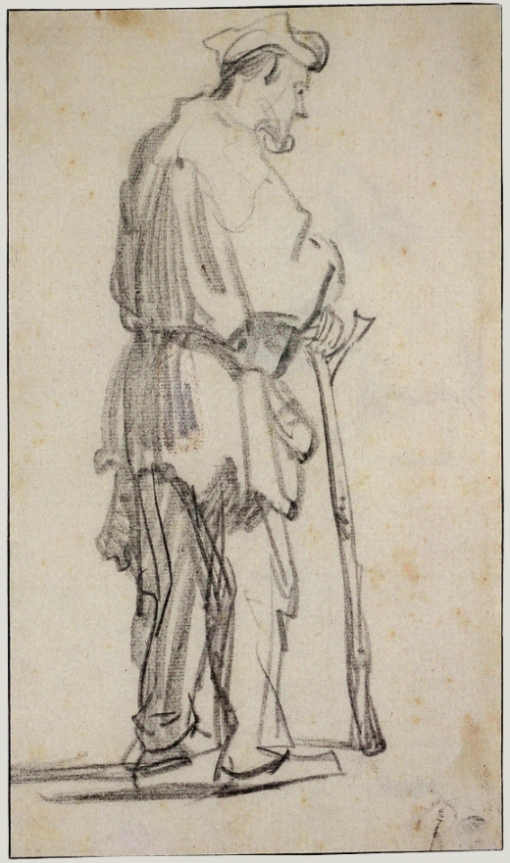
“Standing Beggar Turned to the Right” (1629) captures Rembrandt at the threshold of his career, using the speed and candor of drawing to probe a human presence with remarkable sympathy. The spare sheet shows a man seen from behind and slightly to the side, his weight settled in a patient slant, his head bowed, and his long staff planted as both prop and companion. A handful of assertive strokes define the cloak’s edges, the cap’s fold, the drape of trousers, and the wedge of shoe. Around these firm marks Rembrandt breathes softer shading that suggests worn cloth and the familiar hollows of a body that has walked far. Nothing is theatrical, and nothing is careless. The drawing turns poverty into a subject worthy of the most attentive looking, and in doing so it articulates a vision that would become central to Rembrandt’s art: the dignity of the ordinary, discovered through light, touch, and line.
Leiden Context And The Artist’s Early Curiosity
The date places the sheet within Rembrandt’s Leiden years, when he was barely in his twenties and restlessly experimenting with media, subjects, and modes of looking. Alongside biblical scenes and tronies, he produced a small but potent corpus of beggar studies—etchings, drawings, and oils that treated people at the margins with a quiet gravity. These works were not commissions. They were self-directed investigations, a young artist teaching his hand how to register posture and character without the staging of costume or emblem. The beggar studies also allowed Rembrandt to practice seeing from life, outdoors or standing at a doorway, where time was short and lines needed to count. “Standing Beggar Turned to the Right” condenses that practice into a single, concentrated exercise in observation and empathy.
Composition As A Study In Balance And Restraint
The composition is deceptively simple. The figure occupies nearly the full height of the sheet and stands slightly off center, leaving a slim corridor of space in front of his turned body. That sliver of emptiness is intentional. It creates a path for the eye to travel toward the direction of the man’s attention and gives the impression that he might shuffle forward at any moment. The diagonal of the staff echoes the angle of his spine, binding posture and support into a single gesture. His feet are set apart just enough to convey the stance of someone who has learned stability from necessity. The cap, drawn with a compressed flourish, adds a soft counterweight to the verticality below. Every part of the figure contributes to an architecture of modest equilibrium.
Line That Speaks With Precision
Rembrandt’s line here is both economical and expressive. Thick, committed contours outline the cloak’s border and the staff, while more tentative strokes model the trousers and shoes. Within the torso, short, vertical hatchings gather like threads, implying ribbed cloth or simply the weight of fabric hanging from bone. The drawn line does more than trace shape; it narrates texture, pressure, and age. Where the cloak’s edge breaks into a notch, we feel a tear; where the staff’s base thickens, we sense the grind of wood against ground. The drawing’s eloquence depends on the confidence with which each mark is placed. No line is an afterthought. Each functions as an ingredient in the physics of a life carried on foot.
Light, Shade, And The Breath Of Space
Even in a largely linear sheet, Rembrandt finds room for light. He uses soft, rubbed graphite or chalk to tint the interior of the cloak and to suggest the cylindrical volume of the leg. These halftones never flatten the figure; they round it and set it in air. The untouched paper at the left becomes light spilling in from a doorway or street, against which the beggar’s profile reads crisply. A darker pool under the shoes attaches him to the ground. This subtle choreography of value is what makes the drawing feel spatial rather than schematic. The man is not an outline on a page; he is a body in a pocket of air, made present by the simplest means.
The Ethics Of The Rear View
By presenting the beggar turned away, Rembrandt avoids spectacle and preserves privacy. Many seventeenth-century images of the poor invited viewers to judge faces, expressions, and gestures, often to comic or moralizing effect. Here the decision to show the back dignifies the subject. We are near him without invading him. We study his stance and clothes rather than his features, and we measure his vulnerability through weight and balance rather than through a begged look. The rear view encourages the kind of attention that Rembrandt cherishes: patient, non-possessive, and grounded in the body’s truth.
Clothing As Biography
The drawing tells a life story in the language of drapery. The cloak’s hem dips and frays; the sleeve hangs a little too long; a belt or cord cinches the waist without tailoring the garment. The trousers gather in folds where they meet the shoe, and the shoes themselves splay with the characteristic flattening of long wear. None of these details exaggerates misery. Instead, they register use. The clothes have followed the man through weather and work; they have learned his angles and his pauses. In Rembrandt’s hands, such details never reduce the subject to his poverty. They enlarge him by giving him a history.
The Staff As Tool And Metaphor
The staff is both object and symbol. As object, it is rendered with a confident, nearly calligraphic sweep—thick at the top where the hand bites in, tapering toward a blunt end. Its slight curve tells of wood selected for hand feel rather than straightness. As symbol, it signals a long journey, a claim on space made step by careful step. It may also suggest age or disability, but Rembrandt avoids pitiful tropes. The staff dignifies because it is a tool the man has mastered. He props, he measures distance, he negotiates curb and threshold. In the drawing, the staff works compositionally to tie lower and upper halves, turning posture into structure.
Gesture And The Psychology Of Stillness
Although the figure is motionless, the drawing is alive with implied movement. The slight bend at the waist, the heel just lifting, the forward angle of the staff, and the free hand hovering near the belt suggest readiness rather than exhaustion. The man is caught at a pause between actions, a pause that feels habitual and sustainable. Rembrandt is less interested in theatricalizing suffering than in observing how people hold themselves over time. That attention to sustainable posture—how a person actually stands when nobody is watching—converts the drawing into a psychological portrait without a face.
A Drawing Practice That Feels Like Conversation
The intimacy of the sheet suggests that the encounter was quick and respectful. Rembrandt likely sketched from life, standing close enough to see the folds at the back of the knee and the exact tilt of the cap. The quality of the lines—decisive yet searching—feels like a conversation between hand and subject. The medium permits revision; you can sense places where he traced over an earlier contour or softened a too-hard edge with the side of the chalk. This revisability is essential to the humility of the drawing. It records not a verdict but a look in progress, and it invites viewers to continue that looking.
Relations To The Beggar Etchings And Studies
“Standing Beggar Turned to the Right” resonates with Rembrandt’s etchings from the same year, in which he pictured seated beggars, blind men, and humble couples with dogs. Those prints share a resistance to caricature and an appetite for specific poses. The drawing contributes to this corpus by exploring the rear three-quarter view, a practical study that would inform more complex compositions later. It also reveals Rembrandt’s attention to the narrative potential of small shifts in weight. In the etchings a hand extended to a doorframe or coins scattered on a floor stage the drama; in this drawing a tilted staff tells the story.
The Cultural Climate And The Choice Of Subject
Seventeenth-century Dutch cities were full of itinerant poor, refugees, and veterans. Artists often pictured them to entertain, to moralize, or to sell inexpensive prints to a broad audience. Rembrandt’s approach is more observational than programmatic. He notes the reality of poverty without turning it into a sermon or a joke. The sheet is too quiet to be propaganda and too respectful to be satire. In this restraint lies a moral position: attention itself is an ethical act. To draw the beggar well is to acknowledge his reality, and to carry that drawing into the studio is to preserve a place for him in cultural memory.
Material Qualities And The Pleasure Of the Hand
The work’s material life matters. The tooth of the paper catches the drawing medium, leaving tiny ladders of white between darker strokes that sparkle like worn nap. The pressure of the tool varies—heavy at the outer contour, light inside the fold—creating a rhythm that animates the whole figure. Even the small scrapes and pale stains on the sheet contribute to the sense that this is an object handled, kept, and passed across time. Rembrandt’s haptic intelligence, so celebrated in his late impastoed paintings, is already present in this modest study as a sensitivity to what a line can weigh.
Intimacy, Privacy, And The Viewer’s Role
The drawing positions the viewer behind and slightly to the left of the subject, an angle that feels companionable. We do not confront or corner him; we keep step. This kinesthetic empathy is underappreciated in discussions of Rembrandt’s draftsmanship. By adopting the beggar’s horizon line and by leaving open space in the direction he faces, Rembrandt invites us to move with him rather than to fix him in place. The act of viewing becomes a small ethical rehearsal: we learn to follow without dominating, to attend without demanding a face.
Anticipations Of Later Rembrandt
What appears as a simple study prefigures several hallmarks of Rembrandt’s mature art. There is the conviction that outward simplicity can carry deep human truth. There is the trust in gesture as a bearer of psychology. There is the refusal to prettify or to scorn. And there is, above all, the use of minimal means to produce a dense reality. The compassion and exactness visible here will later lend grandeur to portraits and sacred histories alike. In this sense the drawing is less a sidebar than a seed.
Why The Image Still Feels Contemporary
Contemporary viewers respond to the drawing’s lack of rhetoric. The sheet shows a person taking up a small portion of the world with care and persistence. In a culture accustomed to images that demand attention with spectacle, this modesty reads as radical honesty. The subject’s turned back denies us consumption while offering us participation. We can imagine the next step, the doorway he approaches, the hand that might extend a cup or open a gate. The drawing succeeds because it leaves room for our ethical imagination.
Conclusion
“Standing Beggar Turned to the Right” is a quiet masterpiece of observation. With a handful of strokes, Rembrandt establishes weight, texture, and the inward temperature of a life proceeding under strain yet not without steadiness. The composition’s slanting staff and patient stance hold the page the way character holds a body. The linear economy makes air between garment and ground; the soft tonalities round form and temper judgment. Most importantly, the rear view transforms a common genre into an act of respect. The drawing reminds us that art’s first task is to pay attention, and that through attention the overlooked becomes luminous. In this small sheet from 1629, a young artist learns how to see—and teaches us how to look.
