Image source: wikiart.org
A Figure Drawn From Life, Made For the Conscience
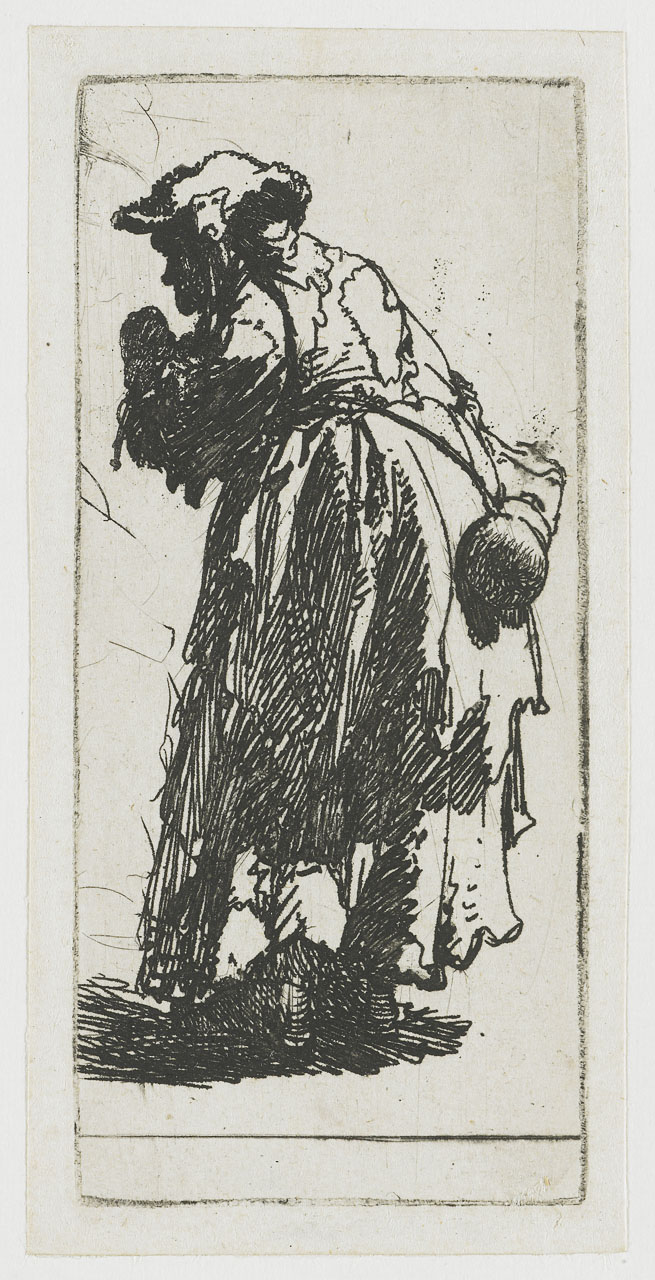
Rembrandt’s “Old Beggar Woman with a Gourd” (1629) is a small etching that fills its modest scale with lived experience. The figure stands almost flush to the picture plane, slightly hunched, wrapped in layered garments that have been patched and abraded by time. A round gourd hangs from a strap at her side. The background is largely blank, a pale field against which the woman’s dark, densely hatched silhouette reads like a moral summons. With a handful of exact lines, the young Rembrandt transforms an anonymous passerby into a presence that refuses to be overlooked.
Leiden, Etching, and the Decision to Look Closely
The print belongs to Rembrandt’s Leiden years, when he was sharpening a language of empathy and attention. Etching suited that project. A waxed copper plate recorded every pressure of the needle, every hesitation and correction, and the acid bite preserved those decisions as a durable image. Around 1628–1629 he made a cluster of beggar studies—men and women seen walking, pausing, conferring—each treated not as a comic type but as a neighbor. In a university town where scholars prized observation, Rembrandt applied the same discipline to humanity on the margins. Choosing to spend copper and time on the poor was not incidental; it was a commitment to a subject that the prosperous were trained to ignore.
Composition That Turns Posture Into Story
The woman is shown in near profile, head inclined, shoulders rounded, weight pitched forward. Her body forms a soft diagonal from upper left to lower right, countered by the backfall of skirt and shawl that drift to the ground. The lower left is anchored by a dark patch of crosshatching—the visual equivalent of a cast shadow and a scrap of road—while the upper right remains open, a pocket of air into which she moves. The placement is decisive. There is no scenery, no architectural frame, only a body negotiating space. The composition tells us where to look and how to read: posture becomes plot, and the plot is the labor of getting through the day.
Line That Thinks and Touches
Rembrandt’s line moves with intelligence. Rapid, slightly irregular hatch builds the heavy wool of the shawl; longer, sweeping strokes articulate the skirt’s pleats; short, scratchy marks scumble the hat’s torn edge. Around the face the needle slows to spare, decisive touches so the features do not harden into caricature. Where two fabrics overlap, the hatching densifies into small pockets of darkness that feel like weight and warmth. The result is not a decorative web but a map of touch. You sense how cloth rubs against cloth, how air wicks through worn seams, how the gourd thuds gently against the thigh as she walks.
The Gourd as Tool, Symbol, and Sound
The small round gourd slung at her side is more than an accessory. In a practical sense it is a vessel for water or thin beer, a portable assurance against long stretches without charity. As a symbol it quietly dignifies self-sufficiency: the woman travels with what she needs to survive the gaps between giving hands. As a sound it allows the viewer to hear the scene—the gentle knock of the gourd against patched skirts with each step. Rembrandt locates it with a crisp contour and a shaded underside so that its weight reads immediately. Placed near the composition’s brightest reserve of paper, it becomes a modest emblem of persistence.
Clothing as a Chronicle of Use
The print treats clothing as biography. Hemlines bristle into fray; seams buckle where they have been let out and taken in; the shawl’s edge unravels into a fringe of small lines that flicker like cold. None of these effects are ornamental. Each mark recalls a decision—a piece added, a corner mended, a layer thrown on in a wind. The garments do not shame their wearer; they testify to her competence at survival. In Rembrandt’s hands, the physics of fabric becomes a language of respect.
The Face and the Refusal to Caricature
Many seventeenth-century images of beggars exaggerate features for satire. Rembrandt declines. The woman’s face is sheltered within the hat’s shadow and the shawl’s hood; the visible planes are described with just enough strokes to establish concentration rather than spectacle. You can sense a mouth set against the weather, a nose angled to the ground, an eye that looks for where to place the next step. The reserve is deliberate. It protects the sitter’s privacy while insisting on her reality. She is not a moral lesson with legs; she is a person in motion.
The Space Around Her and the Social Stage
The emptiness surrounding the figure is not laziness. It is a social stage on which the woman’s prominence signals our responsibility. There is no crowd to absorb her, no architecture to entertain us. The pale paper becomes the world through which she must pass, and we, by virtue of our closeness to the plate, become the passerby within arm’s reach. The print engineers an encounter. It asks us to practice seeing that is free of hurry and judgment.
Plate Tone as Weather
Impressions of the etching often retain a faint film of ink—plate tone—left intentionally on the copper before printing. That veil of gray imparts atmosphere. It thickens slightly at the borders and at the ground underfoot, like dust or moisture collecting where the world exerts pressure, and thins across the woman’s upper back and coif so that the air around her feels a touch clearer. With almost nothing but residue, Rembrandt conjures weather: a day the body can remember.
Movement and the Mechanics of Carrying
The woman leans forward not just from age but from the physics of carrying more than the body wants. The skirt’s lines flare backward; the gourd tugs sideways; the shawl’s folds stream in the wake of motion. Rembrandt’s hatching follows those vectors, so you feel forces rather than simply see shapes. The feet are planted broad and flat, their contours abbreviated to avoid theatrical emphasis. The stance is credible, and credibility is the mother of empathy. When a figure moves as a real person moves, the viewer’s body recognizes it and leans, however slightly, in sympathy.
From Type to Neighbor: The Beggar Series as Research
This print sits beside other beggar etchings from 1628–1629—men with staffs, couples ambling, lone figures pausing. Together they form a study of how bodies adapt to need. Each plate explores a different vantage point or tool: the angle of a stick, the swing of a crutch, the shelter of a hat, the pull of a sack. The old beggar woman contributes the theme of carrying and the quiet agency of a vessel brought from home. The series is research in the truest sense: attention repeated until it becomes knowledge.
Economy of Means and Abundance of Presence
One of the marvels of this little sheet is how few lines it requires. The blank paper at upper right reads as light, the thin outline of the hat brim reads as shade, a cluster of hatch reads as wool, and a tight oval reads as a hard gourd. Because everything unnecessary has been removed, what remains has weight. The woman occupies the field completely. The economy gives the portrait its authority, and the authority derives from the artist’s discipline: knowing how little is enough when each mark is honest.
Ethics of Depiction Without Pity
The print’s tone is neither scolding nor sentimental. There is no theatrical pathos, no stage-managed appeal to tears. The stance is respectful, almost matter-of-fact, and that is precisely why it moves us. Pity requires distance; respect allows nearness. Rembrandt’s line comes close without intrusion, and the woman’s dignity survives the gaze. In a medium prone to caricature, this refusal to cheapen suffering is a moral achievement.
The Viewer’s Path Through the Image
The composition quietly choreographs our looking. We begin at the bright reserve near the gourd, where the paper shines most clearly, then climb the strap to the waist and across the shawl’s dense hatch to the shadowed face under the hat. From there we follow the ragged brim out toward the open field, then down the skirt’s ribbed pleats to the dark ground patch, and back to the gourd again. Each circuit repeats the rhythm of walking: gather, lean, recover. In learning the picture’s path we learn the woman’s pace.
Parallels With Later Compassion
The humane restraint on display here foreshadows Rembrandt’s treatment of elders, widows, apostles, and self-portraits in later decades. He will keep trusting a few well-chosen forms under disciplined light to bear the weight of feeling. He will keep shunning the easy rhetoric of spectacle. The old beggar woman is thus both a singular person and an early sign of a career-long fidelity to the ordinary made luminous.
How to Look Slowly
Hold the print at reading distance and let your eye rest first on the gourd. Notice the crispness of its contour and the soft drag of the strap across the cloak. Move to the hand that clutches the shawl, where short strokes thicken into shadow, then to the face, where the lines thin into suggestion. Let the open space at right rinse the eye, then return down the ribbed skirt to the dark base where weight meets earth. Repeat the circuit until the sound of the gourd and the scrape of hem become audible in imagination. The image will convert from a drawing of a stranger into a meeting.
Enduring Significance
“Old Beggar Woman with a Gourd” endures because it practices a way of seeing that the world still needs. It makes a small thing—the tilt of a head, the logic of a strap—carry a large truth about attention. It honors endurance without romanticizing it, and it grants a person with few resources the one resource only others can give: careful regard. The etching proves that art can enlarge the dignity of a life not by speechifying, but by noticing so well that indifference becomes impossible.
