Image source: wikiart.org
A Small Print With a Giant Human Presence
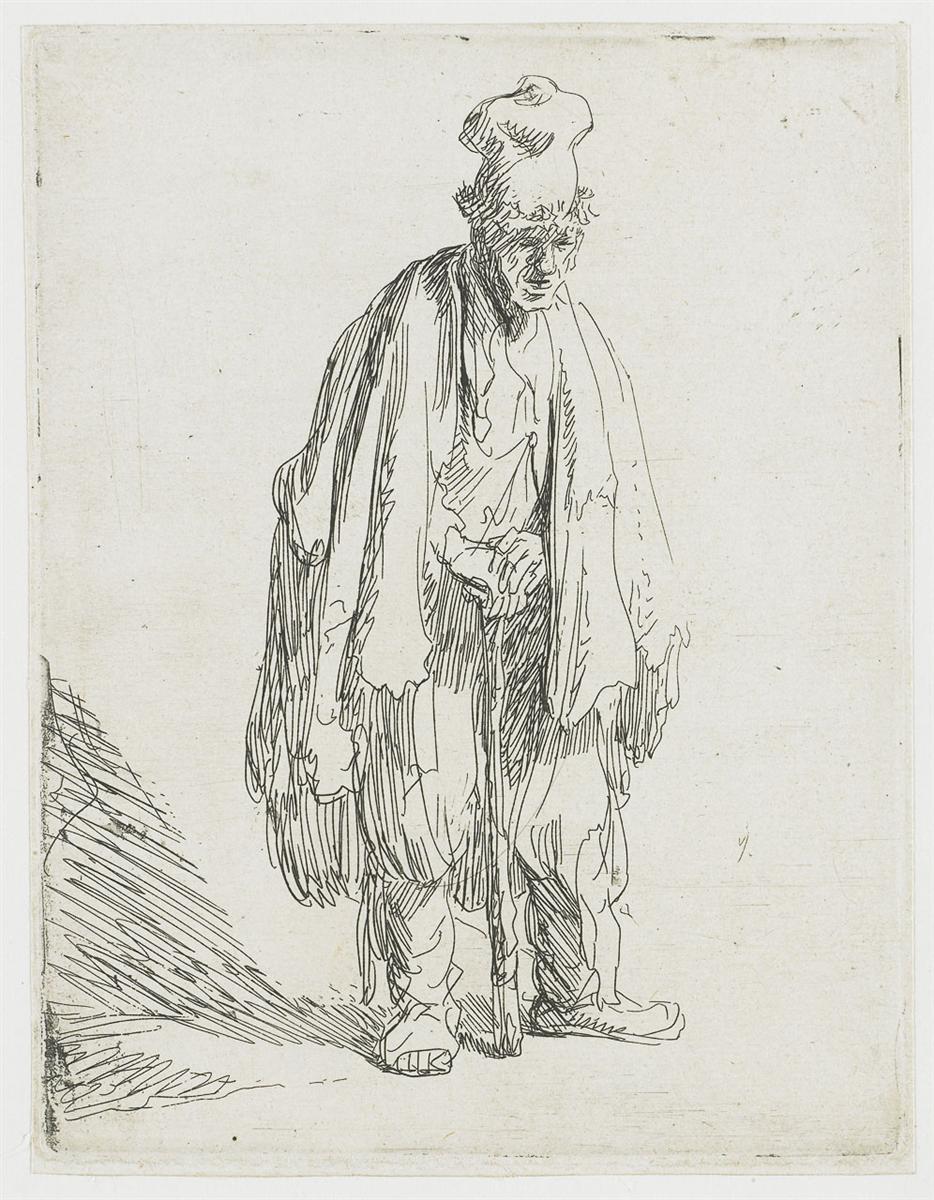
Rembrandt’s “Beggar in a High Cap Standing” (1629) is a tiny etching that feels monumental in spirit. A lone figure, wrapped in ragged layers and crowned by an outsized cap, stands with his weight pitched forward on a stick. The lines are spare, the background almost empty, the light implied rather than described—yet the man’s presence is undeniable. Within a few inches of copper, Rembrandt compresses a full human history of endurance, exposure, and dignity. The print’s power lies not in spectacle but in the artist’s fierce attention: he looks long and well, and that care becomes the subject.
Leiden Years, Etching, and the Ethics of Looking
In 1629 Rembrandt was still in Leiden, refining an artistic language that privileged psychological truth over pageantry. Etching—drawing with a needle into a wax ground so acid can bite the exposed lines—suited his temperament. It records speed, pressure, and the small hesitations of thought, translating touch directly into image. At the same time, Leiden’s streets offered constant encounters with people on the margins. Rather than treat beggars as props or moral warnings, Rembrandt made them central. “Beggar in a High Cap Standing” embodies this ethic: the poor are worth the finest attention an artist can give.
Composition That Centers a Life
The figure stands slightly off-center, the staff falling almost vertically to the ground. A long, low wedge of hatching at the left acts like a cast shadow and counterweight, keeping the man from floating on the blank paper. The high cap lifts the silhouette and emphasizes verticality, while the drooping hems and layered rags create a downward pull. Between those forces—upward cap, downward drapery—the man holds himself together. The empty field around him reads as air and social space: there is nothing to hide behind, nowhere to set down burdens. The composition is a portrait of exposure.
Line That Carries Weight and Weather
Rembrandt draws with an astonishing economy. Long, slightly wavering outlines map the torn hems; quick, parallel hatches compress into darker pockets where cloth overlaps; short notches and tiny hooks suggest the furrows of a tired brow. There is no carpet of cross-hatching, no ornamental flourish. Instead, each stroke does a job: building volume, indicating weight, noting wear. Even the gaps between lines matter; they allow the paper’s light to act as reflected highlights on creases and folds, giving the ragged garments a surprising freshness and air.
The High Cap as Sign and Shelter
The cap—too large for the head beneath it—does double duty. As a sign, it marks the figure as a type familiar in Dutch prints: the wandering poor, sometimes migrants, sometimes disabled veterans. As shelter, it functions practically: a portable roof in a climate of wind and rain. Rembrandt avoids caricature. The cap’s shape is awkward but not ridiculous, its droop more poignant than comic. Because he renders it with the same care he gives to the staff and the torn cuffs, it becomes part of the person rather than a label.
Posture, Balance, and the Physics of Survival
Everything about the stance says “calculated endurance.” The head tips forward, not in shame but to read the ground and the next step. The shoulders sag unevenly under the load of layered rags. The right foot plants flat while the left pivots outward, searching for balance. The staff is not a theatrical prop; it is a third leg. Rembrandt’s lines around the knees and ankles—short, directional, sympathetic—make the joints feel used and stiff. The pose is not melodramatic; it’s biomechanically convincing, and therefore moving.
Clothing as Biography
The garments are an archive of use. Edges fray into tassels drawn as tiny flares of line. Elbows and knees bulge where fabric has stretched and thinned. The overlapping capes and tunic read as accumulated donations rather than a suit chosen at once, each layer a past encounter with a giver. Rembrandt does not fetishize poverty; he records it. The clothes tell us how long exposure lasts, not to shock but to humanize. We sense the itch of seams, the drag of damp cloth, the relief of any patch of sun.
Face and Hands on the Edge of Visibility
The face is the quietest part of the print: a few angled marks for eyes under a ledge-like brow, a nose traced in a single curve, a mouth barely indicated. The minimalism preserves privacy while inviting closeness. You complete the face with your own empathy. The hands are equally spare; one gathers cloak, the other grips the stick. Because these areas are not over-described, the figure avoids the frozen theatricality common in genre prints. He can still move and think; he is a person in progress, not a pictorial emblem.
Space, Silence, and the Social Stage
Rembrandt leaves the field around the beggar mostly blank, punctuated only by the cast shadow and a few faint surface tones. That emptiness is not neglect—it is social commentary. The man stands in public, in the open, with nothing between him and the weather, nothing between him and the passing gaze. The white of the paper becomes a stage where society’s presence is implied by its absence. We feel our own role as the passerby at whom the figure’s downward tilt is directed.
Plate Tone as Weather
Impressions of the etching often retain a light veil of ink—the plate tone—that Rembrandt intentionally left when wiping the copper plate. This soft gray film is thicker near the left wedge and thinner across the figure’s head and chest, as if a breeze had cleared the air around him while dust gathered at the margins. The tone turns the blank into atmosphere, which is exactly right for someone whose life is lived outdoors. In a medium of lines, the air itself becomes an actor.
The Difference Between Record and Judgment
Seventeenth-century prints of beggars can be moralizing, warning against idleness or drink. Rembrandt’s is neither sermon nor satire. He withholds props that would push us toward a fixed reading—no bottle, no placard, no exaggerated deformity. The beggar’s condition is presented as fact rather than verdict. That restraint is ethical: it refuses to turn a life into an example. It also intensifies the image’s staying power. Because the print is not bound to a single lesson, it remains open to the viewer’s conscience.
Relation to the Beggar Series and the Larger Oeuvre
This plate belongs to a small group of beggar studies Rembrandt made around 1628–1629. Together they form a catalogue of human resourcefulness under strain: men and women seated, walking, leaning, carrying; a family on the road; a pair in conversation. The variety reveals a program: to study bodies as they negotiate need. Later in his career, the same attention will deepen his depictions of apostles, widows, and patriarchs. Compassion begins here, in lines that refuse to look away.
Speed, Correction, and the Honesty of Process
Look closely and you can find places where the needle skated and was recalled—micro-corrections along the cap brim, a restarted contour at the elbow, a hatching run that stops shy of overdarkening a fold. Rather than burnish out such passages, Rembrandt lets the copper’s decisions show. The result is a print that breathes. It is not polished to lifelessness; it is finished at the moment exactitude and vitality coincide.
The Viewer’s Distance and Responsibility
The plate’s modest scale demands that we draw close, to reading distance. That intimacy changes the moral geometry of looking. We do not ogle from across a market square; we meet a gaze lowered to the ground only a stride away. The encounter becomes harder to ignore. Rembrandt’s print therefore performs a subtle civic act: it asks the viewer to be the kind of passerby who sees, not the kind who averts.
Comparing Media: Etched Line Versus Painted Flesh
In oils from these years, Rembrandt often builds faces and fabrics with warm glazes and tactile impastos. The etching replaces pigment’s substance with the clarity of thought. Contour and hatch must carry everything—weight, light, texture, mood. The austerity becomes a virtue: with fewer means, truth feels less mediated. “Beggar in a High Cap Standing” proves that line alone, placed with intelligence, can dignify a life.
The Shadow as Narrative
The long wedge at the left is not a naturalistic shadow alone; it’s a path. It starts narrowly behind the figure and flares as it travels, as if marking where the man has come from—the road widening behind him, his options narrowing ahead. Because the wedge aims toward the lower edge of the sheet, it also leads our eye out of the image, into the street where we stand. The narrative remains open-ended, yet the direction of travel is unmistakable: onward, because there is nothing else to do.
The Cap, the Staff, and the Theology of Tools
The print is nearly emblem-free, yet it quietly honors the simple tools that keep a fragile life viable. The cap is portable shelter; the staff is borrowed bone; the layered cloak is storage and blanket. By drawing these things with unembarrassed care, Rembrandt affirms their dignity. The theology, if there is one, is incarnational: grace arrives not as symbols but as cloth and wood well used.
How to Look Slowly
Start with the staff where it meets the ground and feel the pressure of the figure’s weight. Climb the stick to the hand that encloses it and continue into the torn edge of the cloak. Let your eye drift to the cap’s soft, slumping crest and then down across the brow into the notched shadow of the eyes. Trace the hemline where rag meets air, and follow the long wedge of hatch out to the left edge—the road, the day, the weather—before returning to the planted feet. Repeat this circuit until the simple fact of standing becomes eloquent.
Why This Modest Print Still Matters
“Beggar in a High Cap Standing” endures because it achieves a rare balance: exact without pedantry, compassionate without sentimentality, simple without shallowness. It enlarges the place of the poor in art history not by shouting but by looking. In a handful of lines, Rembrandt models a way of seeing that remains radical—granting serious attention to a person whose social role is to be overlooked. The print delivers no slogan, only presence. That presence is the point.