Image source: wikiart.org
A Face Emerging From Shadow
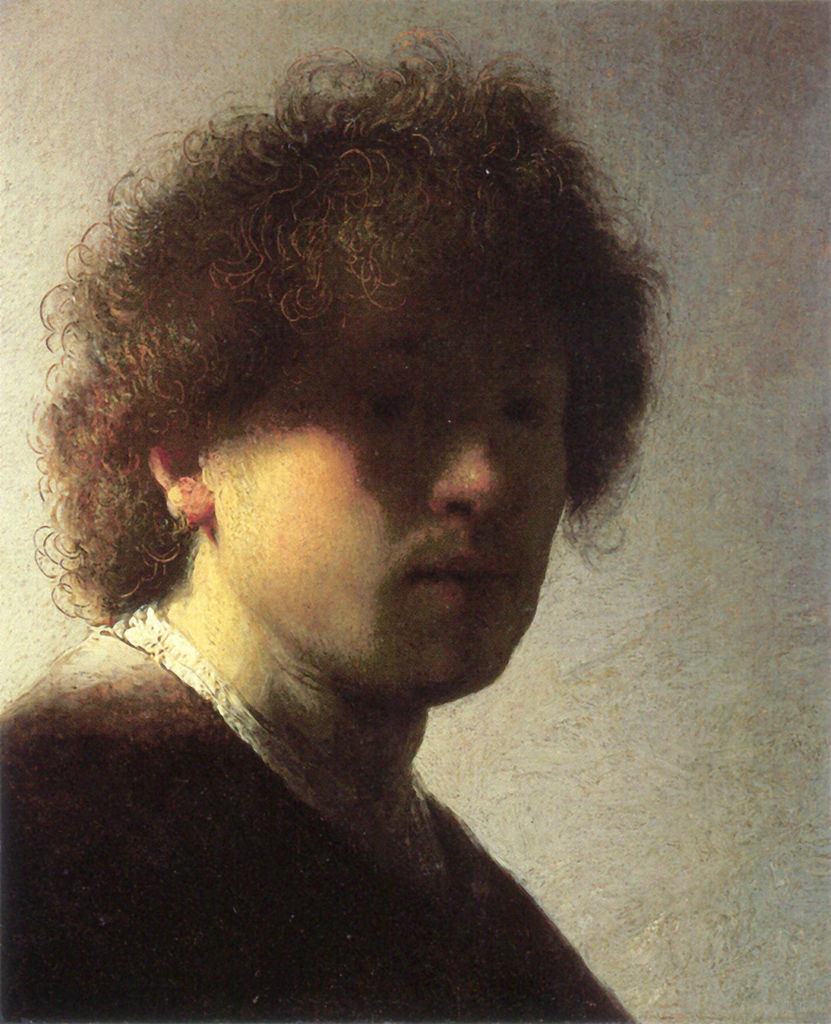
Rembrandt’s “Self-portrait as a Young Man” (1628) is a declaration in low voice. The small panel shows the artist in close three-quarter view, head turned slightly toward the light, much of the face sunk in a calm band of shadow. A cool, textured ground surrounds the figure; hair rises in a corona of soft curls touched by light; the mouth rests without theatrical emphasis. Nothing announces itself loudly, yet the painting exerts magnetic force. It captures the precise moment a young painter learns how light can create not just visibility but meaning—how illumination can be character, and shadow can be thought.
Leiden Years And The Birth Of A Painterly Language
The picture belongs to Rembrandt’s Leiden period, when he had returned from a brief apprenticeship with Pieter Lastman and was rapidly forming an independent voice. In Leiden, a university city of measured tastes, collectors favored small panels, intense heads, and scenes in which psychology outweighed spectacle. The self-portrait answers that market while also serving as a private workshop exercise. It rehearses effects that will become the artist’s signatures: the careful organization of value, the orchestration of edges, the belief that faces hold narratives. Painted when he was about twenty-two, it already carries the authority of a mature program.
A Composition Of Restraint And Precision
The composition is severe, almost abstract in its economy. The torso is cropped at the lower edge, the shoulder forming a dark wedge that pushes the head forward. The background is a pale, variegated field, built from broken strokes that create an air of cool plaster. The head occupies the left two-thirds of the panel, leaving breathing room to the right where light dissipates. The silhouette—soft cap of curls, straight bridge of nose, rounded cheek—reads clearly against that paler ground. The geometry funnels attention to the small triangle of illuminated cheek and lower lip, a quiet fulcrum around which the shadowed halves of the face balance.
Light As Moral Architecture
Light arrives from the upper left, raking across the cheek and ear, then breaking on the lower lip before dissolving into the neck. It does not engulf the face; it edits. The near eye sits in the shadow’s penumbra, the far eye deeper still, so that the expression remains unpinned and exploratory. This distribution of light invents a space where a person can be both revealed and private. The effect is not simply pretty chiaroscuro; it is a stance toward the world. The young painter proposes that genuine presence involves a reserve kept for oneself, and he renders that reserve with a shadow you can feel.
Flesh Built With Air And Oil
Up close, the flesh is woven from translucent layers that trap light rather than merely reflect it. Warm underpaint breathes through cooler, semi-opaque notes at the cheek; the ear holds tiny pinpricks of impasto where the light bites hardest; the lip is constructed from minute, moist touches that avoid gloss yet read as living. There is no brittle enamel. The skin feels like skin because color modulates gradually, and because the brush refuses hard edges where nature offers none. Even in his early twenties, Rembrandt knows the difference between shine and life.
The Halo Of Hair And The Science Of Edges
The hair is a lesson in edges. Tight curls around the temple catch filamentary highlights; farther out, the mass dissolves into feathery strokes that mingle with the ground. The transition from body to air is negotiated hair by hair, a tact that prevents the head from appearing cut out and keeps the atmosphere moving. Where the cap of curls bumps the bright ground, Rembrandt allows the background to invade the silhouette, creating a flicker that feels like light vibrating in air. These delicate “lost and found” edges will become one of his most persuasive devices across decades.
The Background As Active Silence
Though apparently plain, the ground does meaningful work. It is not flat fill but a troweled-looking surface of thin paint laid and dragged in multiple directions. Subtle temperature shifts—cool gray, warm beige, a breath of green—produce a space that feels neither wall nor fog but an active silence around the head. Against this quiet, the illuminated cheek blooms. The background thus functions like a listener: patient, undemanding, supportive of the voice emerging from shadow.
The Psychology Of The Gaze
This is not a confrontational self-portrait. The eyes do not spear the viewer; they hover beneath the brow, attentive and reserved. The mouth rests in a soft line that suggests concentration without strain. The young painter looks the way one looks when testing a pose in a mirror, both model and judge. He asks, in paint, what kind of face he wants to bring into the world. The answer is a face that honors ambiguity, that accepts the half-said as truthful, that understands character as a negotiation between light and shade.
Tronie Or Self-Portrait, And Why It Matters
Seventeenth-century artists frequently made tronies—expressive head studies not tied to named sitters. This panel straddles both genres. It carries the tronie’s freedom from social obligation, letting Rembrandt experiment with effects, yet it is also a frank self-image. That productive ambiguity allows him to be rigorous about painting while remaining candid about self-scrutiny. The costume is minimal; there is no theatrical role to play. In that spareness the work anticipates his later, more philosophical self-portraits, where costume yields to the unadorned person under time.
The Color System And The Temperature Of Youth
The palette is pared to essentials: warm umbers and deep reds in the garment; a constellation of creamy, peach, and olive notes in the flesh; a cool, pearly ground. Within this restricted harmony, small accents carry emotional temperature. The slight redness of the ear suggests blood and warmth; the cooler, greenish tinge in the half-shadow under the cheek keeps the modeling believable; a milkier note along the jaw avoids sentimentality by hinting at the stubble of youth. The color never announces itself; it supports a mood of disciplined curiosity.
Brushwork That Alternates Between Reveal And Conceal
Rembrandt varies the visibility of touch like a composer modulates volume. In the hair and background the strokes remain legible, energizing the surface. In the cheek and mouth they knit into near invisibility, allowing the illusion of flesh to dominate. The transition between these registers—visible mark to vanishing—creates depth without resorting to hard contour. This early mastery of “register switching” is central to his later style, where a rough cuff can coexist with an eye rendered as delicately as breath on glass.
Silence About Status, Confidence About Craft
Unlike many youthful self-portraits of the era, there is no ostentatious chain, no finely embroidered collar, no boastful attribute. A plain dark garment, a clean collar, a head of ungoverned curls—that is all. The understatement about status throws confidence onto craft. He stakes reputation not on costume but on how persuasively light wraps a cheek and retreats into a socket. It is an artistic ethics disguised as style.
The Role Of Shadow As Narrative
The shadow that submerges much of the face is not merely the absence of light; it is a narrative device. It gives the young man privacy and consequence. The eye searches into that darkness and finds just enough—an orbit suggested, a lid hinted, a brow bridging both sides—to feel presence. The painting thus trains viewers to accept the limits of knowledge without anxiety, a lesson the mature Rembrandt will teach with even greater power in biblical scenes where the divine arrives as a quiet clarity touching the edge of mystery.
The Self As Material
A self-portrait is a studio tool as well as a public image. The young Rembrandt had a model always available—himself—to test how paint behaves on skin, how value steps control form, how much information is needed to conjure an eye. In this panel you can sense the pleasure of experiment. The curl highlights allow him to play with tiny impastos; the cheek’s gradient lets him rehearse transitions; the dark half of the face invites audacity in restraint. By making his own face the laboratory, he yokes self-knowledge to painterly knowledge.
Relation To The 1628 Group Of Heads
Around this year Rembrandt produced several small self-portraits and tronies exploring lighting schemes and expressions. Some show theatrical grimaces or swaggering costumes; others, like this one, turn toward the inward. The range suggests a deliberate curriculum he set for himself: to master not just depiction but mood. This painting sits near the center of that curriculum, declaring allegiance to subtlety. It is less flamboyant than the “self-portrait with disheveled hair” and more intimate than the portrait with gorget and scarf. As such it foreshadows the mid-career and late self-portraits, where theatricality recedes and truthfulness advances.
The Viewer’s Distance And The Social Contract
The cropping brings the viewer close, but not uncomfortably so. The head occupies our space without violating it. That calibrated distance creates a social contract of equality rather than performance. We meet a person; the person meets us; neither overwhelms. The effect aligns with the ethos of the Dutch Republic, where culture increasingly evolved through exchanges among citizens rather than declarations by aristocrats.
What The Panel Teaches About Time
Although painted in youth, the work is already a meditation on time. The light’s raking angle evokes morning or late afternoon; the curls have the temporary riot of uncombed hair; the skin has the softness that will soon tighten. The shadow suggests the untried part of life, the large portion yet to be filled with experience. In later self-portraits, the shadow will migrate, sometimes lightening, sometimes darkening, always telling the truth about how time has revised the face. Seen in that arc, this early panel feels like a first page in a life-sized diary.
Why The Painting Feels Modern
The portrait’s modernity lies in its candor and minimalism. There is no emblem to decode, no myth to perform, only a person rendered with an intensity that trusts viewers to recognize themselves in the play of light and doubt. The refusal to shout, the discipline of means, the respect for ambiguity—these qualities make the painting feel closer to today’s sensibility than many works from its century. It models a form of attention we still crave: slow, exact, and humane.
How To Look Slowly
Stand near enough to let the panel fill your field of vision. Begin with the bright flare on the cheek and allow your eye to ride its curve to the ear, where tiny strokes catch and release light. Drift upward into the curls, noticing how some strands dissolve into the background while others gleam like copper wire. Slide down the shadowed bridge of the nose to the mouth’s muted highlight, then step into the darker half of the face and pause where suggestion replaces statement. Step back and feel how the whole head breathes against the pale ground. Repeat this circuit until the portrait begins to feel like a conversation held in a quiet room.
Enduring Significance
“Self-portrait as a Young Man” endures because it articulates a way of being seen that honors complexity. It is the visual equivalent of a measured voice: confident, curious, unwilling to embellish. It proposes that the task of art is not to display certainty, but to hold light and shadow in constructive tension so that character can develop between them. For a painter just beginning his career, that proposition is audacious. The decades to come will confirm it, but the vow is already here—in the soft geometry of a cheek, the hush of a background, the intelligence of a shadow that knows how far to go and when to stop.
