Image source: wikiart.org
A Moment Of Light, A Lifetime Of Promise
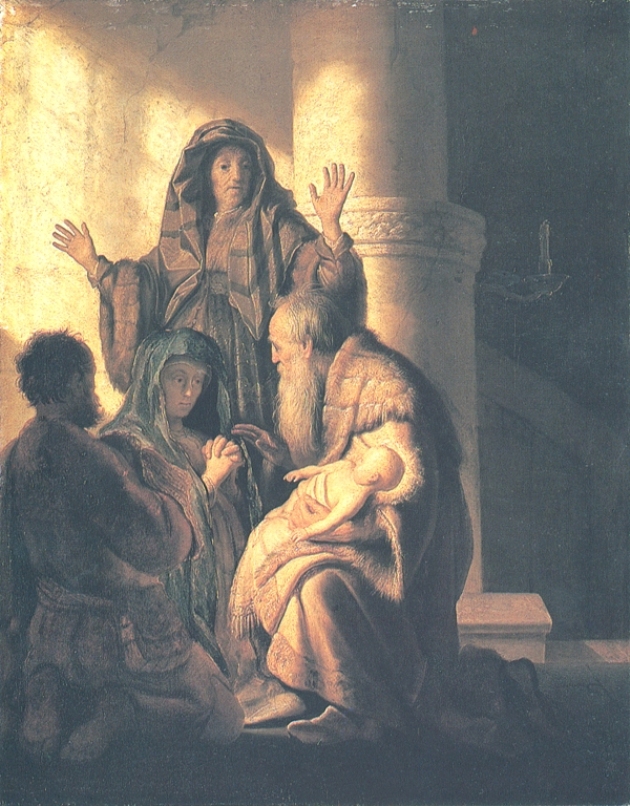
Rembrandt’s “Presentation in the Temple” (1628) condenses ceremony, prophecy, and parental awe into a chamber of light. The infant Jesus is cradled on the lap of Simeon, whose beard flows like a river of time, while Mary kneels with hands folded and Joseph hovers protectively at her side. Behind them the prophetess Anna raises both hands in recognition. The setting is not a vast sanctuary but an architectural pocket marked by a massive column and a stone bench, an interior that feels carved from shadow so that light may choose its subjects. The canvas shows a young Rembrandt already fluent in the language that will become his signature: light as moral speech, faces as landscapes of thought, gesture as theology.
The Biblical Story And The Chosen Instant
The Gospel of Luke recounts how Mary and Joseph brought the child to Jerusalem to “present him to the Lord” and to offer the prescribed sacrifice. Simeon, a righteous man awaiting consolation, receives the infant and prophesies his destiny; Anna, an aged widow and prophetess, joins in praise. Rembrandt selects the exact second when recognition ripples through the group. Simeon inclines toward the child with a tenderness that mutes his oracular authority, one hand hovering in blessing as the other steadies the small body. Anna’s uplifted palms are speech made visible, the silent counterpart to the words of thanksgiving Luke records. Mary’s eyes, deep under a hood, are not triumphant; they are searching, as if measuring what prophecy will mean for a mother. Joseph’s form remains partly in darkness, a steady presence more felt than seen. The painting is not about pageantry but about how revelation moves through real people.
Leiden Years And The Intimate Stage
Painted during his Leiden period, the work bears the imprint of a city that prized learned devotion and close observation over grandiosity. Rembrandt had returned from his brief apprenticeship with Pieter Lastman in Amsterdam, bringing with him a command of narrative clarity and exotic draperies. Yet here he pares down Lastman’s pageant to a circle of witnesses. The background architecture is schematic and functional: a pillar that catches light like a theater flat, a ledge that holds the scene at human scale, the faint suggestion of an aisle receding into shadow. The temple becomes a workshop for meaning, a room where small motions matter. In that reduction Rembrandt announces his preference for drama that transpires within faces and hands.
Composition That Forms A Sacred Vortex
The figures arrange themselves in a tight spiral that draws the eye inexorably to the child. The circular path begins at Joseph’s kneeling form on the left, climbs to Mary’s folded hands and contemplative face, descends into Simeon’s lap where the baby rests, and then rises through Simeon’s beard to Anna’s upraised arms, which in turn nudge the gaze back across the column’s glowing curve to the center. The geometry is not decorative; it is devotional. It creates a vortex of attention where every line of force bends toward an infant who cannot yet speak. The column functions as a luminous anchor for this whirl of regard, a pale drum against which the drama reads with sculptural clarity.
Light As Theology
Light in the painting is not an even wash but a discriminating visitor. It pours in from the left at a height that produces a warm band across the column and lays a benediction on faces and hands. The infant’s head, Simeon’s brow, and Mary’s cheek receive the clearest glow; Joseph remains comparatively subdued, and the farther reaches of the space dissolve into a penumbra. The light’s path traces the arc of prophecy and response: from child to elder to mother to prophetess, and then outward into architectural witness. Nothing about the illumination is accidental. It is staged to teach the eye what matters and in what order it matters. For a painter barely in his twenties, the moral intelligence of this lighting is astonishing.
Color In A Subdued, Reverent Register
The palette favors restrained earths and cooled golds: furred browns in Simeon’s cloak, a fatigued blue-green in Mary’s mantle, the muted russet of Joseph’s garments, and the pale ivory of the column’s surface. Small accents carry large weight. The infant’s flesh, delicately warmed, becomes the chromatic heart around which cooler notes arrange themselves. A reddish note at Simeon’s fingertips animates his touch. The sparse whites—Mary’s veil edge, the baby’s swaddling, Anna’s under-sleeves—act as visual prayers, brief flashes of purity in a sea of quiet hues. The overall effect is reverent; color supports rather than competes with the story.
Fabrics, Fur, And The Texture Of Meaning
Rembrandt’s appetite for describing surfaces is already refined. Simeon’s fur-lined mantle reads as a history of winters survived; its soft bulk contrasts with the tender smoothness of the child’s skin. Mary’s mantle is thin and humbled by travel, its weave catching light in small ridges. Joseph’s rougher clothing dissolves into shadow to emphasize function over display. Anna’s striped headcloth forms a lively pattern that echoes the rhythm of her lifted hands, as if her body were a musical instrument of praise. These textures are not simple displays of craft; they differentiate roles and temperaments. Age wraps itself in warmth and memory; youth carries light; service keeps its distance in muted cloth; proclamation wears stripes that read like spoken lines.
Gesture As Language
Every hand speaks. Simeon’s right hand, hovering above the child, balances authority with tenderness—fingers extended but not rigid, palm soft, the blessing more invitation than decree. Mary’s clasped hands are held close to her chest, part prayer and part protective reflex; the gesture admits both acceptance and the tremor of foreknowledge. Joseph’s hands, one can infer, are steadying, their presence implied in the weight of his posture. Anna’s open palms broadcast recognition to heaven and to the viewer, a clear statement that what has been hoped for is now present. Read together, these gestures describe a theology in human terms: revelation offered, received, supported, and proclaimed.
Faces That Carry Interior Weather
Simeon’s face is a map of years, the skin knotted at the brow, the eyes soft with gratitude, the mouth opening to speak the words Luke records. Mary meets his gaze with a composure that does not cancel apprehension. Rembrandt gives her a complex stillness; the downturned corners of her mouth and the widened eyes suggest a mind already turning the prophecy over. Joseph, half-hidden, wears the fatigue of faithful logistics. Anna’s face, framed by the striped shawl, shows surprise and certainty at once, a blend achieved with minimal strokes. This psychological richness is the picture’s lasting gift: each person is allowed to remain a person, not a type.
The Column As Witness And Stage Machinery
The thick column is more than architectural scenery. Its bright shaft functions as a visual guarantor, a stone witness that remembers earlier covenants and will outlast this moment too. The way light breaks across its drum also helps Rembrandt model depth without relying on perspective tricks. The circular base near Simeon’s feet creates a small dais, a stone crib for a baby who will later be laid in another stone niche. Even the horizontal ledge behind the figures becomes a register of silence, a calm band against which the human voices can be heard with clarity.
The Infant At The Center Of Gravity
Rembrandt refuses sentimentality in depicting the baby. The head is heavy on the small neck; one arm extends loosely while the other tucks close. The swaddling is not decorative but plain, a warm bundle placed in experienced hands. Within the painting’s economy of accents, the infant’s face holds a focal brightness that does not overwhelm the adults but gathers their meaning. The young artist recognizes a paradox: the child who is the least active in the scene exerts the greatest gravitational pull. Everyone else’s motion—Mary’s protective lean, Simeon’s blessing, Anna’s exclamation, Joseph’s quiet vigilance—takes its measure from that still center.
The Sound Of Space
Though the painting is silent, its surfaces suggest sound. The fur murmurs under Simeon’s hand; Anna’s shawl rustles with lifted arms; Mary’s soft mantle seems to sigh as she breathes in. The column’s stone carries a round, low resonance. A small bracket on the right, perhaps a lamp support, hints at the ambient hush of worship interiors. Rembrandt achieves this auditory suggestion by distributing textures so that the eye feels them in succession. The scene becomes more than a picture; it becomes a room we can almost enter and hear.
The Youthful Painter’s Program
Viewed alongside Rembrandt’s other works from 1627–1628—“St. Paul in Prison,” “The Rich Fool,” “Balaam’s Ass,” and intimate tronies—this canvas declares a program. The young painter stakes his future on light as storytelling, on bodies that tell the truth of a story through posture and touch, and on rooms that function as moral instruments. He is learning to temper the theatrical legacy of Lastman with his own preference for interiority. He trusts that a handful of faces, well seen, can carry a doctrine better than dozens of figures in parade.
Color, Light, And The Ethics Of Attention
The dampened palette and controlled illumination also have an ethical dimension. They resist spectacle. The subdued golds and browns build a climate of attentiveness rather than excitement. Viewers are invited to join the circle of witnesses, not to gawk. In this way the painting honors the religious content: the presentation in the temple is an event of recognition and promise, not public show. The young painter already understands how aesthetics can protect meaning from vanity.
The Balance Of Age And Youth
Simeon and Anna represent age; Mary, Joseph, and the infant carry youth. Rembrandt stages their encounter not as a clash but as a complement. Age gives language and blessing; youth receives and will enact. The fur and beard embody the patience of long waiting; the plain cloth and soft skin announce the future’s vulnerability. This balancing act is one reason the painting continues to persuade. It offers not only a devotional image but a social wisdom: generations need each other’s gifts.
Theological Subtext Without Emblem Overload
Seventeenth-century history paintings often employed an encyclopedia of emblems—doves, lamps, scrolls, and temple implements. Rembrandt holds emblems in check. The only near-symbol is the column, monumental and bright; a small wall sconce suggests sacred infrastructure but does not intrude. By refusing an abundance of props, the painter keeps theology inside gesture and light, where it remains moving rather than didactic.
The Viewer’s Place In The Circle
The composition leaves a gap at the front left, a small visual doorway at the level of Joseph’s shoulder and Mary’s knee. That gap is where the viewer kneels. The lighting makes room for us there; the curve of the column ushers us in without breaking the circle. We are not observers at a distance but participants invited to witness what Simeon sees and to hear what he will say. The painting’s success lies partly in this hospitable geometry.
Technique As A Measure Of Feeling
Brushwork alternates between knit precision and soft dissolution. Faces and hands receive the finest control; fabrics are handled with heavier, textured strokes that accept light in broken flashes; the background melts into glazes that read as air. The distribution of paint corresponds to the distribution of feeling. Where thought and touch matter, Rembrandt refuses blur; where context suffices, he lets the brush breathe. This measured variety already anticipates the richer orchestration of his mature canvases.
Human Tenderness As The True Subject
Ultimately the painting’s theme is tenderness under recognition. Simeon’s blessing is tender; Anna’s testimony, though public, rises from tender gratitude; Mary’s inwardness is tender with the ache of love and uncertainty; Joseph’s vigil is tender in its quietness. Even the light is tender in the way it lays itself on skin and stone. The theology of incarnation becomes visible as the simple fact that people handle each other carefully when they know a life’s weight.
How To Look Slowly
Start where light first hits: the curve of the column behind Mary. Let that brightness carry you down to her hands, where fingers knit into prayer and protection. Move to Simeon’s hand and the infant’s cheek; note how the flesh flushes warm against the fur’s cool. Climb Simeon’s beard and meet Anna’s raised hands, then drift back across the arc of light to Joseph’s shadowed form. Repeat this circuit until the room’s air and the figures’ breathing feel coordinated with your own. The painting grows more articulate the longer one travels this loop of attention.
Enduring Resonance
“Presentation in the Temple” endures because it makes a cosmic claim intimate. It shows how a vast promise can be recognized without fanfare, how institutions of stone may serve tenderness, and how a handful of human beings can carry sacred history simply by attending to each other in good light. For a young painter, the achievement is remarkable: a theology of light already fluent, a dramaturgy of hands already eloquent, a sympathy for faces already inexhaustible. The painting stands as an early oath that Rembrandt will keep for the rest of his life—to find the eternal in the human and to let light tell the truth.
