Image source: wikiart.org
A Quiet Face That Teaches How To Look
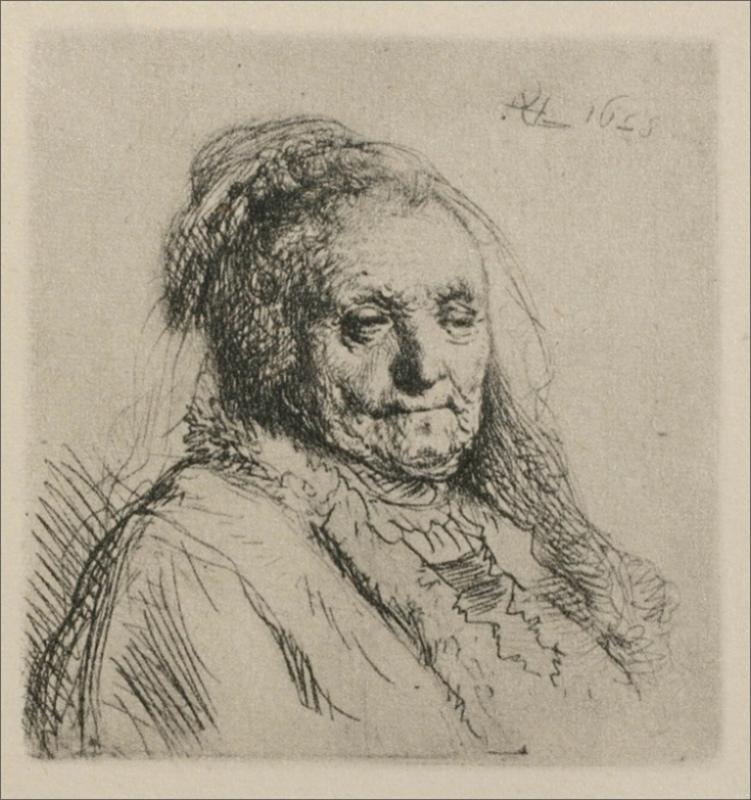
Rembrandt’s “Bust of an Old Woman (Rembrandt’s Mother),” 1628, is a small etching that expands in the mind like a room with a single window. The sitter faces slightly left, her head wrapped, her mouth resting in the soft collapse of age, her eyes half-lidded and reflective. A few inches of copper have captured a lifetime. There is no theatrical prop, no embroidered prestige—only the stubborn music of line, hatching, and plate tone shaping a face that seems to think while it is being seen. The print is often identified as a study of the artist’s mother, a traditional attribution that matters less than the picture’s ethic: the old are worth our finest attention.
Leiden, Family, And A Young Master’s Printmaking Voice
The year 1628 finds Rembrandt still in Leiden, newly committed to etching. Etching was the perfect tool for a twenty-something prodigy: fast enough to keep pace with thought, subtle enough to register micro-decisions of pressure and speed. Unlike engraving, which demands disciplined, premeditated burin cuts, etching lets a hand draw naturally on a wax-coated plate; acid later bites the exposed lines into the copper. Rembrandt quickly learned to exploit every nuance—nervous flicks for hair, open hatch to breathe light, dense cross-hatching to plant shadow. In intimate heads like this one he also discovered his lifelong subject: the inner life visible at the surface.
Tronie And Portrait: A Productive Ambiguity
Seventeenth-century Dutch artists often made tronies—studies of heads in character rather than commissioned portraits with names and heraldry. This print sits fruitfully between the two. It has the frank immediacy of a tronie—quick, exploratory, unconcerned with flattery—yet it feels anchored in the particular history of a person the artist knew well. The ambiguity frees Rembrandt to prioritize truth over likeness while preserving the tenderness that comes from drawing someone within arm’s reach.
Composition That Respects the Person
The bust-length format is cropped high at the head and low at the chest, a framing that keeps the viewer near. The shoulders slope off the plate’s lower corners, creating a gentle wedge that leads the eye back to the face. Rembrandt leaves the background largely empty, with only a faint tonal veil and a few exploratory strokes. The emptiness is not a void but a courtesy. It isolates the person as the room’s subject. Even the signature and date, tucked at the upper right, are small, as if the artist were careful not to speak over his sitter.
Line As Anatomy, Weather, And Memory
Up close, the etching is a patchwork of micro-decisions. Short, parallel strokes around the mouth and under the eyes record the soft architecture of age: folding skin, lost elasticity, tiny sockets of shadow that gather while someone listens. Longer, swept lines in the headcloth describe cloth’s memory of wear; they fall into the rhythm of wrapping a head again and again over years. The contour around the cheek is interrupted—“lost and found”—to let reflected light breathe. This delicacy of edge prevents the face from turning waxen. It feels warm, lit from within by a life that has learned patience.
Plate Tone As Atmosphere
Rembrandt prints often preserve a light film of ink across the plate, the “plate tone” that, if left intentionally, becomes air. Here that veil keeps the ground from going paper-white and gives the figure a soft envelope. He wipes more cleanly at the forehead and cheek to coax highlights, then leaves tone thicker near the shoulder and hair to settle the bust into space. The result is a head that seems to emerge from shadow rather than sit on it, a living presence rather than a diagram.
A Face Read By Hands
No single feature dominates. The eyes are tenderly etched—a few notches of upper lid, a glint within the softened iris—and yet the face’s moral weight gathers around the mouth. The lips do not press or pout; they subside. It is the subsidence of someone who has said many necessary things and now prefers to let others talk. The cheeks carry a ridge of hatching that reads as sag under gravity. Nothing is cruel. The lines register time’s passage without indictment. Rembrandt’s hatching feels like touch, a series of caresses that happen to measure structure.
Headcloth, Ruff, And The Grammar Of Care
Clothes are not ornaments here; they are part of the person’s biography. The headcloth, softly tied, is the domestic crown of an older Dutch woman, neat but not fussy. Its lines arc around her skull, protecting warmth and dignity. The small ruff or collar is sketched in broken dashes that refuse the starch-heavy formality fashionable in portrait studios. The message is quiet: sobriety over show, comfort over costume. These choices align the print with the moral ethos of Leiden’s households, where piety and thrift counted for more than display.
The Psychology Of Attention
The sitter’s gaze is not aimed at us; it drifts slightly left, as if lingering on a memory. That angle preserves privacy while inviting empathy. We are not interrogated by the eyes; we are allowed to observe a mind in transit. The faint asymmetry between the sides of the mouth, the softened eyelids, the infinitesimal lift of one brow—these registers of tired humor and resilience read convincingly even at palm-size because Rembrandt’s lines carry intention, not merely information.
Youthful Audacity, Mature Compassion
It is easy to forget how young the printmaker is here. At about twenty-two, he is already drawing age with the compassion usually learned later. Part of that depth may come from looking intimately at family; part comes from temperament. Rembrandt’s ambition in 1628 is not only to dazzle with technique but to make technique disappear into presence. The plate shows off nothing except the person. That restraint is audacious—and it foreshadows the late etchings where a few scratches conjure entire lives.
Comparing Ink And Oil
In oils from these years, Rembrandt often builds faces from sculptural impasto and warm glazes; light clots on noses and knuckles like honey. The etching replaces those substances with air and inference. Where paint can model flesh physically, the print must convince by rhythm. Notice how a single dark notch at the corner of the mouth turns mass into a real mouth, or how two scalloped strokes at the lower eyelid make the eye wet. The economy of means forces— and reveals—clarity of seeing.
The Ethics Of Not Retouching
Many early etchers would polish out burrs, even out tones, and chase a pristine finish. Rembrandt accepts the plate’s small scratches and incidental marks as part of the print’s truth. They create a fine static around the head, like the auditory hiss in a quiet room. That honesty suits the subject. An older face is not a smoothed surface; it is a field of traces. The print’s own surface echoes that truth, and so viewer and sitter meet in a shared medium of time.
Gesture Without Gesture
Because only the bust is shown, gesture reduces to the tilt of the head and the set of the neck. Those minimal cues prove enough. The slight forward tip reads as attention moving outward and then returning inward; the shoulders fall with fatigue but not defeat. The sitter appears to accept being seen without the armor of performance. Rembrandt often sought this unguarded state in his models—the threshold where people stop enacting themselves and simply are.
The Light He Chooses To Bless
The light is calm, high, and frontal, softening into a warmer tone at the cheek. No showy spotlight, no violent shadow. The choice is theological as well as aesthetic. In Rembrandt, light often functions as a form of blessing. Here it blesses age—not by pretending it away, but by making it beautiful in its exactness. To look long at this print is to feel that beauty settling over the sitter like weather after a storm.
What We Learn About Rembrandt As A Son And Artist
If the traditional identification is right, the print carries filial resonance. But even if the sitter is simply “an old woman,” we learn something about Rembrandt’s loyalty to what he called “the most natural emotion.” He refuses to stage an old age of saintly idealization or comic stereotype. He records the human face as a landscape worth mapping in all weathers. That stance—fiercely observational, fiercely humane—will shape his portrayals of scholars, beggars, brides, and self-portraits across four decades.
A Print Designed For Intimate Encounter
The scale invites the viewer to come close. Held in the hand, the image lives at reading distance—the same distance at which we would speak softly to the sitter. That intimacy changes the social contract of the artwork. Large portraits assert themselves in a room; this etching prefers conversation. It asks not for applause but for time. In exchange it offers a small, renewable revelation: the pleasure of recognizing another person slowly.
How To Read The Lines Slowly
Begin with the glint in the nearer eye—one tiny oval of light that fixes the head’s orientation. Let your gaze drift to the soft buckle of skin beside the nose, then down to the mouth’s eddies, where short hatch lines turn into a kind of topography. Visit the cheek’s edge, where contour breaks to let light in; follow the scalloped strokes around the headcloth; return through the collar’s brisk dashes to the shaded triangle under the chin. Each circuit discloses a new decision: a deepened cut here, a lighter pass there. Those decisions—felt one by one—sum to the feeling that you have met someone.
Enduring Value In A Few Inches Of Copper
Why does this modest print endure? Because it accomplishes a rare double task. It is both an extraordinary lesson in etching—how to balance contour and hatch, how to use plate tone as air, how to extract character with the fewest necessary strokes—and an act of justice toward the aged. It makes looking an ethical pleasure. It insists that beauty lives not in the erasure of time but in its visible work upon a human face. In that insistence the very young Rembrandt already sounds like the artist he will become.
