Image source: wikiart.org
A Page Where Thought Becomes Line
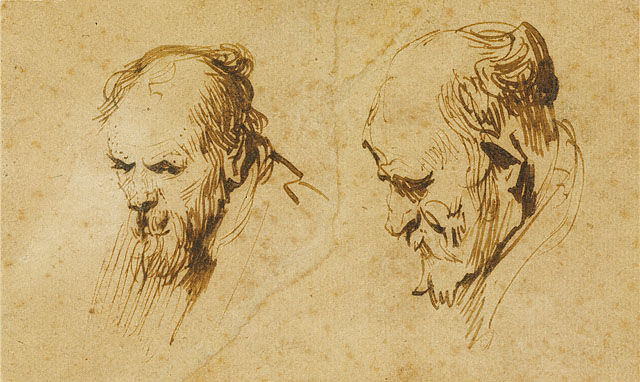
Rembrandt’s “Two Studies of the Head of an Old Man,” dated 1626, is a modest sheet that hums with artistic velocity. On a single piece of paper the young master places two closely related heads in profile and three-quarter view, both looking downward, both emerging from a web of pen lines and a few brisk passages of wash. Nothing here pleads for grandeur. And yet the page stages the very moment when looking turns into understanding. Rather than building an illusionist world with color and mass, Rembrandt lets line carry the burden of form and feeling. The result is a document of attention in action, a rehearsal in which the subject’s inner weather and the draughtsman’s hand arrive together.
Leiden, Apprenticeship, And The Discipline Of Drawing
By 1626 Rembrandt had returned to Leiden after his brief apprenticeship with Pieter Lastman in Amsterdam. While Lastman’s influence is obvious in the young painter’s ambitious narrative canvases of these years, sheets like this reveal the other half of his training: daily drawing from life to sharpen perception and speed. Leiden, a university town crowded with scholars and tradesmen, provided a steady supply of “character heads”—older sitters whose lined faces offered terrain for nuanced study. Drawing was not a casual exercise; it was the skeleton of the painter’s craft, the place where problems of structure, proportion, and mood could be solved without expensive color.
Two Heads And A Single Act Of Looking
The sheet shows two variations on one motif: an elderly man’s bowed head. On the left Rembrandt gives a three-quarter view that invites the eye to travel from brow to cheek to beard. On the right he offers a truer profile, the forehead and nose forming a single gentle slope before falling to the mouth and small beard. The pairing is not redundancy; it is rotation. By turning the head slightly between studies, he measures how light and form shift together. The viewer senses the draughtsman circling his subject, testing how character changes when seen from a different angle.
Pen, Ink, And The Quick Intelligence Of Touch
The medium appears to be pen and brown ink with touches of brush and wash. The pen lines are various: some long and continuous, others staccato and broken, many tapering to a hairline at the end of a stroke. The wash reserves are minimal—shadows under the brow, a pocket along the cheek, a darkening at the temple—and they serve to anchor the linear scaffolding rather than to build mass by themselves. Rembrandt uses the pen as if it were a violin bow, altering pressure to modulate tone. The page becomes a field of micro-decisions where speed and sensitivity collaborate.
Economy As Aesthetic
One of the marvels of the sheet is how little is required to conjure presence. The old man’s hair is not carefully described; it is suggested by a handful of curving strokes that break off before they grow fussy. The ear is a loop and a shadow; the eye, a few angular marks under a brow. The beard is a spray of downward lines, thickened at the chin by two or three darker touches. This economy does not signal haste for its own sake. It testifies to a young artist already gifted at extracting maximum effect from minimum means, a gift that will later let him suggest whole rooms with a few weighted accents.
The Psychology Of A Lowered Gaze
Both heads look downward, and that shared pose generates an atmosphere of meditation. The mouth is set but relaxed, the brow furrowed yet not harsh. The old man does not depict grief or anger; he hosts a private interiority that becomes visible in the tilt of the skull. The downward direction also gives Rembrandt an excuse to study how skin folds over bone at the cheek and how an aging neck compresses. The psychology therefore arises from anatomy honestly seen: thought is not a mask added to the face; it is a function of how the head is carried.
Hatching, Contour, And The Invention Of Volume
Rembrandt balances contour with hatching to deliver volume. Contour lines describe the perimeter of brow, nose, lips, and chin; inside that boundary short, parallel strokes run across form to indicate plane changes. At the temple a cluster of diagonal hatches turns sharply to define the socket; along the cheek, a few faint strokes coach the eye to feel roundness without building a dull gray. The pen’s direction is never arbitrary. It follows the logic of the skull and soft tissue, a silent topography lesson written in ink.
A Studio Habit With A Live Pulse
Sheets like this were often made in the studio with a seated model—sometimes a hired elder, sometimes a friend or relative. The repetition of the same head suggests a long session in which the artist sought not a perfect likeness but a dependable type he could deploy later in paintings and etchings. Yet nothing feels stock. The line retains the pulse of an encounter. We observe the acts of recognition as they happen: the artist notices the way the nostril flares, the way the lip tucks inward, the way a thin strip of highlight must be left along the nose to keep it alive.
The Page As A Field Of Choices
Blank paper is not empty here; it is part of the form. Rembrandt leaves vast areas untouched, allowing the negative space to frame the heads with air. Where he wants weight—at the temple, under the chin—ink grows darker and more layered. Where he wants light to feel thin and fresh—along the forehead, at the bridge of the nose—he draws lightly or not at all. This pattern teaches the viewer to experience light as a substance that fills the room. The heads are carved from that brightness by the pen.
Age As Respectful Subject
Rembrandt’s interest in older faces begins early and remains lifelong. Age offers narrative without narrative, a history written in pores and wrinkles. In this sheet the lines that ladder the cheek are neither sentimental nor cruel. They read as truthful inscriptions of time. The draughtsman’s empathy arrives through accuracy: he draws what is there and lets dignity emerge from the candor of the looking. This respect for age will later blossom in etchings and paintings where elders are depicted with a gravity other artists reserved for saints and kings.
Speed And Correction Visible On The Page
Close looking reveals moments where the pen corrected itself. A contour doubles back, an eyebrow thickens where the draughtsman reinforced a shadow, a line trails away after changing its mind. These visible adjustments animate the study. The viewer senses not just the face but the session—the shifting stool, the pause to reload the pen, the decision to push the ear back a hair’s breadth. Such traces become part of the sheet’s beauty, evidence that truth in drawing is less a single perfect line than a conversation among lines.
Relation To The Painter’s Early Canvases
In 1626 Rembrandt was also producing energetically staged history scenes filled with vigorous heads—martyrs, officials, soldiers, merchants. A sheet like this fed those canvases. The old man here might reappear as a temple elder, a counselor, or a witness in the crowd. More importantly, the discipline of drawing—its insistence on planes, its economy, its brisk intelligence—trained the hand that laid paint. The quick, decisive accents that make these ink heads convincing become, in the paintings, small strokes of highlight and shadow that bring an entire ensemble to life.
The Ink’s Warmth And The Paper’s Time
The brown tone of the ink and the warm paper register as a single harmony, deepened by age. Some of what reads as sepia may be oxidation and exposure, but the warmth suits the subject. The material color acts like a low musical drone under the melodic line of the drawing. Tiny blooms of darker ink where the pen paused announce the sheet’s physicality. It is a made thing, not a ghost of reproduction, and that tactile reality matters because the study’s meaning is bound to the touch that made it.
An Exercise In Breathing Space
The two heads do not touch. Between them a slender column of paper remains blank, a breathing space that prevents crowding and allows comparison. The interval is a quiet lecture in composition: repetition without overlap, variety without confusion. The left head, with more beard, leans slightly forward and occupies more vertical space; the right head sits higher on the page with a clearer ear and more hair. Balance is achieved, but not by symmetry. The eye moves back and forth as if between two thoughts that rhyme without repeating.
The Ethics Of Drawing From Life
Drawing an elderly model at close range implicates trust. The sitter permits scrutiny. The artist owes care. Rembrandt’s line pays that debt. He neither idealizes nor debases. He declines the flattery of smoothing and the cheap thrill of distortion. Instead he practices an ethics of accuracy graciously applied. That stance will characterize his portraits and self-portraits for decades, where truth becomes a form of respect and attention itself feels like mercy.
What The Viewer Learns By Looking Slowly
Spend time with the sheet and small revelations accumulate. Notice how a single dark triangle under the nose lifts the entire muzzle into space. Observe how a tiny notch at the corner of the mouth prevents the lips from going slack. Track how three strokes at the temple create the sensation of thin hair lying close to the skull. Follow the beard’s direction and feel the tug of gravity. Each discovery builds not just appreciation for a face but literacy in drawing’s grammar.
The Study As A Portable Studio
Sheets like this circulated among pupils and collectors as models and pleasures. For a student, they provided an atlas of solutions: how to simplify an ear, how to hinge a jaw, how to abbreviate hair without losing life. For a collector, they offered the intimacy of the artist’s hand at its most candid. This dual use—pedagogical and private—helps explain the sheet’s power today. We encounter not a finished public statement but a teaching moment preserved, one we can still learn from by tracing the lines with our eyes.
Seeds Of The Mature Rembrandt
Looking forward from 1626, we recognize traits that will flower. There is the love of character over prettiness, the belief that light can be suggested with very little, the trust in abbreviated marks to carry large meanings, the willingness to leave evidence of process as part of the final beauty. Even the downward gaze anticipates the introspective gravity of the later self-portraits. The sheet is young in date and confident beyond its years.
Enduring Value In A Few Grams Of Ink
Why does a modest practice page continue to command attention? Because it distills the painter’s craft to essentials: looking, choosing, and marking. Because it demonstrates that empathy can ride on a nib. Because it proves that the difference between a face and a mask is a handful of truthful strokes placed where structure and feeling meet. In an age of polish, this naked rehearsal reminds us what drawing is for—to catch the thought as it arrives, before it forgets itself.