Image source: wikiart.org
Introduction
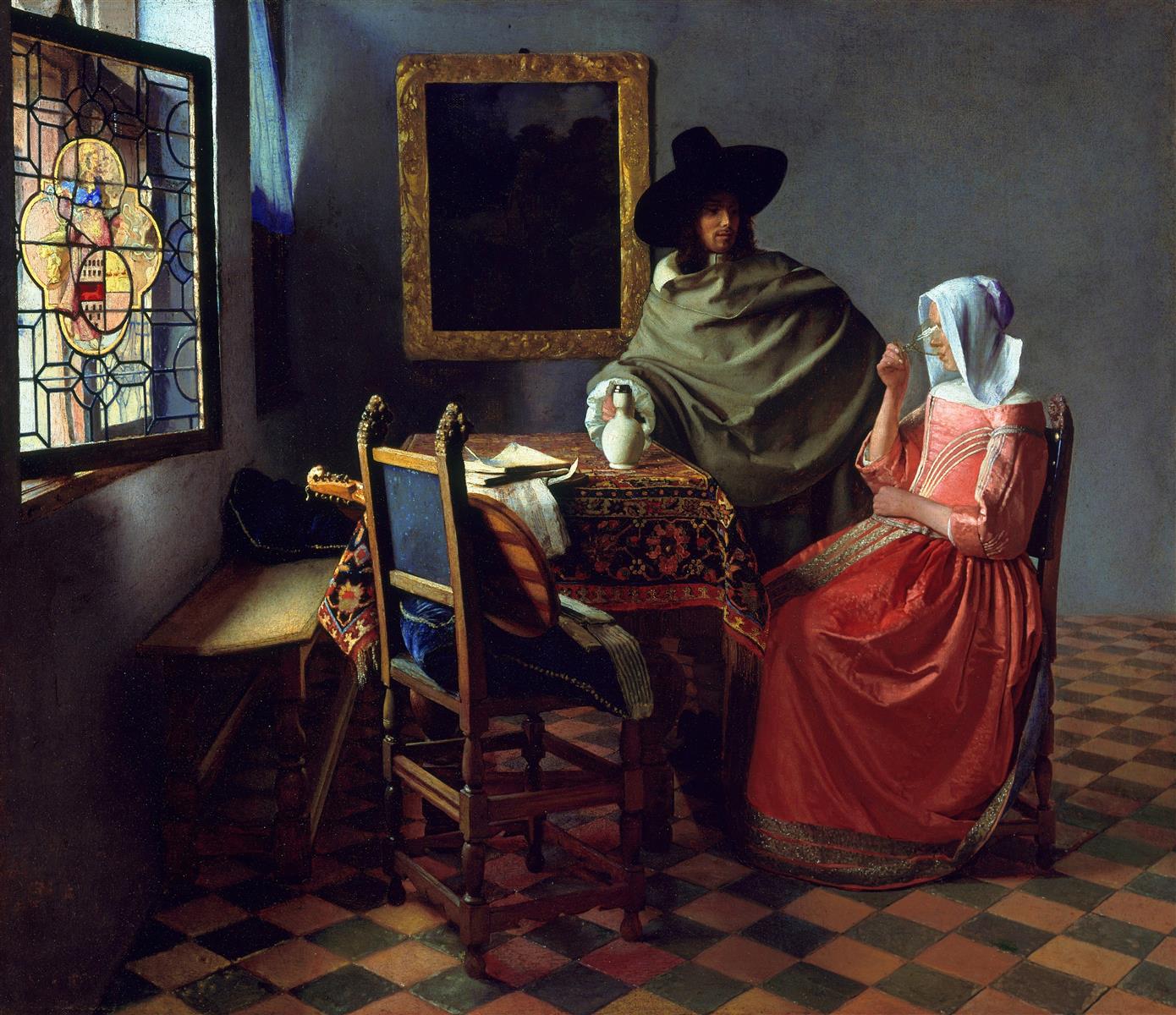
“The Glass of Wine” (1660) is one of Johannes Vermeer’s most finely tuned dramas of persuasion. In a sunlit Delft interior, a young woman in a luminous red dress sits with a roemer glass tipped to her lips, while a gentleman in a broad black hat and olive cloak stands beside a table laid with a richly patterned carpet, a white jug, and a folded letter. A stained-glass roundel glows in the open window at left; a silent, dark painting in a gilded frame hangs on the rear wall; a lute rests across a chair as though conversation has paused the music. Nothing overtly happens, yet every surface and gesture contributes to a negotiation—between appetite and restraint, between hospitality and pressure, between private will and social expectation. Vermeer makes daylight the judge and the room itself the second protagonist.
Historical Context and the Culture of Gallant Conversation
Mid-seventeenth-century Dutch art delighted in scenes of elegant visits, music lessons, and shared wine. These images were more than pleasant records of domestic leisure; they also carried moral overtones about moderation, prudence, and the conduct of courtship. Vermeer adopts this fashionable subject and purifies it of noise. Instead of the bustling tavern of his contemporaries, he gives us a disciplined room in which each object has a purpose and each gesture is measured. The painting belongs to the same years as “A Lady and Two Gentlemen” and “Officer and Laughing Girl,” but here the mood tilts from flirtatious brightness toward warning and self-command.
Composition and the Architecture of Persuasion
Vermeer composes the scene as a triangle of forces. The woman occupies the right third of the canvas, her scarlet skirt anchored to the tiled floor and her white kerchief catching light. The man stands near the center, leaning with one hand on the table and the other hidden, a posture that implies patience and control. The open window at left introduces space and principle—a conduit for clear air—and its leaded panes structure the light that judges the scene. Between window and woman lies the table, a bridge of patterned fabric across which invitations, letters, and glances travel. Orthogonals of floor and table draw the eye toward the woman’s face and glass, where decision is located.
Daylight as Moral Weather
Light enters from the window in a slant that cools the left wall and intensifies as it moves across the table to strike the woman’s shoulder and cheek. The man’s face lies in moderated shadow beneath the brim of his hat; his presence is warm and slightly opaque. The white jug and folded letter absorb and return light in higher keys, transforming from objects into signs of clarity and communication. Vermeer’s daylight behaves like a fair judge. It makes the woman’s choice most legible, keeps the suitor’s intent partly veiled, and renders the room cohesive without harsh contrasts.
The Red Dress and the Chord of Color
The painting’s chromatic heart is the woman’s dress, a crimson that deepens at the folds and sparks where highlights strike. Around this warmth Vermeer arranges a consonant chord: the blue-green sheen of the window glass, the olive of the man’s cloak, the terra-cotta and onyx tones of the tiled floor, the dark blue of the table’s carpet seen beneath the tapestry’s reds and golds. White moments—the jug, the letter, a napkin edge—act as rests in the chromatic music, cooling and resetting the eye. Color here is not decoration; it is rhetoric. The red promises pleasure and heat, while the cool greens and whites suggest measure and sobriety.
Gesture, Posture, and the Language of Hands
Vermeer’s narrative travels through hands. The woman’s left hand cradles the stem of the roemer; her elbow rests on the chair, a sign of self-possession even as she drinks. The man’s visible hand grips the table, a courtly but insistent anchor. He does not offer the glass as in other Vermeer scenes; he waits for her to drink, an important shift that places agency in her decision rather than in his prompting. The tilt of her head and the half-shadow over her eyes keep us from reading her completely, ensuring that privacy remains intact.
The Stained-Glass Roundel and Social Order
The roundel in the window bears a heraldic emblem—a coat of arms with architectural motifs and a small figure—set within graceful leadwork. Such glass signaled civic standing or family identity and filtered daylight into cultural light. As sun passes through the colored glass, it carries the authority of tradition into the room. The roundel thus acts as a countervoice to wine and music, a reminder that behavior unfolds under the sign of reputation and rule. The woman sits between that emblem and the suitor, literally positioned where order and appetite meet.
The Silent Painting on the Wall
The gilded frame behind the man encloses a dark, nearly illegible picture. This void is not a lapse but a device. It turns the wall into a mirror of withheld judgment: the past looks on but neither approves nor condemns. In “A Lady and Two Gentlemen,” a crisp portrait exerts moral pressure; here, Vermeer withdraws the explicit model and lets the weight of precedent hover as a neutral square. The effect is to intensify the present moment. With no exemplum to copy, the woman must rely on her own measure.
Letter, Jug, and Carpet as a Still-Life Grammar
The still life on the table forms a sentence of objects. The folded letter implies communication preceding the visit; a wax seal may have been broken, a message read and considered. The white earthenware jug stands for stored hospitality—wine or watered wine, the household’s control over what is poured. The Oriental carpet draped across the tabletop adds touch and wealth to the scene, a sensual ground that can either aid persuasion or be simply a sign of a well-kept home. Vermeer paints these things with a tact that lets them be both themselves and symbols, never allowing allegory to overwhelm convincing material presence.
The Lute and the Pause of Music
Across the nearer chair rests a lute, its body luminous where daylight grazes it, its neck pointing to the woman. In Dutch painting, a lute often suggests harmony turned toward love, or, when idle, the lapse of discipline. Here it is not abandoned in disorder; it is set down carefully, as if a song has been paused for conversation. The instrument also implies time: the meeting has a past and will have a future, and music waits to resume if the conversation resolves well. The lute’s silent expectancy adds tenderness to a scene otherwise framed by restraint.
The Tiled Floor and the Discipline of Space
The terracotta-and-black checkerboard floor organizes depth with calm regularity. Its squares march toward the back wall, measuring human nearness in rational increments. The woman’s dress pools over those tiles like a slow tide, a beautiful excess that the grid contains. Vermeer’s perspective is gentle, not demonstrative, but it underwrites the theme: within a measured space, the human heart can move freely without chaos.
A Scene of Agency Rather Than Seduction
Compared with many contemporary images of drinking couples, “The Glass of Wine” is conspicuously quiet. The woman is not coaxed; she chooses. Her posture is compact, her feet anchored; the suitor’s presence is persuasive but patient. The drama is internal, located in the second when a sip becomes a sign—of welcome, of courtesy, perhaps of a small surrender to pleasure. Vermeer honors the difficulty of such micro-decisions by refusing caricature. He allows her to remain undecided even as the glass reaches her lips.
The Ethics of Looking and the Viewer’s Position
We stand slightly apart, aligned with the window yet outside the couple’s line of sight. The woman does not perform for us; the man does not acknowledge us. This vantage encourages a respectful gaze. We are witnesses, not participants or voyeurs. The painting thereby teaches a way of looking that parallels its ethical content: to see without pushing, to attend without claiming. Vermeer’s rooms feel trustworthy because they grant privacy within visibility.
Sound, Silence, and the Suspended Second
Although the subject is a drink shared in sociable company, the painting is acoustically muted. The faintest sounds suggest themselves: a gloved hand moving across the carpet’s pile, liquid touching glass, the soft scrape of a chair leg on tile, the dull thrum of the street filtered through leaded panes. Vermeer stretches this slender sonic fabric over the scene so that the single second of drinking acquires the weight of ceremony. Time is not frozen; it is dilated until we can notice it.
Technique, Layering, and the Craft of Light
The painting’s authority depends on Vermeer’s layered method. A warm undertone binds wall, floor, and flesh; thin glazes create the depth of the red satin; tiny impasto lights on the glass, the jug rim, and the lead cames of the window locate the brightest points with economy. Vermeer’s transitions between tones are famously soft, but edges sharpen where truth needs to be explicit—along the glass’s rim, where decision meets daylight; along the letter’s folded edge, where thought has been recorded. The surface is unified yet alive, a skin of paint that breathes.
Comparisons Within Vermeer’s Corpus
Placed beside “Officer and Laughing Girl,” this canvas darkens and slows the tone. There, laughter blooms; here, the mouth is hidden by the glass. “A Lady and Two Gentlemen” shows active coaxing and a triangular moral stage; “The Glass of Wine” reduces the cast and concentrates the charge in a momentary sip. Later works such as “Girl with a Wineglass” complicate the message by making the woman look tipsy; this earlier picture stays disciplined. Across the series, Vermeer keeps faith with a central idea: light can hold desire to account without humiliating it.
Multiple Readings and the Open Moral
The painting keeps interpretation supple. It can be understood as a charming account of a polite visit, as an admonition about drink and flattery, as an allegory of temperance staged between heraldic order and personal appetite, or as a celebration of a woman’s agency. The emptiness of the framed picture, the presence of the letter, the lute paused in silence, and the open window all encourage storytelling but refuse to close the story. Vermeer trusts us to weigh, just as his heroine does.
The Role of Place and Dutch Domestic Ideals
Everything about the room—leaded glass, tiled floor, clean white jug, expensive carpet, tidy bench—speaks to seventeenth-century Dutch ideals of order, cleanliness, and prosperity. The home appears as a civic cell in which virtue is practiced through care of things and moderation of pleasures. The gentleman’s travel cloak and wide hat bring the world’s mobility indoors; the woman’s modest cap and steady posture root the scene in household stability. The painting believes that the best meetings occur where these domains overlap under disciplined light.
Enduring Significance
“The Glass of Wine” remains compelling because it distills a complex human negotiation into the modest choreography of a room. Vermeer shows that freedom is exercised not in grand spectacles but in quiet seconds when one decides how much to drink, what words to accept, how far to let music and company carry the heart. He allows color to seduce and light to interrogate, giving both equal dignity. In an age of speed and noise, the painting continues to teach patience: attend to the angle of the glass, the pressure of a hand on the table, the way daylight changes a face, and you will see choice happening. That attention—so akin to love—is Vermeer’s true subject.