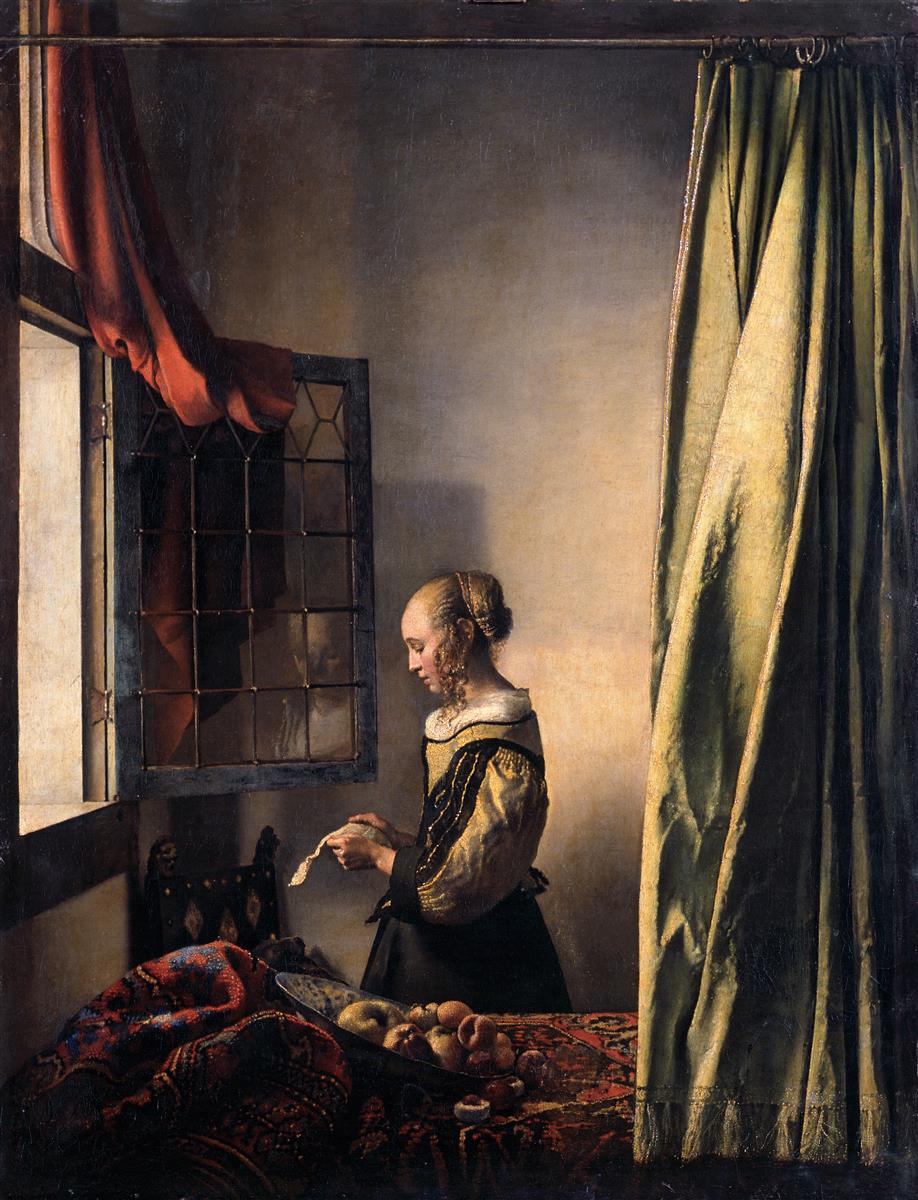
Image source: wikiart.org
Introduction
“Girl Reading a Letter at an Open Window” (1657) is a decisive step in Johannes Vermeer’s invention of the quiet interior as a stage for intimate drama. A young woman stands by a casement, her body turned toward the light while her eyes fall to a letter she holds delicately in both hands. The room is simple yet resonant: a table draped with a thick Oriental carpet, a silver-blue bowl of fruit, a heavy green curtain parted like a theater drape, and—since the painting’s recent restoration—a large picture of Cupid on the back wall. Nothing overtly happens, and yet the air is tense with implication. Vermeer renders thought visible through light, surface, and the measured placement of things, transforming a private moment into a meditation on desire, truth, and the ethics of looking.
Historical Context and the Transformation of Genre
In mid-seventeenth-century Delft, collectors favored domestic scenes that carried moral overtones without heavy sermonizing. Vermeer, in his mid-twenties, had already tried history and tavern scenes; here he aims for something subtler and more modern. He narrows the cast to one figure and makes the room itself the second protagonist. While earlier Dutch genre painters delighted in anecdote, Vermeer pursues interiority. The painting belongs to his early run of interiors that also includes “A Maid Asleep” and “Officer and Laughing Girl,” works in which conversation, courtship, and pause unfold under the discipline of angled daylight.
Composition and the Architecture of Privacy
The composition is a masterclass in orchestrating nearness and distance. The rectangle of the window on the left and the slab of green curtain on the right act like parentheses that enclose the woman, turning the central wall into a delicate plane on which thought can be projected. The table thrusts forward, its carpet’s thick nap rolling toward us, creating a sensory barrier between viewer and subject. The woman stands just beyond that barrier, halfway between public threshold and private retreat. The left-to-right sweep of light draws our eye along the rim of the bowl, up the sleeve’s gilded sheen, and across the line of her cheek, before dissolving softly into the shadowed wall. Everything funnels attention to the letter while protecting the reader’s privacy.
Daylight as Moral Clarification
Vermeer paints daylight as a discriminating intelligence. It enters from the opened casement, filtered by diamond-paned leaded glass, and lays a calm beam across the woman’s face and bodice. The illumination is neither theatrical nor cold; it has the measured warmth of late morning, revealing textures without stripping them of mystery. Where it touches flesh, it rounds volumes gently. Where it grazes metal and fruit, it places clean highlights that feel earned rather than showy. The light also stages the letter as truth-bearer: white paper becomes a local sun, modestly bright, the very index of news and meaning. In Vermeer’s universe, the right light is a moral force.
Color Harmony and the Emotional Key
The palette balances earthy warmth and cool restraint. The carpet’s brick reds and midnight blues pulse beneath the still life; the curtain’s cool green and the wall’s pearl-grey quiet them. The woman’s costume holds the center: a bodice woven with golden threads that catch light like small flames, countered by matte black sleeves pricked with tiny lights. The result is an emotional key pitched between expectation and composure. Nothing here is garish; the chromatic system deepens mood while never distracting from the unspectacular intensity of reading.
The Letter as Plot and Prop
The letter is the painting’s narrative engine and its finest still life. Vermeer describes its light, crimped edge, the slight bend at the fold where fingers press, the shadows that crawl into creases. We cannot read its words, but we are allowed to read its handling. The two-handed grip suggests care; the forward tilt of the head suggests absorption; the slight parting of lips hints at a breath drawn between sentences. Vermeer avoids the clichés of tear or smile. He trusts posture and light to implicate us in the suspense that only letters can generate: the slow revelation of the far made near by ink and paper.
Window, Reflection, and the Ethics of Looking
The window is both source and symbol. Its open lower sash admits air and day; its leaded grid organizes vision into patient units. In its glass we can detect the faint reflection of the young woman’s face, implying that the reader is momentarily both subject and object of the gaze. That reflection is one of Vermeer’s quiet miracles: a reminder that private emotion inevitably throws an image into the world. The open window also introduces the outside as possibility—the street, the lover, the distant sea that Dutch maps so often celebrate—without breaking the sanctuary of the room.
Curtain, Carpet, and the Theater of Interiors
The heavy green curtain to the right functions like a theatrical drape drawn back just enough to reveal a scene. Dutch viewers knew curtains as both practical dust covers and pictorial devices; here the fabric adds depth, privacy, and a note of ceremony. The Oriental carpet on the table is the room’s tactile heart: sumptuous, patterned, a luxury whose thick pile slows the eye and the hand. Together, curtain and carpet create a sensuous foreground against which the sober wall and the clear daylight feel even more lucid. Vermeer loves this conversation between luxury and clarity, fleshly pleasure and moral restraint.
Still Life of Fruit and the Taste of the Moment
The blue-and-white bowl on the carpet carries apples, pears, and perhaps peaches, their skins catching small points of light. A peeled lemon and shell cup rest nearby. Fruit in Dutch art can suggest plenty, pleasure, transience, or temptation; here it marks the room as hospitable and heightens the sensory register of the moment. The crisp rind curls toward the letter as if linking palate to sentiment. Yet Vermeer’s still life remains modest, never competing with the reading woman. It is a chorus humming beneath the solo.
Cupid Restored and the Meaning of Love
For centuries the back wall appeared blank due to an overpainted passage. Recent restoration revealed the large picture of Cupid—a standing figure holding aloft a card and stepping on a mask—originally conceived by Vermeer. The revelation shifts interpretation. A blank wall once seemed to keep the emotional content indeterminate; the Cupid now insists that the letter concerns love. The raised card, associated with the disclosure of a single-hearted truth, and the trampled mask, a symbol of unmasking or fidelity, cast the scene as an allegory of honest affection. Crucially, Vermeer does not bring Cupid forward as loud emblem; he keeps it at the back, letting it work like a remembered principle that frames the present reading.
Silence, Breath, and the Experience of Time
Vermeer’s rooms are constructed out of silence. In this painting, you can almost hear the thrum of daylight on glass, the soft rasp of paper, the distant street muted by leaded panes. The moment is poised between lines read and lines yet to come. Even the curtain registers time—it hangs mid-sway, as if just drawn aside. Vermeer dilates this modest interval until it feels grand; he proves that suspense does not require drama, only attention given to ordinary time.
Technique, Layering, and the Craft of Light
The painting’s surface reveals Vermeer’s layered method. Warm grounds peek through cool upper layers to keep the wall alive; thin glazes of translucent yellow and brown build the bodice’s sheen; small, decisive touches of thick paint stage highlights on fruit and glass. Edges are managed with extraordinary tact: some dissolve into atmosphere; others are sharply accented where objects catch light at a turning point. The lead cames of the window are drawn with quiet authority, their geometry softened by age and use. The whole surface breathes, a slow modulation of tones that allows light to feel like weather.
The Woman’s Psychology and Ethical Center
Vermeer grants the reader full dignity. Her hair is drawn back in a careful knot; her sleeves are costly yet practical; her stance is upright and unposed. She is neither a caricature of yearning nor a token of domestic virtue, but a person learning something about herself in daylight. By refusing to show her eyes to us, Vermeer protects her interiority. We do not seize her feeling; we infer it from posture and atmosphere. This ethical tact—attention without appropriation—distinguishes Vermeer from many contemporaries and helps explain the abiding modernity of his rooms.
Distance, Desire, and the Geometry of Longing
Longing in this painting is built as a geometry of distances. There is the literal distance between the writer and the reader measured by the letter’s travel; the spatial distance between viewer and woman defined by the high table; and the moral distance between private knowledge and public display moderated by curtain and window. Vermeer arranges these gaps so that feeling has room to move, turning absence into a palpable presence. The picture dramatizes how love travels: through mail, through light, through the disciplined order of a room.
Place in Vermeer’s Oeuvre
“Girl Reading a Letter at an Open Window” sits near the beginning of Vermeer’s long devotion to women at meaningful tasks—reading, writing, weighing, making music. It inaugurates motifs he will refine: the left-hand window as protagonist; the lacquered still life as emotional barometer; the painting-within-the-painting as thematic key; the heavy curtain as stage device; and the ethics of a gaze that sees without intruding. Later works will vary the chord—sometimes brightening, sometimes warning—but the essential harmony first sounds fully here.
Cultural Meanings and Domestic Virtue
For a Dutch viewer, the scene affirms a civil ideal: a home orderly enough to host both luxury and lucidity, where news arrives and is weighed in the clear light of morning. The mapless wall replaced by Cupid reconnects the room to the wider world of affect rather than geography, yet the virtues remain civic—measure, cleanliness, moderation, attention. Love appears compatible with order, desire with daylight. Vermeer’s picture thus offers not escapism but a vision of everyday life elevated by care.
Enduring Significance
The painting’s power lies in its union of mystery and clarity. We know enough—the letter concerns love—to feel the scene’s pulse; we do not know so much that the pulse is reduced to plot. Vermeer convinces us that the most consequential experiences can happen in rooms like ours, with tables like ours, at windows like ours, under light that arrives every day whether we notice or not. He teaches a way of seeing that is also a way of living: to let attention polish the ordinary until it discloses the extraordinary within it.