Image source: wikiart.org
Introduction
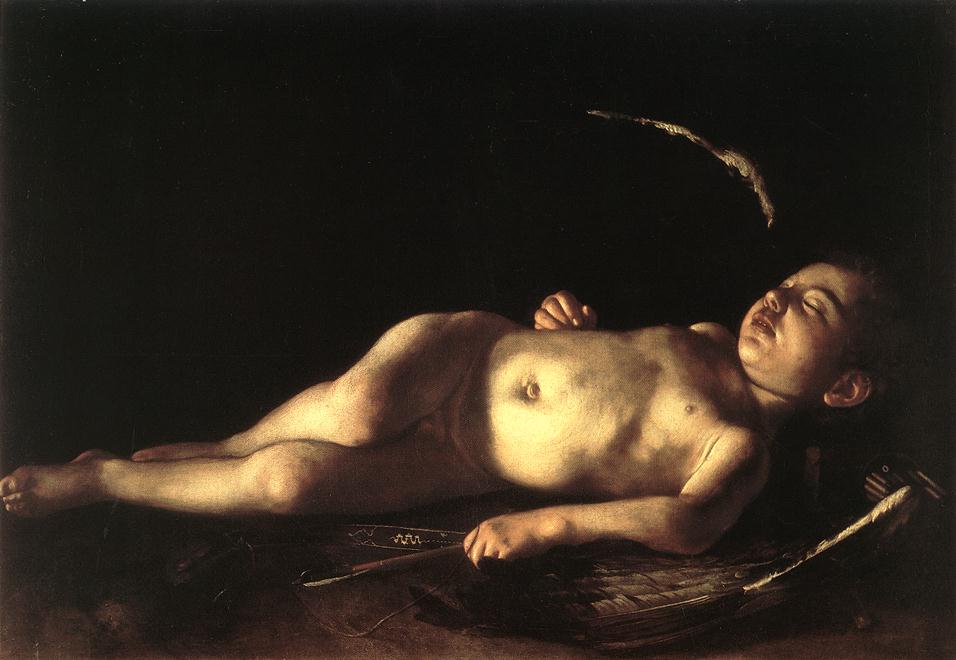
Caravaggio’s “Sleeping Cupid” (1608) is one of the most concentrated and disarming meditations on love, vulnerability, and transience in early modern painting. Stripped of setting and spectacle, the canvas presents the god of love as a drowsing, very human child laid out across a low plane, his wings, bow, and arrows slipping into shadow. The radical simplicity is a late-career hallmark: Caravaggio collapses narrative to a single moment and lets chiaroscuro carry meaning. The result is a work that looks spare at a glance yet deepens with every look, a moral image that speaks through posture, light, and silence rather than through emblems or inscription.
Historical Moment And Late Style
Painted during Caravaggio’s restless years after Malta, “Sleeping Cupid” belongs to a phase when the artist’s language grew austere. The picture can be read beside other late works where space is pared down, palettes are muted, and figures are drawn into a shallow stage carved by light. Gone is the crowded storytelling of earlier altarpieces; what remains is a distilled image, severe and direct, whose clarity suits the devotional and moral expectations of the time. Love’s deity is here not triumphant but subdued, an embodiment of human frailty and the impermanence of desire.
Composition As Argument
The composition is nearly horizontal, the child’s body stretching like a soft chord across the lower half of the canvas. Caravaggio places Cupid just above the picture edge so that the limb foreshortening and the curving belly generate a gentle S-line that guides the eye from feet to tilted head. Above, a gulf of darkness opens like a night sky without stars. Nothing distracts from the body and the scattered attributes. The emptiness is not absence but argument: against the black field, the glowing flesh reads as a brief flare of life, already slipping toward shadow, and the implements of passion have lost their agency.
The Human Face Of A God
Caravaggio’s Cupid is not a mythic bronze; he is a child you might meet in the streets, a boy whose sleep is heavy, unguarded, and unposed. The cheeks are flushed, the mouth parted, the eyelids weighed down with drowsiness. In this unidealized anatomy lies the painting’s disarming power. The deity who stings kings and commoners with desire is, in this moment, defenseless. The painter thereby reverses the usual hierarchy of power: love, which conquers all, lies conquered by sleep. The image honors the classical subject while rehumanizing it to meet Counter-Reformation moral taste, which favored images that teach rather than titillate.
Chiaroscuro That Reads Like Breath
Light in “Sleeping Cupid” is intimate and low, as if cast by a single unseen lamp. It rakes across the boy’s torso, inflating the skin with warmth and leaving the extremities to dissolve at the edges of shadow. The play of light over ribcage, belly, and clavicles creates a living rhythm; one can almost feel breath rise and fall. Caravaggio’s chiaroscuro is less about theatrical shock here and more about tenderness. He models flesh with the subtlest halftones—a cool gray flicker at the hips, a warmer note at the sternum—so that the child feels embodied rather than carved from light.
The Language Of Objects
Cupid’s attributes lie close to his body, half-seen, as if set aside by a child who has fallen asleep mid-game. A feather hovers; a wing catches a sliver of illumination; a thin bow and scattered arrows lie within reach but out of use. Their very ordinariness is striking. Caravaggio paints them not as polished trophies but as worn tools, their surfaces dulled by handling. The message is double: the god’s power is real, for the devices are tangible and familiar, but that power is not constant. Love can be set down, even forgotten. The quiver and arrows become vanitas objects, analogues to skulls and spent candles in the painter’s other moral scenes.
Allegory Of Sleep
Sleep, in Renaissance and Baroque thought, is cousin to death and a frequent allegory for vice subdued. In this painting it becomes a soft metaphor for the suspension of passion. The moment is morally suggestive rather than punitive. Cupid is not punished or bound; he simply rests. In that rest viewers recognize reprieve—the heart’s reprieve from compulsion, the mind’s reprieve from the wounds of desire. Caravaggio often dramatized the havoc love can wreak; here he imagines the world in a quiet interval when love’s arrows do not fly.
A Palette Of Flesh And Night
The color scheme is severe: honeyed flesh tones set against a cave of brown-black. Occasional warm notes—an umber echo in the feathers, a tawny glint on the bow—bind the figure to his implements. The painter’s restraint intensifies focus. Because no robe flashes, no landscape opens, the eye has nowhere to wander but over the skin and along the slender lines of bow and quills. The viewer learns the picture’s grammar quickly and then lingers in its cadences.
Caravaggio’s Naturalism And The Ethics Of Looking
Caravaggio’s naturalism always walks a tightrope between immediacy and propriety. In “Sleeping Cupid” the balance is exemplary. The body is observed with frankness but not with prurience; it is the universal, vulnerable body of childhood, not an erotic display. The artist asks us to attend with the same tenderness we would show a sleeping child in life. In moral terms, this is a training of the gaze. The spectator’s desire to stare is transformed into a patient, protective looking—an ethics of attention that mirrors the painting’s theme of passion set aside.
Comparisons Within Caravaggio’s Oeuvre
Placed beside “Amor Victorious” of a few years earlier, the contrast is instructive. In that earlier picture, Cupid grins triumphantly, his stance cocky, his body an incandescent engine of mischief. The world’s emblems—music, armor, geometry—lie conquered at his feet. By 1608 that swagger has cooled into vulnerability. Where “Amor Victorious” trumpets love’s domination over human pursuits, “Sleeping Cupid” whispers about intervals when love itself becomes subject to time, fatigue, and perhaps grace. Read together, the two canvases enact a baroque dialectic of eros and restraint, appetite and quiet.
Gesture And The Poetics Of Touch
The child’s hands tell a quiet story. One curls loosely at the chest, as if recently grasping, now relaxed; the other lies near the belly, fingers slack, palm turned partly upward. These small gestures refuse rhetoric and therefore feel true. Touch has ceased. The hands that guide arrows and string bows no longer work; touch itself is at rest. The wings echo this grammar: their feathers point away from the body in a gentle fan, not spread for flight. The vocabulary of action is replaced by a lexicon of pause.
Space, Scale, And Viewer Position
Caravaggio flattens the spatial field into a shallow ledge against darkness, bringing the viewer uncomfortably close. The scale is intimate but not miniature; the body occupies a wide swath of canvas, and the head rests near the right edge so that we feel almost bedside. This closeness intensifies the sense of guardianship. We are not distant witnesses; we are the ones who keep watch while Cupid sleeps. The darkness behind reads like a room whose lamplight has been dimmed, a protective screen against intrusion.
Time Suspended
Everything in the painting contributes to a sensation of held time. The feather caught in light seems frozen in mid-fall. The breath we read in the chest seems slow. The absence of narrative cues—no doorway, no horizon, no clock—keeps the viewer inside a prolonged present. This suspension gives the work its contemplative power: it becomes an image for prayer, for reflection on the brittleness of our appetites and on the mercy of intervals when rest is granted.
Theology Of Desire
Caravaggio never moralizes loudly, but the implications are plain. Love, understood as human desire, is powerful, unruly, and often painful. Yet its source is not brute might but vulnerability—the fragile body of a child. When that body sleeps, the instruments of desire fall quiet. In a Christian frame, one might read this as grace: passion given its proper Sabbath, eros folded into peace. The picture does not scold; it simply shows what peace looks like and lets viewers recognize their longing for it.
Material Technique And The Surface Of Light
Caravaggio’s handling is economical. He builds the body with thin, luminous layers that let warm underpaintings breathe through cooler glazes. Highlights are laid with confident strokes along shoulder, knee, and cheek, each placed to mimic reflected lamplight. The surrounding darkness is not a single dead tone but a soft orchestration of browns and blacks that absorb light unevenly, like a room’s corners where plaster, fabric, and air meet. These subtleties keep the picture from feeling diagrammatic; the dark lives, and so does the flesh.
The Vanitas Thread
Like his canvases of saints writing beside skulls, “Sleeping Cupid” threads mortality through beauty. The soft belly and rounded limbs remind us how swiftly bodies change and how briefly innocence lasts. The feather drifting downward is one of the most eloquent vanitas touches in Caravaggio’s oeuvre: an emblem of flight and erotic sting made weightless, falling out of service. Nothing here is ruined; everything is simply yielding to time. The moral is tender rather than severe.
Reception And Lasting Resonance
Viewers across centuries have recognized the painting’s quiet audacity. By refusing opulence and reducing mythology to a sleeping child, Caravaggio created an image that reads instantly yet lingers. It anticipates modern sensibilities that prefer psychological truth over allegorical inventory. Painters and photographers have returned to the pose, the low light, and the horizontal spread of the form as a template for images of repose and vulnerability. The work’s authority rests not in grand statement but in the credibility of a single, luminous fact: even love must sleep.
What The Painting Teaches About Looking And Feeling
To stand before “Sleeping Cupid” is to feel your senses recalibrated. The eye slows to the tempo of breath; the ear invents a soft room tone; the hands remember how to set down what they carry. In a culture obsessed with constant arousal—of appetite, of consumption, of conflict—the painting proposes a counter-rhythm. Rest does not negate love; it guards it. Desire is not destroyed when its tools lie idle; it is restored. Caravaggio encodes these insights not in text but in the angle of an elbow, the weight of a wing, the hush between two shadows.
Conclusion
“Sleeping Cupid” distills Caravaggio’s genius for moral clarity into one intimate image. Through a narrowed palette, a voided background, and a body modeled by breathlike light, he converts a mythic subject into a meditation on the necessity of rest and the humility of desire. The god of love becomes a child again, and the world, for a moment, grows mercifully quiet. In that quiet the painting does its deepest work, reminding us that the heart’s most potent renewals often begin when the arrows are put away and the lamp is turned low.