Image source: wikiart.org
Introduction
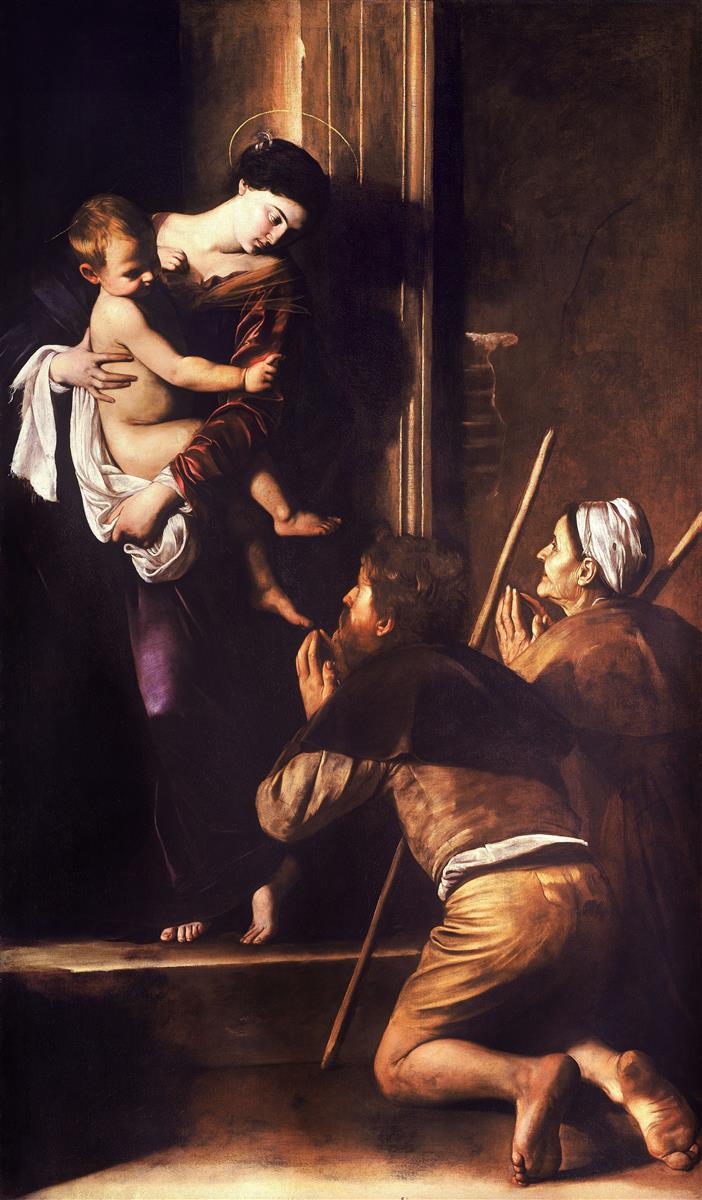
Caravaggio’s “Madonna of Loreto” (1604) stages an encounter between sanctity and street life so intimate that the threshold of a Roman doorway becomes a frontier between worlds. The Virgin stands at a stone step, the Christ Child balanced on her hip; before them kneel two pilgrims with muddy feet, hands pressed in prayer, faces tilted up in a mixture of awe and relief. Everything essential happens within arm’s reach. A blade of light cuts across the scene, revealing skin, cloth, and brick with the same democratic clarity. The miracle is not fireworks but recognition: the sacred appears at the door and chooses to receive those who knock. In a city crowded with gilded altarpieces, Caravaggio offered this: bare feet, work-worn hands, and a mother who leans forward to meet them.
Historical Context and Commission
Painted for the Cavalletti chapel in the Roman church of Sant’Agostino, the canvas answered Counter-Reformation calls for clarity, immediacy, and devotion grounded in lived experience. Pilgrimage culture was thriving; shrines like Loreto promised healing and forgiveness to the faithful who endured long, rough journeys. Caravaggio delivers the theme not by depicting the famous Holy House in Italy, but by relocating its meaning: in his painting, Loreto is wherever Mary and the Child are willing to appear. He eliminates ornamental scenery and describes an urban threshold whose cracks and stains tell you this is not celestial marble, it is the real city. That radical grounding—placing the Madonna at a plastered doorway, welcoming people who look like neighbors—made the work instantly legible to Roman worshippers and controversial to those who preferred idealized sanctity.
The Chosen Moment
Caravaggio freezes the instant when the pilgrims’ eyes meet Mary’s and the Child turns toward them with a small, alert body. Nothing is theatrical. Christ is not airborne; he is a toddler, heft and wobble included, resting against his mother and reaching out with a foot that nearly grazes the supplicant’s clasped hands. Mary inclines her head and shoulders, creating a sheltering curve that brings divine attention down to human height. The kneeling man angles forward into the step as if momentum from a long journey has not yet left his bones; the woman behind him, kerchiefed and weathered, presses her palms together with an intensity that has outlasted fatigue. This is the pilgrim’s payoff: not spectacle, but being seen.
Composition and the Architecture of Approach
The composition is a study in diagonals converging at the moment of recognition. The pilgrim’s body forms a steep incline from bare heel to lifted chin; behind him the woman’s posture repeats the tilt, creating a doubled arrow aimed at the Child’s face. Mary anchors the opposite diagonal: her torso leans in while her mantle drapes downward in a soft counter-slope that stops exactly at the stone step, a line that separates the viewer’s world from the sacred interior. Christ’s body bridges the gap, one leg tucked into Mary’s arm, the other extended toward the pilgrims. The staffs and vertical jambs frame the action like architectural parentheses. Space is shallow, forcing proximity; forms interlock so tightly that the encounter feels inevitable.
Chiaroscuro and Light as Invitation
Light enters from the left and climbs the figures like a welcome. It finds the Child first, then Mary’s cheek and shoulder, then the man’s face, then the woman’s lined profile and clasped hands. A sliver also describes the threshold and the raised panel of the door. Darkness swallows everything extraneous—no landscape, no crowd, no decorative reliefs—so that light can appoint its subjects without distraction. Unlike the punitive beams that interrogate villains in Caravaggio’s martyrdoms, this light is hospitable. It feels like a door opened, a shutter lifted, acknowledging the arrival of guests. Tenebrism becomes pastoral care.
The Bodies That Carry the Story
Caravaggio’s realism persuades because he paints surfaces that know fatigue and warmth. The male pilgrim’s feet are the scene’s most famous detail, caked with road dust and callused to the heel; his cord-tied bundle and worn breeches show journey more than poverty. The woman’s hands are red from labor; her kerchief is tied without vanity; her staff leans where she has leaned on it for miles. Mary’s body is fully clothed yet palpably physical; the Child’s belly and legs have a lifelike weight. Even the doorway is a body of sorts—flaking, scored, modestly dignified. These material truths pull the sacred out of abstraction and into the neighborhood.
Gesture as Theology
In Caravaggio’s vocabulary, the hands preach. The pilgrims’ hands are joined in the oldest grammar of prayer—gratitude and petition at once. Mary’s left hand holds the Child with a firm grip that mothers will recognize: fingers spread, thumb locking the abdomen for security. Her right arm curves to create a pocket of safety; her head’s inclination gives that pocket a voice. The Child’s right hand curls near his chest as if feeling the pulse of attention; his left leg extends inquisitively, toes pointed toward the kneeling man. The gestures do not merely illustrate doctrine; they embody it. Grace arrives as touch and weight, as balance discovered at a doorstep.
The Madonna’s Humanity and Majesty
Caravaggio avoids the golden aloofness of earlier Madonnas. He gives Mary a woman’s neck and wrists, a costume of deep wine and night violet that swallows light rather than flares it, and a halo so faint it reads like the trace left by a departed sunbeam. Yet majesty is present. It resides in the calm with which she manages the child, in the quiet command of her posture, and in the pedestal of the step that lifts her just high enough to represent heaven without abandoning the street. Her face bends toward the pilgrims with an attention that sanctifies them. Power, in this painting, is the ability to notice.
Iconography of the Loreto Theme
The legend of Loreto tells of the Holy House transported from Nazareth to Italy, becoming a shrine where the faithful meet Mary and her Son. Caravaggio translates the miracle into an urban key. The weathered doorway can be read as a stand-in for the house; the step becomes shrine threshold; staffs and bundles mark pilgrimage; the encounter itself is the miracle. He subtracts angels and miracle architecture to preserve the central claim: the holy family makes a home where the poor can arrive. The painting thus honors the shrine while freeing its message from geography.
Color and Emotional Weather
The palette is concentrated and moral. Mary’s mantle drinks in light with blues almost black; her robe burns low in wine red; the Child’s linen catches a few crisp highlights; the pilgrims wear clay browns and earthy greens that tie them to the road. The background is a humid brown that reads as the air of a narrow Roman street at evening. Because the color range is restrained, every small note matters: the white of the woman’s headscarf becomes a flare of attention; the bright skin of the toddler becomes a promise; the pale step becomes a stage. The overall mood is warm, intimate, and serious.
Space, Proximity, and the Viewer’s Seat
Caravaggio compresses the action against the picture plane so we stand at the pilgrims’ backs. The composition makes us witnesses, almost companions; our gaze follows theirs upward, and we share their angle of ascent. The low vantage—close to the step, near the ground—lets the bare feet register with tactile force. The door jambs and the tight cropping suggest a small chapel niche; indeed, in its original setting, worshippers knelt within a few feet of the image, repeating the posture they saw. The painting thus doubles its own viewing: pilgrims in paint and pilgrims in stone space kneel together before a mother and her child.
The Doorway as Theological Device
The step and jambs do more than frame; they interpret. A threshold is a place of decision and welcome. Mary does not stand deep within the house; she stands at the line where inside meets outside. The Child’s exploratory foot nearly crosses. The kneeling man’s staff falls away as if a traveler has arrived at the end of walking. In this architecture, salvation is hospitality, and holiness is the art of holding the door.
The Quiet Drama of the Child
The Christ Child carries a surprising share of the scene’s energy. He twists, eyes bright, toes flexed, as if newborn curiosity could not ignore the faces below. Caravaggio paints him neither as a miniaturized adult nor as an ethereal cherub; he is a solid toddler whose gaze catches and responds. That liveliness represents more than temperament; it proclaims an Incarnation interested in others. The Child’s movement away from mother toward strangers is a small prophecy of a life spent going out.
The Pilgrims’ Faces and the Ethics of Seeing
The man’s face is open-mouthed, his eyes shining with a double emotion: astonishment at being recognized and relief at having arrived. The woman’s profile reads as gratitude made durable by long practice. Caravaggio does not caricature them with comic poverty; he honors them with individuality. Their presence is not a foil for Mary’s compassion but a test of the viewer’s: can we see them as the light sees them—worth the journey and the welcome?
Technique and the Persuasion of Paint
Caravaggio’s brushwork is disciplined and quiet. He lays in large shadow masses, then develops form with softly fused midtones and staccato highlights along edges where sight identifies contact: the step’s rim, a knuckle catching light, the Child’s shin. Flesh is built with thin layers that let warmth breathe up from undercool greys; fabric carries weight through long strokes broken by sudden, crisp creases. The door’s battered surface is described with economical scumbles that refuse picturesque decay. The restraint lets the narrative dominate; the paint never distracts from the encounter it renders.
Reception and Controversy
Contemporaries recognized the painting’s power and bristled at its audacity. Some objected to the “dirty feet” and the tawdry setting; others praised the immediacy that pulled prayer out of rhetoric and into the street. Over time the canvas became a touchstone for how sacred art could honor ordinary bodies. Caravaggio’s choice to render the pilgrims with dignity and particularity has echoed across centuries of religious and social painting, shaping visual languages of inclusion and mercy.
Dialogue with Other Works by Caravaggio
Seen beside “The Calling of Saint Matthew,” this painting shares the grammar of a beam of light identifying chosen people in a dark room. Compared with “Rest on the Flight into Egypt,” it swaps pastoral lyricism for urban realism; compared with “Supper at Emmaus,” it translates revelation into hospitality rather than recognition over a table. In all three, Caravaggio reduces theology to a human exchange—gesture, gaze, and nearness—making doctrine graspable by anyone willing to stand close.
How to Look
Begin at the Child’s face, where the light first declares interest, then follow his outstretched leg to the pilgrim’s praying hands. Climb the slope of the man’s body to his lifted eyes; step back to catch the woman’s profile and the small white flare of her headscarf. Slide up the jamb to Mary’s tilted head, then down along her mantle to the step where her toe peeks into the light. Repeat the circuit until the threshold feels like a living hinge between your world and theirs. The painting will slow your breath into the tempo of arrival.
Meaning for Devotion Today
Four hundred years on, “Madonna of Loreto” still reads like a manifesto of welcome. It proposes that sanctity is not fragile; it can stand in a doorway and receive the worn-out. It insists that the measure of holiness is attention paid to the overlooked. And it suggests that arrival is mutual: the pilgrims have reached the door of mercy, and mercy has reached them. In that double crossing lies the picture’s enduring tenderness.
Conclusion
“Madonna of Loreto” is Caravaggio’s hymn to hospitality. With the simplest props—a step, a door, two staffs, a bundle—he composes a theology of nearness. Light behaves like a host; bodies tell the truth of journeys; a mother’s inclination becomes a sanctuary. The painting does not ask for admiration from afar; it asks for participation up close. To kneel before it, historically or imaginatively, is to join the pilgrims in the oldest prayer: here I am, tired and hopeful, and you have opened the door.