Image source: wikiart.org
Introduction
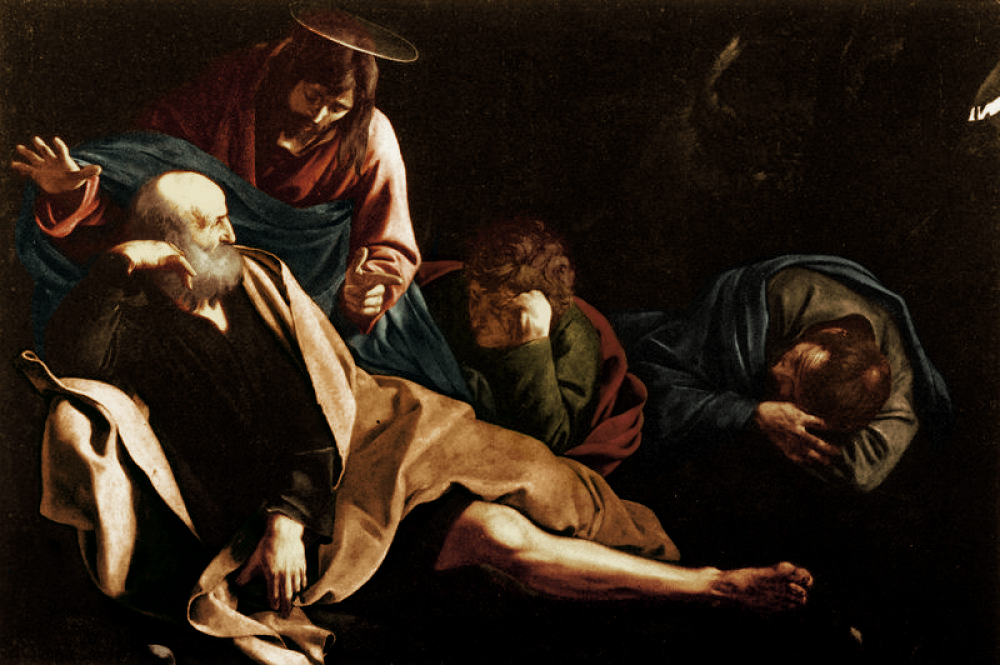
Caravaggio’s “Christ on the Mount of Olives” (1605) condenses one of the New Testament’s most private crises into an intimate knot of bodies and light. In the garden night, Christ bends over the sleeping apostles, his raised hand both a blessing and an urgent call to wake. The entire drama is compressed to the breadth of a few figures huddled at the edge of darkness. There is no distant skyline of Jerusalem, no moonlit marble, only a thicket of shadow out of which a single beam discovers skin, cloth, and the unbearable nearness of the hour. With this painting, Caravaggio turns prayer and exhaustion into a scene of human truth, using light, posture, and touch to make watchfulness and weakness visible.
Historical Context
By 1605 Caravaggio was the dominant force in Roman painting. His success in the Contarelli and Cerasi chapels had made tenebrism—those high-contrast stages of light and dark—the visual language of religious feeling. Patrons asked for sacred narratives that ordinary people could recognize, not idealized spectacles but convincing experiences. The episode of Gethsemane suited Caravaggio’s sensibility perfectly. It is a story of proximity rather than pageantry, of a teacher and friends who cannot stay awake through the heaviest hour of his life. Earlier artists frequently framed the scene with angelic visitations or soldiers approaching with torches; Caravaggio narrows the field to the essential relationship between Christ and the men he loves, locating the whole crisis in the distance between wakefulness and sleep.
The Chosen Moment
The painting fixes the instant when Christ returns from prayer and finds his disciples sleeping. He leans toward them, halo thin as a ring of breath, hand lifted in a gesture that is at once reproof and mercy. Peter, closest to the viewer, has half-roused himself, propping a hand at his neck as if to push away dreams; John sinks forward into his cloak, and the third disciple curls inward with his face in his hands. This is not a scene of betrayal or arrest but of human limits revealed in the presence of love. Caravaggio’s choice of moment allows the painting to breathe in the time between events, the hush before soldiers enter, the pause when decisions are still being made inside the body.
Composition and the Architecture of Night
The figures form a low arc that runs from Christ’s raised hand to the outstretched foot of Peter. The sweep is contained in the lower half of the canvas, leaving a roof of unbroken darkness above them. That weight of shadow is not decorative emptiness; it is the pressure of the night itself, the spiritual weather bearing down on the group. Christ’s body tilts diagonally into the circle of the sleepers, his mantle flaring a cool blue against the earthen browns and greens of the apostles’ cloaks. The group reads like a single breathing organism: waking, drowsing, turning in on itself while the moment of history approaches from beyond the frame.
Chiaroscuro and Light as Appeal
Caravaggio’s light enters from the left like a whispered appeal. It touches the bald crown of Peter’s head, the knuckles of his hand, Christ’s cheek and raised palm, the shoulder blades of John, and the fold of the far apostle’s sleeve. Everything else recedes into a soft dusk that refuses distraction. This is not the hard, judicial light Caravaggio uses in scenes of trial; it is an interior light, the kind that arrives when someone opens a shutter just enough to see the faces of friends. By allotting visibility so sparingly, the painter turns light into moral focus. It falls where attention must fall: the gesture that asks, the bodies that cannot answer.
Christ as Watcher and Companion
The figure of Christ is neither aloof nor overwhelmed. His posture bends toward the sleepers as a companion bends into a circle to speak quietly without waking those further away. The face is gentle and grave, the open palm more invitation than command. Caravaggio avoids the theatrical swoon or the transfigured blaze; he paints a man who has just spent himself in prayer and now spends a little more to try, once again, to draw his friends into vigilance. The halo is an almost-dismissable ring, a modest acknowledgment of sanctity that refuses to overpower human presence.
The Apostles and the Grammar of Exhaustion
Each apostle speaks a different dialect of fatigue. Peter leans back on one elbow, the other hand spread at his neck in the half-conscious gesture of someone shaken from shallow sleep. His bare leg, extended to the right, becomes an unmissable diagonal that locks the body to the earth like a tent stake. John curls in on himself, face buried, shoulders gathering heat beneath his cloak. The third disciple, further right, doubles over with his brow in his forearm, so far gone into sleep that he seems to resist the light itself. Caravaggio does not judge them; he simply observes what bodies do when they can no longer carry wakefulness. The dignity of the picture comes from this patient witnessing.
Gesture as Theology
In Caravaggio’s work, hands preach. Christ’s raised hand delivers the homily of the scene: wake, watch, be with me. Peter’s hand at his neck is the response of a conscience surfacing. John’s hidden face speaks the truth of those who love and fail, while the third disciple’s clasped arms confess the reflex to protect oneself from demands one cannot meet. The gestures do not explain doctrine; they incarnate it. Vigilance and weakness appear not as abstractions but as postures the viewer can feel in his own muscles.
The Garden as Interior Landscape
Most paintings of Gethsemane display trees, rocks, and distant torches. Caravaggio reduces the setting to a suggestion of ground and a canopy of dark air. The garden becomes interior—a room of the soul where prayer searches and sleep answers. By discarding scenic detail, he refuses the safety of distance. The viewer is not outside looking in on a picturesque hillside; the viewer is inside the press of bodies and shadow, close enough to be counted among them.
Color and Emotional Temperature
The palette is subdued but eloquent. Christ’s blue mantle and scarlet tunic hold two poles of feeling—cool composure and fervor—while the apostles wear earth colors that absorb light. The bright flesh of Peter’s foot and forehead catches the beam like exposed facts. The darkness is not black but a layered composite of umber, green, and violet, so deep it reads as airlessness. Within this low register, small notes of cream on hands and faces become significant as words in a whisper. The painting’s temperature is night-warm with a slight chill where the light brushes skin.
The Silence Inside the Scene
Everything here is quiet. Even Christ’s raised hand seems to hush more than to command. Caravaggio achieves that silence by allowing large fields of shadow, by avoiding any object that might clink or gleam, and by compressing the space so that figures seem to share breath. The effect is liturgical, as if the painting had learned the logic of Compline, the last prayer before sleep. That hush is not emptiness; it is expectancy.
Technique and the Persuasion of Paint
The paint handling is economical. Broad shadow masses establish the envelope of darkness; within that, flesh and drapery emerge with thin, translucent layers that preserve the warmth of the ground beneath. Highlights are placed with stinginess where they will matter most: the ridge of a cheekbone, a knuckle, the rim of a bald head catching faint glow. Drapery carries weight through long, quiet strokes broken by a sharp crease only where a fold turns. The brush never shows off; it obeys the tempo of the scene. The result is a surface that breathes like a room at night.
Comparisons with Other Treatments of Gethsemane
Compared with Mantegna’s monumental landscape or Correggio’s angelic consolations, Caravaggio’s version is a chamber piece. Where others place Christ at a distance from the disciples, he brings them into touching range. Where other painters set the scene in a narrative continuum—prayer, wake, arrest—he arrests time between those phases. The choice aligns with his broader transformation of religious art: the sacred event becomes an encounter rather than a tableau, a matter of breath and skin rather than of decor and architecture.
The Psychology of Proximity
Because the disciples lie inches from Christ, the painting reads as an analysis of closeness. Love has gathered them here, but the body pulls away into sleep. Christ’s gesture refuses to turn that failure into exile; he bends back toward them, preserving companionship in the face of disappointment. The proximity implicates the viewer, who stands effectively in the circle, close enough to feel the heat of bodies and the cool of night air. It is an ethical position: you are near enough to be addressed; what will you do with your wakefulness.
Symbolism That Grows From Reality
Caravaggio resists overt emblems, yet meanings sprout from the real. Peter’s extended leg foreshadows the path he will soon stumble down, from bravado to denial; the bare foot reads as vulnerability. The thin halo around Christ’s head is less a badge than a line of concentrated light, as if sanctity were simply the part of a person most available to illumination. The darkness above the group, unbroken and heavy, suggests a cup about to be drunk, not by allegory but by atmosphere. The painting trusts the viewer to find theology in the physics of night.
How to Look
Begin at Christ’s raised hand and let the light carry you down the slope of his arm to the bent head and halo’s faint ring. Slide left to Peter’s lit forehead and the hand pressed at his neck; follow the long diagonal of the leg to the bare foot poised at the painting’s edge. Circle back to the center, where John folds into his cloak, then to the far right, where the third disciple’s face hides in his sleeve. Return to Christ and feel how the arc of bodies turns toward him like a slackened bowstring awaiting tension. A few such circuits slow your breathing to the pace of the scene.
Devotional Meaning and Contemporary Resonance
For seventeenth-century viewers, the image offered a study in discipleship: the discipline to watch, the frailty that fails, the mercy that invites again. It still works that way. Many paintings dramatize heroism; this one dignifies fatigue without excusing it. In an age that burns attention like fuel, the canvas quietly praises vigilance as a work of love—the willingness to stay awake with someone who dreads the coming hour. It suggests that the first form of courage may be presence.
Legacy and Influence
Caravaggio’s chamber-scale Gethsemane helped set a Baroque fashion for scenes of tight proximity and compressed narrative. Painters in Naples and Spain learned from his willingness to let a single beam of light carry moral weight and from his habit of locating drama in bodies rather than in architecture. The emotional grammar here—raised hand, sleeping friend, thick night—echoes across later images of vigils and failures, sacred and secular alike. The legacy is a new permission: to tell large truths with small groups in small rooms.
Conclusion
“Christ on the Mount of Olives” is a painting of attention. Christ attends to his friends; the viewer is asked to attend to them all. Through a few bodies and a disciplined light, Caravaggio transforms a garden into an interior where fatigue and fidelity wrestle. The power of the picture lies in restraint. Nothing explodes; everything waits. In that wait the choice is posed—wake or sleep, accompany or withdraw—and the raised hand, steady and merciful, keeps asking.