Image source: wikiart.org
Introduction
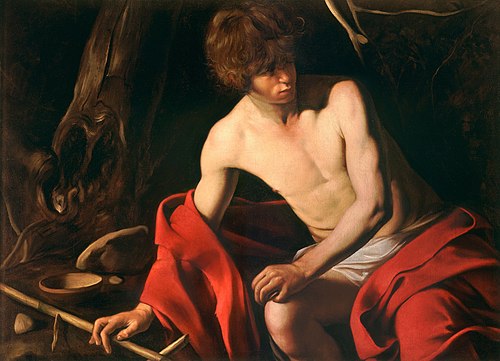
Caravaggio’s “John the Baptist” (1604) is a portrait of vocation held in suspension. A young man sits in the wilderness, half-wrapped in a scarlet mantle, his torso turned by a shaft of light that discloses strength not yet used. His gaze slides off to the right, wary and inward at once, while his hands play along a reed cross that lies across the foreground like a staff waiting for its bearer. Around him the world is spare: a rough bowl, a stone, a gnarled tree, a piece of the animal pelt that will become the prophet’s only garment. In this charged quiet Caravaggio makes the Baptist not an emblem but a person—hesitant, chosen, and thinking his way toward the cry that will split the air.
Historical Context and Subject
Painted during Caravaggio’s Roman maturity, the picture belongs to a sequence of Baptist images he created between 1598 and 1610. His patrons prized the saint as a model of penitence and as the herald who clears a path for transformation. Unlike earlier Renaissance depictions that idealize John as an ascetic icon—gaunt, aloof, haloed with symbols—Caravaggio brings him down to human scale. The body is youthful and real; the wilderness is a tract of rock and timber; the attributes are pared to essentials. The result suits Counter-Reformation desires for direct, affective devotion while demonstrating the artist’s new way of thinking about sacred narrative: theology told through body, light, and gesture rather than through elaborate emblem.
The Chosen Instant
The painting halts at the threshold of decision. John is not baptizing, preaching, or pointing to the Lamb. He is sitting, angled sideways, in an inward turn that holds the energy of a coiled spring. The reed cross lies parallel to the picture plane, just beyond his right hand; the scarlet cloak, associated with martyrdom and prophecy, spills across his lap and onto the ground like an unfinished vestment. Caravaggio delights in this half-state. The saint has not yet stepped into his public role, but the audience can feel the imminence of speech. The moment reads like the breath before the first word.
Composition and the Architecture of Tension
The composition is a study in diagonals that tug against one another. John’s torso twists from left to right, a living spiral that begins in the shadowed shoulder and ends at the wrist near the reed. The cloak throws a powerful counter-diagonal, falling from the left margin to the lower right corner where it pools in folds that seem heavy as stone. The reed cross forms a low, persistent line that keeps the foreground taut, preventing the figure from drifting into reverie. Behind, the knuckled trunk and lean branches scratch at the darkness, echoing the saint’s sinews. Everything—cloth, wood, bone—pulls in different directions, and the eye keeps traveling those lines until the latent action becomes palpable.
Chiaroscuro and Light as Calling
Caravaggio’s tenebrist light is charged with meaning. It pours from an unseen source at the left, brushes across John’s chest and face, and then slips off his back into night. This is not decorative modeling; it behaves like a summons. The shoulder that receives the first touch of brightness is the shoulder that will carry the message. The face it chooses to reveal is vigilant, not serene. Meanwhile the objects that shape the Baptist’s identity—the bowl for water, the fur pelt, the reed—live in half-shadow, as if the vocation itself were waiting to be fully acknowledged. Light here is not only visibility; it is vocation moving through a life.
The Body as Biography
Caravaggio’s bodies always tell their stories. John is no ethereal ascetic. His torso bears the cool sheen of a young man who works outdoors; the muscles are clear but not theatrical; veins gather along the wrist where the right hand flexes. The hip is slightly elevated, making a shelf for the mantle, a practical posture that keeps the chill off. The saint’s hair—tousled, unbarbered curls—casts small shadows across the brow. It is a materially convincing body, and precisely because of that realism the spiritual meaning lands harder. The future prophet is not a symbol; he is one of us, a person who must choose what to do with strength, attention, and time.
Gesture as Grammar
In Caravaggio, hands do the talking. John’s left hand hovers at the cloak’s edge, caught between gathering it around himself and casting it off to stand. His right hand steadies the reed, thumb and forefinger forming a loose ring that could become a grip or give way in release. The angular elbow points into the darkness like an arrow about to fly. The angle of the head—turned away from the viewer, chin slightly tucked—reads as listening. Put together, the gestures announce a mind engaged, not stalled: the boy is measuring what obedience will cost, and the hands show that decision runs through the body before it becomes speech.
The Reed Cross and the Desert’s Vocabulary
The reed cross is a humble thing—light, hollow, easily broken. That fragility is theologically appropriate for a forerunner whose authority will be entirely borrowed. Laid diagonally along the foreground, the reed introduces a low hum of a future instrument—the staff that will be carried, the sign that will later mock a different king, the vertical that will turn into a tree. Nearby sits a simple bowl, the tool of his trade. Stones and thorny branches complete the desert lexicon. Caravaggio requires no inscriptions. The props are real enough to serve daily use and resonant enough to bear symbol.
Color and Emotional Climate
The palette is stripped to essentials: earths, flesh, and one commanding red. The mantle’s scarlet intensifies the painting’s emotional temperature without tipping into spectacle; it warms the cool notes of torso and background and telegraphs a life that will end in confrontation. Flesh tones move through a delicate scale—from waxy half-tones across the abdomen to warmer notes where light pools on shoulder and forearm. The background is a forest of browns and greens so deep they read as black, a breathing darkness against which the illuminated body can announce itself. The climate is dusk in the desert, a time suited to listening.
Space, Proximity, and the Viewer’s Seat
Caravaggio sets his saint close. The ledge and reed zip across the lower edge as if the viewer were seated on the same ground. There is no deep ravine or distant river to dilute the intimacy. This nearness is not merely optical; it is devotional. By placing John within arm’s length, the painter denies spectatorship and solicits self-inspection. The same questions that run through the saint—Who am I? What do I announce? How do I use strength?—find their way to the viewer, not as slogans but as the pressure of a gaze turned aside to think.
Youth, Vulnerability, and Courage
The boy’s age matters. He is no desert elder hardened by decades of solitude. His skin has not yet been cut to leather; the chest is lean but tender. Caravaggio thereby insists that courage begins in vulnerability. The future prophet will speak hard truths, but first he sits with the fear and wonder that accompany a calling. The red mantle protects and exposes at once, its folds both shelter and challenge. Even the reed cross seems matched to a beginner: a staff so light that a breath could bend it, yet long enough to steady a long walk.
Dialogue with Caravaggio’s Other Baptists
Compared with the smiling, sensual youths of some earlier Caravaggio Baptists, the 1604 version is sober. The playfulness has cooled into attention. The later Baptist paintings, especially those from Malta and Naples, deepen that gravity, giving us a darker palette and a more explicit reed cross. In this mid-career canvas we catch the pivot: the moment when the artist’s fascination with youth’s beauty turns toward a fascination with youth’s responsibility. The painting thus charts Caravaggio’s own evolving sense of the sacred, moving from theatrical revelation to interior readiness.
The Wilderness as Interior Space
Most artists treat the Baptist’s desert as a stage set. Caravaggio makes it psychological. The tree’s tortured grain repeats the tense twist of John’s torso. The scattered stones echo the knuckles of clenched fingers. Patches of light perforate the ground with the uncertain geometry of thought. The result is not picturesque; it is accurate to the experience of solitude where a person hears the size of his life. The wilderness becomes a mirror in which the saint sees the shape of his task.
Technique and the Persuasion of Paint
Caravaggio’s paint handling is as spare as his iconography. He blocks the great shadows first, then builds the body with thin, elastic layers that allow warm ground to breathe through cool upper tones. Highlights are placed with stingy precision on clavicle, shoulder rim, and wrist, the places where touch would first report form. Edges sharpen where light bites—a reed’s ridge, the hard crease of the cloak—while elsewhere forms dissolve gently into air. The brush does not show off. Its modesty is the painting’s credibility; the viewer trusts what the eye can almost feel.
Time, Threshold, and the Ethics of Attention
This canvas is a threshold image—one of those rare pictures that describe time’s hinge. Nothing essential has happened, and everything has. The boy sits; the mantle waits; the reed rests; the desert holds its breath. To enter the painting is to practice attention, and that attention becomes an ethic. If the voice that will cry in the wilderness is to be worth hearing, it must be born of disciplined looking—at self, at world, at the quiet where a vocation ripens. Caravaggio, often associated with drama and shock, here demonstrates that suspense can be more exacting than climax.
How to Look
Begin with the shoulder where the light first lands; trace the spiral of the torso to the turned head and catch the way the hair’s shadows veil the eyes. Drop to the right hand poised above the reed cross and feel the tremor between decision and delay. Follow the reed’s line across the foreground until it meets the cloak, then ride the scarlet fold up and back to the saint’s left hand that toys with its edge. Let your gaze drift into the bark’s knots and the small dish’s humble ellipse; return finally to the face and register how the surrounding darkness makes the skin feel warmer. Repeat this circuit until the painting’s silence begins to speak.
Meaning for Devotion and Today
For early seventeenth-century viewers, the Baptist embodied conversion, truth-telling, and the necessity of preparation. Caravaggio’s rendering preserves those meanings but routes them through the experience of a young person weighing a summons. In this the painting remains strikingly contemporary. Anyone standing on the cusp of choice can recognize the posture, the guarded eyes, the hands learning the weight of a tool. The image does not flatter or scold; it invites. It suggests that the way to truth is through attention to the body’s knowledge—how shoulders tense, how breaths shorten, how hands hover when the next step is hard.
Conclusion
“John the Baptist” (1604) is Caravaggio’s hymn to readiness. It compresses symbol into objects you could lift and names vocation with beams of light that feel like touch. The saint is not a marble exemplar but a living adolescent in a hard place, half-clothed, half-decided, wholly absorbing the task ahead. By withholding spectacle, the painting heightens interior drama; by bringing the figure near, it recruits the viewer into the same brink. Four centuries later, the canvas still does what the Baptist himself did: it asks us to clear a way—through noise, fear, and delay—for the word we are meant to speak.