Image source: wikiart.org
Introduction
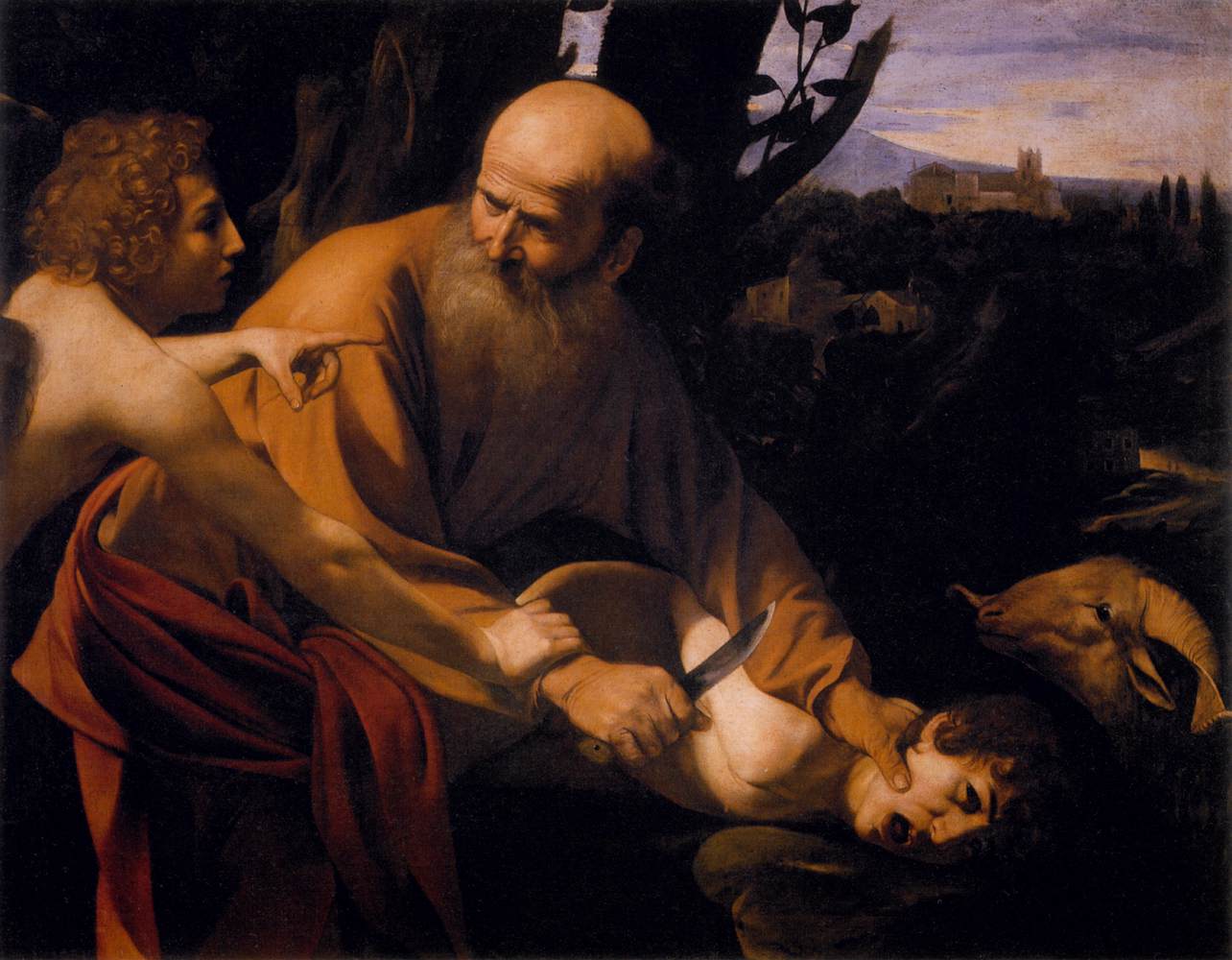
Caravaggio’s “Sacrifice of Isaac” (1602) captures a biblical story at the instant it turns from terror to mercy. In a cramped pocket of darkness, Abraham’s knife glints inches from his son’s throat when an angel seizes the patriarch’s wrist and points to a ram caught in a thicket. Isaac’s body arches with panic, his mouth open in a cry the viewer can almost hear. The drama is not spread across a distant hillside; it happens at arm’s length, where every muscle and breath counts. With this painting, Caravaggio distills the episode to its decisive second, letting light and touch do the theological work that inscriptions and symbols once carried.
Historical Context
By 1602 Caravaggio had reshaped Roman painting with a new visual language: shallow stages, ordinary models, and tenebrist light that behaves like a narrator. The “Sacrifice of Isaac” belongs to this mature phase and likely engaged the cultivated taste of Cardinal Maffeo Barberini (the future Pope Urban VIII), who owned one version of the subject. Whether painted for Barberini or another patron within his circle, the canvas demonstrates how Caravaggio integrated Counter-Reformation clarity with radical naturalism. Instead of presenting a generalized “lesson,” he makes faith legible through an event that looks as if it unfolded in the same room as the viewer.
Subject and Narrative Instant
Genesis tells how Abraham obeyed a divine command to sacrifice his son Isaac, only to be stopped by an angel who provided a ram in his place. Caravaggio chooses the hinge when obedience collides with reprieve. Abraham’s left hand grips Isaac’s jaw, forcing back the head; his right fist, tendons bristling, holds a knife that has already nicked the boy’s skin. The angel lunges in from the left, catching Abraham’s wrist with a human urgency that contradicts the stereotype of ethereal messengers. With the other hand the angel points toward the ram, the substitute that transforms the scene from slaughter to covenant. The boy’s body anchors the composition, bridging terror and salvation.
Composition and the Engine of Diagonals
The drama is built from intersecting diagonals that bind the three central figures. Abraham’s torso forms a broad downward arc from upper left to lower right; the angel’s outstretched arm slices across it, redirecting force. Isaac’s contorted body creates a counter-diagonal that drives the eye back to the knife. These vector lines meet at the patriarch’s wrist—the physical pivot of the story. Caravaggio compresses the stage until the figures fill the frame, eliminating any extraneous space that might dissipate the pressure. A fourth presence, the ram, occupies the right edge, its head emerging from shadow like a living punctuation mark to the angel’s gesture. In the far distance, a small landscape with buildings and a pale sky expands the scene just enough to register that this gripping moment belongs to a wider world.
Chiaroscuro and Light as Command
Light falls in a concentrated beam from the upper left, carving Abraham’s bald head, beard, and forearm, glazing the knife’s blade, and catching Isaac’s bare torso where fear tightens the skin. Darkness swallows the background and most of the angel’s body, heightening the sense that the messenger is a burst of illumination rather than a resident of the scene. Caravaggio’s tenebrism functions like speech: it names the essential actors and events while silencing distractions. The ram’s muzzle and horn catch just enough light to become intelligible, which is precisely how providence often appears in the narrative—clear, but not ostentatious.
Abraham’s Body and the Ethics of Obedience
Abraham is no marble patriarch. Caravaggio paints an old man with work-thickened hands, a shoulder sunk with age, and a beard that records years of dust and sun. This honesty intensifies the ethical drama. The decision to obey is not enacted by an idea but by a body. Notice how the left hand clamps Isaac’s chin in a grip that is both parental and terrible; the thumb digs into flesh, the fingers press the jawline. The right hand, arrested mid-arc, still owns the knife. Abraham’s eyes, however, have already shifted to the angel. The moment we witness is the instant of transfer: intention will become restraint; blade will lower; obedience will be reinterpreted as trust. Caravaggio captures the paradox without sermon—this is fidelity that yields when the same voice that commanded now forbids.
Isaac’s Terror and the Reality of Vulnerability
Isaac is the painting’s raw nerve. His body twists away from the blade, ribs surfacing under taut skin, mouth open in a cry stifled by the choke-hold on his neck. The boy’s features are individualized rather than idealized; he is not a symbol of youth but a specific adolescent whose fear imagines the worst. Caravaggio does not hide the violence that was about to be done, yet he refuses spectacle. A faint cut along the neck proves how close the act has come, but blood is minimal. The image is not about gore; it is about the brink. Isaac’s visible breath—his throat stretched, lips parted—becomes the measure of mercy when the hand relaxes and the knife lowers.
The Angel’s Intervention and the Grammar of Gesture
Caravaggio’s angel is pure gesture made flesh. The figure lunges in from the dark, one hand seizing Abraham’s wrist with almost painful pressure, the other pointing past the patriarch’s shoulder to the ram. The movement is urgent but not chaotic; the drapery swirls with a kinetic logic that makes the plunge believable. Importantly, the angel and Abraham are close enough that their forearms interlock, a detail that makes divine intervention read as intimate rather than theatrical. The angel’s face, softly illuminated, is calm and persuasive—the countenance of a messenger who redirects action not by force alone but by reasoned indication: “Look—there.”
The Ram and the Theology of Substitution
At the right edge, the ram’s head enters the pool of light as if summoned. Caravaggio renders the animal with the same care he gives human skin: a moist eye, velvety muzzle, horn curving forward. Its presence clarifies the story’s theological axis—substitution. The ram’s body, still mostly in shadow, suggests potentiality rather than spectacle; it is enough to change the future without stealing the scene. The angel’s finger knits the creature to the narrative logic, offering Abraham a path of obedience that does not require bloodshed. In a single glance, the viewer experiences both catastrophe averted and covenant confirmed.
Fabric, Flesh, and the Credibility of Matter
Material truth is the painter’s most persuasive tool. The heavy, rust-colored wrap around Abraham is modeled with long ramps of shade that break into knife-edged highlights at folds; it feels thick enough to weigh down movement. Isaac’s skin shines where stretched, matte where pressed by the patriarch’s grip. The angel’s drapery sweeps across his torso in soft ribbons of light that communicate velocity without fuss. The knife’s metal catches a single glint and vanishes into shadow along its back, a flash that reads as sharpness rather than decoration. These tactile cues build credibility; the viewer believes the near-accident because paint behaves like flesh, cloth, horn, and steel.
Landscape, Space, and the Breath of the World
Unlike many of Caravaggio’s tightly boxed interiors, this painting opens a window to a landscape on the far right—dusky hills, clustered buildings, a cool evening sky. The distant view, small but insistent, places the event within a living geography. The world goes on while this drama unfolds; people in those houses do not know that a family’s story—and by extension a people’s—has just been redirected. The juxtaposition of claustrophobic foreground and airy distance generates the emotional rhythm of the piece: pressure, then release; a clenched second, then a horizon.
Color and Emotional Temperature
Caravaggio limits his palette to warm earths, human flesh, and nocturnal blues. Abraham’s robe supplies the dominant rust, echoing the color of soil and sacrifice; Isaac’s skin glows in a honeyed range that reads as warmth under threat; the angel introduces higher key flesh tones and a flicker of red cloth that ties him chromatically to Abraham while signaling difference. The landscape’s violet dusk cools the overall climate, marking the scene’s threshold quality: the day is closing, a chapter is ending, and a promise is beginning.
Comparisons with Caravaggio’s Earlier Treatment
Caravaggio painted the subject more than once. In the earlier version (c. 1598) the angel almost wrestles Abraham, and the figures crowd the frame even more aggressively. The 1602 canvas refines the narrative by clarifying the angel’s pointing gesture and by articulating the ram more clearly. The later work also introduces the distant landscape, a small but telling expansion that allows the viewer to sense the story’s historical and theological reach. The evolution shows Caravaggio moving from sheer shock toward a more articulated argument—intervention, substitution, and future.
Psychology, Faith, and the Ethics of Looking
The painting dignifies Abraham’s obedience while refusing to sentimentalize it. We do not see a saint immobilized by trance but a man who can be stopped, redirected, and taught. Isaac is not reduced to an emblematic lamb; he is a son whose terror matters. The angel is not vapor; he is a body that grabs. This realism commits the viewer to an ethics of looking. Caravaggio will not let us consume the scene as comfortable allegory. We must feel the pressure of the hand on the boy’s throat and the weight lifting from it. In doing so, we become witnesses of a mercy that respects the cost of the moment it cancels.
Technique and Paint Handling
Caravaggio’s method in this canvas is disciplined and economical. He blocks large tonal areas—Abraham’s robe, Isaac’s torso, the black ground—then articulates edges surgically where light breaks across volume: the knife’s bevel, the thumb’s knuckle, the tendon straining at the wrist. Flesh is layered thinly so that warmth seems to breathe under cooler hits of highlight; drapery is handled more opaquely, then glazed to enrich shadows. The landscape is abbreviated but convincing, a quiet counter texture to the intense foreground. Nowhere do we feel virtuosity for its own sake. Brushwork submits to legibility—what must be seen is seen; what is not essential melts into tenebrae.
Symbolic Undertones Without Emblems
Caravaggio avoids overt iconography—no scrolls, no inscriptions, no heavenly rays inscribed with words. Yet the painting hums with symbolic undertones. The knife’s slight blood smear confirms how close death came; the ram’s horn, a future shofar, anticipates a people’s memory of deliverance; the angel’s pointing finger echoes the hand that calls Matthew in the Contarelli Chapel, linking vocation to restraint. Even the landscape—a settlement on a ridge—quietly forecasts a nation that will live because this boy lives. Symbolism here is not pasted on; it grows from action.
The Viewer’s Position and Complicity
Caravaggio places us dangerously close—near enough to hear Isaac’s breath and to see the angel’s fingers dent Abraham’s skin. The knife points toward our space, as if to remind us that the story’s violence implicates everyone who sees it. The composition thereby transforms spectators into participants. We are not looking at a solved puzzle; we are present at a moment when decision changes meaning. The moral pressure we feel is the painting’s real subject: how humans respond when a command is revised and a life is spared.
How to Look
Begin at Abraham’s right hand and feel the torque in the wrist where the angel grips. Follow the knife to Isaac’s throat, then let your gaze leap to the boy’s eyes and open mouth. Ride the angel’s pointing arm across the canvas to the ram’s head, then drift outward to the cool strip of landscape where a pale sky assures us that time continues. Return to the knot of hands. On each circuit the image tightens and releases like breath, teaching the story’s rhythm—obedience, interruption, substitution, promise.
Conclusion
In “Sacrifice of Isaac,” Caravaggio compresses one of scripture’s most troubling episodes into a scene we trust because it looks and feels true. Flesh resists, cloth weighs down, steel glints, and a hand intervenes. The painting does not preach; it stages a change: a father’s will is interrupted, a son’s life is returned, and a future opens. The angel’s finger, the ram’s patient head, the slight cut on the boy’s neck, the old man’s turned gaze—each element works like a clause in a sentence whose final word is mercy. Four centuries on, the canvas remains unsettling because it understands that salvation is more gripping when we feel the cost of what did not happen.