Image source: wikiart.org
Introduction
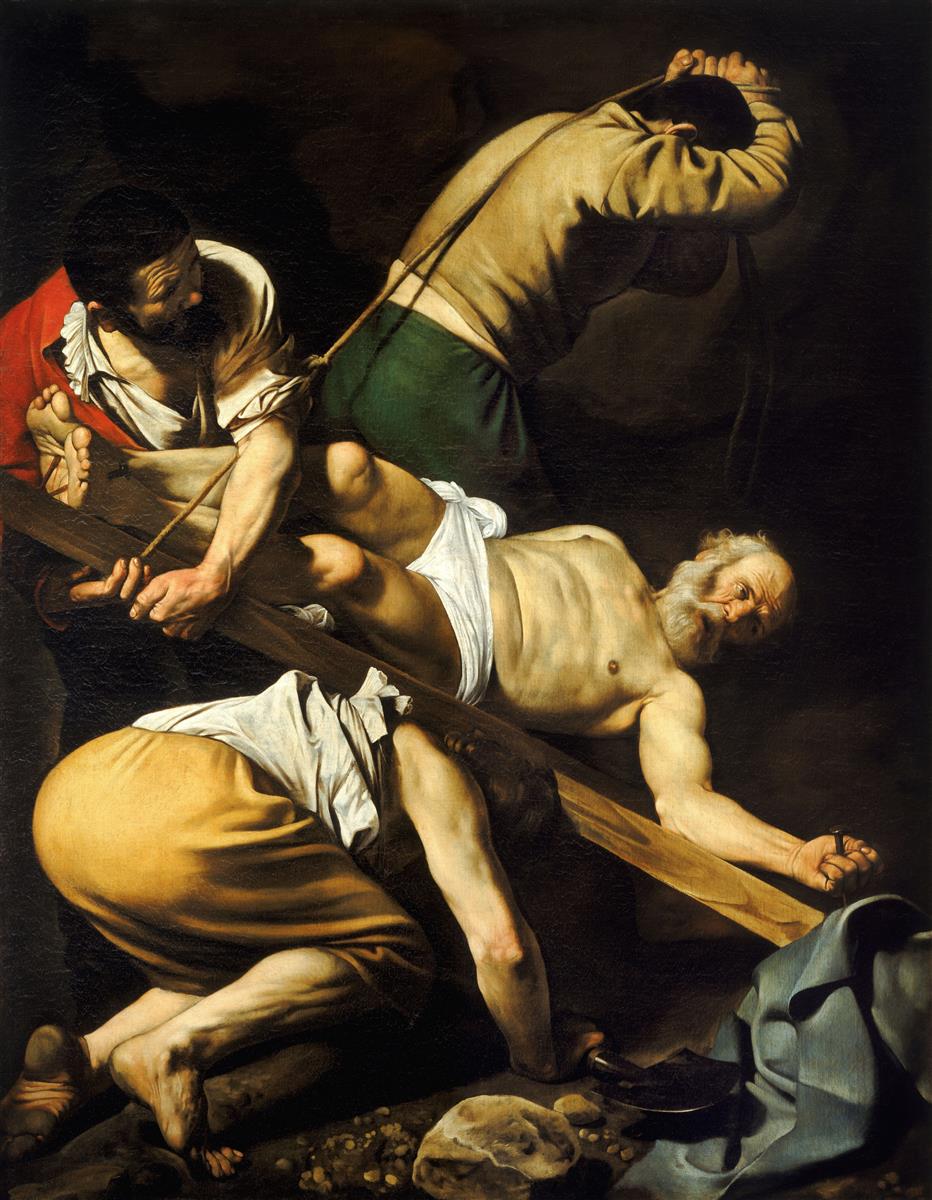
Caravaggio’s “Crucifixion of Saint Peter,” completed in 1601 for the Cerasi Chapel of Santa Maria del Popolo, is a painting that exchanges spectacle for weight. Instead of a crowded hill and a sky torn by omens, the scene offers three laborers struggling to hoist a rough-hewn cross while an old man fixes his gaze out of the frame. The apostle’s body is not yet vertical; it drags the cross toward the bottom corner like an anchor. Raking light catches knotted rope, splinters, calloused hands, and the pebbled ground. The drama is muscular and stubbornly physical, as if the world must be convinced inch by inch to accept what is happening. Caravaggio refuses every decorative instinct, allowing the work of martyrdom—the lifting, hauling, and fixing—to carry both narrative and meaning.
Historical Context
The Cerasi Chapel commission paired this painting with “Conversion on the Way to Damascus,” presenting the birth of Paul’s mission opposite the seal of Peter’s witness. Rome at the turn of the seventeenth century demanded sacred pictures that were immediate and intelligible. Caravaggio’s solution was to bring the gospel down to the floorboards: no ethereal platforms, no glazed allegories, but bodies in a shallow, dark space, lit as if by a window just out of sight. The Crucifixion of Peter embodies that program with almost programmatic clarity. Where earlier artists placed the apostle before a teeming audience, Caravaggio stages a private execution with anonymous workers whose backs are turned to us. The choice is theological as well as aesthetic. It insists that sainthood passes through ordinary labor and that redemption is enacted with the tools of a worksite—rope, shovel, timber, and human strength.
Subject and Narrative Focus
According to tradition, Peter asked to be crucified upside down, unwilling to die in the same posture as Christ. Caravaggio paints the moment when that inverted cross is being raised. The story’s moral force comes not from spectacle but from process, and the painter isolates the process with relentless honesty. One man crouches at the base and heaves the beam on his back. A second, perched on the opposite side, hauls at a rope looped around the wood. A third braces his legs and shoulders while gripping a corner of the cross. Their effort is palpable in the twist of torsos and the spread of feet. Peter’s body lies at a diagonal, head low, ankles bound, one hand clenched around a nail, the other already pinned. He is not yet a tableau; he is a body about to become a sign.
Composition and the Architecture of Weight
The composition is built on crossing diagonals that pivot on the crossbeam near Peter’s hip. The massive timber runs from the lower right to the upper left, locking the picture into a single vector of effort. The laborers form a counter-triangle that pushes against that vector: one kneeling, one standing bent, one high with arms over his head. This triangular engine gives the painting kinetic tension; every figure seems to lean into the same invisible resistance, the planet’s own refusal to yield. Caravaggio keeps the space shallow and the background nearly void, a dark cavern that absorbs all but the event. The eye has no place to wander; it must follow the beam and feel its drag. Stones and scraps at the bottom edge reinforce the sense that we stand on ground with the workers, close enough to hear breath and scrape.
Chiaroscuro and the Ethics of Illumination
Light enters from the left like a judicial sentence. It strikes the men’s forearms, the rope’s fiber, the cross’s splintered edge, and Peter’s aged torso. It does not gild or flatter; it clarifies. Tenebrism here is moral rather than theatrical. Darkness swallows identity, leaving the executioners faceless instruments; light reveals the dignity of work even when work serves brutality; light also grants Peter’s flesh an almost marble authority without turning him into a statue. The illumination spares no texture. The cloth twisted around a laborer’s waist gleams where sweat has polished it; the rope casts a thin, credible shadow across the plank; the apostle’s hair and beard catch granules of brightness that read like dust in the air.
The Body of Peter
Peter’s body is the painting’s emotional core, rendered with Caravaggio’s unsentimental compassion. Age reads in the looseness of skin over ribs, the soft pouch of the belly, the grain in the forearm, the dimming strength in the fingers. His face is alert, neither serene nor panicked. The eyes turn outward and slightly upward, not to a painted heaven but toward an unseen horizon, perhaps the chapel’s space itself. He is present to the work being done to him. The left hand already receives the nail; the right hand holds another nail like a small, stoic admission that the process will end as intended. The loincloth is modest and practical, a twist of cloth like the workers’ belts, emphasizing his continuity with the world even as he departs it. In all this, Caravaggio honors the paradox of martyrdom: a public witness made through a very private suffering of muscles and breath.
The Workers as Necessary Agents
Caravaggio refuses to demonize the executioners. They are not sneering villains; they are laborers doing a difficult job. We see dirty heels, rolled sleeves, patched trousers, a rope biting the shoulder, and a brow bent under effort. Their anonymity is crucial. By refusing to individualize them, the picture comments on the machinery of sanctioned violence: history often records names of saints and tyrants, but erases the hands that make events happen. In this erasure, Caravaggio also finds universality. The workers could be any of us under a particular command, our bodies lending strength to purposes we do not choose. Their presence deepens Peter’s act; his forgiveness and witness are offered to the very men who hoist him.
Tools, Ground, and the Tactility of Fact
Few paintings make matter so persuasive. The wood looks heavy and unplaned, its edges rough with fresh cuts, its surface absorbing light like thirsty grain. The rope is not a painted line; it is a twist of fibers that throw tiny shadows. The shovel and the spade in the lower right corner catch a dull metal shine, as if laid aside for a moment before the final digging. Stones and soil under the men’s toes are rendered with small, varied marks that give the ground a believable irregularity. Caravaggio’s material exactness keeps the picture unarguable. One cannot sentimentalize what is happening when the world itself—wood, earth, rope—behaves so truthfully.
Gesture and the Psychology of Resolve
The picture’s gestures compose a litany of resolve. One worker winds his rope around the beam and plants his foot, a decision made in ankles and calves. Another compresses his entire torso into a single thrust. The kneeling man is almost archaeological, his back a rounded mound under the cross, his hands serving as wedges. Peter’s gestures oppose theirs by refusing struggle. The turn of the head and the open mouth suggest breath gathered for prayer or address; the free hand gripping the nail is both cooperation and acknowledgment. These gestures build psychological weather: effort meets consent, and meaning rises.
Theological Resonances Without Emblems
There are no angels, no inscriptions, no visionary architecture. Yet the painting murmurs theology through action and placement. The inverted cross, still horizontal, is a line that will overturn the world’s measure of honor and shame. The upward push of anonymous backs states a mystery of vocation: people who do not know they are lifting a saint nevertheless participate in history’s hinge. The raking light entering from outside the frame hints at a source not drawn because it is better inferred—providence that does not interrupt physics, grace that respects weight. The voided background refuses worldly spectacle, aligning the scene with the stripped austerity of the chapel’s other canvas.
Dialogue with “Conversion on the Way to Damascus”
Across the chapel, Caravaggio places the fallen Saul under a quiet horse and a steady groom. There the drama is interior, a life turned by a voice. Here the drama is exterior, a life offered in a craft of violence. The two pictures answer one another across the nave: open hands receiving a call, open hands yielding to nails; a worker holding a bridle so a man can hear, workers hauling a cross so a man can witness. The shared tenebrism and shallow stage bind them into one meditation on beginnings and endings, both happening in the company of ordinary labor.
Color and the Emotional Temperature
The palette is disciplined: earthy browns, muted greens, ochres, and the chalk white of Peter’s aging skin. A single splash of saturated hue—the red lining at the shoulder of the leftmost worker—acts like a small alarm within the otherwise quiet range. Caravaggio avoids rhetorical reds and blues that would associate the scene with courtly or celestial registers. The colors feel like workshop pigments, chosen to keep the mood close to earth. This restraint intensifies the effect of light; where brightness falls, it seems earned rather than theatrical.
Technique and Paint Handling
Caravaggio constructs the forms with broad tonal masses and then articulates edges where light breaks across volume. Flesh is laid thinly so warmth rises from underlayers; cloth is more opaque, then glazed to deepen folds. The rope is achieved with swift, confident strokes that twist and catch highlights; the cross is built with diagonal planes that repeat the beam’s direction. The pebbled ground is a scatter of dabs and scrapes, perceptually correct without fussy description. Brushwork remains subordinate to legibility. The surface breathes, but the viewer never feels invited to admire virtuosity for its own sake.
Space, Silence, and Proximity
The dark background creates a vacuum in which sound is imagined but not heard—the scrape of wood, the grunt of effort, the rasp of rope. Because the stage is shallow, the bodies push into our air. We share the space with the men and the cross, so the painting can recruit our muscles in imagination. That proximity has ethical force. We are close enough to bend and help, close enough to protest, close enough to witness. Caravaggio positions the viewer not as spectator but as neighbor.
Peter’s Gaze and the Viewer’s Conscience
Peter’s eyes do essential work. He does not look at the executioners; he looks out of the frame toward the right, into the chapel space where congregants once stood and where present viewers now stand. The gaze is searching rather than reproachful. It functions as address: you are here, he seems to say; what will you make of this? The device collapses centuries and makes the painting less a record than an event renewed whenever a viewer steps into the beam.
The Cross as Engine and Sign
The timber’s sheer physicality is the most audacious element. It is not an emblem inscribed with words; it is a tool being handled. At one moment it is lever and ladder, at the next it becomes the instrument of death and, finally, the sign of Peter’s chosen imitation. Caravaggio’s insistence on the cross’s mass underscores a theology of incarnation: meaning rides into the world on objects that obey gravity. The men cannot lift symbol; they can only lift wood. Once lifted, the symbol will lift them.
Reception and Afterlife
From its unveiling, the painting was noted for its raw realism and its refusal of ornament. Some viewers found the scene too low, the workers too coarse, the space too bare. Yet the canvas quickly became a touchstone for artists seeking a new seriousness in sacred art. Baroque painters learned from its diagonal engine, its control of light, and its respect for manual labor as subject. Modern audiences continue to find in it a credible sanctity, not in halos but in calluses, not in clouds but in the human back under weight.
How to Look
Enter at the kneeling figure whose broad back carries the beam and feel the load transmit through spine and thighs. Follow the cross toward Peter’s body, pausing at the nail gripped in his right hand and the other hand already fixed. Climb up the rope to the man hauling with arms over his head, then drop along the line of his forearms to the worker bracing at left. Return to Peter’s face and let the gaze draw you outward into the room. Repeat this circuit until the diagram of force and consent sinks in: labor pushing up, witness opening out.
Conclusion
“Crucifixion of Saint Peter” is Caravaggio’s plainspoken masterpiece of martyrdom. The painting replaces pageantry with process, allegory with rope, and rhetoric with weight. In the struggle to raise a rough cross, in the old man’s steady gaze, and in the beam of light that renders everything undeniably present, the canvas articulates a theology of action: holiness is not a glow but a choice carried through the body to its end. Across from Paul’s beginning, Peter’s end becomes the chapel’s anchor. The viewer is left not with a memory of spectacle but with a sense of having stood near work that mattered, and with the lingering pressure of the apostle’s eyes asking what kind of strength we are willing to lend to the truth.