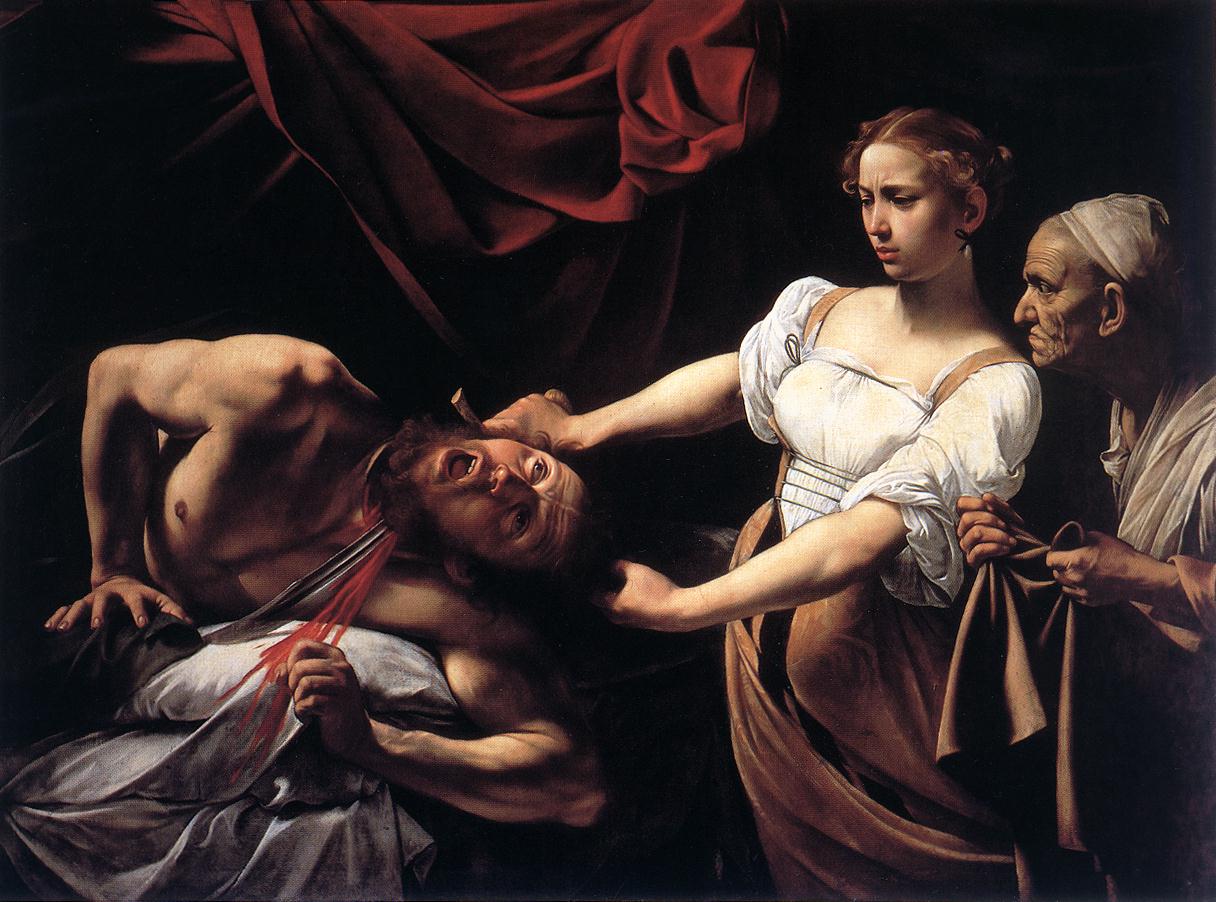
Image source: wikiart.org
Introduction
Caravaggio’s “Judith Beheading Holofernes,” painted in 1599, arrests the viewer at the most volatile second in the Book of Judith. The Assyrian general has been drugged and lured to bed; now, in a slice of brutal daylight, Judith seizes his hair and drives a sword through his neck while her attendant Abra stands ready with a sack. Caravaggio does not show aftermath; he shows impact—sinew tightening, blood jetting in an arterial arc, jaws thrown open mid-cry. The painting compresses seduction, courage, and violence into a single stage of light against deep shadow, making the story feel contemporaneous rather than remote. With astonishing economy—three figures, a red curtain, a bed—the painter builds one of the early Baroque’s most unforgettable images of decision carried out by the body.
Historical Context
In the closing years of the sixteenth century, Rome demanded sacred art that was immediate, legible, and morally urgent. Caravaggio responded by rejecting mannerist fantasy in favor of observed reality: common faces, directional light, and shallow spaces that thrust figures into the viewer’s air. “Judith Beheading Holofernes” belongs to his early Roman breakthrough, when he redefined religious narrative by choosing the decisive instant—neither preparation nor consequence, but the moment when choice becomes action. The subject itself was popular in Counter-Reformation Italy, where a virtuous heroine saving her people resonated with contemporary Catholic self-understanding. Caravaggio takes the theme out of allegory and into flesh, crafting a picture that reads as both biblical drama and psychological document.
Subject and Narrative Instant
Judith, a widow from Bethulia, infiltrates the enemy camp, charms Holofernes, and beheads him in his tent. Caravaggio isolates the split second when the sword bites and the general’s body realizes its fate. Judith’s left hand grips a twisting fist of hair; her right arm extends in a measured, almost fencing thrust. Holofernes slams backward, torso torqued, eyes bulging toward the source of pain; one hand claws the sheet, the other flares open as if to brace against a catastrophe that is already inside him. Abra leans in with fierce concentration, her bag held open like a ritual vessel. The scene is so present that the viewer can feel the air displaced by the sudden movement and the weight of the bed under the convulsion.
Composition and the Architecture of Violence
The composition is a triangle that locks the figures into a tense geometry. Holofernes’s body forms the base: a muscular diagonal that launches from the lower left toward the center. Judith and Abra, aligned along the right edge, create the triangle’s vertical side, their bodies near-parallel but differentiated by age, costume, and role. The sword establishes the dominant vector, a gleaming bar that points from Judith’s hilt-hand through Holofernes’s neck to the viewer. The writhing sheet functions like a second wave of motion, its fold echoing the blood’s arc. Above, a red canopy whips across the darkness like a theatrical curtain yanked mid-performance, reinforcing that what we witness is revelation. Caravaggio pushes the stage forward; there is almost no depth beyond the figures, making the bed a raft of reality in a sea of black.
Chiaroscuro and the Allocation of Meaning
Light enters from the left and cleaves the nocturnal scene into hard truths. It chisels Holofernes’s torso and forehead, carves Judith’s face and forearms, and gives Abra’s profile a stony resolve. Everything outside this cone of visibility recedes into tenebrae. Caravaggio’s chiaroscuro is not decorative; it assigns importance. The brightest surfaces are sites of decision—the blade’s path, the hands that grip, the muscles that resist. The red canopy absorbs light in its folds like congealed passion. Darkness swallows the tent’s depths, ensuring that the eye cannot escape into scenic distraction. The light is surgical, a moral spotlight that makes the act undeniable.
Judith’s Psychology
Judith’s expression has startled viewers for centuries: focused, cool, even slightly detached. Caravaggio refuses melodrama. She does not grimace; she concentrates. Her brow gathers, her lips compress, and her body aligns around the task. The face belongs to a woman who has calculated what must be done and is now doing it without rehearsal. Her costume—a clean white chemise under a fitted bodice—sharpens the sense of moral clarity; the whiteness takes and returns light, turning her into the picture’s most coherent form. She is not seductress-as-siren here; she is an agent whose beauty has been weaponized prior to the act and whose will is weaponized within it.
Holofernes’s Body as Ethical Engine
Caravaggio renders the general with pitiless accuracy: sinewed forearms, heaving chest, slackening grip, and a face that registers shock turning to comprehension. Blood spurts in a graphic ribbon, not as ornamental gore but as anatomy: a pressure line that confirms the sword’s edge has found its groove. The head thunks backward into the pillow as the torso arches, creating a C-shaped recoil. Even the left hand’s splayed fingers tell the story of a man reaching for balance in a bed that has betrayed him. The painting does not diminish Holofernes into a cartoon villain; it grants him a terrifying humanity, which in turn magnifies Judith’s steadiness.
Abra’s Necessary Presence
Abra, the aging servant, is more than accessory. Her compact frame and tight grip on the sack supply the practical backbone of the operation. She leans in with experienced calm—alert, unflinching, and unglamorous. The lines carving her face are a counterpoint to Judith’s youth; together they form a spectrum of feminine agency: cunning, strength, and the domestic knowledge of how to finish what has begun. Abra’s presence also shifts the scene from solitary heroics to coordinated action, making the victory communal rather than individual.
Fabrics, Props, and Caravaggio’s Material Truth
The bed’s rumpled linen, the heavy curtain, the rough cloth of Abra’s sack—Caravaggio paints each with tactile justice. The sheet bunches under Holofernes’s clutch like dough, saturated with light along ridges and slipping into shadow within troughs. Judith’s sleeves puff and fold realistically around the elbow’s pressure. The sword’s broad blade gleams with a cold, matte edge rather than showy sparkle; it is a working instrument, not a theatrical prop. Such material exactness anchors the miracle in a recognizable world: wood, cloth, steel, and skin obey the same physics under sacred pressure.
Blood, Restraint, and the Ethics of Looking
Caravaggio is uncompromising about what happens to a body when it is cut, but he refuses sensationalism. The blood jets, stains the sheet, and stops. He does not paint fountains or splatter for effect. Instead, he gives the viewer just enough to acknowledge the cost without luxuriating in it. The restraint allows the painting to function as moral drama rather than spectacle. We are compelled to look long enough to understand, not long enough to gape.
Gender, Power, and the Inversion of Force
“Judith Beheading Holofernes” performs an inversion of the usual gendered script of early modern violence. The armored male body is made defenseless by sleep and wine; the unarmored female body exercises decisive force through planning, proximity, and nerve. Caravaggio’s realism refuses to eroticize the moment; Judith’s beauty is present, but purpose erases seduction. The painting thus reads as an exploration of how power actually works: not as size or ornament, but as will, timing, and moral clarity.
Stagecraft and the Viewer’s Proximity
Caravaggio’s shallow stage places the viewer at bedside. The sword and spurt angle toward us; the red curtain seems to whip in our air. This proximity produces complicity. We cannot imagine ourselves distant judges; we share the tent’s oxygen and the shockwave. The bed thrusts forward like a platform; there is no escape route for the eye. In this way, Caravaggio transforms a biblical anecdote into a present tense that presses against our own sense of danger and deliverance.
Comparisons and the Evolution of the Theme
Artists before Caravaggio often set the beheading in a broad, decorative space, making Judith a pageant heroine. Caravaggio compresses and darkens, emphasizing psychology over ceremony. His solution influenced later painters who adopted tenebrist staging and brutal immediacy. Within his own oeuvre, the picture aligns with other decisive-instant works—“Sacrifice of Isaac,” “David and Goliath”—in which a blade and a body define a moral frontier. The difference here is the dual agency of women and the cool concentration that replaces ecstatic zeal.
Technique and Paint Handling
The surface reveals the painter’s economy. Flesh is built with thin, translucent passages that let warmth breathe under cool hits of highlight at brow, shoulder, and knuckle. Fabrics are laid in with opaque body color, then enriched with selective glazing to deepen folds. Edges sharpen where light meets form—the sword’s rim, Judith’s fingers, the glistening blood—while other edges soften into penumbra, allowing volume to turn without drawing attention to brushwork. Small accents—a catchlight in an eye, a bright seam on a sleeve—are placed with precision like notes in a score. The total effect is inevitability; the painting looks as if it had to be painted this way.
Symbolic Undertones Without Didacticism
Though grounded in realism, the picture hums with symbolic undertones. Judith’s white chemise reads as virtue inhabiting flesh; the red canopy murmurs of violence and providence; the sack suggests the sober logistics of victory. Yet Caravaggio will not allow allegory to outshout fact. He trusts the viewer to infer meanings from events rather than from emblems. The moral is embodied: salvation arrives through courage enacted at arm’s length.
Reception and Enduring Power
From the seventeenth century onward, viewers have responded to the picture’s shock of honesty. Some admired Judith’s heroism, others recoiled at the explicitness of the act. Modern audiences often read the work through lenses of gender and justice, seeing in it a prototype of resistance—beauty turned to power against predation. Whatever the interpretation, the painting remains inexhaustible because it unites craft and truth: the light is irresistible, the bodies credible, the moment unrepeatable.
How to Look
Begin with Judith’s face, calm under pressure. Follow the sword to the bright wedge of Holofernes’s neck, then to the blood’s precise arc. Track his backward lunge along the bed and feel how the sheet’s folds echo the spray’s curve. Move to Abra’s hands and bag, recognizing the partnership that steadies the act. Rise to the red canopy and sense the stagecraft that frames revelation. Return to the intersection of hands—Judith’s grip on hair, Holofernes’s claw in linen—and let the triangle of will, flesh, and fabric teach you how this picture speaks.
Conclusion
“Judith Beheading Holofernes” is Caravaggio’s manifesto on action. It shows how a moral decision inhabits muscle and light, how courage can be quiet in the face, exact in the wrist, and devastating in result. By collapsing space, rationing color, and treating objects with tactile truth, he moves the story from legend to present tense. Judith and Abra do what has to be done; Holofernes, in a single terrible instant, understands that charm has turned to weapon. The viewer, caught in the cone of light, learns that salvation sometimes arrives with a blade and that painting, when told the truth, can make that fact bearable and unforgettable at once.