Image source: wikiart.org
Introduction
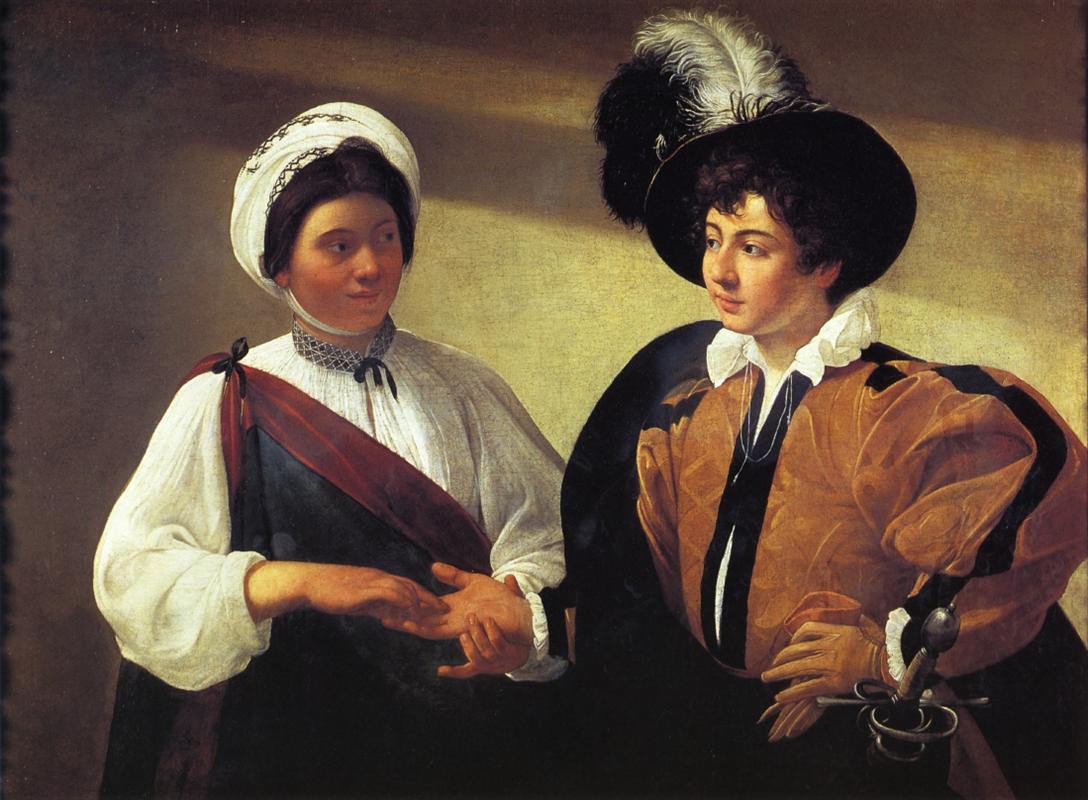
Caravaggio’s “The Fortune Teller,” painted in 1599, turns a casual street encounter into a compact drama of charm, naiveté, and cunning. A fashionable youth leans toward a young woman who holds his hand to read his palm. She meets him with a demure smile, eyes lowered, body arranged in the decorum of a genteel artisan. He answers with a hint of swagger—gloved hand at his hip, plumed hat lifted into the light, rapier angled like an exclamation point of self-regard. Between them a quiet theft unfolds: as she traces his lifeline, her other fingers tease loose the ring on his finger. The painting is not a moralizing cartoon; it is an anatomy of attention and misdirection, captured at the human scale Caravaggio favored. Light pours in from the left, revealing the textures of linen, leather, and feather, and fixing the viewer’s gaze precisely where the game is being played—at the nexus of hands where trust and deceit touch.
Historical Context
Caravaggio arrived in Rome in the early 1590s and, after an apprenticeship of hardship and studio drudgery, began painting small genre scenes that felt startlingly modern: cardsharps, street musicians, boys with fruit, and, here, a fortune-telling encounter that could have happened outside the studio door. Rome at century’s end was a city of processions and courts, but also of inns, markets, and the everyday theatre of bargaining and flirtation. Counter-Reformation bishops wanted devotional clarity; collectors wanted novelty and truthfulness. Caravaggio gave both camps what they desired by applying the same naturalism to sacred and secular subjects. “The Fortune Teller” belongs to that early burst of secular pictures that advertised his astonishing eye for gesture and texture. It also introduces themes—attention, deception, persuasion—that would power some of his most profound religious scenes.
Subject and Narrative Distillation
Fortune-telling in the streets of Rome was a familiar performance. Clients paid for prophecies and, sometimes, paid extra by losing a purse or a ring. Caravaggio distills the exchange to its essentials. There are only two actors and a table edge, no props beyond the clothing they wear and the rapier at the youth’s hip. The woman holds the boy’s hand and reads; while she reads, she steals. The young man, lulled by flattery and ritual, offers his palm with the display-minded innocence of someone pleased to be the subject of attention. Caravaggio sets the moment before discovery. The ring has not yet vanished; it is only loosening under the spell of conversation. Viewers see more than the victim does, and that complicity gives the scene its delicious tension.
Composition and the Theatre of Hands
The composition engineers a corridor of intention from face to face across the bridge of touching hands. The woman stands to the left, her torso angled slightly forward, her right arm descending in a gentle diagonal toward the youth’s palm. His left hand emerges from his sleeve, fingers open in the posture of trust; his right hand, gloved, rests on his hip where the sword hilt gleams. Feathers erupt from the hat like a plume of vanity; the sash cutting across her dress answers that plume with sober geometry. The background is a warm, undetailed wall, allowing the bodies to project into our space. Caravaggio avoids significant recession; the figures are nearly life-size and elbow-close. He wants us to feel the physical intimacy that makes the theft possible.
Chiaroscuro and the Direction of Meaning
Light travels from the upper left, sliding across the fortune-teller’s white turban and blouse, then jumping to the youth’s illuminated cheek, collar, and sleeves. Shadows accumulate in the folds under his arm and along the black vest, forming a soft cradle for the glowing ochre of his puffed sleeves. The most intense illumination rests on the hands, those instruments of agency and desire. Caravaggio’s chiaroscuro does not merely dramatize; it allocates significance. Where the light falls, attention follows; where darkness gathers, the viewer senses potential—what has not yet been seen by the gullible boy, what may never be noticed if the theft succeeds.
Costume, Fabric, and Social Signaling
Clothing is language in this picture. The youth’s attire—plumed hat, slashed doublet in warm ochres, gloves, and the elegant rapier—declares a self-styled gentleman, perhaps a soldier without war or a student with more swagger than substance. The fortune-teller’s costume blends cleanliness with economy: a crisp white blouse tucked under a striped and dark sash, a modest headwrap threaded with lace, a sober palette that suggests respectable craftsmanship rather than ragged marginality. Her neatness is part of the ruse; she is not the stereotype of a ragged charlatan but a poised young woman whose manners disarm the watchful. Caravaggio paints the fabrics with tactile truth: the blouse gathers where the elbow bends; the glove catches a low highlight along its seam; the feather’s barbs alternate between cloudy softness and sharpened quills.
Gesture as Persuasion
Caravaggio’s genius lies in how he lets small motions carry psychological weight. The woman’s touch is light yet proprietary; her thumb rests along the youth’s palm as if it were her reading surface, while the index and middle fingers of her other hand approach the ring with the practiced delicacy of a jeweler. Her head inclines fractionally, signaling attention; her eyes, lifted just enough, suggest knowledge without challenge. The boy leans close, shoulders squared, confidence unguarded. His glove pins his hip in a self-affirming pose, but that glove also immobilizes the hand that might otherwise sense the theft. The painting is a lesson in how bodies sell stories: openness invites advantage; modesty masks strategy.
The Smile and the Psychology of Flattery
The woman’s expression is one of warm professionalism—a smile calibrated to engage without overpromising. She appears to be telling him something he wants to hear. That “something” is not audible, but Caravaggio lets the viewer imagine the genre: long life, quick wit, station rising—compliments tailored to clothing and youth. Flattery, more than any sleight of hand, is the engine of the scene. It captures attention, loosens vigilance, and creates the small window in which the hand can do its work. The boy’s answering smile, narrow and expectant, shows complicity: he believes in the story being told because it flatters the person he wants to be.
Moral Temperature Without Sermon
Genre scenes often carried moralizing captions, but Caravaggio trusts the viewer’s intelligence. He offers no printed warning, no wagging finger. The moral insight is embedded in the theatre itself: where admiration flourishes untested, judgment sleeps; where judgment sleeps, loss follows. Yet there is tenderness in the portrayal. The boy is not punished on canvas; the moment is suspended before injury. The fortune-teller is not demonized; she is cunning, observant, and, in her way, professional. The painting respects both actors as human beings making choices inside a street economy.
Realism and Caravaggio’s Models
Caravaggio painted from life. The fortune-teller’s face has been associated, by some early sources, with models he used elsewhere; the youth’s features echo those in his musician pictures. This continuity across canvases creates a small repertory theatre in which the same faces play saints, rogues, and lovers. The effect reinforces one of Caravaggio’s central convictions: virtue and vice are not born from different physiognomies; they are conditions of choice and circumstance. The same young man who here risks his ring might elsewhere appear as a penitent or a martyr. Reality is elastic; painting records its episodes.
Space, Silence, and Proximity
The scene takes place in a room without windows, or rather in a mental stage lit to the needs of the story. The shallow space pushes the figures forward until the viewer is nearly part of the triangle. This proximity is crucial. Pickpocketing succeeds at touch-distance; fortunes are told with breath audible; jewelry is lifted under noses that are busy listening. Caravaggio’s choice to suppress background detail denies the viewer any exit. We must stay with the eyes and hands, the only things that matter to the transaction.
The Rapier and the Irony of Protection
One of the painting’s sly jokes lies at the youth’s hip: the rapier, symbol of honor and defense. Its steel loops and polished pommel catch light like a guarantee. Yet the weapon does nothing to guard against the theft unfolding inches away. It protects reputation in public, not gullibility in private. Caravaggio often delights in showing the mismatch between the tools people value and the dangers they fail to imagine. Here, the sword says “I am safe,” while the hand says “Not here.”
Color Harmony and the Temperature of Trust
The color scheme binds the characters together visually even as it contrasts their roles. Ochres and warm browns dominate the boy’s costume, giving him an inviting, sunlit glow. The woman’s whites and dark sash cool the palette, communicating clarity and restraint. Between them, the neutral wall receives a spill of light that keeps the whole scene warm rather than theatrical. The harmony encourages the viewer to like both figures, which in turn sharpens the scene’s tension; empathy is divided, and moral certainty is postponed, as it often is in life.
Technique and Paint Handling
Caravaggio’s brushwork is confident and efficient. He builds the fortune-teller’s blouse with opaque whites scored by grey lines that declare creases; the headwrap’s texture is suggested by lace-like strokes that never become finicky. The boy’s puffed sleeves are modeled with large planes of warmed ochre, their volume defined by strategic shadows within the slashes. Flesh tones are laid in thin layers that let warmth from underpaint breathe; highlight accents—on knuckles, lips, and the feather’s spine—are placed with surgical economy. There is no ornamental fuss; every stroke serves visibility.
Comparisons and Evolution
“The Fortune Teller” pairs naturally with Caravaggio’s “Cardsharps,” painted around the same time. Both show a triangular economy of gull, accomplice, and cheat; both rely on hands to tell the story; both position the viewer as a privileged witness, morally implicated by foreknowledge. Compared with “Cardsharps,” however, “The Fortune Teller” is quieter, almost pastoral in tone. It replaces the sharpened psychology of gambling with the soft theatre of prophecy. This shift shows Caravaggio testing registers of deception—from rough trickery to velvet persuasion—that would later inform his depictions of religious conversion and betrayal.
Social Commentary and Urban Theatre
Beyond individual psychology, the painting sketches a social world where classes mix and personal agency collides with performance. The youth’s costume speaks of aspiration within a city of hierarchies; the fortune-teller’s trade speaks of survival through skill and reading people. Between them flows the currency of attention—a resource as valuable as coin. Caravaggio captures how cities create intimate arenas for strangers to test trust. The painting is less a scold than a field note: this is how people look when a story is selling and a ring is loosening.
How to Look
Begin with the faces, poised in polite conversation. Let your gaze drop to the hands and linger on the slightly lifted ring. Travel along the diagonal of the boy’s sash to the sword hilt and glove, then return through the plume to the fortune-teller’s headwrap. Notice how each return to the hands increases their eloquence; small distances between fingertips begin to read like plotted coordinates. Step back and receive the whole as a clean triangle of attention held within a warm, shallow room. Then start again. The painting is a loop the eye happily walks—just as the boy happily listens.
Conclusion
“The Fortune Teller” is Caravaggio’s early masterpiece of soft drama. Two people stand in a room; light falls; a ring slides. From these elements he crafts a world of psychology, class, and theatre. The scene’s pleasure lies not only in catching the trick but in recognizing the habits that make such tricks possible: our hunger to be seen, our belief in flattering stories, our willingness to relax where manners are graceful. Caravaggio does not ask us to despise either figure. He invites us to observe what attention does—how it opens the hand and quiets suspicion—and to carry that knowledge into our own encounters. In a city then and now, the fortune-teller’s smile and the young man’s trust are everywhere. The painting, like a whispered warning shared among friends, teaches us to keep an eye on our own hands when we are enjoying the sound of our own fortune.
