Image source: wikiart.org
Introduction
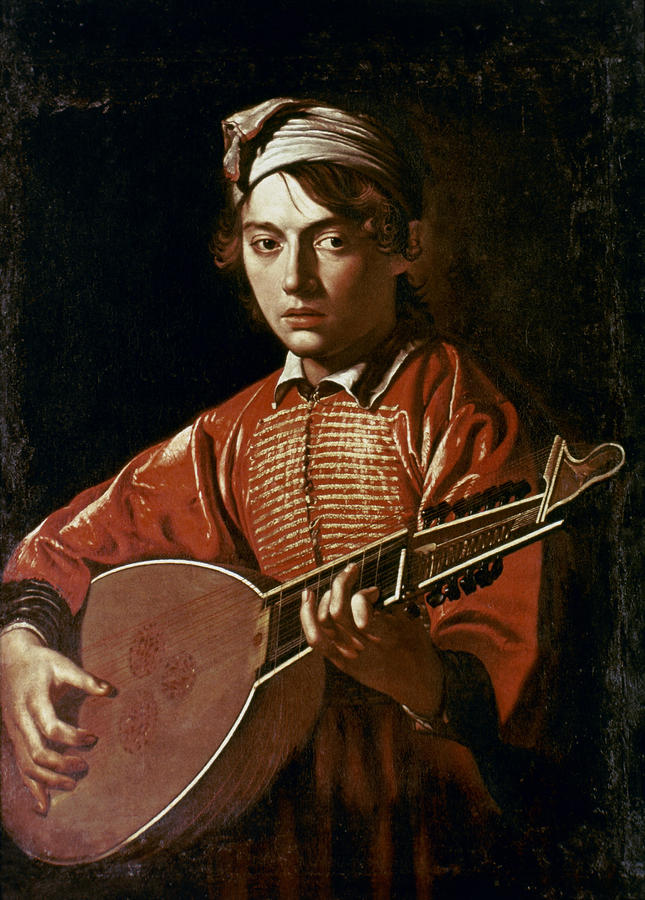
Caravaggio’s “The Lute Player,” painted in 1597, is a declaration that music can be seen. A young performer turns toward the viewer with an instrument nestled against his torso, fingers poised in mid-phrase, the polished belly of the lute catching the light. There is no stage and no audience beyond us. Against a field of darkness, the musician’s red garment shines with the intensity of a voice at its peak, while the calm, appraising gaze suggests both discipline and vulnerability. Caravaggio fuses portraiture, still life, and genre painting into a single, concentrated experience of sound made visible, giving the early Baroque one of its most persuasive images of artistic presence.
Historical Context
The late 1590s were formative years for Caravaggio in Rome. He had recently found patrons who valued his unsentimental naturalism and his ability to invest ordinary scenes with moral and sensory force. Music was everywhere in the city—in oratories and banqueting halls, in academies and private salons—and painters and musicians mingled in the same circles. The “Lute Player” emerges from this sociable culture, in which amateurs and professionals made music an emblem of civility, learning, and refined pleasure. Caravaggio’s treatment honors that milieu while also dissenting from its decorum. Instead of an ornate salon with decorative echoes, he offers a bare stage of light and shadow. The focus rests almost entirely on the performer’s body, the instrument’s geometry, and the expression that ties sound to self.
Subject and Iconography
At first glance the painting appears to be a straightforward portrait of a musician. Yet Caravaggio hints at layers of meaning already familiar to his audience. The lute, associated with amorous songs and cultivated leisure, carried connotations of ephemerality: music fades as soon as it is born. This association makes the painting a subtle vanitas meditation, a reminder that beauty and youth are brief. Unlike allegorical versions that surround the player with wilting flowers, hourglasses, or scattered scores, Caravaggio reduces the symbolism to essentials. The young man’s skin, the sheen of the varnished wood, the creases in the red sleeve, and the silent mouth between phrases are enough to speak about transience. The iconography is deliberately underplayed; the message is not delivered as a sermon but felt as a mood accumulated from observation.
Composition and the Architecture of the Body
Caravaggio builds the composition around intersecting arcs. The rounded belly of the lute answers the oval of the face; the instrument’s long neck projects diagonally into the dark, establishing a vector that leads the eye from the performer’s left hand to the far tuning pegs. The right forearm, bent to pluck, traces a counter-arc that contains the central space of action. Behind these curves the musician’s torso forms a steady triangle, stabilized by the vertical fall of the garment’s front placket. The head is slightly tilted, not in theatrical rapture but in attentive listening to the sound being made. The net effect is a poised balance between movement and stillness, as if the entire body were tuned to sustain a single note over time.
Chiaroscuro and the Discipline of Light
Light breaks across the scene from high left, sharpening the cheekbone, igniting the woven gloss of the red sleeves, and skimming along the instrument’s edge before dissolving into a warm penumbra. Caravaggio’s chiaroscuro is not a mere effect; it is a grammar of significance. What the light touches matters. The face and the right hand receive the most concentrated brightness, guiding attention to expression and technique. The black field behind the figure is thick and close, not a void but a pressure that makes the illuminated forms palpable. The painting’s acoustics seem to depend on this lighting: the more the surrounding darkness hushes the world, the clearer the imagined sound becomes.
Color and Fabric as Vocal Register
The garment’s red is not uniform; it modulates from ember to velvet dusk as the sleeves swell and fold. Caravaggio understands color as a register of voice. The bright passages read like the leading tones that carry a melody; the deeper reds ground the harmony. The white headscarf and the narrow bands of pale stitching across the chest punctuate the composition like held notes, preventing the red from overwhelming the face. The fabric’s weight is precisely calibrated. It must be substantial enough to catch the light in broad planes yet supple enough to show the movement of the forearm beneath. In the end, color is not décor; it is an instrument that helps the eye hear.
The Lute as Engineered Form
Caravaggio renders the instrument with a luthier’s respect. The rosette patterns are softly indicated, acknowledging their delicacy without turning them into miniatures. The bridge sits low; the strings cross in parallel precision; the pegs on the extended head appear as black punctuation marks against the dark. The slight shadow along the edge of the belly confirms the lute’s volume, while micro-highlights suggest the varnish’s thickness. This precision carries narrative weight. The instrument is neither prop nor symbol alone. It is a tool whose intimacy with the player defines his identity. Caravaggio allows the viewer to sense the tautness of the strings, the delicacy required to draw sound from them, and the way the left hand’s placement on the fingerboard maps the pitch of the moment.
Gesture and the Mechanics of Sound
The right hand hovers with the poised economy of a trained musician. The thumb and fingers are separated just enough to articulate a pluck; the wrist is relaxed; the forearm carries the memory of recent motion. The left hand’s fingers press the strings with accuracy, and the slight indentation across the fingertips hints at habitual practice. These gestures are not generic; they are legible to anyone who has played a fretted instrument. Caravaggio captures not a contrived tableau but an actual bar of music, cut from time and kept alive by the viewer’s eye.
Psychological Realism and the Exchange of Looks
The player’s gaze is frank and level, carrying neither coquettish charm nor heroic intensity. It is the look of someone listening to what he is doing. Caravaggio’s psychological realism resides in such subtleties. The mouth is relaxed, not performing; the eyes are clear but not dramatic; the tilt of the head compresses the neck slightly, as it would when one leans closer to hear harmonics. The portrait thus accomplishes a delicate task: it acknowledges the viewer without performing for us. We have interrupted him in the midst of playing, and he accepts our presence as a fact without surrendering to it.
Sound and Silence
All music portraits confront the paradox of depicting sound with silence. Caravaggio embraces the paradox by converting sonic decisions into visual ones. Rhythm becomes the spacing of highlights along the sleeve; timbre becomes the contrast between the lute’s pale belly and the deep red cloth; volume becomes the magnitude of shadow around the figure. The picture persuades because each of these visual parameters is handled with the same care a musician applies to dynamics and articulation. We do not need to hear the note to feel its duration.
Youth, Beauty, and Transience
The player’s youthful face and loose hair introduce the painting’s poignancy. The red garment amplifies vitality, yet the eyes carry a quiet gravity. Nothing is moralized, but time hovers over the scene. Music is a time-bound art; its beauty is inseparable from its passing. Caravaggio does not scold us with symbols; he simply allows the viewer to feel the fragility of a moment when concentration, skill, and youth align. The picture holds that alignment as long as we look, knowing that the next pluck will alter it irrevocably.
Costume, Class, and the World of Performers
The clothing suggests a performer dressed to be seen, but not a courtier in brocade. The headscarf is practical, keeping hair from eyes; the close-fitting torso and voluminous sleeves allow ease of movement. Caravaggio maps the social world of late sixteenth-century musicians with accuracy: skilled, visible, and mobile between households and patrons. He resists the temptation to ennoble the figure with aristocratic signs or to sentimentalize him as a street player. The result is a portrait of a working artist at the top of his powers, a person defined by craft as much as by charm.
Versions, Models, and Caravaggio’s Workshop Thinking
Caravaggio painted more than one “Lute Player” in these years, re-testing the idea with variations of setting, attire, and still-life accompaniment. The version here, stripped to performer and instrument, represents the concept in its most concentrated form. Repetition in Caravaggio is never mechanical. It is an experimental method, refining the balance between the empirical fact of a sitter and the abstract structure of a picture. The familiar features of the model in his musical canvases demonstrate how the painter treated human faces as remarkably adaptable instruments—capable of conveying sacred fervor in one context and secular artistry in another—without betraying their individuality.
Technique and Paint Handling
The surface rewards close looking. Caravaggio constructs the head with broad, interlocking tonal planes, then sharpens the contours at the eyelids, nostrils, and mouth’s corner. The hair is not fussed into separate strands; it is blocked in masses, with quick descriptive flicks at the edges to suggest curl and stray locks. The garment’s sheen depends on a practiced alternation of opaque body color and thin glazes that let the underpaint warm the highlights. On the instrument, the brush shifts into a different vocabulary—fine, nearly calligraphic strokes for strings and pegbox, a softer, stippled touch for the rosettes. Throughout, the paint feels decisive. The picture looks inevitable because the painter refused to dither.
Naturalism and the Ethics of Attention
Caravaggio’s realism is not a cynical catalog of flaws; it is an ethics of attention. The player’s features are particular but never mocked. The hands bear the signs of use without becoming caricatures. The instrument looks played rather than polished for display. Such attention grants dignity to the subject while anchoring the picture’s authority. Viewers trust what they see, and that trust allows the painting to deliver subtler meanings about art’s labor and the delicacy of performance.
Influence and Afterlife
“The Lute Player” helped set the terms for seventeenth-century musician portraits, influencing artists in Italy and beyond who learned from Caravaggio that a single figure against darkness could carry narrative and emotion without architectural scaffolding. The directness of the gaze, the close crop, and the instrumental detail recur in later Baroque canvases where violinists, singers, and players of wind instruments confront the viewer as professionals, not props in allegories. The work also prefigures modern photographic portraiture, in which performers appear in rehearsal rather than on stage, their personality inseparable from the tool of their trade.
The Work’s Place in Caravaggio’s Musical Imaginary
Music threads through Caravaggio’s oeuvre in ways both explicit and implicit. He paints players, listeners, and instruments, but he also builds pictures like compositions—balancing themes, modulating tone, and orchestrating contrast. In “The Lute Player,” the sensibility is particularly audible. The dark ground functions as a low continuo, the bright sleeve as melody, the face as a sustained middle voice that holds the harmony together. The analogy is not decoration; it clarifies the painter’s method. He does with light and form what musicians do with sound: construct an interval of time the viewer inhabits.
How to Look
Let the eyes start at the right hand, where a note is about to be born, and trace the strings toward the left hand’s pressure. Follow the instrument’s neck into the dark until the pegs disappear, then return along the broad curve of the belly to the bright seam of the sleeve. Only then settle on the face, which holds you with the neutral intensity of focused listening. Step back and let the entire figure resolve into a single chord of red, flesh, and wood against black. Approach again and notice the small factual graces: the loosened hair under the headscarf, the soft shadow under the lower lip, the way a single highlight on the knuckle turns a hand into three dimensions. The painting will continue to change tempo as you change distance.
The Human Claim of the Picture
Beyond virtuosity, “The Lute Player” makes a human claim: art is work done by bodies. The musician’s concentration, the calibrated pressure of fingers, the disciplined posture—these are the means by which invisible sound enters the world. Caravaggio honors that labor with the highest resources of painting, and in doing so he gives viewers access to the dignity of a craft often enjoyed but seldom seen up close. The painting invites respect rather than mere admiration, understanding rather than fantasy.
Conclusion
“The Lute Player” is one of Caravaggio’s clearest statements about presence. It asks for nothing more than the attention we would give a performer mid-phrase, and it rewards that attention with a deeply persuasive fusion of sight and sound. The composition’s arcs bind instrument and face into a single expressive engine; the light isolates what matters; the color sings in registers from ember to wine; the hands speak the language of practiced motion. By refusing scenic ornament, Caravaggio brings us to the threshold where technique becomes music and observation becomes empathy. The result is a portrait that feels as alive as the art it depicts—a young player in the glow of the moment, listening to himself, and letting us listen with our eyes.