Image source: wikiart.org
Overview
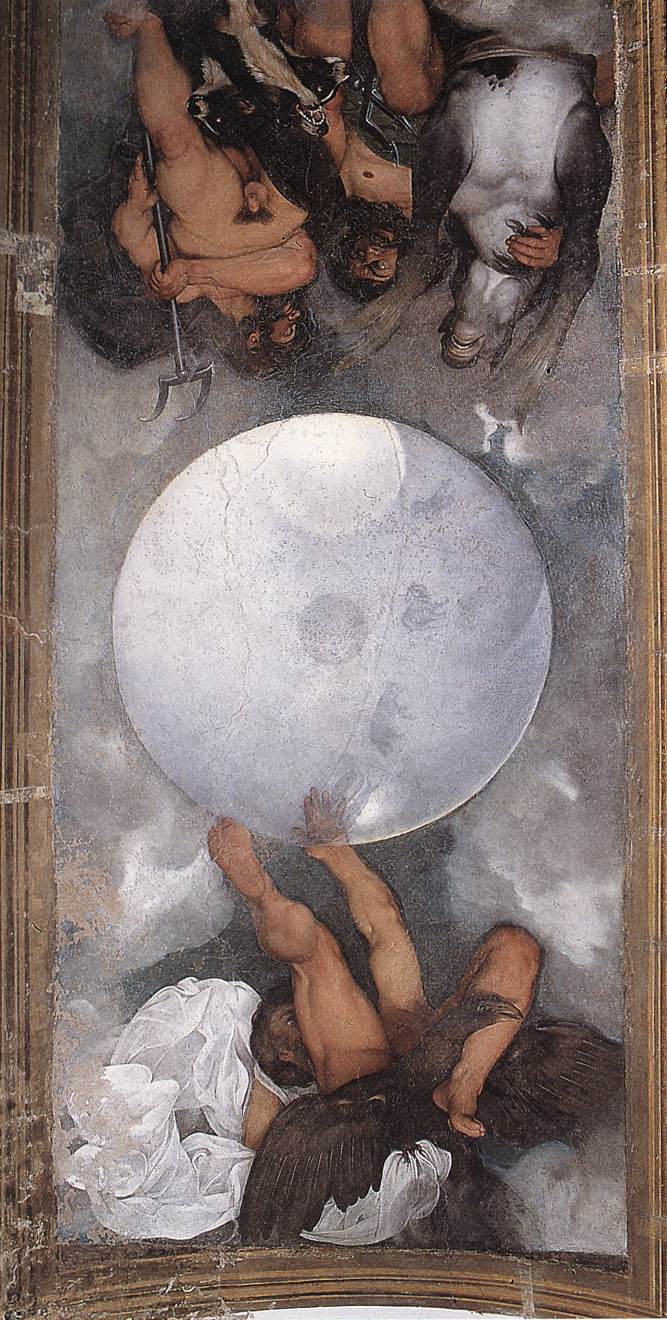
Caravaggio’s “Jupiter, Neptune and Pluto” (1597) is a breathtaking experiment in illusion and meaning: a ceiling painting that turns the viewer into a witness beneath three Olympian deities who whirl around a luminous celestial sphere. Executed in oil directly on plaster in the small vault of Cardinal Francesco Maria del Monte’s private study in the Villa Ludovisi, the work is Caravaggio’s only surviving ceiling and one of his most audacious departures from conventional narrative. The gods are not remote, marble-still ideals; they are foreshortened, muscular bodies seen from below, bodies that seem to hover just over our heads as they reach, grasp, and push at the round orb that anchors the composition. The entire scene behaves like a sky opened by vision, a theatrical oculus in which myth, science, and alchemy orbit one another.
Patronage, Place, and Purpose
The commission matters for understanding what we see. Cardinal del Monte, Caravaggio’s early Roman patron, maintained a private cabinet of curiosities and a small room devoted to the speculative arts—music, chemistry, astronomy, and the natural philosophy that early moderns often grouped under the umbrella of “alchemy.” This ceiling was designed for that intimate, learned setting. In contrast to church altarpieces and public canvases, it functioned as a conversation piece overhead, a stimulus for discussion about the structure of the cosmos, the powers governing nature, and the unity of elements. The choice of subjects—Jupiter, Neptune, and Pluto, masters of sky, sea, and underworld—translates those concerns into antique form, while the strikingly modern handling invites the onlooker to think about the mechanisms of the world as much as its myths.
Radical Illusion: The “Di Sotto in Sù” View
Caravaggio embraces the di sotto in sù (“from below upwards”) viewpoint associated with Renaissance ceiling illusionism, but he weaponizes it with his characteristic focus on bodily reality. The gods are seen as if we stood on the floor and looked straight up at them tumbling through cloud. Limbs are sharply foreshortened, torsos twist, and shoulders protrude into our space. The vantage point abolishes architectural distance; there is no decorative framework to soften the plunge from room to sky. The breadth of the wing beneath Jupiter, the up-thrust elbow of the figure at lower center, and the angled horse and trident above pull the eye in a continuous spiral around the great sphere, making the entire ceiling feel kinetic rather than merely painted.
The Celestial Sphere at the Center
At the heart of the composition floats a silver-grey globe—a celestial “engine” around which the gods revolve. Its mottled surface, with pale seas and darker patches, has prompted various identifications: a world-sphere standing for the macrocosm, a lunar disc, or a generalized model of the heavens. In the intellectual climate of del Monte’s circle, the ambiguity is purposeful. The orb represents the totality of nature, an object to be set in motion, measured, and pondered. Caravaggio gives it a cool, glassy luminosity, different from the bodies and beasts around it. The globe is not flesh; it is idea and element, the subject of thought. As Jupiter extends his hand to nudge it, the painting implies a cosmic mechanics: divine intelligence initiating or maintaining the rotation of creation.
Three Gods, Three Domains
Each deity is identified by attribute and animal.
Jupiter appears with his eagle. He is poised below the sphere, his body dramatically foreshortened so that a knee thrusts outward and a hand reaches up to touch the globe. In Renaissance iconography Jupiter stands for sovereign order, the rational law of the heavens. Here that order is literalized as physical contact with the celestial machine. The eagle’s powerful wings expand under him, a dark, feathery counterpoint to the pallor of clouds and the sheen of the orb.
Neptune is recognized by the trident and by the equine companion at the upper end of the vault—an allusion to the horse he was mythically said to have created and to the waves he commands. The body tilts, as if he swims within air rather than water, which suits the ceiling’s fiction of a sky where sea gods fly.
Pluto occupies the third corner, attended traditionally by the three-headed hound, and by a bestial gravity of form and shadow that signals his dominion under the earth. Even when Cerberus is not fully visible, Caravaggio conveys Pluto’s domain through darker tones and the weight of his musculature. The heaviest god holds the lower, shadowed edge of the vault, as though the underworld presses up from beneath our feet into the scene above.
Alchemical and Philosophical Readings
Viewers in del Monte’s circle would have detected layered meanings. The tripartite scheme maps neatly to the classical elements—air or fire for Jupiter, water for Neptune, earth for Pluto—and also to Paracelsian “tria prima”: sulfur, mercury, and salt, the three principles thought to compose all matter. In that sense, the ceiling dramatizes a unified nature: volatile and fiery (Jupiter/sulfur), fluid and transformative (Neptune/mercury), fixed and corporeal (Pluto/salt). The sphere becomes the world-as-laboratory, the arena where elements combine, separate, and recombine according to cosmic laws. Caravaggio’s elegant solution is to make philosophy visible without abandoning the thrill of myth. The bodies convince us first; the symbols unfold as we look.
Oil on Plaster: A Technical Outlier
Instead of fresco, Caravaggio used oil paint on prepared plaster, a medium he knew intimately from canvas. The choice was daring and practical. Oil allowed him to model flesh with the soft half-tones and sharp accents that were becoming his signature, to adjust contours over time, and to stage dramatic contrasts between gleaming orb, feathered wing, and human skin. It also enabled richer darks than true fresco would permit, essential for the sense of void around the figures. The price of such freedom was durability—the technique is more fragile than fresco—but the immediate effect in a small, personal room would have been intoxicating, like looking into air rather than at a wall.
The Bodies: Weight, Strain, and Visibility
Caravaggio’s gods are not ethereal abstractions. Their legs bulge, their feet arch, their hands spread against resistant surfaces. The strain reads especially in the lower figure’s calves and in the clutching hand that almost smears across the sphere. These are the same kinds of bodies Caravaggio used for his saints and martyrs—unidealized, palpably human—but here they play the roles of immortals. That reversal is meaningful. Instead of gilding myth with marble perfection, Caravaggio gives Olympus the vigor and fallibility of the street. Divinity, he suggests, works through the same muscular realities we know.
Light, Color, and Atmosphere
The palette favors cool greys, clouded silvers, and earthy browns, punctuated by the white of drapery and the deep black of wings and hair. Light floods the orb and skims along limbs, then slips into the vaporous dark that frames the scene. The resulting atmosphere is meteorological rather than theatrical: we feel clouds and altitude rather than stage sets. Color serves narrative roles: the silver sphere reads as cosmic mechanism; the ruddy flesh anchors the gods in the realm of touch; the black wing and the dark horse ground the extremes of the vault. The balance of cool and warm keeps the eye circulating without fatigue.
Motion Engineered Through Composition
Everything moves. The arc of the eagle’s wing, the angle of the trident, the oblique limb positions, and the slight tilt of the sphere create a vortex that spins the viewer’s gaze. That engineered motion is not decorative; it communicates a thesis about the cosmos as perpetual rotation. Even the animals behave like vortical cues: the horse’s head bucks along the rim; the bird sweeps a curve that mirrors the sphere; Cerberus (when present) twists into a knot of alert heads. Caravaggio composes to make motion feel inevitable.
Dialogue with Classical Ceiling Painting
Caravaggio knew the grand tradition of ceiling fresco—from Mantegna’s oculus in Mantua to the great illusionistic vaults of Rome—but he eschews classical architecture, putti, and allegorical clutter. The field is stripped to essentials: three gods, their beasts, one globe, and cloud. Where earlier masters lavishly built fictive architecture to “open” the ceiling, Caravaggio opens it by removing everything that would read as frame. The result is austerely modern. The painting does not pretend to be a dome; it pretends to be air.
Relationship to Caravaggio’s Oeuvre
Seen against Caravaggio’s better-known religious canvases of the same decade, this ceiling confirms habits that define him. He fixes on the crucial instant—here, the moment the heavens are set in motion—and he materializes spiritual or intellectual content through bodies that feel lived-in. He prefers close, physical proximity to grandiose distance. He relies on simple but potent props. And he builds meaning from observation: feathers ruffle, hands press, clouds thin into light. The subject is myth; the method is empirical seeing.
The Scholar’s Room and the Viewer’s Body
Because the work crowns a small chamber, its effects register bodily. Stand beneath it and the gods seem within arm’s length. The orb becomes a focal “lamp,” so luminous that it feels like the real source of the room’s light. That intimacy was intentional. Del Monte’s guests—musicians, scientists, courtiers—were to experience a cosmos you could almost touch, a nature whose elements could be grasped, tested, and set in motion. The ceiling thus becomes a manifesto for curiosity: look up, theorize, adjust, turn the globe with your hand.
The Animals as Emblems and Anchors
Caravaggio’s animals are not afterthoughts. The eagle provides the widest, darkest tonal plane, its wing a sweeping support beneath the god of the sky. The horse, cropped at the edge, contributes a flash of recognizable power and hints at the marine “hippocamp” of classical Neptune without lapsing into fantasy. Cerberus, when fully visible, knots together three muzzles into a single tense sign—guardianship and fear—and helps balance the triangle of deities. These creatures signal domains, but they also solve problems of composition and weight.
The Science Inside the Myth
Del Monte’s fascination with astronomy adds one more layer. The globe’s appearance—cool, pitted, and shining—resembles an observational object. Whether the artist intended Earth, Moon, or a generalized cosmos, he paints it as something studied rather than adored. The gods do not simply pose with it; they manipulate it. In a period poised between medieval cosmology and telescopic discovery, the image becomes a snapshot of intellectual transition: divinity and experiment cohabiting the same vault.
Touch and Agency
A small, almost throwaway detail carries powerful implications: the open palm pressed to the sphere. That gesture supplies agency. The heavens are not static; they respond to touch. The hand is the instrument of the artisan, the scientist, the musician—roles cultivated in del Monte’s household. Caravaggio gives them a mythic endorsement. To act upon nature is not to violate it but to participate in its order.
Legacy and Rarity
Because it is both unique in Caravaggio’s corpus and site-specific, “Jupiter, Neptune and Pluto” has often been described as a curiosity. Yet its rarity is precisely what makes it influential. Later Baroque painters learned from its assertive foreshortening and its willingness to strip a ceiling to pure action. The work also stands as an early statement of Caravaggio’s capacity to fuse the ancient with the contemporary, to make a modern picture out of old stories by returning them to physical experience.
Conclusion
“Jupiter, Neptune and Pluto” condenses a worldview into a few, unforgettable forms: three gods, three animals, and a revolving sphere. It is a picture about power, but not only divine power. It is about the power of seeing, of touching, and of thinking—a manifesto in paint for a culture that believed the secrets of nature could be known through experiment as well as through myth. Caravaggio, never a decorator by temperament, invents a ceiling that behaves like a mind at work: stripped of ornament, charged with motion, and devoted to making ideas tangible. Stand beneath it and you feel two invitations at once—to marvel and to inquire.