Image source: wikiart.org
Introduction
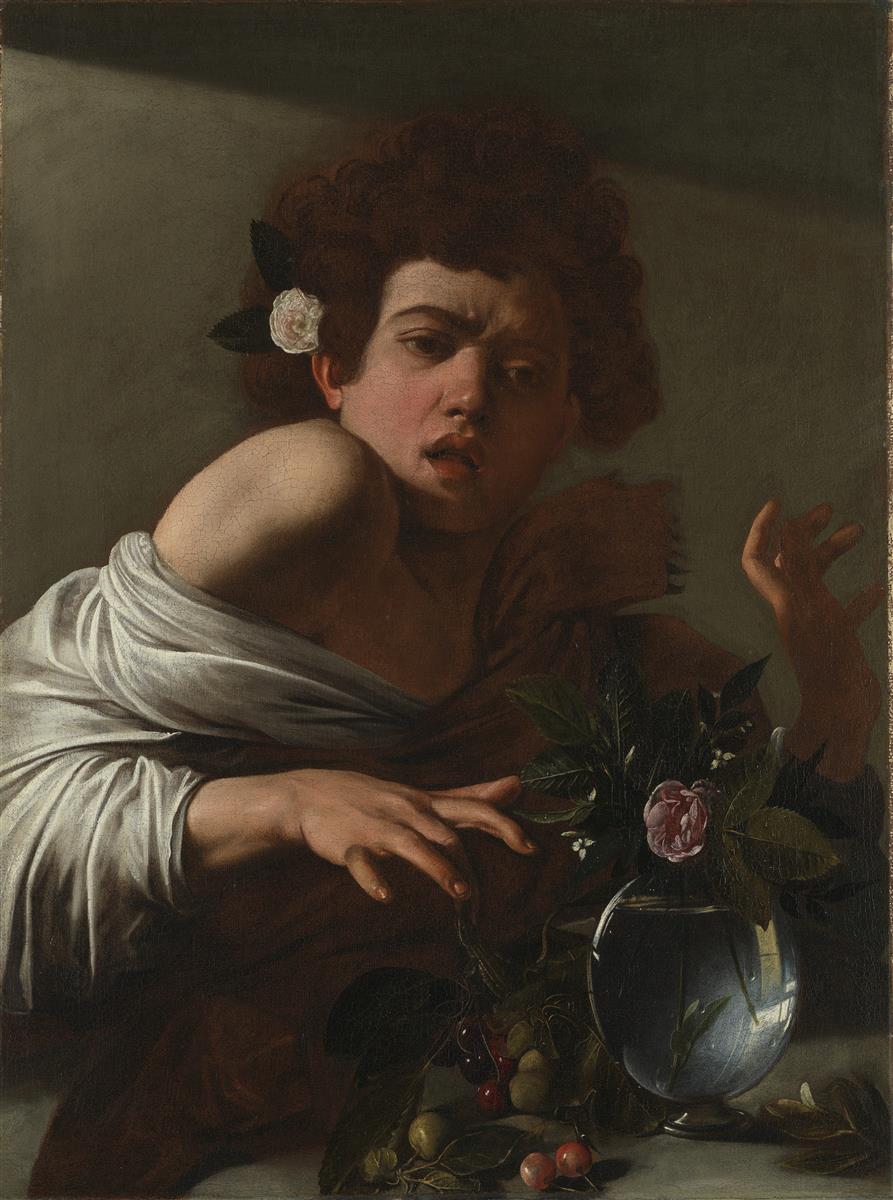
Caravaggio’s “Boy Bitten by a Lizard” (1596) turns a split second of surprise into a complete drama. A youth, crowned with a white blossom, recoils from an unseen sting as a small lizard clamps onto his finger among a spill of cherries, plums, and leaves. The gesture is so abrupt that the white sleeve fractures into creases, the shoulder surges forward, and the boy’s lips part in a cry. Light slices across the scene from the upper left, igniting flesh, satin folds, glossy foliage, and the mirrored globe of a water vase, then collapses everything else into shadow. In a single, tightly cropped panel, Caravaggio condenses the human body’s reflex to pain, the seductions of sense perception, and the moral fable of pleasure’s bite.
A Scene Stopped In Mid-Cry
The composition pivots on interruption. The boy’s head twists toward the source of pain while his torso lunges away, creating a torque that we can feel across clavicle, shoulder, and throat. The raised right hand articulates shock with fingers splayed and wrist bent back; the left hand drops reflexively, still tangled in the greenery that concealed the reptile. Caravaggio’s genius lies in catching exactly the interval between sensation and comprehension. We witness the moment before the mind has words, when the body speaks by flinch and gasp.
The Choreography Of Light
A narrow, raking light models the boy’s shoulder as a luminous swell, sculpts the forearm into a cylinder, and traces the moist bloom of his lower lip. At the same time, it fastens on the vase, where a bright, elliptical highlight curves around the glass and a window’s reflection skims the surface of water. The strong highlight on the glass becomes a second, silent drama inside the painting, a miniature world where light and form play by optical rules. Caravaggio’s handling of chiaroscuro is never merely theatrical; it’s investigative. He uses light not only to direct attention but also to demonstrate how things are made visible.
The Shocked Face And The Psychology Of Pain
The boy’s expression feels uncoached: knitted brows, slightly parted teeth, and a tongue that presses forward as if to exclaim. Caravaggio avoids grotesque exaggeration. The pain reads as credible and brief, the sort that brings a sting to the eyes rather than a scream. That restraint is one source of the painting’s power. It convinces us that we’re looking at life and not at a studio demonstration, even as we know the scene is staged. The flower behind the ear, echoing the theatrical laurel of a Bacchus figure, adds an ambiguous note of play, beauty, and transient pleasure.
A Tabletop Still Life With Teeth
The lower third of the picture works like a still life that has suddenly come alive. Cherries glow, plums dully shine, and leaves exhibit a waxy, nearly tactile sheen. The lizard, half-hidden among stems, provides the shock that animates the arrangement. Caravaggio isn’t content to paint sweet surfaces. He injects risk, reminding viewers that beauty often comes with barbs. The moral, if we want one, is not scoldingly explicit; it’s folded into the event. Reach too eagerly for sensual reward and you may be bitten.
Symbolic Echoes Without Didactic Weight
Caravaggio inherited a language of symbols—flowers, fruit, glass, and water—that Renaissance painters often used to spell out moral lessons. He engages that vocabulary but refuses to underline it. Roses and jasmine suggest fragrance and youth; cherries have long associations with desire; the water-filled vase, so carefully painted, points to clarity, reflection, and the fragility of surfaces. Together they whisper about the volatility of the senses and the perishability of pleasure. Yet the painting never slips into sermon. The emblematic content emerges from the boy’s own experience and our recognition of it.
Flesh, Fabric, And The Reality Effect
The boy’s bare shoulder is a locus of painterly delight. Caravaggio builds it with pearly half-tones, faint violet shadows, and a crest of light that slides across the rounded deltoid. The white sleeve, cinched at the forearm, is a study in creases that follow the logic of motion rather than the conventions of drapery. This attention to the physics of fabric—how a sleeve twists when an arm retracts, how folds sharpen at stress points—proves Caravaggio’s care for the reality effect. We believe the surprise precisely because everything around the emotion behaves truthfully.
The Vase As Optical Laboratory
The vase at the right edge is more than decoration. Its belly gathers reflections from the studio window and the light-colored table while its water refracts stems into broken lines. Caravaggio revels in these visual facts, trusting that spectators will register the accuracy even if they cannot name it. The curved highlight and the doubled stems provide a painter’s signature that says: I see what the eye sees, and I can prove it with glass and water. That claim anchors Caravaggio’s naturalism as a method, not a mannerism.
Two Versions, One Idea Of Instantaneity
Caravaggio returned to this motif in at least two variants during his Roman period, an indication of its conceptual richness. The core idea—a youth jolted by an unseen bite—remained constant, while the exact angle of the head or placement of the still life could shift. What stays is the sense of instantaneity, the decision to freeze action at the precise moment before narrative resolves. That timing would become a hallmark of Baroque painting, where the viewer is enlisted to complete the story.
Close Cropping And The Viewer’s Space
The image is cropped so tightly that the boy’s elbow disappears outside the frame and the vase nearly touches the edge. This closeness implicates the viewer. We are not distant observers; we are within swatting range of the lizard. The theatrical distance of classical narrative yields to the intimacy of a private mishap. Caravaggio’s early Roman patrons collected pictures for studioli and salons, spaces designed for witty conversation. “Boy Bitten by a Lizard” fits such a setting perfectly, inviting a flurry of talk about desire, deception, and the reliability of the senses.
Sensation, Knowledge, And The Five Senses Tradition
The painting belongs to a late Renaissance fascination with the five senses, a current that produced countless allegories of touch, taste, smell, hearing, and sight. Caravaggio compresses that tradition into a single event. Touch is primary—the bite—but it is inseparable from sight, since the boy fails to see the danger; from taste, implied by the fruit; from smell, conjured by the flowers; and from hearing, imagined in the hiss or rustle that might have preceded the pain. The senses, the painting suggests, collaborate and betray in equal measure.
From Pleasing Surfaces To Embodied Time
Caravaggio transforms the still-life table into a stage where time exists. Fruit, flowers, and glass are no longer inert trophies; they participate in a now that will immediately become a then. The bite will loosen, the boy will laugh or curse, the hand will wave away the leaves, and the startled face will relax. We sense that sequence even as the canvas refuses to proceed. Such temporal compression is central to Caravaggio’s art. He allows viewers to inhabit the present tense more intensely by stopping it.
The Body’s Grammar
Look at the chain of forms from the boy’s forehead down to his fingertips. Brow ridges pull together; cheek muscles lift; lips part; the sternocleidomastoid tightens along the neck; the shoulder rises; the elbow swings; the hand contorts. It is a grammar of pain that the body speaks without instruction. Caravaggio assembles those forms with anatomical economy—few lines, powerful volumes, decisive edges—and the result reads instantaneously. The body communicates faster than language.
Color As Emotional Temperature
The palette is a low, earthy register punctuated by the bloom of the rose and the red of cherries. Flesh tones range from warm peach to cool gray-violet depending on light exposure. The brown scarf and deep green leaves absorb light, keeping the eye cycling back to the face and shoulder. This chromatic restraint heightens drama. The few saturated notes act like exclamations, while the subdued ground allows the figure’s heat to radiate.
The Bite As Eros
From antiquity forward, artists and poets linked lizards, snakes, and thorns with the unpredictable snap of desire. The boy’s flower behind the ear and his open shirt—downy chest exposed as if careless with his own allure—frame the bite as an erotic jolt. Pleasure, curiosity, and risk entwine. Caravaggio’s treatment is neither moralizing nor prurient; it feels psychologically accurate. Attraction and injury often arrive together, and both feel like news to the body.
Craft And The Mark Of A Working Painter
Details that a lesser artist would gloss—dirtying around the fingernails, tiny dents along the knuckles, scratches on the fruit skin—are tokens of Caravaggio’s working ethic. He painted what was in front of him and what he remembered from handling things. The paint itself alternates between creamy blends in flesh and slightly rougher passages in leaves and cloth. That textural variety enlivens the surface and underscores differences among materials without resorting to fussy finish.
The Corner Of Space And The Weight Of Shadow
The shallow diagonal of shadow at the upper left hints at a room corner or a beam, a minimal architecture that situates the event in real space. Darkness in Caravaggio is never empty; it is mass. The broad field of umber surrounding the boy presses forward like a closed curtain, making the lit forms pop with sculptural force. Tenebrism here is not just contrast but contact, a way to make bodies push against surrounding air.
Dialogue With Earlier Works
Placed next to Caravaggio’s “Boy with a Basket of Fruit,” this canvas seems like a counter-argument. The earlier youth presents fruit as unbitten promise; this youth discovers that promise has a bite of its own. Where the earlier picture is poised and frontal, this one is slanted and kinetic. Together they map a mini-education of the senses: the cheerful offering of delight followed by the lesson that sensation is never innocent. Pain does not cancel beauty; it complicates it.
Influence And Posterity
The painting’s immediacy radiated through the next generations of Baroque painters. Caravaggisti in Rome and beyond borrowed the recipe: a tight foreground, a sudden action, light as plot engine, and objects so precisely depicted they seem factual. But few captured the same combination of psychological acuity and optical curiosity. Many imitated the darkness; fewer grasped why the darkness was needed—to make perception itself feel high-stakes.
Why The Picture Still Feels New
Four centuries later, “Boy Bitten by a Lizard” reads like a candid photograph taken at the instant flash burns the retina. We recognize the reflex in our own shoulders, the hiss through teeth, the mix of embarrassment and irritation. The painting’s veracity does not date because Caravaggio anchored it in bodily knowledge. He trusts the viewer to bring experience to the canvas. That trust is the painting’s quiet modernity.
Conclusion
“Boy Bitten by a Lizard” is one of Caravaggio’s great arguments for painting as an art of the present tense. With a handful of objects, a diagonal of light, and a figure whose reaction precedes words, he builds a scene that joins still life to drama, symbol to sensation, and optical fact to human truth. The picture does not tell us what to think; it lets us feel first. Only afterward do its emblems—flower, fruit, water, reptile—rearrange themselves into meanings about youth, desire, risk, and knowledge. In that order of encounter lies the spell of Caravaggio: emotion first, then interpretation, always under the governance of light.