Image source: wikiart.org
Introduction
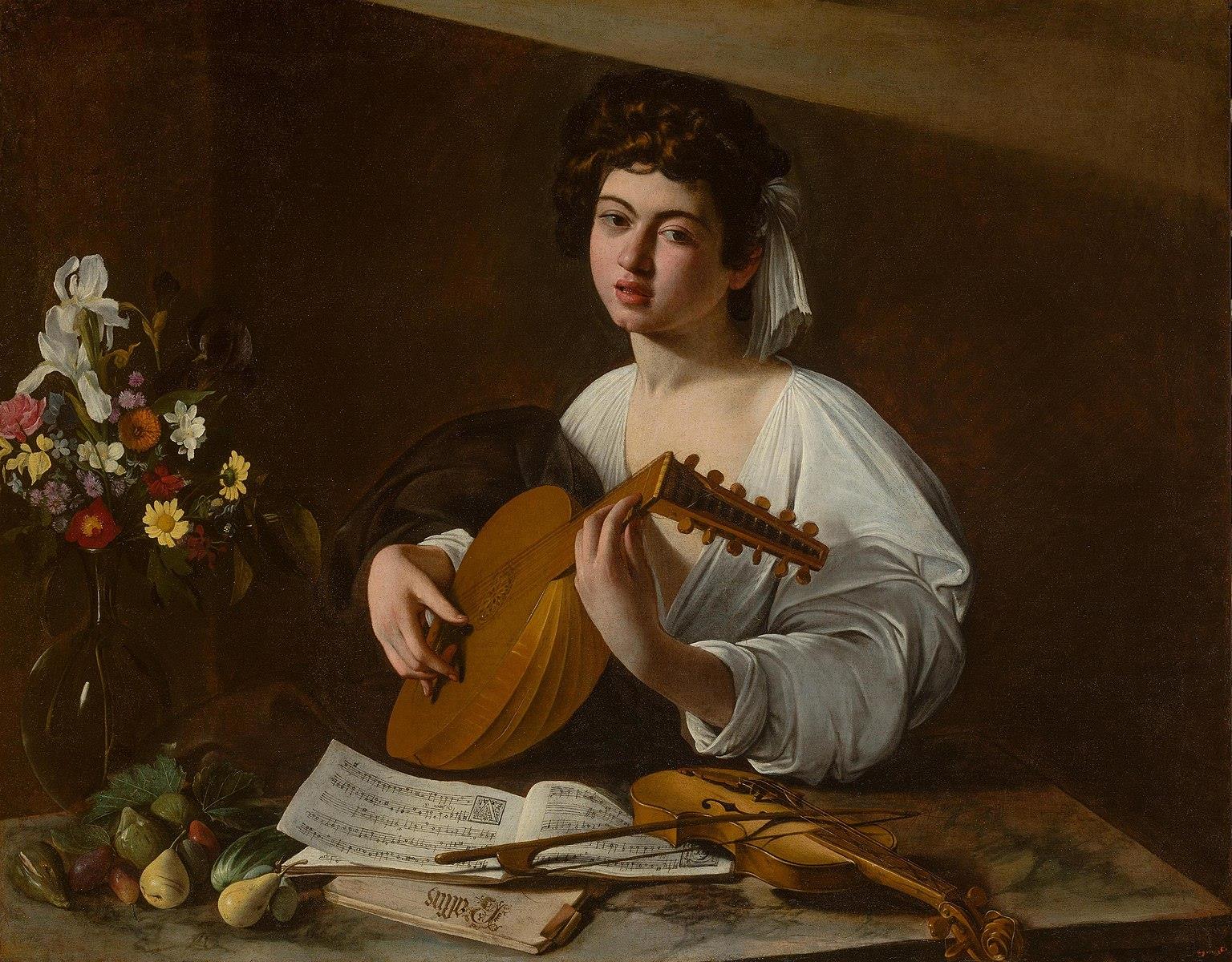
Caravaggio’s “The Lute Player” (1596) is one of the most lucid statements of his early naturalism and his feeling for intimate performance. A single youth sits at a table, the instrument cradled in his arms, eyes half raised as if listening to an inner pitch. Around him lie a bouquet of flowers, a scattering of summer fruit, a pair of violins, and open partbooks whose crisp staves catch the light. The painting presents music as an art of attention and touch, and it binds that attention to the textures of the visible world. Everything we need to understand Caravaggio’s revolution—truthful light, tactile surfaces, bodies that breathe—is here within arm’s reach.
A Roman Studio Turned Concert Room
The tightly cropped setting suggests a studio rather than a courtly stage. There is no architectural vista, no crowd, only a table pushed up against a plain wall. This modesty is strategic. By sparing embellishment, Caravaggio concentrates intensity on the subject’s face, hands, and instrument. We feel the closeness of a rehearsal, the hush of a room where a single tone might sound enormous. The choice fits the milieu of Cardinal del Monte, the sophisticated patron who gathered musicians and painters under one roof. “The Lute Player” reads like a souvenir of those gatherings, distilled to the exact second when the first note is about to bloom.
Composition As A Quiet Chord
The canvas is organized like a chord built from overlapping arcs. The lute’s soundboard forms the dominant curve, countered by the youth’s rounded sleeve, the bow of his shoulder, and the ellipse of the glass vase. Diagonals anchor this circularity: the neck of the lute angles toward the upper right; the violin bodies lie along the table’s long edge; the folded music and a narrow letter create slivers of perspective that pull our eye into depth. The effect is harmonic rather than dramatic. Each object takes its place within a balanced constellation, just as a melody seats itself inside accompaniment.
The Face That Listens
Caravaggio paints the musician’s face not as a mask of performance but as a device for listening. The eyelids are lifted, the mouth loosens, the head tilts with a patient receptivity familiar to anyone who tunes an instrument. In that small tilt lies the picture’s dramatic center. The youth gazes neither at us nor at the score; he attends to something invisible—pitch, memory, the interval between fingers and string. This inwardness is Caravaggio’s great subject. He turns a portrait into an audible state of concentration.
Hands, Strings, And The Intelligence Of Touch
The left hand supports the lute at the soundboard while the right hand poises above the strings. Fingers are long, soft, and slightly pink where blood gathers in the pads. Caravaggio takes care to show the precise architecture of the instrument’s ribbing and the crisp cut of the rosette; he does so not as a cataloguer but as an advocate for tactility. The viewer’s body seems to learn from the image how pressure will translate to tone. The moment before sound, when touch has not yet become vibration, is prolonged into an exquisite suspense.
Light As Trustworthy Witness
A cool, directional light enters from the upper left and spreads evenly across faces, fabrics, wood grain, and paper. It glances off the lute’s ribs, migrates across the varnish of the violins, and beads on the glass vase with shy highlights. Shadows are soft but decisive, establishing depth without obscuring detail. This obedience to optical truth is Caravaggio’s compact with the viewer. He asks us to believe not because the subject is noble, but because the light is honest. Once we trust the light, the painting can propose subtler meanings without forcing them.
Music On Paper And In Things
The partbooks are not idle décor. Caravaggio allows their typography and notation to flirt with legibility, offering the thrill of recognition to anyone who reads music. The pages are weighted by a small knife and a folded sheet, as if the player had just set them down to tune. Adjacent to the pages lies a violin, its bow angled like a calligraphic flourish. The paper records what sound will be; the instruments promise its embodiment. This duet of notation and object turns the table into a workbench where idea becomes physical vibration.
Flowers And Fruit As Countermelody
At the left edge a bouquet of irises, roses, and field flowers glows from within a smoky glass vase. On the tabletop a sprig of vine, figs, and pale pears create a small, earthy still life. These organic presences complicate the scene’s allegory. Flowers yield quick scent and rapid decay; fruit ripens and bruises; music vanishes as soon as it appears. The ensemble becomes a meditation on ephemerality, expressed not with skulls and hourglasses but through the simple facts of the living world. The youth’s beauty, the oil’s gloss, the flowers’ freshness—each is a time-sensitive state.
Androgyny And The Poetics Of Youth
Caravaggio’s model has the tender, androgynous features he favored in the mid-1590s: broad eyes, smooth cheeks, a full lower lip, and a delicate neck framed by a loose white chemise. Gender here is a softened field rather than a fixed category, enhancing the painting’s erotic charge while keeping it chaste. The mixture would have pleased del Monte’s circle, which valued learned allegory and the Platonic ideal of beautiful youth. The androgyny also serves a pictorial purpose: it lets the face read as a universal instrument of expression rather than as a particular social type.
Drapery As Weather Of The Body
The white shirt is a marvel of painting-as-sculpture. Sleeve folds cup light like basins; seams stiffen into lines; the open collar gathers in a soft V that sets off the warm flesh. Caravaggio makes fabric behave like weather, drifting in soft fronts across the figure. The brown cloak behind the youth anchors the whites with a deep undertone, and the ribbon in the hair echoes the paper’s pale tones. These correspondences knit the figure to the table’s still life, making the whole surface a single climate.
The Table As Threshold Between Worlds
Caravaggio uses the table’s front edge as a threshold. On our side lies the viewer’s space; beyond it lies the small republic of music and objects. He activates that threshold by letting certain things approach it—the violin’s scroll almost touches the lower edge, and a folded letter leans outward as if sliding toward us. The device implicates the viewer, inviting the fantasy that we might reach to steady the paper or pluck the lute’s open string. The picture grants us membership in the quiet, disciplined intimacy of rehearsal.
The Ethics Of Exactitude
What distinguishes Caravaggio from other still-life-friendly painters of his era is the moral pressure his accuracy exerts. The grape leaf is not generically green; it is particular, with rips and yellowing veins. The violin’s bridge carries tiny notches where strings bite; the lute’s pegs cast needlelike shadows. This exactitude is not pedantry. It’s an ethic: to attend carefully is to honor the world. The painting teaches a discipline of looking that is itself a form of devotion.
Sound And Silence In Balance
Although nothing moves, the image vibrates with implied sound. The lutenist’s right hand is poised to strike; the violin waits like a second voice; the notated page glitters with potential. Yet Caravaggio holds everything inside a generous silence. The quiet is active, thick with breath and awareness. In this balance between imminence and stillness, the painting rehearses a paradox fundamental to music and painting alike: both arts live by suspending time—music by organizing it, painting by halting it.
A Dialogue With Earlier And Later Traditions
“The Lute Player” answers both past and future. It recalls Venetian love of rich still life and Lombard interest in the hard truths of optics, yet it anticipates the Baroque’s insistence on immediacy. Later Dutch painters of musical scenes would multiply objects and narratives, but Caravaggio’s restraint keeps attention on essence: face, hand, instrument, light. Even his own subsequent works, darker and more dramatic, will preserve this commitment to the human moment attended without adornment.
Color As Key And Mode
The palette is narrowly tuned. Warm flesh tones play against the cool whites of linen; the lute and violins offer amber and honey; the flowers introduce brief, lyrical notes of purple, yellow, and red. The dark ground secures all of it in a single tonal family. Like a madrigal written in a favored mode, the color harmonies create an atmosphere rather than a spectacle—serene, thoughtful, and slightly melancholic. The missing bright blues of the sky or the royal golds of courtly rooms underscore the painting’s interiority.
The Psychology Of Address
Unlike the boys in the crowded “Musicians,” this player regards us directly. The gaze is calm, almost expectant, as though we share the room and the score. The look neither seduces nor challenges; it invites collaboration. We are asked to listen with him, to bring the ear of attention that music requires. In this exchange the painting becomes a partner rather than a display, and Caravaggio turns spectatorship into a kind of chamber music.
The Bouquet And The Science Of Looking
The flowers, often discussed for their symbolism, also display Caravaggio’s optical science. Petals are modeled by minute shifts of value rather than by outline; the glass vase refracts stems into doubled and kinked forms consistent with the physics of water and glass; droplets on leaves catch pinprick highlights. These effects show a painter determined to let the world’s own rules write the picture. Faithful seeing becomes the most persuasive kind of invention.
Mortality Without Morbidity
If the painting carries a vanitas undertone, it does so with grace. Fruit will soften and spot; flowers will droop; the bow hair will fray; even paper yellows and curls. Yet there is no reproach in these truths. Caravaggio does not warn; he records. The youth’s beauty is not weaponized against him as a moral lesson. Instead, transience is offered as the very reason to savor the moment—the sweetness of a note held perfectly in tune, the bloom on a pear before the first bruise.
What The Painting Teaches About Caravaggio
More than an image of music, “The Lute Player” is a primer in Caravaggio’s method. He starts with ordinary things he can place before a lamp and observes them without idealization. He chooses the second before action, investing it with pressure. He lets light argue for truth and lets touch carry feeling. He binds allegory to matter so tightly that the picture can be read both as a private concert and as a contemplation of love’s ephemeral pleasures. From this method his mature masterpieces will grow.
Enduring Freshness
Why does this early work still feel modern? Because it respects the exchange between viewer and object. It trusts that if forms are rendered with integrity, meanings will arrive without coercion. It suggests that art is not a sermon delivered from a distance but a conversation whispered across a table. In an age flooded with spectacle, the painting’s refusal of excess gives it a rare authority. Its music is quiet, but it stays with us.
Conclusion
“The Lute Player” gathers the core instruments of Caravaggio’s art—light that behaves, surfaces that convince, and bodies caught at the threshold of action—and tunes them to a chamber key. It is a hymn to attention. The youth listens, we listen, and for a long, generous moment the world is reduced to things that can be held and sounded: wood, string, paper, flower, fruit, breath. In that reduction the painting discovers abundance. This is Caravaggio’s lasting gift: the assurance that ordinary reality, faithfully seen, is already resonant enough to carry the deepest human themes.