Image source: wikiart.org
Introduction
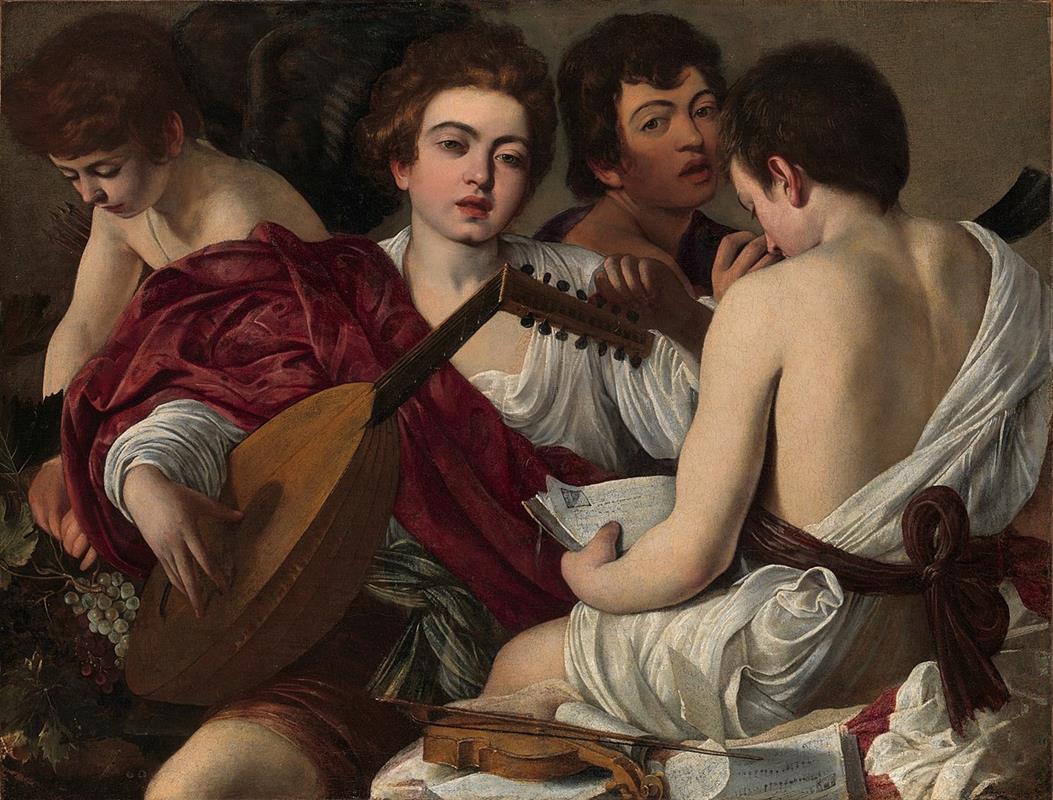
Caravaggio’s “Musicians” (1595) is a revelatory early canvas that gathers four young men into a narrow foreground to stage a drama of sight, sound, and desire. At first glance it appears to be a simple concert: a lutenist tunes or begins to strum, a singer turns a page of music, another figure leans in to play a cornetto, and a fourth boy at left reaches down toward a cluster of grapes with a faint Cupid’s wing brushing his shoulder. Yet the closer we look, the more the scene resists the casual category of “genre.” The painting is a manifesto for Caravaggio’s naturalism, an experiment in how bodies occupy space, and a meditation on love—both musical and erotic—carried by textures of skin, cloth, fruit, and wood under a single, focused light.
A Concert Of Bodies
Caravaggio compresses the quartet almost uncomfortably into the picture plane. Shoulders overlap, arms interlock, and instruments wedge between chests and knees. The lutenist dominates the foreground, his instrument’s oval pushing forward like a second torso. Behind him, the cornettist’s face emerges in profile, lips puckered, cheeks taut with breath. To the right, a boy with his back to us bends over a score, the sash at his waist crisply tied; to the left, a youth with softly curling hair dips toward grapes, the brush of a small wing marking him as Cupid. These bodies do not occupy a politely staged tableau. They crowd the space with palpable weight and heat, making us feel the closeness from which music is born.
Composition As Choreography
The design is triangular, but its energy is circular. The lutenist’s gaze meets the viewer’s directly, pulling us into the ensemble. From his eyes we travel to the cornettist’s half-shadowed face, then down to the reader’s turned back and the sheet of music he holds, across to the violin and scattered pages at the lower edge, and back up through Cupid’s bowed head. Draperies echo the movement: the crimson mantle at center swirls around the lutenist’s shoulder, the white shirts ripple with sleeve folds, and the brown sash cinches the reader’s waist with a rhythmic knot. This choreography of glances, fabric, and limbs produces the sensation of an ensemble tuning itself into a single pulse.
Light, Shadow, And The Credibility Of Sound
Caravaggio’s famous chiaroscuro is already present in 1595, though more tender than in his later, starker works. A soft but directional light enters from the left, slipping across shoulders, cheeks, and instruments. It turns the lute’s ribs into a warm sequence of highlights and throws the cornetto’s finger holes into miniature wells of darkness. The white linen catches this illumination with particular appetite—the sleeve at left glows with a vaporous softness, the sash on the reader’s back snaps with a sharp edge of light, and scattered pages of music gleam like little mirrors. This not only shapes the forms; it also makes the sound imaginable. We sense the audible brightness of plucked strings and the breathy grain of a cornett tone because the light models the instruments with such frank clarity.
The Lute As Protagonist
The lute is the centerpiece of Caravaggio’s still-life virtuosity. Its soundboard bears subtle wear, the rosette’s filigree is delicately incised, and the angled pegbox bites into space with convincing geometry. The musician’s left hand hovers in a poised curve, fingers ready to settle; his right hand rests loosely, prepared to strike. The lute becomes an extension of the body, echoed by the curve of the lutenist’s shoulder and the swelling folds of crimson cloth. Caravaggio’s faithful description of the instrument is not mere craft; it is psychological. The lute’s roundness and warmth embody the painting’s theme of sensual fullness—the state of being tuned by proximity, touch, and expectation.
Cupid Among Musicians
The youth at left, barely winged, introduces the picture’s most subversive idea. Music and love are traditional companions, but Caravaggio literalizes the allegory by placing Cupid within arm’s reach, not as a hovering emblem but as a participant. He leans toward grapes—symbols of Bacchic pleasure—while his downcast eyes and parted lips echo the introspective mood of the ensemble. The gesture folds Eros and Dionysus into a single, secular atmosphere. The implication is delicate rather than didactic: the harmonies at play are not purely musical, and the vulnerability provoked by song is kin to the submission of love.
Intimacy And Androgyny
Caravaggio’s models blur gender lines. The lutenist’s features are soft, his cheeks luminous; the reader’s shoulders are broad yet smooth; Cupid’s bare torso is adolescent and ambiguous. This androgyny intensifies the painting’s erotic charge while avoiding vulgarity. It also aligns with the tastes of the aristocratic Roman collectors Caravaggio courted, who prized the beauty of youthful bodies and the intellectual play of allegory. The painter heightens the effect by dressing the boys in loose studio costumes—white chemises slipping off shoulders, a mantle cascading like stage drapery—so that the scene sits between rehearsal and performance, the threshold where identities are most fluid.
The Score As Narrative
Scattered sheets of music serve as more than props. They animate the surface with flickers of whiteness and suggest an unfolding time. The page in the reader’s hand is mid-turn; the violin and bow lie idle, implying a recent pause or a part yet to join. The sense of imminence—sound about to start—imbues the quiet scene with tension. Caravaggio freezes the breath before the first note, the fragile second when concentration bends the world inwards. That chosen instant reveals the painter’s talent for capturing action in potential rather than motion, a strategy that would later anchor his most dramatic religious scenes.
The Violin As Counterpoint
At the lower edge, a violin lies across a folded cloth, its amber varnish glistening. It is secondary to the lute but vital to the composition’s balance. Where the lute is round and expansive, the violin is narrow and linear; where the lute projects forward, the violin nestles horizontally. The pairing creates visual counterpoint, just as in music one voice complements another with contrasting rhythm and range. Caravaggio uses instruments as compositional voices, and in doing so he turns still life into music by other means.
Skin, Cloth, And The Erotics Of Texture
Caravaggio’s great gift is to translate touch into sight. The painting glows with tactile contrasts: the cool sheen of linen against the warmth of flesh, the velvet gravity of the crimson cloak, the polished grain of wood, and the tender bloom of grapes. Skin is neither idealized marble nor moralizing flesh; it is simply alive—fretted with soft shadows, punctuated by a knuckle, a dimple, a wrist’s bluish vein. The result is intimacy without sentimentality. We feel the heat generated by bodies working together in a small room, a heat that arises from concentration as much as from desire.
A Stage Without Depth
The background is shallow and largely unarticulated, though not blank. A dark mass looms behind the lutenist, possibly a studio curtain; a narrow strip of wall grounds the figures. This limited depth draws the ensemble toward us, compounding the effect of inclusion. There is no escape into distant architecture; we share the air these boys breathe. The immediacy anticipates the frontal pressure of Caravaggio’s later canvases and announces his preference for human drama over elaborate settings.
Naturalism And The Training Of Sight
The painting reveals the young Caravaggio’s method: paint what you see, but choose what you see with ruthless intelligence. He observed live models in his studio, lit them with a controlled source, and aimed for optical truth rather than ideal beauty. Yet within that truth he composed with refinement—deciding which edge should harden, which fold should brighten, which gaze should meet the viewer. “Musicians” is thus both natural and made, a paradox that lets realism bloom into poetry. The lesson is that accuracy can serve emotion when governed by selective focus.
Music As Allegory Of Painting
Caravaggio’s concert is also a self-portrait of the artist’s craft. Music requires tuning, collaboration, and the disciplined management of intervals; painting asks for the same. The lutenist’s hand poised above strings mirrors the painter’s brush about to touch canvas. The cornettist’s breath control parallels the control of light and shadow. The reader’s turned back, intent on the score, resembles the painter’s inward focus amid a busy studio. Even Cupid has a role: he stands for the passion that fuels the whole enterprise. By staging these analogies, Caravaggio quietly argues that painting, like music, is a moral art of attention.
Human Faces As Instruments
The faces of the boys function like instruments with their own timbres. The lutenist offers a direct, luminous soprano of gaze; the cornettist, half in shadow, provides the husky midrange of intrigue; the reader’s unseen face becomes a silent bass, grounding the group with the fact of labor; Cupid’s downcast profile supplies the alto of modesty. The quartet’s expression ranges from openness to secrecy, and together they form a chord whose resonance is the painting’s mood. Caravaggio’s psychological orchestration is as deliberate as his placement of instruments.
The Sensual Morality Of Attention
Moralists sometimes read Caravaggio’s early boy pictures as purely erotic displays. “Musicians” complicates that verdict. Desire is present, but it is bound to work—reading, tuning, breathing, rehearsing. The sensuality is the sensuality of labor done with care. Even the grapes, that traditional emblem of pleasure, sit partly in shadow near a battered violin case, their sweetness proximate to discipline. Caravaggio’s ethic here is neither prudish nor indulgent; it is a celebration of diligence conducted within the charged field of beauty.
Patronage And The Roman Studio World
Painted during Caravaggio’s years with the sophisticated collector Cardinal del Monte, the work reflects a household that prized music, science, and the pleasures of conversation. The models are likely studio companions rather than professional performers, which lends the picture its mixture of amateur earnestness and aristocratic polish. This context matters because it explains the painting’s dual allegiance: it flatters taste while insisting on observation, it entertains while it studies, and it makes a courtly theme feel as immediate as a rehearsal glimpsed through an open door.
Color As Key Signature
The palette is closely held: warm flesh, crimsons, whites, browns, and the dusky wood tones of instruments. Within that restraint Caravaggio composes a harmonized score. The red mantle at center supplies a dominant note, echoed by the maroon sash on the reader and the reddish varnish of the violin. Whites act as highlights—the sleeve, chemises, and sheets of music sparkle like grace notes. Earthy browns ground the scene in human warmth. The color never distracts from form; it articulates the rhythm of the composition the way key and mode structure a piece of music.
The Moment Before Sound
One of the canvas’s miracles is its ability to make silence audible. The lutenist’s fingers hover, the cornettist’s lips prepare, the reader’s page is mid-turn. It is the second of intake before breath becomes tone and touch becomes song. Caravaggio understands that anticipation is a powerful aesthetic resource. By stopping time here, he lets emotion pool in the viewer. We lean forward, supplying in imagination the first pluck, the first breath, the first chord. The painting thus recruits us as collaborators.
The Afterlife Of A Theme
“Musicians” seeds a lineage in European art: staged concerts with handsome youths, close-up instruments, and the sensual hush of practice. But few successors match Caravaggio’s psychological intensity or his ability to keep allegory grounded in touch. Later painters often drift toward theatrical genre, while Caravaggio keeps the mystery immediate. His achievement lies in the balance: enough symbolism to deepen the scene, enough realism to keep it honest.
Why This Early Work Matters
Seen alongside Caravaggio’s later religious masterpieces, “Musicians” may seem modest. Yet it teaches crucial lessons the artist would carry forward. It proves that sacred feeling can develop from ordinary concentration, that intimacy is more moving than spectacle, and that light’s authority is earned by its obedience to the physical world. The painting also demonstrates his unmatched command of the human face at close range, a skill that would give future saints and sinners their unforgettable presence.
Conclusion
“Musicians” is a compact universe of listening bodies, poised hands, and shared breath. Caravaggio compresses four figures into a single, audible hush and lets light shape their labor into beauty. Instruments become extensions of touch; cloth and skin conspire to register warmth; Cupid quietly reminds us that harmony is born where attention and desire meet. In this early canvas the painter articulates the credo that will guide his career: the human moment, observed with radical sincerity, is enough to carry the whole weight of art.