Image source: wikiart.org
Introduction
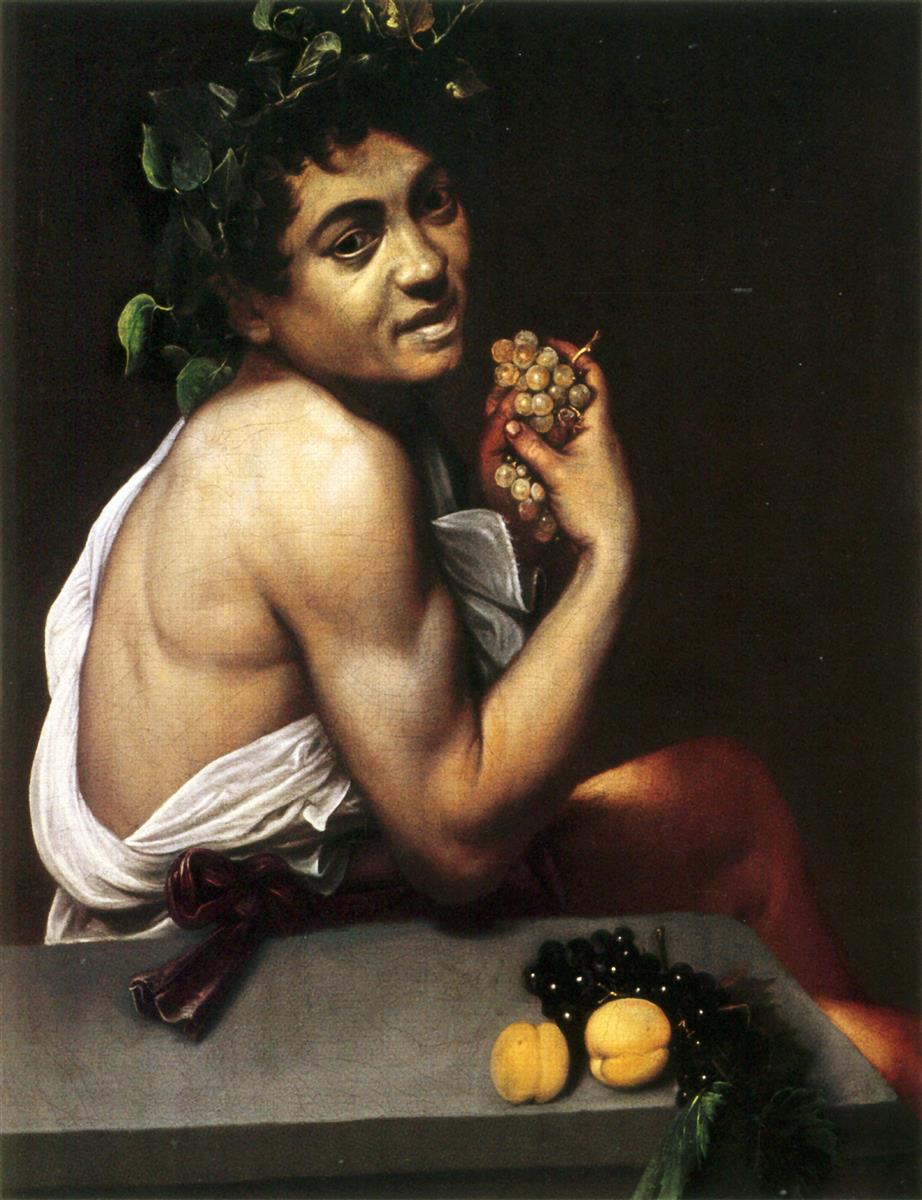
Caravaggio’s “Young Sick Bacchus” (1593) is one of the most unsettling and revealing self-presentations in early Baroque art. The painting appears, at first glance, to be a witty genre piece: a youth disguised as Bacchus, the Roman god of wine, wearing a crown of ivy and clutching a cluster of grapes. Yet the closer one looks, the more the costume collapses. The boy’s skin has a sallow cast, his lips tighten into a strained half smile, his fingernails are darkened, and the left shoulder bears the faint greenish tint of poor health. On the stone ledge a still life of apricots, black grapes, and a sprig of foliage sits in chill light, more morgue slab than banquet table. This is not mythic abandon but a cool study of frailty—likely painted when the young Lombard had recently recovered from illness. With shocking candor Caravaggio uses a classical mask to stage a manifesto for radical naturalism, turning the god of intoxication into a mirror of human vulnerability.
Rome, Apprenticeship, And A Self-Inventory
In the early 1590s Caravaggio arrived in Rome from Lombardy, hungry for commissions and armed with a training that favored direct observation. The Roman art world still prized mannerist elegance and antique quotations. “Young Sick Bacchus” comes from these first difficult years, when the artist was hustling in studios and selling small pictures to keep afloat. The canvas reads like a self-inventory. Instead of flattering patrons with a smooth ideal, Caravaggio gambles that truth—especially the truth of an ailing body—can achieve a new kind of authority. He borrows the title and trappings of Bacchus, but only to flip them. Laurel and ivy suggest revelry, yet the sitter’s stare is cautious and exhausted, the wreath wilting, the pleasure of fruit thickened into a reminder of appetite’s limits. It is as if the painter, still unestablished, tests what the market can bear while also testing himself.
Composition And The Turned Figure
The figure is cropped tightly against a dark, unarticulated background. Caravaggio chooses an unusual pose: the body twists away while the head swivels back toward us. This turn makes the entire composition a hinge. The left shoulder pushes forward, catching the main light; the right arm hooks around the grapes and a pomegranate held to the chest; the waist and hip are wrapped in a white sheet knotted at the side. The stone ledge at the bottom builds a cool, horizontal counterweight to the figure’s curve. By compressing depth and eliminating distractions, Caravaggio amplifies the tactile immediacy of skin, fruit, and cloth. We are as close as the painter, and the gaze we receive feels unguarded because the body is already turned, midmotion, as if caught before it could pose.
Light, Chiaroscuro, And The Temperature Of Skin
Light slides in from the upper left and measures the sitter with ruthless clarity. This is early Caravaggio chiaroscuro: strong but not yet the pitch-black theater of his mature altarpieces. The modeling is descriptive rather than rhetorical. A soft highlight rides the collarbone; the left shoulder blooms with cold light; the cheek holds a warmer flush that fades toward the jaw. Crucially, the painter allows green and gray tones to cool the flesh in the shaded areas, creating the pallor that gives the picture its name. Shadows are not opaque. They admit the brown ground and whisper of subcutaneous blood. The grapes he clutches share the same illumination as the shoulder and cheek, uniting still life and portrait in one optic field. Light is the impartial judge that treats everything with the same attention.
The Face As A Field Of Ambivalence
The expression refuses easy reading. The mouth tightens as if holding back discomfort; the eyes look outward but without the languor of a god in reverie. This is not drunkenness, not rapture, and not moralized repentance. It is the fatigue that follows fever, the inward watchfulness of someone who has recently tested his limits. Caravaggio’s ability to render psychological states through minute control of edges and values is already fully present. The eyelids are heavy but not swollen; a small highlight on the lower lip lends life rather than gloss; the shadow under the cheekbone is a measured plane, not a mannered notch. The viewer senses a living, singular person answering the light with whatever dignity he can gather.
The Body Without Idealization
Caravaggio deliberately abandons the smooth anatomies beloved of courtly painters. The back is compact and muscular, more worker than deity. Veins and tendons register beneath the skin. A faint blue-green tone on the shoulder, possibly referencing the jaundice-like cast seen in illness, is painted without exaggeration. The draped cloth, knotted casually, reveals as much about the studio’s realities as about mythic costume. Everything points to the painter’s refusal to lie. Even the fingernails, touched with darkness, assert the truth of a life that has been lived rather than staged. The result is a body that belongs to the world of experience. It dignifies the sitter by locating beauty in candor rather than in polish.
The Fruits Of Knowledge
On the ledge, Caravaggio offers a brief but resonant still life. Two apricots sit beside a gleaming coil of black grapes; a small sprig of foliage trails into the shadows. These are not lavish accessories; they are a quiet chord that sounds the painting’s key. Apricots, with their tender bloom and quick ripening, are seasonally fragile; the black grapes hint at the wine that traditionally belongs to Bacchus, yet here they read more medicinal than ecstatic. Their glassy highlights echo the cool sheen on the sitter’s shoulder and make a stark contrast with the blood-warm grapes clutched at the chest. The still life is both palate and parable. Pleasure is here, but in careful doses, arranged like a doctor’s ration rather than a god’s feast.
Costume, Ivy, And The Classical Inversion
The wreath of ivy leaves signals Bacchus by convention, but Caravaggio paints it with the same unsentimental observation he gives to flesh. Edges curl, some leaves show insect damage, and the crown sits slightly askew, as if set on quickly. A thin red sash peeks from the knot of the sheet, a trace of theatricality that the sober light immediately disciplines. The inversion is complete: myth serves reality rather than elevating it. Bacchus is not a license to indulge but a frame within which the painter studies recovery, appetite, and the endurance of the body under scrutiny.
Technique, Ground, And The Speed Of Decision
The brushwork is lean and decisive. Caravaggio famously painted directly from life without detailed preparatory drawings, and here he allows the warm priming to participate in the flesh, lending warmth to half-tones. The background is thinly scumbled to a near-black, creating a void that presses the figure forward. Highlights are placed with merciless economy. The grapes in the right hand are built with small glazed ovals touched by quick, bright caps; the apricots are modeled by broader, velvet strokes that preserve their bloom. The sheet’s folds are described with long, dragged lines that assert weight without fussy detail. Everywhere the surface feels alive because the marks read as decisions rather than habits.
A Self-Portrait And A Statement
Many scholars read “Young Sick Bacchus” as a self-portrait painted with a mirror, citing the left-handed grasp of the fruit and the unmistakable resemblance to other early likenesses. Whether literal self-portrait or close proxy, the image functions as a statement of identity. Caravaggio shows himself as a working body, not as an ideal. He accepts the mortal limits that classicism tended to ignore and turns them into a resource for truth-telling. By offering his own imperfect flesh to the discipline of light, he asserts what his art will be: a practice grounded in the observation of what is, not what should be. This ethic will later make his religious paintings so persuasive, because saints and sinners alike will be rendered as people with pores and weight.
Allegory Without Program
The painting admits allegorical readings without collapsing into emblem. Bacchus was historically linked with rebirth and seasonal cycles; here, the god’s attributes become an allegory for the body’s return from illness. The grapes near the heart suggest both wine and blood, both communion and convalescence. The twisted pose hints at the tension between appetite and restraint. Yet Caravaggio never insists. He trusts that meaning will arise from the exactness of surfaces and the rightness of relations. The more truthful the depiction, the more pliant it becomes for thought.
Dialogue With “Boy with a Basket of Fruit” And “Boy Peeling Fruit”
Placed alongside the two other early masterpieces, this painting reveals a spectrum of early concerns. “Boy with a Basket of Fruit” celebrates abundance offered; “Boy Peeling Fruit” observes quiet labor and discernment. “Young Sick Bacchus” adds a third note: the body’s limit, the sobriety taught by illness. All three works share a disciplined light, a shallow stage, and a fierce love of the tactile world. They differ in psychological temperature. Here, the coolness is palpable, not only in palette but in mood. The result is a triangular program: offering, work, and endurance, each explored without allegorical scaffolding, each grounded in looking.
The Ethics Of Imperfection
One of Caravaggio’s enduring gifts is his insistence that imperfection is not the enemy of beauty. In this canvas the blue-shadowed shoulder, the dark nails, the uneasy mouth, and the discolorations of fruit become instruments of truth. They are not provocations for their own sake; they are the materials by which the painting convinces us. This ethic has consequences. It democratizes attention, giving leaves and skin equal dignity. It dignifies the viewer as well, assuming we can receive unvarnished fact without moral panic. And it sets the stage for the later religious works where the credibility of the sacred derives from the palpability of the ordinary.
Psychological Realism And The Viewer’s Role
The painting’s turning pose makes the viewer an active participant. We catch the youth mid-turn; he has not arranged himself for us. The gaze he throws back carries the faint reflex of someone who has been called unexpectedly. That momentary acknowledgment draws us close without collapsing distance. We witness, but do not intrude. This tact is crucial to the image’s power. It grants the subject privacy even as it measures him. The effect is not voyeurism but witness, a stance Caravaggio would refine in scenes such as “The Calling of Saint Matthew,” where the viewer becomes the silent third at the table.
Color, Harmony, And Controlled Heat
The palette is restrained and intelligent. Flesh runs from warm ochres through cool olive half-tones; the white sheet moves from pearl gray to brief flashes of chalky light; the grapes balance honeyed yellow against bitter green; the apron of black grapes on the ledge anchors the lower edge with a bass note. Small red accents in the sash and pomegranate skin keep the range from slipping into chill. Caravaggio thus composes with temperature rather than with high saturation, fitting the mood of convalescence and study. The harmony feels inevitable, as if dictated by the light itself.
Reception, Afterlife, And Influence
The early self-portrait-as-Bacchus quickly became emblematic of Caravaggio’s difference. Copyists and followers imitated its turning pose and tactile still life but rarely matched its psychological poise. In the long arc of art history the painting reads as a threshold. It marks the point at which classical subject matter submits to modern scrutiny, and it demonstrates that a painter can make a compelling public statement out of private truth. Later artists—from Velázquez to Courbet—will draw courage from this kind of candor, finding in the unidealized body a channel for ethical clarity.
Why The Picture Still Startles
“Young Sick Bacchus” startles because it refuses to separate myth from mortality. Rather than using antiquity to escape the human condition, Caravaggio uses it to expose that condition. The result is not cynical. The boy’s endurance, the steadiness of his grip, and the persistent gleam of the grapes are quietly heroic. The painting honors appetite while acknowledging fragility, and it does so without rhetoric. Its authority comes from the ring of truth in the observed detail and from the humane intelligence of its structure.
Conclusion
Caravaggio’s early Roman period gave European painting a new contract with reality. “Young Sick Bacchus” is one of the signatures on that contract. A youth crowned with ivy turns back to us, pale yet alert, holding fruit that is both pleasure and measure. The light is cool, the space shallow, the surfaces exact, the drama internal. From these limited means the painter draws a work of enduring gravity—an image that teaches attention, tempers delight with knowledge, and finds in the ordinary body the ground for modern art.