Image source: wikiart.org
Introduction
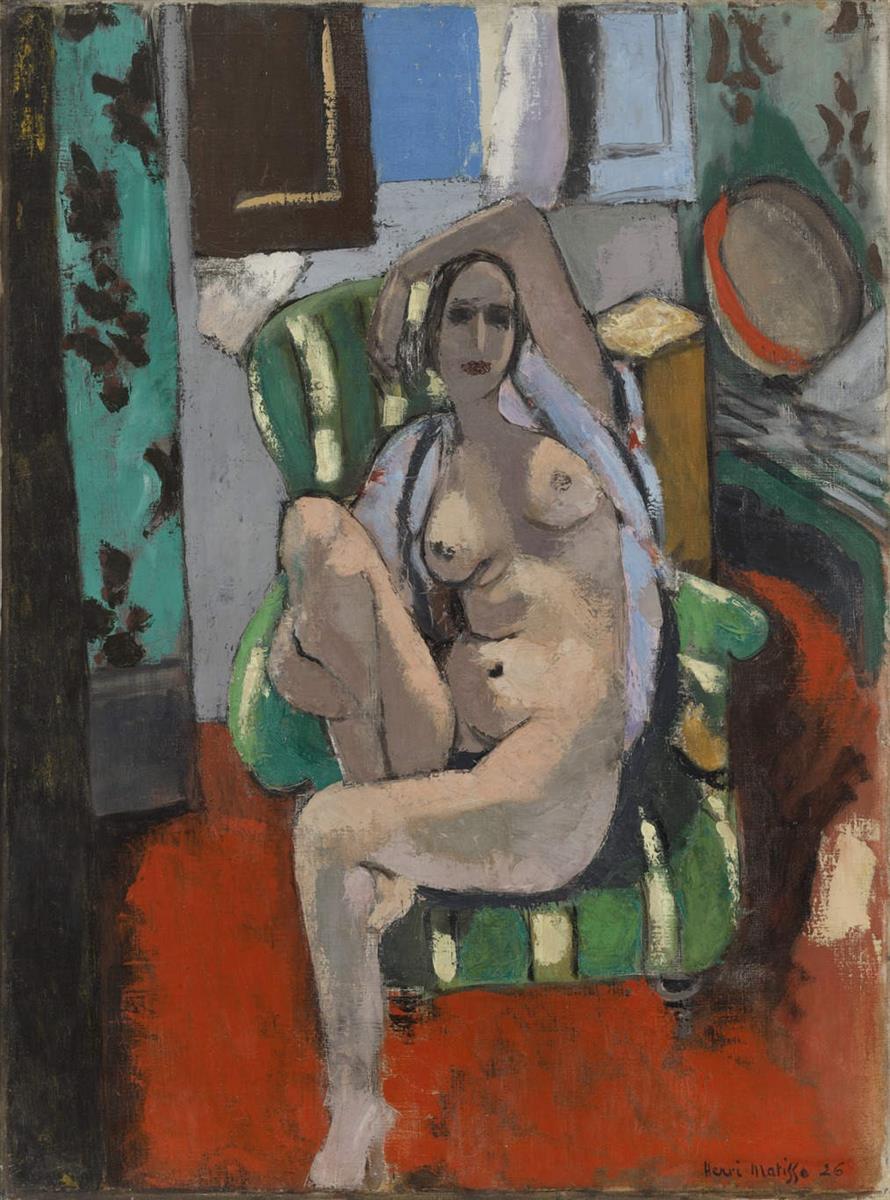
Henri Matisse’s “Odalisque with a Tambourine” (1925) compresses the drama of his Nice interiors into a taut, vibrating image: a nude model reclines and twists in a green-striped armchair, one arm thrown overhead, the other crossing the torso, while a tambourine rests at the right edge among draperies. The room is stitched together with blocks of teal, brown, and blue, and the floor flares in a burning red. Nothing here is incidental. The pose, the chair’s stripes, the window’s pale panes, and the drum’s ochre ring all participate in a carefully tuned chord where color and contour carry the psychological weight. It is a work that feels relaxed in theme yet rigorous in construction, a hallmark of Matisse’s mature Nice period.
The Nice Period and the Odalisque Reimagined
By the mid-1920s Matisse had turned the Mediterranean light and modest hotel rooms of Nice into a personal theater. The odalisque—a European studio fiction borrowed from Orientalist imagery—gave him a permissive framework: languor, patterned fabrics, studio props. In his hands, the theme is less a fantasy of elsewhere than a means of investigating relationships on the canvas. “Odalisque with a Tambourine” belongs to a subset where the figure is frontal, cropped close, and nested in a capacious chair. Narrative expectation dissolves into decorative intelligence: the tambourine is present, but it is a pictorial disk first, a cultural sign second.
Composition as a Coil of Energy
The composition tightens around a spiral that begins at the figure’s lifted forearm, descends through the head and breast, turns across the crossed leg, and resolves at the grounded foot against the red floor. The chair’s green verticals counter this coil, while the rectangular beats of window and wall hold the swelling forms in check. The cropping is bold; Matisse brings us so close that the body, chair, and floor become interlocking shapes. Space is shallow by design: the armchair presses forward, the floor rises, and the far wall acts like a painted screen. This compression energizes the pose, making repose feel charged rather than slack.
Color as Architecture and Temperature
Color organizes the room and sets its emotional temperature. The floor’s volcanic red is the dominant field, saturating the lower half and licking upward at the edges. Against it the chair glows in cold greens striped with cream, a cooling counterweight that keeps the red from overheating. The figure’s flesh is a complex weave of warm and cool grays—violet at the shadows, peach at the lit planes—so the body belongs to both climate zones at once. Patches of cyan, teal, and sky blue appear around the window and drapery, breathing air into the boxed interior. Ochres and browns in the tambourine and shutter provide earthy accents that tether the palette. The chord is high-contrast without being garish, a disciplined conversation between heat and coolness.
The Tambourine as Pictorial Counterpart
Placed to the right and partly occluded by fabric, the tambourine works as a circular echo of breast, knee, and head. Its ochre ring, brushed with a red edge, repeats the floor’s warmth in a higher key. Rather than advertise performance, it acts as a compositional weight that balances the green chair and the blue window. The idea of sound—latent rhythm, offstage music—hovers, but the drum’s primary function is visual: a round pause within a field of angles and stripes.
Pattern, Stripe, and the Discipline of Ornament
Pattern in this painting is structural, not superficial. The armchair’s vertical stripes pace the largest volume in the image and clarify the chair’s bulges without heavy modeling. At left and right, patterned textiles soften the room’s geometry while anchoring two color columns—teal foliage at left, earthier motifs at right. The window panes introduce a small grid of light squares and a single sky-blue panel, a cool rest amid the red and green. These patterns are measured like musical bars, giving the eye a time signature as it moves across the canvas.
The Authority of Contour and the Economy of Drawing
Matisse builds the figure with a few assertive lines that expand and contract with the turn of form. The jaw is firm, the nose carved in a single slant, the eye sockets set with dense darks that give the face its masklike dignity. Around the torso, contour loosens into broken, breathing edges so the body can merge with the surrounding air. The hands—one behind the head, one crossing the ribcage—are simplified to their structural arcs. There is no virtuosic modeling; volume arises from the duet of line and color temperature. This economy grants the nudity gravity rather than spectacle.
Light, Atmosphere, and Mediterranean Quiet
Light enters indirectly, as if filtered through the adjacent room and bouncing off pale walls. Instead of sharp highlights and theatrical shadows, the painting is modeled by small temperature shifts and scumbled transitions: a warm veil along the sternum, a cool gray under the thigh, a dusky violet at the wrist. This treatment keeps the atmosphere calm even as the colors intensify. The window—patches of white, gray, and blue—suggests daylight more than it describes a view, letting the interior remain sovereign.
Space, Depth, and Productive Ambiguity
The painting balances legible space and decorative flatness. The chair’s volume is credible, yet its stripes flatten its bulges into rhythms on the surface. The floor recedes, but the red field also reads as a broad plane of pigment. The window promises depth but functions mostly as a color panel. Even the tambourine hovers between object and disk. This fruitful ambiguity invites two readings at once: a woman in a chair and a constructed tapestry of shapes. Moving between them keeps the image alive.
Gesture, Process, and the Feel of Paint
The surface tells the story of its making. Thick, dragged strokes articulate the chair; drier brushes scumble flesh so that underlayers breathe through; the red floor is laid with dense sweeps that leave bristled edges. Passages show revision: a shoulder line adjusted and softened, a window patch repainted with a cooler tone, an arm contour pulled and reasserted. The tactile record of decisions mirrors the model’s own poised rest—beneath serenity lies work.
The Figure as a Modern Icon
Although labeled “odalisque,” the model reads as a modern person occupying a modern room. The short bob frames a direct, unflustered face. The posture is theatrical but not submissive; the lifted arm feels like a stretch rather than an invitation. She is an axis around which the room’s relations organize, not an object dissolved by pattern. Matisse transfers the authority once reserved for classic nudes to a contemporary model in a modest interior, demonstrating that monumentality can be achieved without marble, allegory, or myth.
Dialogues with Matisse’s Earlier and Later Work
This canvas speaks to several moments in Matisse’s career. From Fauvism it inherits the liberation of color from literal description, though now tuned to harmony rather than clash. It recalls the 1916 “Piano Lesson” in its compressed architecture and frank geometry, but replaces severity with warmth. It anticipates the late paper cut-outs in the way chair stripes, window panes, and the tambourine’s rim behave as flat, interlocking shapes. Within the Nice series, it stands among the more muscular statements—less lace and languor, more block and chord.
Rhythm, Music, and the Silent Beat
The presence of a tambourine invites a musical analogy the whole painting sustains. The chair’s stripes are a steady meter, the window panes a syncopated beat, the tambourine a round accent, the red floor a sustained pedal tone, and the figure a melodic line that stretches and resolves. Even the brushwork keeps time: long pulls for the chair, quick dabs along edges, scumbles for flesh. The room is quiet, but it throbs with a silent rhythm.
Orientalism Reconsidered and Redirected
Historically, odalisque imagery carried fantasies of the “exotic feminine.” Matisse neither rehearses those narratives nor formally repudiates the motif; he redirects it. The tambourine and draperies nod to the theme, but they serve pictorial ends. The figure’s agency—centered, unembarrassed, structurally necessary—counters voyeuristic tradition. By relocating the odalisque to the modern studio and binding her to a network of formal relations, Matisse turns a loaded subject into an instrument for thinking about painting.
Psychological Tone and Viewer Experience
The painting’s mood is alert repose. The model’s eyes are weighted by dark lids, her mouth set, her limbs arranged with deliberate ease. The red floor’s heat suggests life under the calm; the cool window’s patch suggests breath. As the viewer’s gaze loops—from face to arm to knee to tambourine to chair to floor—the painting quiets and intensifies at once. It invites prolonged looking rather than quick consumption, the way a held musical chord gathers complexity the longer it sounds.
Material Memory and the Ethics of Calm
The surface’s pentimenti—the moved contour, the repainted patch—signal patience. Matisse’s calm is not naïve; it is composed. In a decade jittery with change, the Nice interiors proposed an ethics of attention: arrange, adjust, reduce, tune. “Odalisque with a Tambourine” embodies that ethic. Harmony here is not sweetness; it is equilibrium achieved after negotiation among powerful forces—hot and cool, curve and stripe, volume and plane.
Why the Painting Endures
The canvas endures because its pleasures are structural and renewable. Each return finds a new hinge: the tambourine’s ochre answering the floor, a green stripe aligning with the forearm, a violet shadow cooling a hot passage, the blue window calming the face. The figure remains human and present, but the real protagonist is relation itself—the way colors hold one another, the way shapes interlock, the way a room can be both shelter and stage. It is this durable architecture of feeling that keeps the painting modern.
