Image source: wikiart.org
First Impressions and the Charge of Simplicity
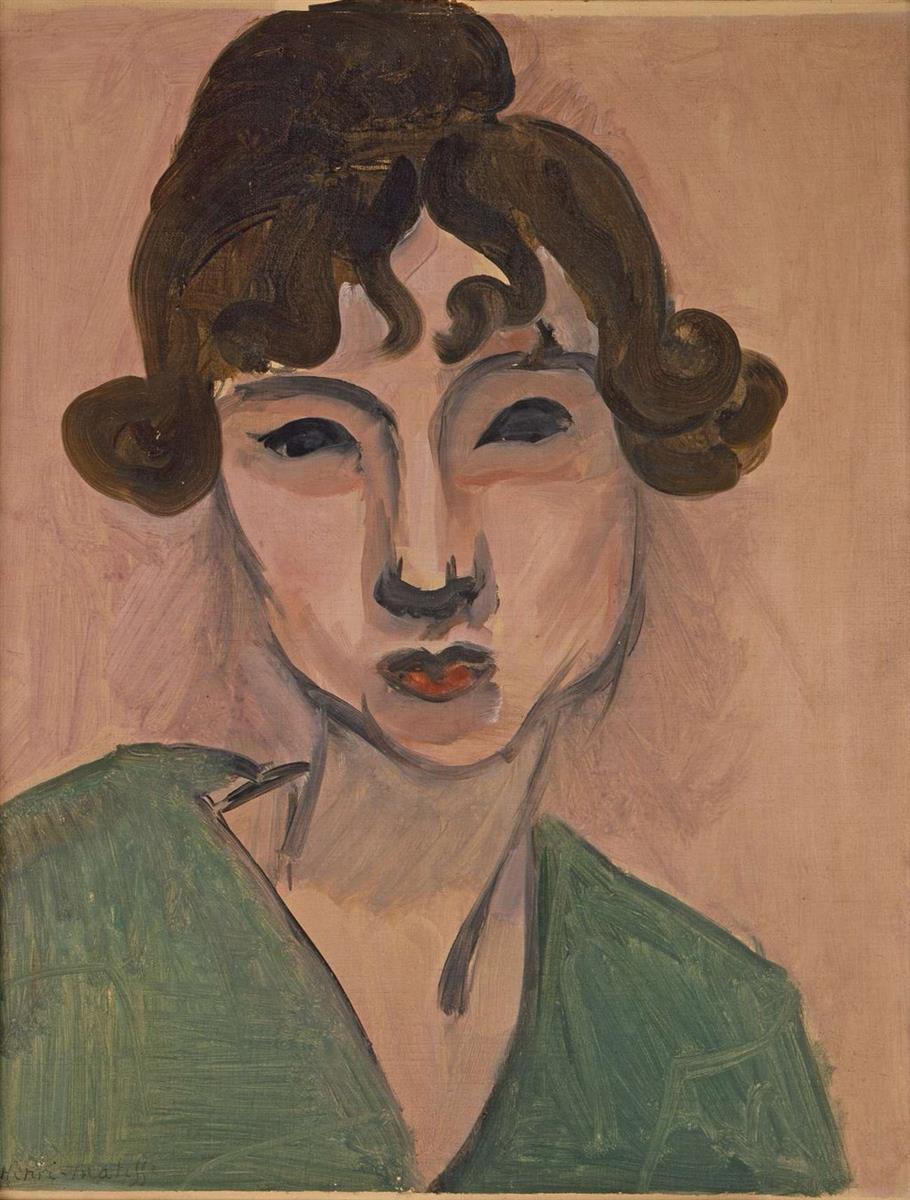
Henri Matisse’s “Laurette au Châle Vert” (1917) greets the viewer with a head-and-shoulders likeness stripped to essentials. A young woman, known across Matisse’s 1916–1917 output as Laurette, leans slightly into the picture, her hair swept up and curled into sculptural coils, her lips a compact flare of red, her garment a deep green shawl that rises like a wedge toward the chin. Behind her stretches a uniform, breathing field of pale rose. The image is so reduced that it risks feeling unfinished, yet that very spareness generates authority. Matisse offers the minimum number of forms necessary to anchor presence, and then he lets color, contour, and interval do the expressive work.
The Composition’s Tilt and the Geometry of the Head
The canvas is almost square, but Matisse unsettles that stability with a delicate tilt. Laurette’s head angles a few degrees to her left, the neck counter-tilting, while the green shawl thrusts diagonally from lower left toward the center. This opposition of axes keeps the portrait from locking into a static bust. The hairstyle, piled high and turning into three emphatic curls at the temples and nape, forms a dark crown that balances the mass of the shawl. The face itself is organized as a set of anchored triangles: the hairline cuts a shallow inverted V; the nose is a narrow wedge; the red mouth is a small lozenge; the shawl opens in a green V that repeats, at larger scale, the facial geometry. This repetition of shapes—V within V—provides structural consonance beneath the portrait’s casual air.
A Palette Tuned to Climate, Not Spectacle
The chromatic cast is restrained: rose for the ground; olive and pine for the shawl; warm and cool flesh notes in soft alternation; deep earth-browns and blacks in hair and contour; a measured red for the lips. In his Fauvist years Matisse let colors blaze; in 1917 he tempers the scale so that atmosphere, not fireworks, governs the room. The rose background cools the flesh without chilling it, and it sets the green shawl aglow through complementary contrast. The red of the lips is the painting’s most saturated accent, but it remains a punctuation mark rather than a cry, contained by the surrounding cooler temperatures. This climate of color—warm skin against cool rose, green cloth rising through that air—stabilizes the portrait’s mood of poised alertness.
Black as a Constructive Color
By 1916–1917 Matisse had reintroduced black as a structural color, and here it acts like the architecture holding the image upright. The eyebrows are supple arcs; the lids thicken into dark commas; the nostrils are firm dots at the nose’s base; the lip line is a single decisive curve; the green shawl’s edges are toughened with narrow runs of black; and the hair’s coils are described with dense, lacquer-like strokes that carry their own light. These marks are not mere outlines. They press and release, recording the speed and pressure of the brush, and they bear weight like wrought iron. Because black is allowed to be color—not just absence—it organizes the pale, high-key field without making the head feel cut out.
The Rose Ground as Breathable Space
The background is neither a wall nor a void. Matisse lays pale rose in broad, shifting passes, letting the brush’s direction create a gentle halo around the head and shoulders. Variations of warm and cool within the pink keep the field lively; it never collapses into poster flatness. This breathed surface does subtle work. It equalizes the chroma of flesh and garment, it reads as light rather than as architecture, and it grants the face’s planar transitions a softness that more assertive backgrounds would crush. The rose becomes a climate rather than a location, and in that climate the figure can expand.
Modelling by Planes and Temperatures
Laurette’s face is not built out of detail; it is constructed from adjacent planes whose temperatures carry the turn. A cooler shadow tucks beneath the brow; a warm cheek swells toward the viewer; a cooler note at the jaw withdraws into the neck; a pale band rides the bridge of the nose and is pinched into a narrow highlight at its tip. The throat is divided by a single, long, cool stroke that signals the vertical column without heavy shading. This planar method allows the portrait to read clearly at a distance while retaining softness at close range. It is an ethic of economy: do enough to ensure volume, then stop before polish drains life.
The Green Shawl as Structural Counterpart
The garment named in the title—the green shawl—does more than clothe. It is the composition’s base and counterweight. Its triangular rise from the picture’s lower edge points toward the mouth and nostrils, leading the eye back into the face. The green is carried in varied densities, from rich pine at the garment’s deeper folds to olive and jade in the crests where light catches. The paint sits differently here than in the flesh, with longer, slightly drier strokes that suggest fibrous cloth. Where the shawl meets the neck and hair, hairline blacks and cool grays prevent shapes from bleeding together, a subtle bit of carpentry that keeps the portrait crisp.
Hair as Sculpture and Calligraphy
The hairstyle is a marvel of dual function. Massed up and back, with three curled outcroppings, it behaves as sculpture, giving the head amplitude and upward energy. At the same time, those curls are calligraphic loops—bold, rhythmic, nearly abstract. Matisse brushes them in with a heavy mixture that leaves ridges and shallow valleys, catching actual light on the painting’s surface. This textural variety contrasts with the thinner paint of the background and flesh, reminding us that different materials are at work: glossy hair, breathing skin, woven cloth, airy wall. The hair’s darkness also anchors the composition’s value structure, keeping the head from dissolving into the high-key field.
The Lips as a Small, Decisive Theater
Among the portrait’s few saturated notes, the lips are the most eloquent. Their color is a contained vermilion, deepened at the center and eased at the corners, their contour a single, sure stroke that stops short of fetishizing moisture or texture. Set against the cool notes at chin and throat, the red warms the face from within; set within the green V of the shawl, it echoes complementary harmony in miniature. Because Matisse avoids theatrical expression elsewhere, the mouth’s slight press becomes a source of quiet drama: reticence, contemplation, a gentleness that knows its own line.
Light as a Democratic Envelope
Illumination arrives without theatrics. There is no hard shadow cast from a single directional source. Instead, light floats evenly, clarifying planes and allowing color to speak. Highlights concentrate at the bridge of the nose, at the crest of the cheekbones, on the forehead’s central swell, and as soft flares on the hair’s coiled ends. Shadows are cool and modest, especially under the jaw and eye sockets. This democratic light is central to Matisse’s aim during these years: to produce images that offer balance and repose while remaining vibrantly alive.
Brushwork and the Truth of the Surface
Stand close and the painting registers the tempo of its making. The rose ground’s strokes vary in direction like breezes; the flesh is laid with shorter, interlocking marks that follow anatomical turns; the shawl shows longer pulls that read as textile; the hair carries denser, looping tracks. These shifts of velocity and pressure keep the small canvas animated without clutter. They also assert painting’s material honesty. Matisse does not buff the surface into anonymity; he lets touch remain visible, so that presence is understood as something made, not conjured.
Space by Overlap and Interval
Depth is achieved with simple means: the shawl overlaps the neck; the curls overlap the background; the hairline overlaps the brow. The background’s consistent value keeps the space shallow, a deliberate compression that enhances intimacy. Intervals are carefully tuned: the distance from lip to chin; the narrow strip of skin between hair and brow; the breathing room between the head and each edge of the canvas. These measurements, more than any modeled depth, establish the portrait’s poise and the viewer’s comfortable proximity.
Laurette as a Motif and the Discipline of 1917
Laurette—sometimes called Lorette in catalogues—was Matisse’s primary model in the months spanning late 1916 and 1917. Across dozens of canvases, drawings, and prints she appears with turbans, patterned dresses, green shawls, and in states of rest or quiet alertness. “Laurette au Châle Vert” belongs to the austere end of that spectrum. Compared to the odalisque fantasies of the early 1920s, this portrait is all restraint: a tightened palette; black as structure; even light; reduced anecdote. It exemplifies Matisse’s wartime discipline, when clarity rather than spectacle governed the studio and when the painter rehearsed how few elements could yield durable presence.
Dialogues With Tradition in a Modern Accent
The bust-length female portrait is among Europe’s oldest genres. Matisse keeps faith with its essentials—frontal gaze, head-and-shoulders crop, calm light—while discarding the trappings that once signaled status and narrative. There is no jewelry, no embroidered interior, no window to a landscape. Instead, he converses with tradition as an argument about structure. The echoing Vs of hairline, nose, mouth, and shawl recall the canonical concern for geometry in portrait composition, but the brush’s frankness and the high-key rose ground declare the picture thoroughly modern.
The Eye’s Path Through the Picture
Matisse choreographs a satisfying itinerary for the gaze. Many viewers enter at the red of the mouth, climb the narrow ridge of the nose to the dark keystones of the brows, circle through the almond-shaped sockets, and expand into the hair’s looping curls. From there the eye descends along the jaw’s cool edge to the green shawl, follows its diagonal toward the lips again, and repeats the circuit. Each turn is punctuated by clear contrasts—green against pink, red against cool chin, black curls against rose air—so looking becomes rhythmic rather than restless.
What the Painting Refuses
The portrait gains much by refusing more. It refuses the temptation to finish every edge; it refuses the lure of descriptive detail; it refuses the condescension of sentimentality. Those refusals are ethical as much as stylistic. They propose that a sitter deserves clarity rather than decoration, structure rather than chatter. Laurette’s dignity is lodged in the exactness of relations: how the green meets the rose, how the black calligraphy rides the planes, how the red mouth holds its own amid cool light.
Comparisons Within the Laurette Series
When set beside other Laurette portraits, this canvas reads as a distilled variant. In “Lorette with a White Blouse,” Matisse lavishes attention on fabric and sleeve; in “Lorette with a Cup of Coffee,” a still-life counterpoint deepens the narrative; in “Lorette in a Turban,” a patterned robe and garden greens amplify decorative richness. “Laurette au Châle Vert” strips those contexts away. What remains is fundamental: the person and the painter’s language. This stripping down is not a step back from complexity; it is complexity concentrated into structure.
The Shawl’s Green and the Psychology of Poise
Color psychology is often misused, but here the green’s work is legible. It calms the portrait, cooling the heat of rose and red, and it inflects Laurette’s presence toward poise rather than flirtation or spectacle. The chroma is strong enough to declare itself yet held back from cliché jewel-tones. Because the shawl rises in a V, the green’s cooling effect gathers near the throat and mouth, exactly where the most saturated warm—the lips—rests. This tension of temperatures at the picture’s center produces an inward steadiness that the viewer can feel.
Material Particulars That Reward Looking
Close inspection reveals the practical life of the image: a pentimento where the jaw was adjusted inward; a strengthened stroke at the nose’s right edge to tighten the wedge; a place in the background where a warm underlayer peeks through the rose and lends it breath. Such particulars prevent the painting from becoming a diagram. They keep it human—decisions made and remade—while preserving the portrait’s overall inevitability.
Why “Laurette au Châle Vert” Endures
The canvas endures because it answers a difficult question with grace: how little is needed to make a portrait that carries human presence and pictorial satisfaction? Matisse’s answer here is not asceticism but measure. A limited palette, a few planes, a handful of black strokes, and well-tuned intervals are enough. From across the room the image reads as a clear, modern bust; up close the surface rewards attention with the pleasure of touch and the intelligence of restraint. It is a painting that steadies the eye and, through that steadiness, offers the calm Matisse hoped his work would give to thoughtful viewers.