Image source: wikiart.org
A Face That Fills the Frame
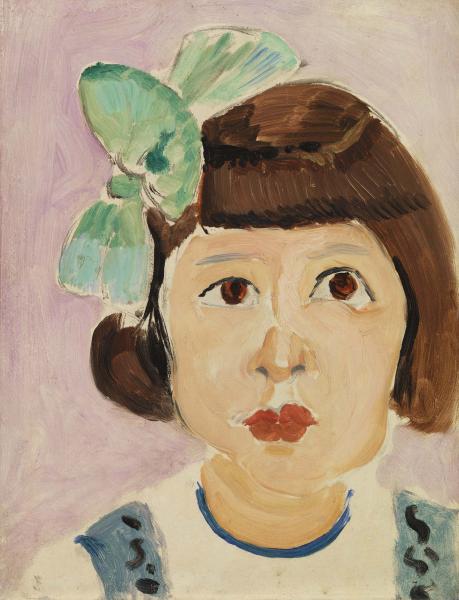
Henri Matisse’s “Head of a Young Girl” (1917) is a small canvas with large presence. The child’s face occupies almost the entire surface, a round world of warm light framed by a blunt bob of brown hair and crowned with a mint-green bow. A lilac field surrounds her like a soft aura. Nothing distracts from the encounter: no furniture, no window, no narrative props. The directness is disarming. Matisse brings us close enough that the picture stops being a portrait in the conventional sense and becomes an experience of looking—at planes, edges, temperatures, and the quick certainty of a painter’s hand.
Cropping as a Modern Gesture
The first modern decision is the crop. The top of the bow and the lower edge of the blouse both meet the frame, telling us that the picture is not about a child situated in a room but about a head set in color. The face rises like a moon inside the rectangle; shoulders barely enter, noted only by two small epaulette-like passages of blue that steady the composition. The eyes sit just above mid-height, and the mouth—pursed, newly red—centers the lower half like a small seal. The cropping denies anecdote and asserts design: round face, squared fringe, thick bow, oval pupils. It reads instantly across a room.
Palette as Climate
Matisse builds the scene from a handful of hues: warm peach and ochre for skin; chestnut and black for hair and contour; a tender lilac background; blue accents at collar and shoulder trims; and the mint-green bow that carries the picture’s cool light. Because the scale is small, the relationships do the expressive work. The lilac field cools the warm skin without turning it sallow. The blue collar keeps the lower edge fresh and lifts the head, while the bow’s green notes prevent the brown hair from clamping the composition shut. Nothing is saturated to shouting; all color is tuned to daylight, generous and even.
The Bow as Pictorial Engine
That mint bow is not an accessory so much as a pictorial engine. It introduces the highest value in the painting, a breath of near-white where light seems to accumulate, and it sets up the only large, cool shape that competes with the face. Matisse paints it quickly, with loaded strokes that describe both knot and loop in the simplest terms. The bow’s green modulates into turquoise and pale jade, and within those shifts it finds enough life to justify its prominence. Structurally, the bow keeps the top of the composition from feeling heavy with hair; psychologically, it reminds us that childhood is curated by adults—someone tied this knot—but the painter refuses sentimentality. The bow is paint first, symbol second.
Black Contour as Architecture
By 1917 black had returned to Matisse as a constructive color. Here it operates like wrought iron: the arc of the hairline, the crisp fringe, the almond rims of the eyes, the small notch of the nostrils, and the scalloped line dividing lip from lip. These strokes thicken and thin as they travel, recording pressure and speed. They are not outlines filled in later; they are structural decisions that let the big color fields stay broad and frank. Around the jaw and cheek, the line softens and occasionally vanishes so that flesh can breathe into background. This alternation—firm where needed, absent where not—keeps the head from hardening into a mask.
Modeling by Planes, Not Details
The face is built with planes rather than with descriptions of features. Look at the forehead: a pale, wide table that rolls gently toward the fringe. Each cheek is a warmer wedge, turning with only a shift in temperature and a slight deepening of value along the nasolabial fold. The nose is a narrow, cool ridge, shaded just enough on one side to read as volume; the mouth is compact, with a central bloom of deeper red and paler edges that imply moistness without highlights. There is no eyelash counting, no fussing at pores; the likeness arrives from the fit of these few planes. It’s a method that honors both drawing and paint.
The Background as Breath
The lilac field is not a wall; it is a breathable atmosphere. Matisse lays it with broad, circular strokes so that it never congeals into a flat poster color. Bits of warmer ground peer through at points, and the brush’s direction shifts around the head, setting up a halo-like motion that gently frames the face without literalizing it. The chroma is low enough to stay politely behind the head yet high enough to keep the flesh tones lively. This background is a master class in how to use “empty” space to do real work.
Eyes That Hold the Room
The title calls attention to the head, but the composition insists on the eyes. They are not particularly detailed—dark irises, a small highlight, simple lids—but they are perfectly placed: slightly elevated, just off symmetry, with the tiniest asymmetry in shape that prevents doll-like regularity. Their direction is ambivalent—somewhere between looking out and looking up—which suspends the moment between attention and inwardness. Children often look this way when a thought meets a room full of adults. Matisse catches it without dramatics.
Gesture, Mouth, and the Drama of Childhood
If the eyes hold the room, the mouth gives the picture its drama. It is pursed into a small flower of red, neither smile nor frown, a shape that suggests both stubbornness and concentration. Matisse deepens the color at the center to imply pressure and lets it fade toward the edges so that the lips remain soft. The result is a reading of childhood that resists sugar. The child is not cute; she is serious in the way that children are when a grown world becomes briefly theirs to measure.
Brushwork You Can Feel
Stand close and the surface is candid. The hair is swept in dense, lacquer-like passes whose direction changes at the curve behind the ear. The bow is laid in broader, wetter strokes that carry white, green, and a touch of blue in a few loaded gestures. Flesh is a mesh of short, directional strokes that follow the turn of cheek and chin. The background’s stroke is larger and more relaxed, preserving the weave of the canvas in places. These different velocities—dense in hair, loose in bow, measured in flesh, floating in background—keep the small picture lively.
The Role of Blue Accents
Two quiet blues do major work: the collar’s narrow arc and the paired shoulder trims. The collar forms a cradle for the head, separating face from ground and giving the composition a clean horizon. The shoulder marks, placed symmetrically but not mechanically, echo the bow’s coolness and keep the lower half from feeling underwritten. Their brushwork is brisk, almost playful, and they prevent the painting from resolving too neatly into head versus field.
Space by Compression
Depth is minimal by design. Hair overlaps cheek; face overlaps collar; shoulders overlap the lower edge. There is no room behind the head because none is needed. This compression intensifies presence. It also pushes the painting toward abstraction: a set of calibrated shapes that read as person because their relations are true. Matisse’s achievement is to give the viewer both—a recognizable child and a satisfying orchestration of forms.
1917: Discipline After the Blaze
The date places the work within Matisse’s wartime period, when the blazing Fauvist palette had settled into a more measured spectrum and black returned as a structural tone. The artist was working through a series of portraits of Lorette and other models, testing how few elements could deliver durable presence. “Head of a Young Girl” shares that ethic. It restrains chroma, clarifies contour, and trusts light as an even envelope rather than a dramatic event. In the years to come, Matisse would move into the patterned interiors of Nice; this canvas is a hinge—firm about essentials, ready for ornament.
Dialogues With Tradition, Spoken in a Modern Accent
The bust-length child portrait is a staple of European painting, often handled with anecdote and finish. Matisse converses with that tradition but speaks in his own syntax. Instead of polished transitions, he leaves the brush visible; instead of elaborate background, he offers a clear field; instead of storytelling objects, he trusts posture and planes. The bow, which in another hand might have turned into a sentimental flourish, becomes an abstract device for color and light.
The Eye’s Route Through the Picture
The painting proposes a simple and satisfying itinerary. Most viewers begin at the bow’s bright loop, slide to the blunt fringe, drop to the almond of the nearer eye, cross the bridge of the nose to the farther eye, then settle on the small red bloom of the mouth before returning up the cheek to the bow again. Each step is marked by a clean value or color contrast—mint against lilac, brown against peach, red against warm ochre—so the circuit can repeat without fatigue. Looking becomes a small circle of pleasure.
Material Facts That Ground the Image
There are modest pentimenti—small adjustments along the jawline, a reinforced stroke at the eyebrow, a slight expansion of the bow’s upper edge—that remind us the head was sought and found rather than traced. The canvas weave reads through thinner passages, and the paint sits with different bodies—creamier in flesh, denser in hair—so that light plays differently across the surface. These facts keep the painting out of illustration and firmly in the world of painted things.
Childhood Without Sentimentality
What makes the portrait compelling is its refusal of easy charm. The child is present and dignified, not prettified. Matisse acknowledges the cuteness of the bow and the roundness of the cheeks but balances them with serious eyes and a mouth that withholds. The painting recognizes that childhood contains concentration, will, and privacy, and it grants those qualities the same formal respect he gave to adult sitters.
Why This Small Canvas Endures
“Head of a Young Girl” endures because it accomplishes a hard task gracefully: it turns a head into a complete world with almost nothing. A few planes, a handful of colors, several decisive lines, and the courage to crop close—that is the recipe. It shows, too, how a painter can let color behave as climate rather than decoration and how contour can support rather than imprison. Across a room the face reads immediately; up close the work of the hand becomes a pleasure in itself.
A Closing Reflection on Clarity and Care
The longer you look, the more inevitable the picture feels. The mint bow could only be there; the lilac could only be that precise temperature; the collar’s blue could only be that thin arc. Such inevitability is the product of care. Matisse simplifies not to impoverish but to concentrate. In this concentration the child’s presence brightens, and the viewer receives what the painter often promised: balance, calm, and a gentle correction to the day’s disorder.