Image source: wikiart.org
A Portrait That Leans on Line, Light, and Looking
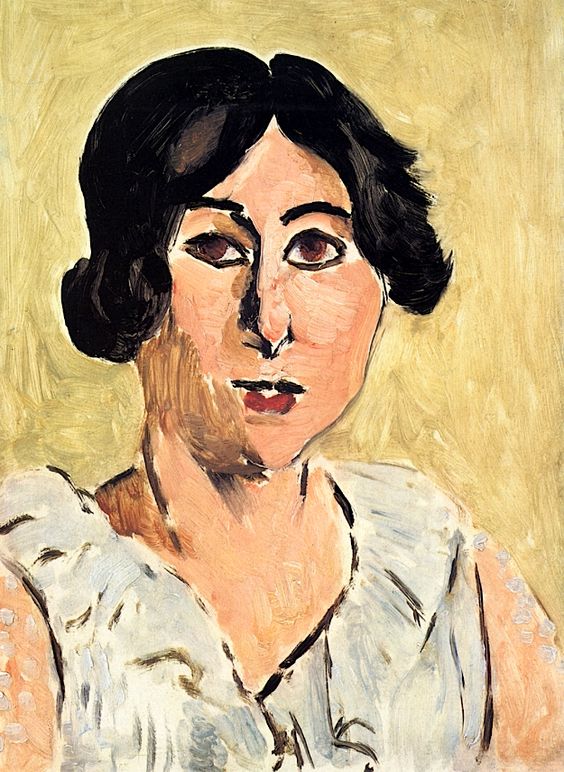
Henri Matisse’s “Lorette with Black Eyes” (1917) condenses a living presence into a handful of decisive elements: a close-cropped head and shoulders, a pale dress treated as a field of light, a matte, sandy ground, and a network of emphatic black contours that lock the likeness in place. The title points to the work’s most magnetic trait—the dark, almond-shaped eyes whose outlines do much of the portrait’s structural work—yet the painting’s power rests on how all parts cooperate. With very few colors and an economy of strokes, Matisse uses planes, edges, and temperatures to create a modern portrait that reads instantly across a room and then rewards patient, intimate viewing.
Frontal Cropping and the Architecture of the Head
Matisse brings the sitter so close to the picture plane that the portrait becomes a conversation rather than a spectacle. The forehead nearly meets the upper edge; the shoulders slope off before the canvas can answer their full width; the torso is abbreviated to a soft V of neckline and the faint suggestion of a collarbone. This compression compels the viewer to attend to the face’s architecture. The head is built like a small, coherent building: broad brow, triangular nose wedge, slightly asymmetrical cheeks, compact mouth. The shoulders behave like foundations, supporting the head’s mass without insisting on themselves. By eliminating anecdotal background and accessories, Matisse concentrates the composition around the structural dialogue of these planes.
A Limited Palette That Feels Like Climate
The color scale is disciplined and calm. The background is a warm, slightly olive ochre laid in with broad, swirling strokes; the dress is an ensemble of cool whites and pale grays that register as fabric and light at once; the flesh carries ochres, peaches, and cool notes that model plane without blush; the hair and the contouring of features are deep blacks and near-blacks that function as both color and drawing. Because the palette is so restricted, relationships do the expressive work. Flesh glows because the cool dress and warm ground are kept in balance. The blacks sharpen the image and decide rhythm. Nothing redundant is asked of color; everything present serves the portrait’s clarity.
Black Eyes and the Mask Logic of Modern Drawing
The painting’s name encourages you to begin with the eyes, and Matisse ensures that decision feels right. He constructs the eyes with dark, assertive curves for brow and lid, a single sweep to place the iris, and a small glint that keeps the gaze alive. Around them, a few strategic shadows describe sockets and bridge. The effect is mask-like but never inhuman. Matisse borrows the economy and authority he admired in non-Western carving and early modernist sculpture, yet the surrounding temperatures of the skin soften severity. The “black eyes” become the portrait’s anchor points, fixing direction and temperament while allowing the rest of the face to remain tenderly modulated.
Planes, Not Details, Make Likeness
Rather than chasing eyelashes or pores, Matisse builds the head with a sequence of planes whose joins carry recognition. The forehead is a gently warming field; the left cheek cools where it turns away; the right cheek carries a warmer note that pushes it forward; the nose is a narrow, vertical wedge that casts just enough shadow to state depth; the chin turns with a small, cool crescent; the neck mixes warm and cool to suggest both volume and the slight tension of pose. This planar thinking allows the portrait to hold together at any distance. From afar it reads as a clear, living structure; up close it reveals a weave of strokes that are honest about paint’s materiality.
The Dress as a Field of Light
The white dress is treated not as ornamental lacework but as a luminous plane broken by a few suggestions of seam, fold, and ruffle. Matisse lays in the whites broadly, nudging them cooler or warmer depending on proximity to skin and ground. Where he wants weight, he drags the brush to reintroduce the canvas’s texture; where he wants brightness, he lays paint more opaquely so it catches real light. The dress thus becomes the portrait’s reflector, a quiet source of illumination that lifts the head and keeps the composition from collapsing into a mass of warm tones.
The Background as Breath, Not Stage
The ochre ground is simple at first glance—an even, sandy field—but it is riddled with movement. Matisse drives the brush in small eddies and slanted passes so that the color never congeals. This soft activity is crucial. It keeps the background recessive while giving the portrait air, and it sets off the matte black of the hair with a complementary warmth that prevents harsh contrast from feeling brittle. The wall is not a place; it is a climate that supports the portrait’s measures of light.
Contour as Decision
Throughout the picture, the black line behaves like architecture. It establishes the silhouette of hair and jaw, the hinge of nostrils, the sweep of brows, the lip edge, and the strong seams of the dress near the neckline. These lines pulsate—thickening where weight is needed, fading to let light slip between planes, breaking and resuming to suggest softness. In several places Matisse lets a line stand in for modeling altogether: the bridge of the nose is partly a stroke; the upper lid is a single arc. The portrait depends on these decisions in the way a building depends on its frame: everything else can be open and breathing because the structure is sound.
The Psychology of a Quiet Tilt
There is no theatrical posture here, no thrown glance or emphatic expression. Instead, character emerges from small asymmetries and the tempering of light. The right eye sits fractionally higher; the mouth is compact and softly closed; the head’s slight lean and the neck’s subtle angle suggest attention without effort. The sitter’s presence is poised, thoughtful, and free from performance. Matisse achieves psychological depth by tuning intervals and planes rather than by signaling emotion with obvious gestures.
Lorette as Muse in a Year of Discipline
“Lorette with Black Eyes” belongs to the prolific group of portraits Matisse made of the model known as Lorette in 1916–1917. Across the series he tested a spectrum of solutions—from patterns and elaborate interiors to stripped-down heads like this one. The date matters. In 1917 Matisse had set aside the blazing Fauvist palette of a decade earlier and returned to black as a constructive tone. He favored steadier light and more deliberate compositions in which a few relationships carried the whole. This portrait exemplifies that discipline: color is rationed, drawing is candid, and likeness is delivered with almost musical economy.
Between Fauvism and the Nice Period
Within a few years of this painting, Matisse would turn to the sunlit interiors of Nice, where patterned fabrics, screens, and iron balconies bloom in airy rooms. Seen from that vantage, “Lorette with Black Eyes” looks like a hinge. It already privileges serenity and the authority of line—traits that carry forward—but it refuses the later interiors’ decorative excess. The painting is thus both end and beginning: a summation of wartime clarity and a seed of the balanced repose that would define the 1920s portraits.
How the Eye Moves Through the Picture
Matisse choreographs the viewer’s route with admirable economy. Most eyes begin at the dark irises, trace the brows, drop down the narrow ridge of the nose to the compact mouth, glide along the chin line to the neckline’s V, and then climb the shoulder and hair edge back to the eyes. Each turn is punctuated by a strong contrast—black against ochre at the hairline, warm flesh against cool white at the neckline, the sharp dark of the upper lid against the warm socket—so the circuit remains engaging across repeated passes. Looking becomes rhythmic rather than analytic; the portrait is an object you read by feel.
The Material Truth of the Surface
Up close, the canvas records the tempo of making. In the background, the brush’s circular speed remains visible; in the flesh, strokes change direction as planes turn; in the hair, blacks are laid over lighter underlayers so that edge flickers with life; in the dress, the shift from scumbled thin whites to opaque passages adds volume without thick modeling. A handful of small corrections—an edge of cheek repainted slightly inboard, a shoulder seam adjusted—are allowed to remain as pentimenti. Matisse trusts these traces; they keep the portrait honest and particular.
The Ethics of Reduction
What gives the painting its enduring authority is the courage to leave much unsaid. The head is not decorated with anecdotal jewelry, dramatic shadow, or voluptuous highlights. The dress is not embroidered into distraction. The ground does not tell a story about place. By refusing such temptations, Matisse gives the eye room to recognize what matters: the relation of black eye to pale face, of dark hair to warm ground, of cool dress to warm skin. The portrait is generous precisely because it is strict.
Dialogues with Tradition, Spoken in Matisse’s Syntax
The bust-length, almost-iconic format calls to mind historical portraits that place the viewer and sitter in quiet proximity. But the grammar is modern. Where a nineteenth-century painter might refine transitions to an invisible polish, Matisse leaves the brush visible. Where academic description would multiply detail, he substitutes strong contour and broad planes. The result converses with tradition without wearing it. You sense the continuity of portraiture’s human contract—one person attending to another—carried out in a language sharpened for the twentieth century.
Why the Painting Endures
“Lorette with Black Eyes” endures because it solves a hard problem with persuasive ease: it makes a singular personality appear using a minimal set of pictorial terms. Across a room the head reads at once—two black eyes under decisive brows, a sculpted nose, a firm mouth, hair cutting a strong silhouette against ochre ground. At arm’s length the surface clarifies as a sequence of confident passages whose honesty keeps sentimentality at bay. The portrait is not a performance but a presence, and presence built from first principles is durable.
A Closing Reflection on Balance and Gaze
Spend time with the picture and its balance teaches you how to look. The black that could have been harsh becomes humane because it is balanced by warm ground and cool garment. The close cropping that could have been claustrophobic becomes intimate because the light remains broad and calm. The eyes that could have frozen into mask become a meeting point because the surrounding planes are tender. Matisse’s aim—an art of balance and serenity—finds a quiet, durable embodiment here. The portrait does not insist; it abides, and invites the viewer to do the same.