Image source: wikiart.org
A Landscape Built From Wind, Light, and a Red Path
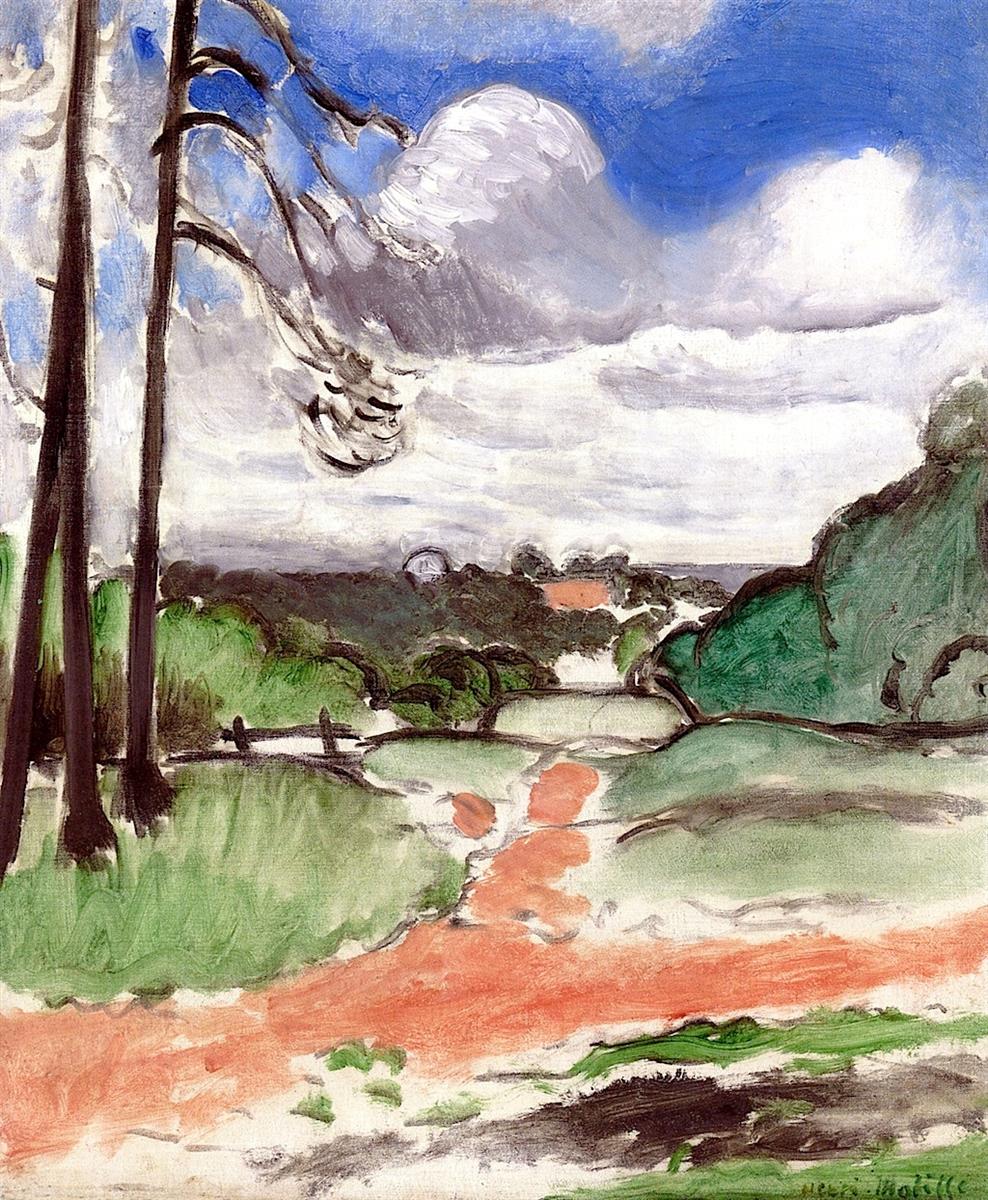
Henri Matisse’s “Chalais Meudon” (1917) is a landscape that feels as immediate as weather. A wide sky of quick blue and chalky cloud presses over a rolling green foreground, and a red earthen path zigzags toward a distant ridge. Two tall pines at the left edge lean into the breeze like actors entering a stage, their trunks and tufted branches stated with a few assertive strokes. The composition is spare and open, yet the scene is vivid enough to summon the smell of grass after rain and the rough grit of the track underfoot. Matisse reduces the countryside south-west of Paris to a handful of essential relations—updraft and horizon, cool green and warm earth, strong contour and breathing brushwork—so that the viewer grasps the idea of place in a single glance and then lingers to enjoy the painting’s living surface.
Where We Stand and What We See
The vantage point appears low and slightly to the left of the red path, as if we have stepped off the track for a moment and now look across it. The path begins as a broad, irregular band at the bottom edge, narrows as it climbs a gentle slope, and reappears as a smaller ribbon just before the far trees. At left, three pine trunks rise nearly the full height of the canvas; they are dark, vertical accents that both frame the space and measure the scale of the sky. To the right, rounded masses of foliage hold the edge in counterweight. The horizon is high, so sky occupies roughly half the surface, giving weather a co-starring role with land. The effect is a landscape experienced as a set of directions—forward along the path, upward with the trees, outward beneath the clouds—rather than as a catalog of things.
The Composition’s Axes and the Rhythm of the Path
Matisse organizes the painting with a simple but potent geometry. The verticals of the pines anchor the left side; the red path lays down a diagonal that pulls the eye into depth; the long, dark horizon stretches across the composition as a stabilizing bar. The path is not straight; it kinks and pools, creating a rhythm of steps and pauses. That broken progress is echoed in the sky, where cloud banks arrive in layered tiers rather than a single continuous strip. By letting land and air share this stop-start cadence, Matisse makes the entire picture breathe at one tempo.
Color as Climate Rather Than Costume
The palette is intentionally limited: sky blue and cloud white; a range of fresh greens that shift from mint to bottle; dark olive and black for trunks and contours; and the one saturated warm—the orange-red of the path. Because he withholds additional warm colors, the path does a remarkable amount of expressive work. It suggests iron-rich soil, yes, but it also reads as the human route through the landscape, the warm trace of passage amid cool, indifferent nature. The greens are not descriptive botany; they are air-cooled chords that set the season and time of day. Blue is not a mere local color for the sky; it is the coolness against which everything else glows.
Drawing With the Brush and the Authority of the Contour
Matisse’s line is a loaded brush that thickens and thins according to need. The pine trunks are drawn in sweeping verticals that taper as they rise; branches are suggested by quick hooks and commas, nothing more. The edges of the path and the shadows beneath the banks are reinforced with firm, dark strokes that act like structural beams. These contours do not fence in color; they collaborate with it, much as the lead in stained glass both separates and supports the panes. In several places the line is intentionally broken or feathered, letting the ground breathe through and keeping the picture from hardening into outline-and-fill.
The Pleasure of the Surface: Scumbles, Skips, and Exposed Ground
A close look reveals how frankly the painting records its making. The greens are laid in with open, dragging strokes that leave the weave of the canvas visible. White ground flickers through fields and sky, making light feel like a substance rather than a mere illumination. Cloud passages are built from scumbles that change direction as if pushed by gusts; the blue around them is brushed in long, confident arcs that retain the bristle of the brush. The red path is not one flat note; its pigment thins and thickens, picking up cooler or warmer undertones as it crosses lighter or darker ground. Nothing is polished to hide decision or correction. The surface lets us watch the picture being found.
Space Without Fuss: Overlap, Value, and the Good Tilt
Depth is achieved with minimal carpentry. The path narrows and overlaps the pale grass; the near trees cut in front of mid-distance foliage; the dark band of far trees lies under a paler sky. A gentle tilt in the foreground plane brings the turf toward us and prevents the lower half from lying still. Matisse avoids forced perspective lines and the theatrical plunges associated with academic landscape. He wants a space we can inhabit without calculation and a surface we can enjoy without apology.
Wind in the Pines and Weather in the Sky
Although the picture contains no moving figures or water, it feels kinesthetic. The long needles of the leftmost pine are blown in one direction, registering a breeze that also seems to shape the clouds. Those clouds are not cottony symbols; they are masses with different densities of paint—some heavy and gray, some light and silvery white—so that they read as layered, shifting bodies. Bright blue slips between them like a brisk draft. The landscape becomes a record of forces, not just features: a place where air, light, and ground are perpetually negotiating.
Chalais-Meudon as Motif and Memory
Chalais-Meudon, on the ridge west of Paris, offered Matisse a mixture of open meadows, pine stands, and distant views toward the Seine. The dome-like shape peeking over the horizon in the center may allude to the nearby observatory; whether or not that identification is precise, the hint of a distant structure helps the scene register as a lived landscape rather than a wilderness. The specificity of the site matters less than the kind of countryside it represents: edges of city and nature, places reachable in a day’s walk, where a path is as important as a panorama. Matisse turns the locale into an emblem of access and clarity.
A 1917 Temperament: Discipline Without Bleakness
The year marks a hinge in Matisse’s development. The explosive primaries of his Fauvist decade have quieted; black and dark olive return as structuring tones; large color fields replace small, competing accents. Yet the work refuses gloom. “Chalais Meudon” is lucid and buoyant. The red path, the sky’s open blue, and the clean contrasts deliver reassurance without sentimentality. In a moment shadowed by war, the picture holds to clarity, measure, and fresh air.
Echoes of Tradition, Spoken in a Modern Accent
The painting converses with earlier French landscape—Corot’s measured horizons, the Barbizon painters’ affection for forest edges, Impressionism’s light—but its grammar is unmistakably modern. Instead of dissolving forms into vibration, Matisse simplifies them into legible shapes. Instead of building depth with multiple perspective cues, he relies on overlap and value bands. The black contour, anathema to many Impressionists, is here a principal actor, a calm skeletal line that keeps the scene from floating away. The result is a landscape that honors perception while asserting the autonomy of the painted object.
How the Eye Travels Through the Picture
The composition invites a circuit. Most eyes begin at the bright swath of the near path, climb its broken staircase into the middle ground, and pause at the narrow bridge of pale land before the distant trees. From there, the gaze rises into the great cloud mass, drifts right along its underside, and then crosses the blue to the left pines, sliding down their trunks back to the grass. The loop repeats, each passage revealing a fresh seam of paint, a new exchange between cool green and warm red, another rhythmic echo between path and cloud. Because Matisse has placed his largest value contrasts along this route, the circuit remains satisfying no matter how many times it is walked.
The Red Path as Human Time
Landscape painting can easily lose the human scale in favor of majestic distances. The red path prevents that here. It tells us where feet have traveled and will travel again. Its warmth suggests touch and friction, the mild disorder of use. Where it breaks into pale patches, we read puddles or washed-out gravel; where it darkens, we sense compression in shade. The path is not only a compositional line; it is a pocket of narrative time—the past of many steps, the future of ours. By anchoring the painting in this modest sign of life, Matisse keeps grandeur at bay and intimacy close.
Ornament Found, Not Applied
Decoration in this landscape is the result of looking, not an overlay of pattern. The tufting of the pines, the scalloped contour of hedges, and the pulled ribbons of cloud provide ornamental pleasures that grow directly from the forms themselves. Matisse’s affection for arabesque—the sinuous line that would later flourish in his Nice interiors and cut-outs—appears here in the curves of foliage and the undulating edge of cloud. Ornament supports structure: those curves steady the big rectangles of sky and ground and keep the composition lively without noise.
The Ethics of Economy
Much of the painting’s power comes from what is left out. There are no individual blades of grass, no cataloged leaves, no glints on water. Matisse chooses the few relations that tell the truth of the day and declines the rest. This economy is not laziness; it is trust—trust that the viewer can complete the scene from experience and that the painting’s job is to set the stage for that completion. The exposed ground and broad strokes invite participation; the landscape becomes a collaboration between painter and eye.
Light as an Embrace
The light in “Chalais Meudon” is not a spotlight or a patchwork of hard shadows. It is a full, even embrace that reveals the world in rounds rather than edges. The bright cloud at center bleeds softly into the blue; the green mounds lift and fall without theatrical contrast; the red path glows as if sun-warmed rather than lit by a single, directional source. Such light feels ethical as well as optical: it gives each area enough visibility to be itself without stealing drama from its neighbors. The painting achieves calm not by muting everything to gray, but by letting colors share one envelope of luminance.
A Landscape That Thinks
The painting’s simplicity is thoughtful rather than naive. Each piece proposes a way of seeing. The path argues for the value of human measure; the pines insist on the dignity of verticals in a horizontal world; the sky and cloud demonstrate how large fields can carry feeling without detail; the black contour proves that drawing can live inside painting without either dominating. The work becomes a small treatise on pictorial logic disguised as a walk.
Why the Picture Endures
“Chalais Meudon” endures because it gives the sensation of landscape with the fewest necessary means and organizes those means so gracefully that looking becomes restful. From across a room, the painting reads immediately—red track, green banks, tall pines, blue sky and white cloud. Up close, it rewards with the texture of the brush, the breath of exposed ground, and the minute calibrations of color temperature along every edge. It is generous to both the glancing viewer and the committed one. The scene feels particular and universal at once: a specific ridge near Paris and a timeless idea of openness.
A Closing Reflection on Walking and Seeing
Stand before this canvas and your body seems to know what to do: breathe deeper, follow the path, look up. Matisse has distilled the act of walking into the act of looking by giving your eye a trail and your imagination a breeze. He has replaced the anxiety of perfect description with the relief of clear relations. In 1917, amid noise and uncertainty, that clarity was itself a form of hope. Today the painting still performs the same service. It shows how a red path, a few pines, and a sky full of movable weather can be enough to make a world—provided the relations are true and the hand is honest.