Image source: wikiart.org
A Tower Held Between Stone and Sky
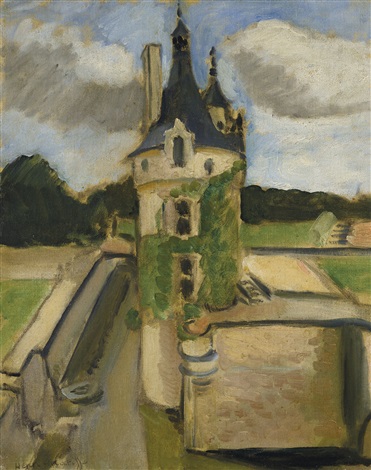
Henri Matisse’s “La Tour de Chenonceaux” (1917) turns a famed Loire Valley landmark into a compact meditation on structure, weather, and time. Instead of offering a postcard view of the château’s grand galleries, Matisse isolates a single turret wrapped in ivy, setting it against bands of terrace, moat, lawn, and a slow, clouded sky. The subject is architectural, but the painting’s energy comes from painting itself: from the way a few harmonized colors, firmly drawn contours, and simplified planes make the tower feel inevitable—rooted to its site and yet light enough to meet the air.
First Impressions
At the center rises the turret, capped by a dark conical roof and guarded by small dormers. Ivy climbs its pale stone in a green, irregular column that softens the vertical thrust. The view is elevated and slightly oblique, as if the painter leaned over a parapet; we look down onto the moat on the left and across the right-angled terraces that step away into the landscape. A band of trees closes the far horizon, while clouds roll across a gray-blue sky. The palette is restrained—buff stones, mossy greens, charcoal blacks, and gentle blues—so the painting reads instantly, almost like a relief carved from a few blocks of tone.
Composition as a System of Axes
Matisse builds the composition with a dialogue between vertical and horizontal forces. The tower is the principal vertical, set a hair off center so the eye never settles into symmetry. It rises like a column through three stacked zones: moat and terrace, dark roof and dormers, and the airy cap of sky. Pushing against that pillar are strong horizontals: the glacis of the terrace wall, the long stripe of the tree line, and the calm band of the moat. Right angles at the terrace corners create a geometry of turns; each turn slows the gaze so that the vertical can assert itself again. The image is thus a measured alternation—up through the tower, out across the land, back up again—an architecture of looking that echoes the architecture depicted.
The Discipline of a Limited Palette
Color here is atmosphere more than costume. Stone carries a warm gray that slides into sandy beige; the ivy registers as a damp, cool green; the roof gathers blues and blacks into a single persuasive darkness. Matisse withholds high chroma. By narrowing the range, he amplifies relationships: green glows because warm stone surrounds it; the roof’s near-black deepens the sky’s softness; the moat’s ocher-green suggests water more by contrast than by descriptive detail. The coloristic restraint belongs to his wartime vocabulary, where clarity mattered more than spectacle. It also suits the subject: a Renaissance tower that lives not by ornament but by proportion.
Light, Weather, and Breathable Space
The day is overcast but open. Light is broad, not theatrical; it rakes planes gently and keeps edges legible without casting hard shadows. The sky’s clouds are built from wide, loaded strokes—no vaporous glazes—so they carry weight and motion. That treatment hovers between description and structure: clouds are weather and also compositional counters to the tower’s mass. The terraces and moat are not lit so much as clarified; their planes are differentiated by subtle value shifts. Because Matisse refuses to dramatize the light, the architecture feels calm and inhabitable; it belongs to its air.
Drawing with the Brush
Contours hold the picture together. Matisse uses a loaded, dark brush to assert the tower’s edges, the roofline, the terrace corners, and the inner curve of the moat. These lines thicken and thin with pressure, giving edges life rather than mechanical precision. Inside the shapes, paint is laid in broad, opaque patches whose slight overlaps keep the surface breathing. The ivy is a chain of broken greens that lets stone peep through; the tree line is a single dark belt softened where it meets the sky. The whole surface declares its making—confident but not fussy, adjusted in places where a line has been shifted or a plane warmed.
Perspective and the Elevated Vantage
The viewpoint—high and slightly off-axis—does crucial work. It reveals the plan of the site: how the moat cinches the base, how terraces interlock, how the landscape steps back in measured bands. The foreshortening of wall tops and the converging edges of terraces are observed but simplified; they give just enough perspective to be convincing while preserving the canvas as a flat field. The camera-like crop, which cuts the tower near its apex and the terraces near their ends, keeps the subject from becoming a static emblem. The scene feels like a pause in a walk, not a lesson in geometry.
Architecture as Character
Matisse grants the tower personality without caricature. Tiny dormers, like alert eyes, punctuate the roof; the turret’s drum lifts above a string course that reads as a belt; narrow windows dot the shaft as if the tower breathed through them. The ivy is not decoration; it is the tower’s companion, a living counter to stone. Together they dramatize a relationship central to the painting: solidity meeting softness, duration meeting growth. The château’s historic identity—residence, refuge, symbol of the Loire’s courtly past—whispers through these choices, yet the painting never slips into anecdote.
Pathways for the Eye
Matisse designs a graceful itinerary. Most viewers enter at the lower right terrace, follow its edge until it meets the base of the tower, then are pulled up by the ivy’s green ladder to the roof and into the clouds. From the cloud mass the eye drifts left along the tree line, slides down to the moat’s calm ribbon, and returns to the terrace wall in the foreground. The loop repeats, each time discovering small pleasures: the rounded stone knob that caps a balustrade, the darker patch where ivy thickens, the soft reflection caught on the moat’s surface. The route is satisfying because value contrasts—dark roof against pale sky, pale terrace against shadowed moat—are placed precisely along it.
The 1917 Temperament
Created during a period of war and transition, the canvas carries the temperament of 1917: disciplined, measured, lucid. Coming off the chromatic blaze of Fauvism, Matisse embraces a quieter scale in which black and gray regain authority. At the same time, he holds onto the freedom of his earlier color thinking by making green and blue do expressive work within restraint. The result is an image sturdy enough to honor its historical subject and nimble enough to feel contemporary. It is neither sentimental nor austere; it is patient.
Historical Site, Modern Eye
Chenonceau is one of France’s most beloved sites, famous for its gallery bridging the Cher River. Matisse sidesteps the postcard view and instead shows a tower with its immediate environment—moat, terraces, fields—so the architecture reads as lived, not monumentalized. By limiting the subject and keeping forms simplified, he places the château within his modern language: solid silhouettes, legible planes, and a clear orchestration of masses. The painting becomes less an inventory of details than a meditation on how a building holds place and time.
The Poise Between Decoration and Structure
Matisse had long been fascinated by ornament, but here decoration is held in check by architectural order. The ivy supplies pattern; the small dormers and ridge ornaments add accents; the cloud forms billow like soft drapery above the hard tower. Yet the picture never loses its backbone. The tower’s cylindrical rise, the crisp terrace angles, and the flat fields at right and left keep the image upright. This poise allows the painting to be both enjoyable and rigorous—a window image that is also a constructed object.
Material Truth and Revision
Look closely and you’ll find traces of revision that humanize the surface. A terrace edge has been strengthened with a darker drag; an earlier contour shows faintly under a final line; a cloud’s boundary softens where wet paint met wet. These visible decisions tilt the painting away from polished illustration toward lived experience. We see not only what Matisse saw but how he chose, corrected, and affirmed.
Symbolic Readings Without Program
The tower can be read as a figure of endurance, the ivy as time’s gentle insistence, the moat as boundary between history and present. In 1917, such associations arrive unforced. The painting does not allegorize; it simply allows viewers to sense the cohabitation of stone and plant, human order and natural cycle, which for Matisse was always an essential theme. Even the clouds participate: their migrating masses place the tower within a larger rhythm that exceeds architecture and painting alike.
Dialogue with Landscape and City Views
In the same period Matisse painted harbors, studio interiors with open windows, and wooded landscapes. “La Tour de Chenonceaux” consolidates lessons from each. From the harbors it borrows the balance of vertical structures against broad horizontals; from the interiors it takes the idea that a window or vantage organizes a whole world; from the woods it inherits the conversation between rigid trunks and flexible foliage. The tower is therefore not an outlier but part of a broader exploration of how a few confident shapes can hold a complex scene.
Durability of the Image
The canvas endures because its solutions are lucid. The central vertical gives identity; the stepped terraces articulate near-to-far; the measured palette unifies mood. You can read the painting across a room as a simple sign—tower, wall, sky—and you can approach closely to enjoy the play of brush against edge, stone against ivy, cool against warm. That double legibility makes the image generous to many kinds of looking, from a glance to prolonged study.
A Closing Reflection
“La Tour de Chenonceaux” offers a way to look at historical architecture with a modern eye. Matisse keeps what counts—proportion, mass, relationship to land and sky—and releases what would merely decorate. In doing so he discovers a new kind of monumentality: not grandeur forced by detail, but firmness achieved through order. The painting invites a quiet, attentive gaze. It trusts that a tower, a wall, some water, and a sky—handled with care—can carry memory and present tense together. The invitation is still open.