Image source: wikiart.org
A Harbor Painted Like Weather
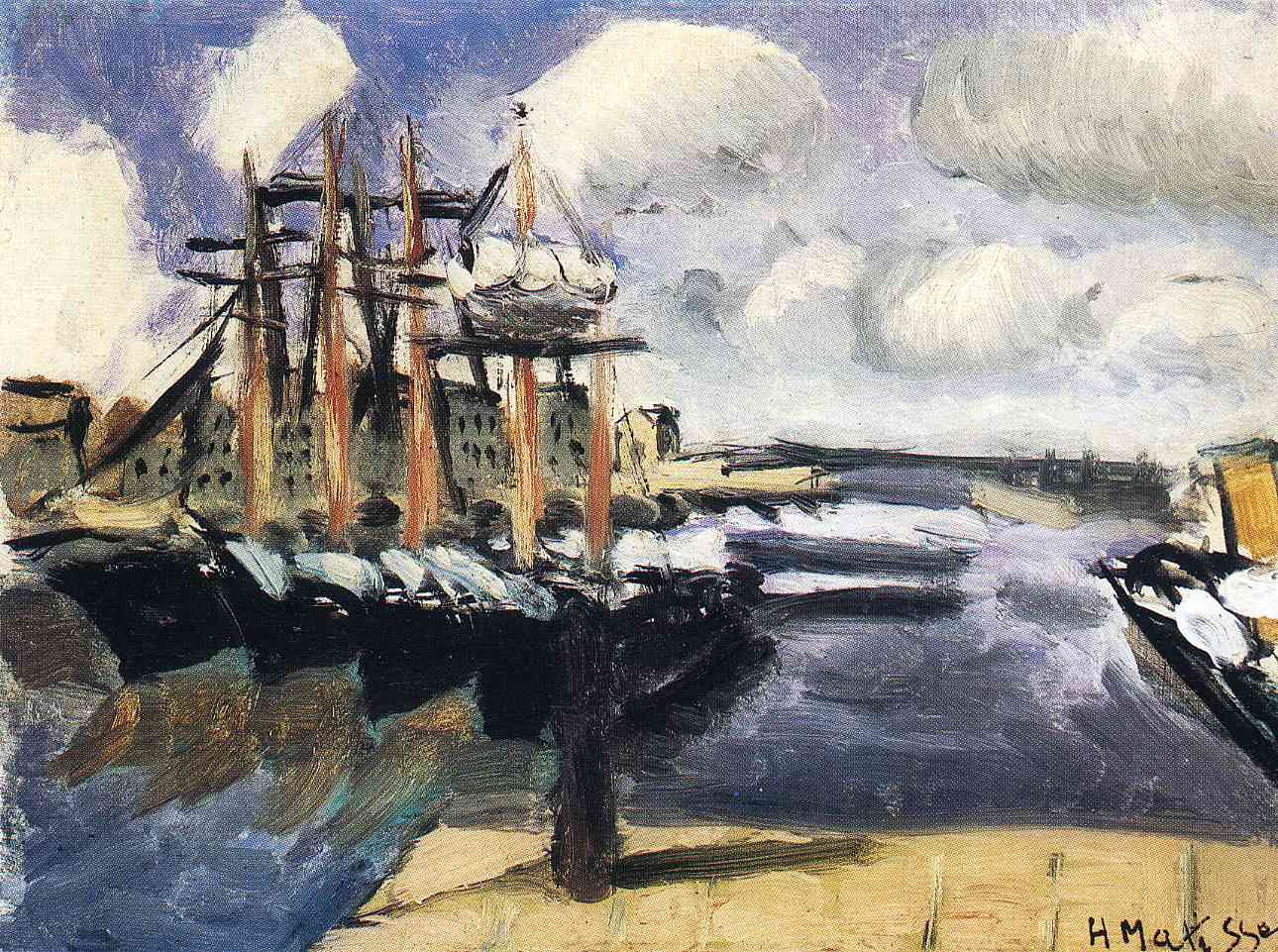
Henri Matisse’s “Four Boats Side by Side in the Marseilles Harbor” (1916) condenses the bustle of a port into an image that feels as immediate as a gust of sea air. The painting’s energy comes less from descriptive detail than from the way the paint itself behaves: scumbled blues and violets for moving water, fat dabs of white for clouds and sailcloth, long vertical swipes for masts, and charcoal-dark accents that pin shape to surface. In a single, wide glance Matisse gives the sensation of standing on the quay with the hulls, rigging, and shifting weather looming and receding at once. The harbor becomes a theatre in which wind, light, and human structure briefly align.
What Meets the Eye First
Viewed from a quay at lower right, the scene opens onto a basin of purplish water that reflects a sky filled with woolly clouds. At left, a dense cluster of masts stakes the skyline; their rust and umber strokes cut through the pale atmosphere like bundled matches. Beneath them, a band of dark hulls is studded with cool white highlights, shorthand for awnings, sails, or sun on tarred planking. Across the middle distance, ocher buildings press against the waterline, their windows abbreviated by quick dots. To the far right, two angled boats slice into the frame, while the stone quay in the foreground creates a firm, geometric platform and a place for Matisse’s signature. Despite the speed of execution, the harbor reads instantly. Gesture stands in for cataloged fact, yet the result is truer to perception than a meticulously itemized view.
Composition and Point of View
The composition hinges on a dialogue between verticals and horizontals. Masts thrust upward in a compressed forest at left; the waterline and quays throw assertive, dark horizontals across the center; the cloud deck lays a soft counter-horizon in the sky. These simple axes organize a view that might otherwise dissolve into incident. Notice the subtle triangular arrangement: the mass of rigging at left, the open water tapering to the horizon at center, and the oblique pier and prow at right. This triangular logic guides the eye in a revolving movement: up the masts, across the far shore, back down the diagonal quay, and into the near water again. The cropped framing, particularly the way the right-hand boats are cut by the picture edge, gives the sense that the port extends beyond what we see. The painting doesn’t lock the harbor into a postcard; it implies a living continuum.
Brushwork as Weather
Matisse paints the harbor as if it were made of wind. The paint in the sky is swept, feathered, and dragged in soft arcs that mimic clouds blown apart then gathered again. Water is broader and heavier: long, dark strokes lay the foundation of the basin and are interrupted by lighter touches that suggest ripples catching light. In the cluster of boats, the marks become more abrupt—short slabs and slashes—mimicking the stop-start rhythm of rigging, belaying pins, and stacked gear. The brush not only describes objects; it mimics their behavior. Everywhere, the physicality of paint equals the physicality of the harbor.
Color and Value
The palette is restrained. Sky and water are built from modulated blues leaning toward violet and slate; shore buildings are ochers and muted greens; the boats and masts are dark umbers tipping to black. Against this cool field Matisse injects bursts of white that work as both light and structural emphasis. He does not rely on saturated color to excite the eye; he relies on value contrasts and on the temperature relationships between cool water, neutral stone, and warm wood. The limited scale intensifies the mood: the harbor feels like late afternoon as a front moves in, when colors mute and forms are held together by a shared grayness. Into this hush the reds and rusts of the masts glow like coals.
Light and Atmosphere
Light here is diffuse but strong enough to produce edge flashes: the small streaks of white along hulls, the pale scum of foam against quay stones, the sails that catch a sudden burst from behind a cloud. The clouds themselves are not airy glazes; they are blocks of paint—solid, palpable, and in motion. Matisse suggests depth in the sky by varying the density and direction of the strokes: denser impasto in the nearer clouds, thinner scumbles in those drifting toward the horizon. The overall effect is of weather that can change in minutes, of a harbor where work continues under a sky that refuses to settle.
Movement and Time
Although nothing in the scene literally moves, the painting is full of motion. Brushstrokes angle and collide; the water’s surface runs diagonally, broken by dark troughs and pale caps; rigging lines lean left then right as if caught in a crosswind. Matisse selects a moment when all these energies cross. That sense of time—the momentary nature of light and gesture—derives from Impressionism, but Matisse weds it to a bolder, more structural drawing. He does not dissolve the boats into shimmering flecks. He keeps their silhouettes legible, giving the transience of light a firm scaffold.
Marseilles and the Year 1916
Marseilles, the Mediterranean gateway, was a place of commerce and migration, a port where tall-masted ships, steamers, and fishing craft intermingled. In 1916, wartime pressures complicated maritime life, yet harbors still pulsed with activity. Matisse, working through a transitional period, looked to such motifs not for documentary accuracy but for their capacity to hold energy and structure. The painting’s speed and decisiveness feel like an answer to the times: fewer words, stronger verbs; fewer pigments, stronger contrasts. The harbor subject let him ally the rigor of vertical masts and horizontal quays with the unpredictability of weather and water—order and contingency in a single theme.
A Transitional Style Between Fauvism and Nice
Compared with his flamboyant Fauvist canvases a decade earlier, the chroma here is low, and black plays an organizing role. Yet the picture is far from somber. Its vitality comes from the orchestration of masses and the velocity of the mark. In the years just after 1916, Matisse would migrate toward the airy interiors of the Nice period—open windows, patterned textiles, reclining figures. “Four Boats” stands just behind that turn, showing him tuning his instrument: clarifying silhouettes, simplifying forms, compressing color into climate rather than spectacle. It is a harbor painted by a draughtsman who trusts his hand to say more with less.
Drawing With the Brush
Matisse’s line is never separate from his paint. The masts are pulled with the full belly of the brush, then sharpened with a second, darker drag. Hulls are massed with broad strokes and then cut by a single, decisive dark that acts as a keel. The quay in the foreground is laid down with rectangular slabs whose edges hold small ridges of paint, catching real light in the gallery just as stone catches sunlight by the sea. What looks spontaneous rests on years of discipline: an economy of marks that lets every stroke count.
Water and Sky as Surfaces
One of the painting’s pleasures lies in the way water and sky are treated as kindred surfaces. The same milky blues and slate violets appear above and below, but the direction of the strokes and the interruption of reflections keep the two realms distinct. The sky’s strokes are rounded, cloud-like; the water’s strokes are horizontal pulls broken by darker seams. Where white intrudes—on cloud tops, on wavelets, on sails—it acts like a common currency. This echoing of textures creates a unity that binds the entire harbor into a single weather event.
Boats as Architecture
The cluster of boats at left is a makeshift architecture. Vertical masts function like columns; cross-spars and yardarms behave as entablatures; halyards read like cables of a bridge. Matisse leans on this architecture to stabilize the painting. The verticals also operate as a kind of score for the eye, a series of measured beats against which softer shapes—clouds and water—riff and swirl. The right-hand boats, thrust diagonally, counter the leftward weight and prevent the composition from ossifying into a mere façade.
Negative Space and the Working Edges
The intervals between masts matter as much as the masts themselves. Matisse carves sky through the rigging with pale plugs of paint; these negative spaces sparkle, giving the cluster its breath. At the bottom edge, where the quay meets the water, a dark seam flickers with small intrusions of pale paint, like the smacking contact line where chop hits stone. The edges of the picture are “working edges”: the rightmost boats dive in from offstage, and the leftmost shadows spill beyond the frame, as though the painter had pressed the harbor slightly too large for the canvas on purpose. That scale pressure intensifies the sense that we are in the scene rather than observing it from a safe distance.
Emotion and Psychology
Despite the briskness of execution, the painting carries a quiet emotional weight. The low-chroma palette and the thick clouds imply a world of labor under uncertain skies. Yet there is no melodrama. The harbor is not threatened; it persists. The paint’s energy communicates confidence—the confidence of continuing to work and to see clearly when events are unsettled. The painting becomes a kind of mental harbor: a place where structure holds even as weather shifts.
Dialogues With Predecessors and Peers
The subject recalls Monet’s and Pissarro’s ports, but Matisse’s approach is leaner and more frontal. Rather than building a vibrating tapestry of small strokes, he commits to bold masses and decisive cuts. In its structural clarity the picture nods to Cézanne, whose lesson—organize by planes and axes—Matisse absorbs and simplifies. Where Cubists of the time might have faceted the scene, Matisse preserves the legibility of boats and quays, preferring the drama of silhouette against atmosphere to analytic dissection. He takes what he needs from each tradition and recombines it into a language that feels unmistakably his.
How the Eye Travels
The viewer’s path is choreographed with economy. The foreground quay catches our feet; from there the dark seam of the near water pulls us left to the shadowed hulls. We climb the masts into the clouds, scan the far shoreline where ocher buildings stitch the horizon, and then slide down the diagonal prow at right back to the quay. The loop is seamless, and because the painting’s value contrasts are strongest along this route, the eye happily repeats the circuit. This circular journey turns looking into a rhythm, a visual echo of waves lapping against stone and hull.
Why This Harbor Endures
The image endures because Matisse achieves a difficult balance. The painting is immediate but not careless, simplified but not thin, atmospheric yet architectonic. It can be read at a glance from across a room as a bold arrangement of sky, water, and rigging; up close it rewards scrutiny with rich brushwork and a surprising variety of edges and densities. It is a record of perception made at speed and a considered design that holds together under prolonged viewing. In fewer than a dozen key decisions—palette, axes, crop, intervals, distribution of whites—Matisse builds a harbor that continues to breathe.
A Closing Reflection
“Four Boats Side by Side in the Marseilles Harbor” encapsulates Matisse’s 1916 search for clarity and resonance. The painting honors the physical reality of a specific port while affirming painting’s capacity to stand as its own object—marks, surfaces, and intervals organized into a living whole. We feel the salt in the air, the give of water, the creak of lines, and we also feel the pressure of the brush and the authority of design. That double awareness—of world and of painting—makes the canvas a small but potent demonstration of what Matisse could do when he stripped description to essentials and let the weather take care of the rest.