Image source: wikiart.org
Overview
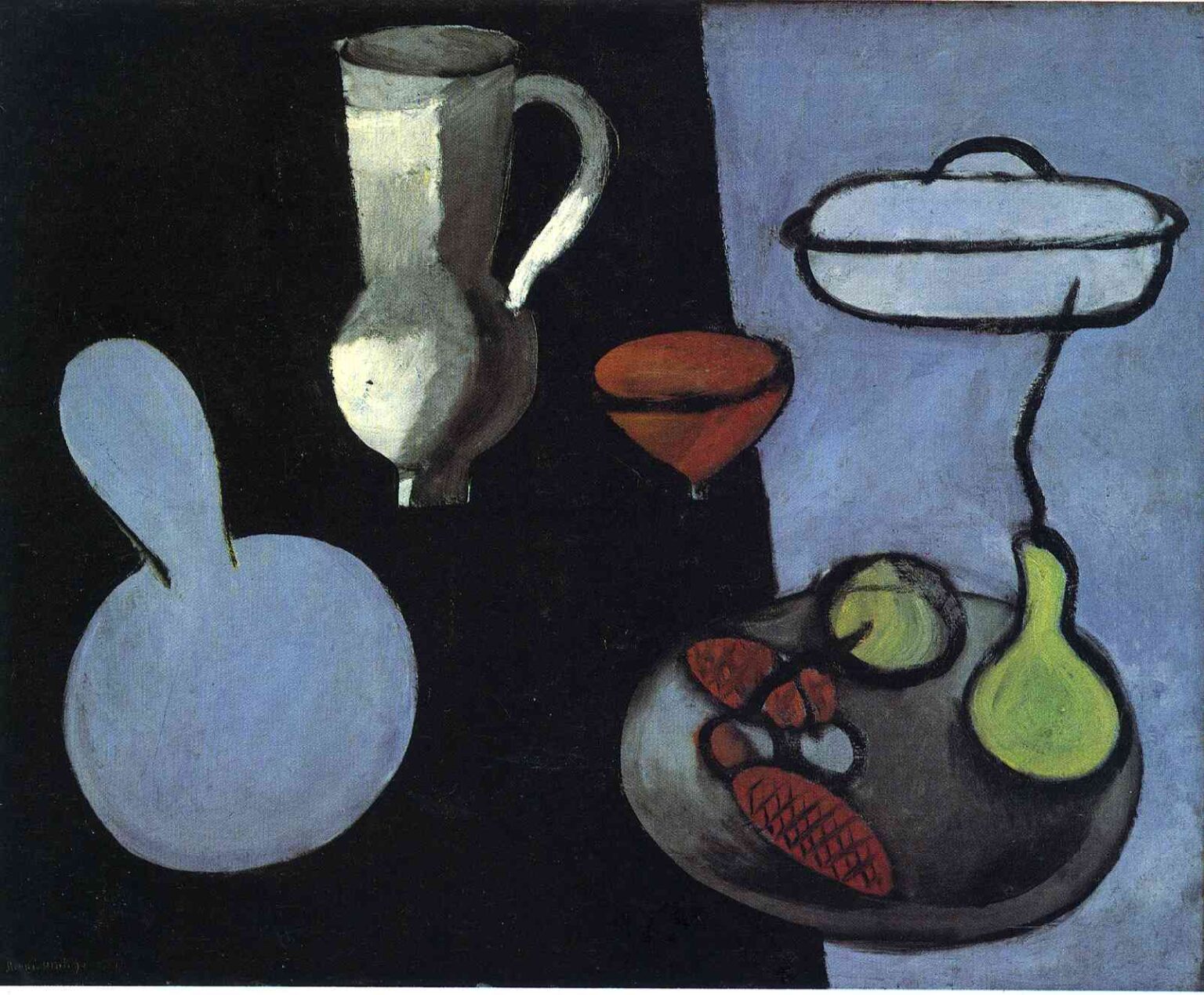
Henri Matisse’s “The Gourds” (1916) compresses a still life into a stark duet of color fields and a handful of emphatic shapes. The composition is divided vertically: on the left, a deep, velvety black; on the right, a cool periwinkle blue. Against these flat grounds Matisse sets a cluster of everyday objects—a stout pitcher, a lidded casserole or tureen, a shallow orange compote, a platter laden with fruit and breadlike forms, and a round cutting board with a handle—each simplified to essential silhouettes and ringed with dark, elastic contour. With almost ascetic restraint, the painter turns kitchenware and produce into a lucid demonstration of modern pictorial thinking.
Historical Context
By 1916, Matisse had moved beyond the blazing chroma of Fauvism to a language of strong shape, limited palette, and structural clarity. The First World War had brought a sober tone to Paris; Matisse responded by paring his means and intensifying his design. In the same period he made the window interiors of the Quay Saint-Michel, the portraits of Michael and Sarah Stein, and disciplined canvases such as “View of Notre Dame” and “Apples on a Table, Green Background.” “The Gourds” belongs to this wartime phase, where color becomes orchestration rather than spectacle, and everyday things are recast as formal actors on a stage of planes and lines.
The Two-Field Composition
The painting’s first decision is radical in its simplicity: a vertical seam cleaves the canvas into black and blue panels. That binary establishes a theater of opposition—warm versus cool, night versus day, depth versus air. The objects are distributed to acknowledge the seam without obeying symmetry. The pale pitcher holds to the left field so its lights blaze against black; the white tureen migrates to the right field where its form holds steady against blue; the orange compote touches the seam like a pivot; the platter with fruit settles low on the right, grounding that half with weight; and the round cutting board glows on the left like a lunar disk. This arrangement creates equilibrium by counterweight rather than mirroring.
Shapes as Characters
Matisse treats each object as a character with a clear silhouette. The pitcher’s belly and short spout describe a swelling volume in three strokes. The tureen is a long capsule with a handle—practically a sign for containment—its lid described by a single elliptical line. The compote is a trapezoid with a stem, tipped like a musical accent. The platter is an oval that holds a pear-shaped gourd, an apple, red breads or pastries with crosshatching, and a scatter of smaller, round morsels. The cutting board’s circular head and stubby handle are drawn as one continuous profile. By reducing description to such direct signs, Matisse allows the painting to read instantly at a distance and, up close, to reveal the variations of touch that vivify each sign.
Color Strategy
The palette is disciplined: large fields of black and blue; object whites grayed with umber; a few chords of acid green and lemon yellow in the gourd; a flame of orange-red in the compote and the breads; deep charcoal in the platter’s shadow. The restraint heightens contrast. The whites burn against the black and stay cool against the blue; the red marks appear incandescent because they are rare; the green gourd vibrates because it is framed by the gray platter and blue ground. Rather than the Fauvist clash of complementaries, the color here is deliberate punctuation—just enough to differentiate forms and inject rhythm.
The Authority of Contour
Dark contour is the painting’s backbone. It wraps each object with an elastic line that thickens and thins in response to pressure and turning. Around the tureen’s lid, the line is taut, giving the object a crisp, ceramic snap. Around the pitcher’s belly it widens and loosens, letting volume breathe. The pear-shaped gourd is crowned by a delicate, wavering outline that keeps it alive rather than schematic. This contour does not sit atop color as decoration; it fuses with the painted forms, both describing and structuring them, much as calligraphy carries both meaning and design.
Brushwork and Surface
Despite the graphic clarity, the surface is richly worked. The black field is not a dead void; it holds scumbled passages and faint tonal variations where the brush drags over the weave, generating a felt darkness. The blue field carries long, slightly diagonal strokes that suggest air and direction without becoming sky. Object whites are built from stacked strokes that curve with form—a creamy impasto at the pitcher’s highlight, thinner paint across the tureen’s lid. The red compote is laid in a dense, matte pigment that absorbs light, while the green gourd shows thin glazes over gray that shift its temperature from tip to base. The overall effect is sobriety animated by touch.
Geometry and Balance
Matisse builds a geometric armature to balance the composition. The circular cutting board on the left answers the circular platter on the right; the vertical seam divides them; the pitcher’s upright echoes the tureen’s horizontal ellipse; the compote’s small wedge at center acts like a keystone. There is a dance of curves and straight segments, of complete and truncated shapes. Even the negative spaces between objects—the black pockets around the pitcher, the blue wedge under the tureen’s handle—read as intentional shapes, as carefully considered as the objects themselves.
Space Without Illusion
Traditional still life often constructs depth via cast shadows and graded perspective. Matisse instead flattens space into a shallow stage where objects coexist at one level of frontality. The platter’s ellipse hints at tilt, but the lack of converging orthogonals and descriptive shadows keeps the eye on the picture plane. This designed shallowness allows the viewer to perceive relationships—how white meets black, how green activates gray—without being distracted by virtual depth. The painting thus operates as a diagram of seeing: space is a network of intervals rather than a room measured with a ruler.
The Gourds and Their Meanings
Gourds have long histories in many cultures as symbols of fecundity, vessels for water or wine, and motifs in textiles and ceramics. In Matisse’s hands they also become emblems of plastic problems: swelling volume, tapering neck, skin that can hold both sheen and flat color. The pear-shaped gourd here is not merely edible; it is a perfect form to test how a single contour and a limited gradient can persuade the eye of roundness against a flat ground. Its neighbor, the apple, carries a denser, more compact volume, giving the platter a counter-weight and diversifying the rhythm of shapes.
Dialogue with Decorative Arts
The objects feel chosen as much for their silhouette as for their domestic function, aligning Matisse’s still life with traditions of the decorative arts. The tureen could be a ceramic memory from a Moroccan or Mediterranean table; the compote’s angular flare has an almost metalwork crispness; the platter’s crosshatched bread echoes textiles or basketry patterns. Rather than copy ornament, Matisse distills it into contours and color accents. The still life becomes a meeting ground where painting absorbs the functional beauty of vessels and food into pure design.
Light and Value Management
Value relationships are carefully rationed. The brightest notes—the pitcher highlight, the tureen lid, the cutting board—sit just below pure white, allowing headroom for subtle glints. The black field sets the deepest value, while the blue field and gray platter occupy a middle register that keeps the reds and greens brilliant. Notice how the red compote, though small, reads with authority because it is the only saturated warm shape against both black and blue. The fruit on the platter employ darker reds and earthy oranges that harmonize with the gray base, avoiding a competing focal point.
Negative Space as Active Design
The painting’s emptiness is active. The swaths of black at left and the wedge of blue at right are not mere background; they are sculpted intervals that let the objects breathe and establish tempo. The space between pitcher and compote is calibrated so the compote’s triangle feels suspended; the hole of blue between tureen handle and body gives the white vessel buoyancy; the gap between platter and lower edge anchors the oval while keeping it from sinking. Such negative spaces are crucial to Matisse’s modernism: they carry as much weight as the depicted things.
Process and Evidence of Revision
Look closely and the surface reveals moments of adjustment. Along the pitcher’s handle, a faint gray halo suggests an earlier contour; at the gourd’s shoulder, a thin, darker arc peeks beneath the final line; around the cutting board’s edge, a shadow of black underpainting sets off the blue-violet disk. These pentimenti do not read as hesitation; they register the artist’s search for the most convincing curve or weight, keeping the painting open and alive rather than sealed.
How to Read the Picture
The canvas invites two tempos of looking. From a distance, read the design as a flaglike partition of black and blue, punctuated by four or five emblematic shapes. Then move near to trace the contour’s thickness, the soft merge of white into gray on the pitcher’s belly, the tiny notches that make the breads feel textured, the gourd’s cool-to-warm transitions. Cycle between the two distances so that structure and touch keep clarifying one another. This oscillation is the experience Matisse designs.
Relation to Matisse’s Other Still Lifes
Compared with the exuberance of “Apples on a Table, Green Background,” “The Gourds” is austere, even meditative. It shares with “Still Life with Lemons” and “Still Life, Peaches and Glass” the wartime preference for fewer colors and stronger drawing, yet it pushes further toward planar abstraction by denying tabletop perspective and by deploying that bold two-field background. It also prefigures the later Nice period’s love of clear silhouettes and object theater, while keeping the muscularity of the 1914–1916 Paris interiors.
Emotional Temperature
Despite its restraint, the painting has warmth. The orange punctuations feel like embers against the night of the left panel; the gourd’s citrine glow is tender rather than acidic; the whites carry a handmade softness. There is domestic quiet here—the intimacy of kitchenware assembled after use—balanced by the intellectual clarity of a studio experiment. Matisse threads these moods with poise, refusing melodrama in favor of sustained attention.
Materiality and Scale
The objects read at true, human scale—neither monumentally enlarged nor miniaturized. That fidelity gives the painting a tactile plausibility: one can imagine lifting the pitcher or sliding the cutting board across a table. At the same time, the planar background and the insistence of contour signal that we are not inside a kitchen but inside painting, where use is transformed into form. Scale thus serves both recognition and abstraction.
Legacy and Lessons
“The Gourds” teaches that reduction can deepen, not thin, sensation. With five or six forms and a handful of hues, Matisse constructs a complete visual world, one where every interval matters and every contour convinces. Painters and designers alike can glean a method from it: establish a clear ground; choose distinct silhouettes; ration color; let negative space speak; and trust line to both describe and bind. Viewers, meanwhile, receive an antidote to excess—a reminder that attention, carefully organized, can make humble things luminous.
Conclusion
In “The Gourds,” Matisse stages a quiet demonstration of mastery. The divided ground sets the problem; the objects answer it with clarity; the contour conducts; the color punctuates; the surface records deliberation. The result is a still life that feels at once intimate and rigorous, domestic and architectural. It is less a table set for eating than a table set for seeing, a distilled meditation on how form, color, and space can converse until the simplest vessels and fruits appear inexhaustibly fresh.