Image source: wikiart.org
Introduction
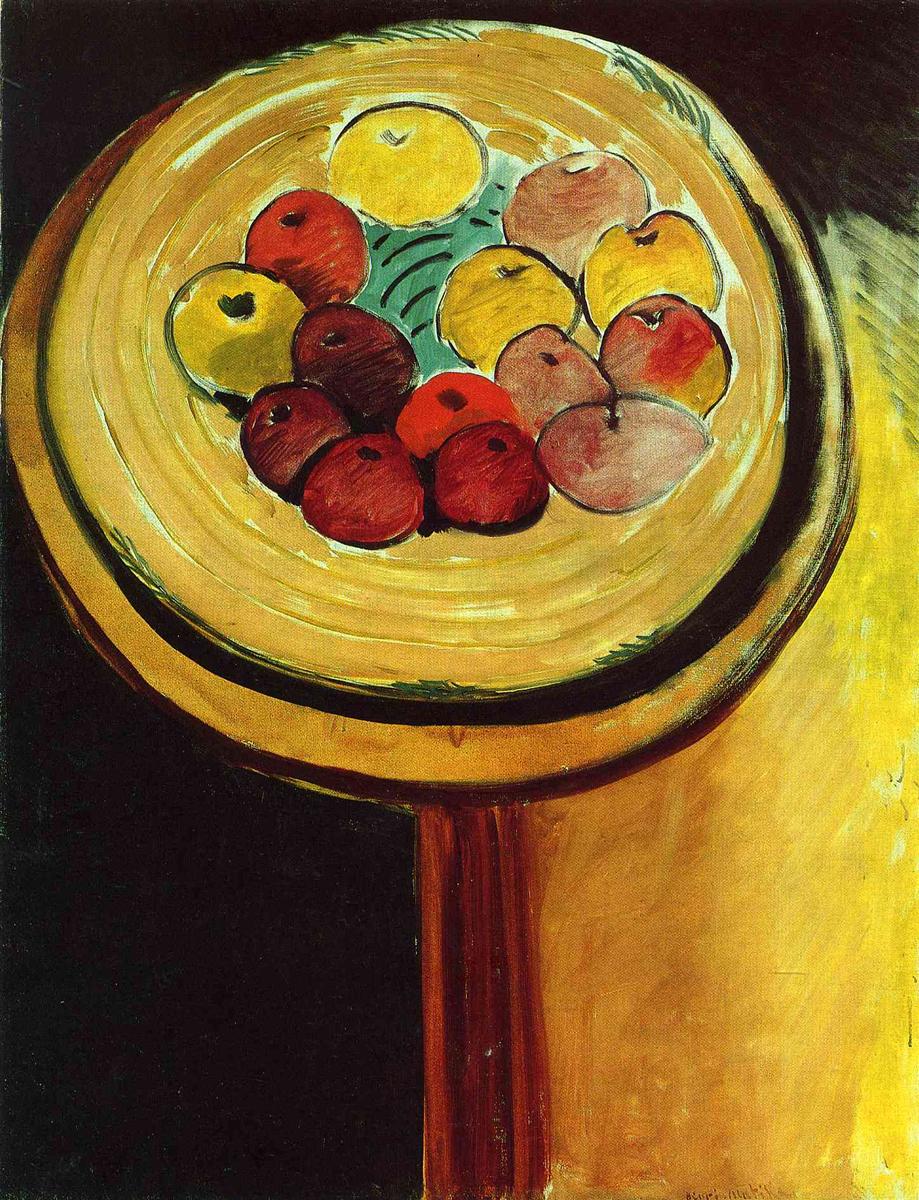
Henri Matisse’s “Apples” (1916) is a still life that looks startlingly simple at first glance and then becomes inexhaustible. A round tabletop fills the canvas like a target. At its center, a shallow dish holds a circle of apples—scarlet, yellow, ocher, and pink—arranged in an irregular ring around a greenish pool of paint. Broad bands of ocher and honey sweep outward to the plate’s rim, then deepen into a dark, emphatic contour that separates vessel from space. Below, a stout pedestal descends like a column, anchoring the composition. The world outside the tabletop is suppressed to two fields—deep black on the left and glowing yellow on the right—so that the eye returns, again and again, to the fruits’ weight, the plate’s light, and the rhythmic circles that structure everything. The painting compresses a century of still-life tradition into a new, modern grammar where contour, color temperature, and movement of the brush carry the meaning.
Historical Context
Matisse painted “Apples” in 1916, during the intense wartime period when he stripped his language to essentials. The flamboyance of early Fauvism had already given way to a more architectural sensibility. In 1914–1917 he produced a series of interiors, portraits, and still lifes defined by decisive drawing, large planes, and a narrowed palette. “Apples” belongs to this search for order. It is close in spirit to his stacked-plate pictures and to the reflective tabletops of 1914–1916, yet it chooses a radically simplified point of view—a top-down glance that turns a table into a target and a fruit dish into an emblem. In the midst of external upheaval, the painting proposes an inner stability: one circular table, one ring of fruit, one orchestration of color that holds.
First Impressions and Visual Walkthrough
From across the room the painting reads as a dominant circle floating on an abstract field. The fruit dish is centered but slightly high, allowing the column of the pedestal to touch the lower edge and fasten the composition to the world. The apples form a necklace of nine or ten discs, with one bright red fruit thickening the chain at the bottom. Three yellow fruits brighten the upper left and right, while a cooler rose color softens the far edge. The plate, built from creamy yellows with flashes of white, spirals inward toward a patch of watery turquoise, as if the dish contained a reflected sky. Outside the plate, the painted world falls away into a deep, velvety black at left and a sun-colored slope at right. The pedestal’s reddish stem bisects that yellow, offering a quiet vertical counterpoint to all the circles above.
Composition and Viewpoint
Matisse composes “Apples” with an aerial viewpoint unusual for his still lifes. There is almost no perspectival depth. Instead, geometry orders the picture. The round dish sits within the round top of the table; the apples themselves are small circles, each with a stem-dimple like a punctuation mark. The pedestal below and the strong black arc at the dish’s edge function as the few straight or sharply defined lines. This top-down view eliminates distractions—no chair backs, no window frames, no second plane—and transforms the act of looking into a meditation on relations: circle within circle, warm within cool, bright within dark. The design is direct and monumental, yet the slight off-center placement of apples and the uneven spacing keep it alive.
The Circle as a Structural Device
Everything in the painting participates in a circular rhythm. The apples’ ring is the most obvious instance, but the plate’s concentric brushstrokes reinforce it with each sweep of warm yellow and cream. The heavy dark contour around the plate, almost calligraphic, is the circle that replies to all the inner circles, giving the eye a crisp boundary to push against. Even the turquoise pool at the center is made of curved, wave-like strokes that spiral outward. The circle in Matisse’s hands is never static. The thick-and-thin of the brush, the slight deflection of an apple from the ring, the small wedge of light that breaks the plate’s band—these perturbations infuse the form with a pulse. The table becomes not a diagram but a living orbit.
Color Architecture and Temperature
The painting’s palette is restricted yet sumptuous. The dish and tabletop glow in honeyed yellows that slip from ocher to cream, with impasto flashes of white to suggest porcelain glare. The apples modulate from deep red to orange, brick, and rose, punctuated by solid yellows whose cool highlights keep them from melting into the plate. The center’s turquoise is not the local color of anything observable; it is a calculated cool that lets the warm surround breathe. Around the table Matisse stages a dramatic polarity: left-side black that swallows light and right-side yellow that seems to generate it. This opposition prevents the circular form from becoming merely decorative; it gives the composition direction, like sunlight entering a dark room. The red pedestal catches some of that warmth and carries it down into the lower register, so the color architecture reads from top to bottom as well as side to side.
Light, Value, and the Illusion of Volume
There is no literal mapping of a single light source. Instead, values are assigned to make the picture intelligible. Each apple is modeled with two or three steps at most: a dark housing color, a lighter face angled to our gaze, and a lace of highlight at the stem. This economy makes the fruit feel solid without breaking the picture’s decorative unity. The plate’s highest values are focused on the ring of white accents that dance along the rim and in a few creamy slashes on its surface. Matisse uses these whites sparingly so that when they appear, they make the entire dish shine. The deep black arc around the plate forms the painting’s darkest value, a device that both contains the luminous center and enhances its perceived brightness.
Brushwork and Surface
The surface of “Apples” is visibly painted. The plate’s bands are laid with broad, confident strokes that follow the ellipse around, leaving ridges that catch light in the gallery. These strokes are staggered so that warm ground peeks between them, a method that keeps the ochers from congealing. The apples are rubbed on like quick, dense medallions and then pricked with dark stems. Within the central turquoise pool Matisse uses brisk, scalloped marks; these suggest liquid reflection or perhaps the bottom of a shallow bowl, but more importantly they enliven the center so it doesn’t die into a flat patch. The surrounding field is handled differently: the left black is brushed in long, absorbing sweeps, while the right yellow is scumbled more thinly, allowing a bit of canvas texture to flicker through. Each zone’s touch corresponds to its role—active where attention must move, calm where space must hold.
The Table as Totem and Stage
Because the tabletop fills so much of the canvas, it becomes more than furniture; it is a totem. The pedestal descends like a column, centered and unwavering, giving the whole a sculptural gravitas. In previous still lifes the table may be the ground on which things rest; here it is also the actor. Matisse emphasizes that status by cropping the round top so that its rim becomes a bold compositional curve in the painting, and by choosing a viewpoint that removes the usual legible edges. The table’s wood feels warm because of the surrounding yellow; you sense its presence not through grain or carpentry but through color and weight. It is both stage and protagonist, the necessary architecture that lets the smaller drama of apples rotate.
Rhythm, Repetition, and Movement
Though the subject is still life, the picture moves. The eyes step from apple to apple, guided by small notches of stem, by shifts of red to yellow, by the occasional pink relief. The rind of the plate, with its high-contrast band, works like a track that carries the gaze around before propelling it inward to the cool center. The pedestal’s vertical stroke then draws the gaze down and returns it upward again to the fruit. This circulation does not tire because the painter provides variety within repetition. No two apples are the same size; none of the plate’s highlights is identical; the black rim thickens and thins. Movement is born of these tiny differences.
Spatial Compression and the Picture Plane
“Apples” compresses space to the threshold of abstraction while retaining just enough cues for bodily recognition. The top-down view is part of that compression. There are almost no cast shadows, no recessional diagonals, and no descriptive edges other than the plate and table rim. Yet the work does not flatten into pattern because Matisse keeps the illusion of depth in small ways: modeling at the fruit tops, the slightly eccentric ellipse of the plate that tips toward us, the pedestal that projects from below. He balances the demands of painting-as-surface and painting-as-space with unusual poise, giving us a world that feels both graspable and autonomous.
Dialogue with Tradition and Cézanne
A bowl of apples inevitably recalls the still-life tradition from Chardin to Cézanne. Matisse’s debt to Cézanne is visible in the reliance on simple forms—spheres and ellipses—and in the use of color to articulate volume. Yet “Apples” marks its distance from Cézanne’s trembling architecture. Where Cézanne builds space with accumulated, tilting patches, Matisse constructs it with sweeping bands and decisive contours. The result is calmer, more emblematic. The painting acknowledges the history of still life while confidently stating a modern alternative: objects as tuned relations rather than as meticulously observed facts.
Symbolic Resonance of Apples
Matisse avoided heavy allegory, but still life always carried a whisper of meaning. Apples in Western art speak of health, harvest, knowledge, and temptation; here they are most of all tokens of everyday abundance. Their circular arrangement and the painting’s strong centrality invite a more inward reading: the ring of fruit becomes a kind of wreath or mandala, a measured order around a cool core. In wartime, such a balanced arrangement could have promised steadiness without sermonizing. The picture’s radiance arises not from narrative but from the felt integrity of its parts.
Process and Pentimenti
Attention to edges reveals the painting’s process. Along the plate’s right rim a faint under-band suggests an earlier ellipse that Matisse tightened. Near the bottom red apple, a dark halo hints that the fruit was nudged to improve spacing. On the pedestal, a thin reddish wash bleeds into the yellow ground before the final contour was reinforced. These traces of decision-making keep the image human; the final simplicity is achieved, not automatic. They also clarify why the painting remains so energetic: its forms were tuned on the canvas until the intervals sounded right.
How to Look
The best strategy is to begin large and then go small. Let the circular table assert itself as a dominant form against the two contrasting fields. Once you feel its weight, step into the ring of apples and test how your eye travels from red to yellow and back. Attend to the plate’s highlights; note how the pure whites appear sparingly, just where the rhythm needs a beat. Move to the turquoise center and allow it to cool your gaze before you follow the pedestal downward into the yellow ground. Finally, step close enough to see the drag of bristles in the ocher bands and the tiny dabs that create stem dimples. The painting thrives on this oscillation between structure and touch.
Lessons for Artists and Designers
“Apples” offers durable lessons about clarity. Reducing the palette does not mean reducing impact; when colors are precisely tuned—cool center against warm surround, black arc against cream—the image can burn more brightly than a crowded spectrum. Compositional boldness pays off; the choice to fill the field with a circle creates instant authority and gives small variations room to register. Texture and direction of stroke can do as much as shading; concentric brushwork alone turns a flat plate into a luminous vessel. And the most important lesson: relations make the picture. The spacing of fruit, the thickness of the rim, the decision to let black occupy a third of the field—these are not afterthoughts but the sources of expressiveness.
Place within Matisse’s 1916 Series
Viewed alongside works like “Still Life with Nutcracker,” “The Green Pumpkin,” and the two versions of “Sculpture and Vase of Ivy,” this canvas shows Matisse tightening his art around a few sturdy motifs: fruit, vessels, isolated objects staged on shallow platforms. Each painting becomes an experiment in climate. In “Apples,” climate is established by the golden plate and the dueling fields of black and yellow around it. The image is perhaps the most austere of the group—no figure, no window, no textiles—yet it may also be the most serene. It is a still life reduced to its essentials and then made resonant through touch.
Enduring Appeal and Conclusion
A century after it was painted, “Apples” still feels fresh because it trusts the essentials. Form is clear without being brittle. Color is disciplined yet generous. The painting refuses spectacle and earns luminosity through relation, not effect. It invites long looking and rewards it with small discoveries—the way a tiny white nick quickens an apple; the way the turquoise center keeps the plate from closing in on itself; the way the vertical pedestal settles the whirling world above. In difficult years Matisse found steadiness in a ring of fruit and a circle of light. That steadiness is why the painting continues to calm and concentrate its viewers today.
