Image source: wikiart.org
Introduction
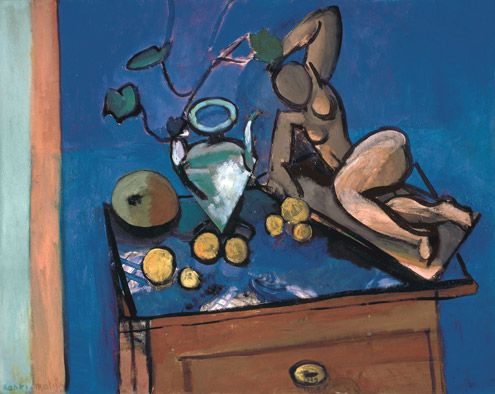
Henri Matisse’s “Sculpture and Vase of Ivy” (1916) turns a tabletop into a miniature stage where objects, outlines, and color fields negotiate balance. On a polished surface, a turquoise jug and trailing ivy share space with lemons, a greenish melon, and a reclining sculptural figure simplified to looping contour. A drawer front with a brass pull grounds the lower edge; a wide blue wall fills the background; a sandy vertical band at the far left hints at a doorway or canvas edge. The subject is domestic, even modest, yet the painting reads like a precise essay on relations: vertical against diagonal, glass against flesh, living vine against wrought form, warm accents against the oceanic blue that holds everything together.
The 1916 Context And Why It Matters
Painted in the heart of Matisse’s wartime period, this canvas reflects the discipline he adopted between 1914 and 1917. During these years he pruned his vocabulary. Interiors flattened into planes. Portraits became masklike. Still lifes were rebuilt from decisive contours and tuned color blocks. “Sculpture and Vase of Ivy” belongs to a cluster of works in which he staged a dialogue between crafted figures and living plants, often using the same motifs on differently colored grounds. The blue version here introduces a new climate. Rather than the rose table and gray curtain of a sister composition, an expansive blue field creates calm and heightens the sparkle of reflections across the tabletop.
First Impressions And Visual Path
From across the room, the picture condenses into a few large chords. The blue wall is the dominant note. The tabletop cuts diagonally from lower left to upper right, its black edge drawn in a firm, elastic line. On that stage sit a pale turquoise jug, a handful of lemons, a greenish melon, and the reclining ocher figure on a small plinth. A vine ascends, leaf to leaf, toward the figure’s head. The eye moves from the jug’s oval mouth to the bright fruits, then along the body’s long curve and back down the diagonal to the drawer’s oval pull. The route is efficient and satisfying; the painting invites circling without confusion.
Composition As Architecture
Matisse builds the composition from two governing axes. The diagonal of the table establishes thrust and depth, while the vertical blue wall holds a broad, stabilizing counterplane. Inside this framework he sets smaller balances. The jug stands nearly vertical, echoing the background even as it leans slightly along the table’s tilt. The sculptural figure provides a nested diagonal, reclining opposite the table’s slope so the two vectors lock like dovetail joints. The lemons form a chain of bright discs that bridge jug and figure. The melon on the far left acts as a counterweight, keeping the arrangement from listing to the right. Nothing is symmetrical, yet every mass has a partner.
Color Architecture And The Role Of Blue
The painting’s climate is defined by blue. It fills the wall, slips into reflections on the tabletop, and peeks through the jug’s translucency. Rather than a single note, the blue arrives in several temperatures: a saturated ultramarine across the wall, softer blue-grays glancing off the polished table, and turquoise in the glass. Against this sea of cool color, Matisse deploys controlled warmth. The figure’s body is built from ochers and pale coral pinks; the lemons carry clear cadmium yellows; the melon’s skin leans olive. The drawer front, with its honey color and brass pull, repeats that warmth at the bottom, knitting the palette. The result is a harmonic field where blue calms and warm accents pulse.
Light, Value, And The Miracle Of Reflection
Light is not mapped via a theatrical spotlight; it is distributed to clarify materials. The tabletop is the primary reflector. It behaves like painted wood or lacquer, catching highlights in silvery streaks along the diagonal. These strokes double the forms above: pale echoes of lemons, hints of jug, a smudge of figure. Reflections do not aim for photorealism; they are painterly abbreviations that persuade because they are tuned to value rather than detail. The figure’s back and hip receive higher light, giving the body weight without heavy modeling. The jug’s interior rim is crisp and bright, while the belly is explained through a single gradient. The large blue wall stays relatively even in value so that objects can read as discrete, legible actors against a quiet backdrop.
The Sculptural Figure As Pictorial Engine
The reclining figure is not a naturalistic nude; it is a sculptural sign. Its contour is a continuous ribbon that thickens over shoulders and hip, thins at the wrist, and loops briskly around the head. Inside the line, color is laid thinly, allowing the ground to breathe and suggesting the porous matte of plaster or clay. The figure lies on a rectangular slab, a studio plinth that announces its identity as an art object. Crucially, the body’s diagonal pushes against the table’s slope, creating a hinge for the whole arrangement. The figure’s ear and raised forearm form a small arena where vine and hand almost meet, a charged pause that animates the stillness.
The Vase Of Ivy And The Language Of Arabesque
If the figure supplies weight and counterthrust, the jug and ivy supply lift. The jug rises as a turquoise column with a round mouth, a curving handle, and a tapered belly. Its glassiness is conveyed with minimal means: a bright oval for the lip, pale runs along the shoulder, and a darker wedge at the far side. From the jug, ivy stems escape in loose arabesques, placing dark leaves at measured intervals across the blue. These leaves act like punctuation in the painting’s sentence. They also bridge the artificial and the natural: the living plant leans toward the sculpted body, and a single leaf overlaps the figure’s head, crowning it softly without ceremony.
The Lemons And Melon As Rhythmic Punctuation
Matisse places bright rounds of lemon along the table’s diagonal so the eye has stepping stones from one object to the next. Each lemon is painted briskly—one or two shifts of value and a dark outline that refuses perfect circularity. The variation in size and spacing prevents a mechanical beat. The melon at left, heavier and duller, is the bass note that starts the rhythm. Together, these fruits do more than describe a meal; they stitch the painting spatially and temper the blue’s coolness with edible warmth.
The Tabletop As Theater Of Paint
The table is a painter’s delight. Its surface gloss allows Matisse to slip between description and abstraction. When he drags a loaded brush diagonally, highlight becomes both reflection and pure mark. When he allows a blue-gray to sit under a black contour, shadow and depth are announced with almost no effort. The front of the table, by contrast, is flat and calm, a honey panel with a centered oval pull that echoes the jug’s mouth above. This panel functions like a stage apron: it separates the viewer’s space from the fiction of the tabletop while repeating the painting’s key shapes.
Space, Depth, And The Tilted Stage
Depth is shallow but believable. The table tilts toward us, granting a clear view of objects, while the blue wall suppresses extraneous perspective cues. Overlaps carry most of the spatial work: lemons in front of jug, jug partly in front of figure, vine over blue, figure on a slab. Cast shadows are brief and strategic. The result is a classic Matisse stage—a decorative plane that still reads as space, where things can sit with gravity yet never escape the harmony of the surface.
Drawing And The Authority Of Contour
Contour is the painting’s grammar. The black lines vary in pressure, allowing Matisse to assign character to each thing. The jug’s contour is rounded and a bit even, appropriate to fired glass; the lemons are encircled in quick elastic rings; the figure receives the most expressive treatment, a lively calligraphy that turns anatomy into a few decisive bends. Lines occasionally sit just off the color patches, leaving a sliver of blue or brown that makes the edge vibrate. This slight misregistration gives the picture breath and keeps the design from feeling machined.
Brushwork And Materiality
Across the surface, the brush speaks in multiple dialects. In the wall, strokes are broad and parallel, laying down an even field that nevertheless shows the hand. On the table, paint is dragged and flicked to mimic sheen. The jug’s highlights are struck and left, not blended. The body’s interior paint is thin, letting the canvas or underlayer suggest the granular surface of sculpture. Nothing is over-finished; each area tells you how it was made, and this candor contributes to the painting’s calm authority.
Nature, Artifact, And The Theme Of Companionship
One of the canvas’s quiet pleasures is how it holds living matter and made things in gentle proximity. The ivy is cut from a garden and kept alive in water. The lemons and melon bring the season indoors. The reclining figure is crafted and durable. Together they sketch a philosophy: art is not an escape from life but a companion to it. The vine’s arc toward the figure dramatizes that companionship; the reflections beneath them fold the world into a single surface. The painting avoids allegory and delivers its theme through the felt coherence of its forms.
Dialogues With Neighboring Works
This picture speaks to other Matisse canvases from the period. It shares the structural discipline of “Still Life with Gourds,” the reflective tabletop of “Still Life, Peaches and Glass,” and the studio-window equilibrium of “Interior with a Bowl with Red Fish.” Compared with a related composition on a pink table, the present version shows how a shifted ground color rewrites mood. Blue quiets the room, heightens the citrus, and makes the ocher body glow. The experiment is typical of Matisse: repeat a motif not to copy it but to test its limits under new climates.
Evidence Of Process And Revision
Close looking reveals changes that animate the final image. A faint halo along the jug’s right shoulder suggests an earlier width. The contour of the figure’s hip bears a ghost line beneath the present curve. The black edge of the table includes small corrections, thickened where the painter reasserted the diagonal. On the tabletop, buried highlights indicate trial marks that were partly veiled. These traces are not defects; they are the record of choices, proof that the painting’s clarity is earned.
How To Look
Start with the largest relations. Let the blue wall wash over your eyes and then feel how the table’s diagonal cuts into it. Move from the jug’s bright rim through the lemons to the figure’s back and hip. Follow the vine upward leaf by leaf until it hovers over the head. Step back until the scene compresses into four or five planes; step forward to read the drag of white in a reflection and the tiny dark nick that shapes a lemon. This oscillation between distance and proximity is where the picture yields its richest pleasures.
Lessons For Painters And Designers
The canvas offers practical guidance. Limit the palette and make temperature carry emotion. Design objects with contour and let value do only what is necessary. Use reflections as both description and abstract punctuation. Place warm accents along structural routes to guide the eye. Keep depth shallow so the surface can sing. Above all, orchestrate relations so each element supports the others. Matisse shows that harmony is not blandness; it is precision.
Conclusion
“Sculpture and Vase of Ivy” is a quiet summit of Matisse’s wartime search for order. A jug, some fruit, a vine, and a sculptural figure become instruments in a small orchestra tuned by blue. The painting is not about spectacle; it is about balance strong enough to hold feeling. It proves that the studio—especially in lean times—can be a place where ordinary things reveal structure, color reveals climate, and a handful of lines can conjure a world that still feels fresh a century later.