Image source: wikiart.org
Introduction
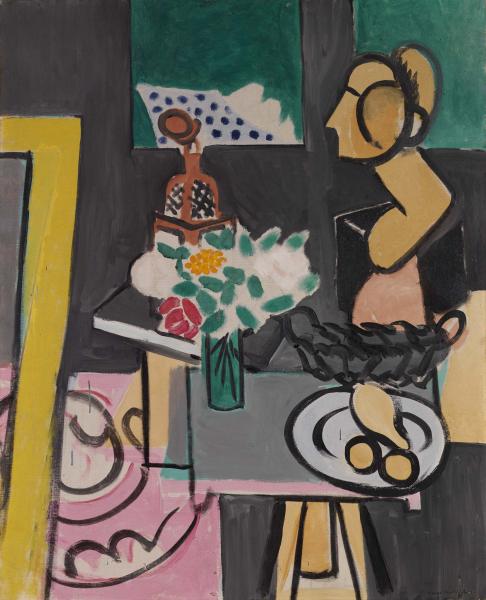
Henri Matisse’s “Still Life with Gourds” (1916) is an audacious studio drama in which tabletop objects, a stylized figure, and fragments of interior architecture lock into a crystalline arrangement of planes. At first glance the painting reads as an abstract tapestry of blacks, greens, pinks, and grays. Step closer and a world clarifies: a vase of white blossoms punctuated by a red rose, a gray table set with a plate and sliced gourds, a wicker basket, the curved profile of a seated woman, and a patterned textile fluttering like a banner on the back wall. Rather than describing the room in naturalistic depth, Matisse builds it from taut shapes and emphatic contours, allowing color and line to shoulder the roles of space and volume. The result is both still life and stage set, a wartime summation of the structural clarity he had been pursuing since 1914.
Historical Moment
By 1916, Matisse had pared his vocabulary to essentials. Fauvism’s unbridled color remained in his blood, but the Morocco journeys and the long sequence of window pictures pushed him toward economy. The war sharpened that tendency: he sought calm, balance, and a constructive order that could withstand the turbulence outside the studio. In “Still Life with Gourds,” these ambitions come together. The canvas is not severe—flowers glow, pinks play against greens—but design rules. Every motif is simplified to a sign, and signs are arranged with an architect’s sense of mass and interval. The painting stands as a midpoint between the near-abstractions of 1914 and the sensuous Nice interiors that would follow.
First Impressions and Visual Walkthrough
Seen across a room, the composition resolves into a few large chords. A dark scaffolding of vertical and horizontal blacks anchors the field. Inside this grid, a cool green rectangle crowns the upper right, echoed by the deep teal of the flower vase and the paler mint of a tabletop edge. A luminous rose-pink semicircle spills at lower left like a carpet. The gray tabletop cuts diagonally into the center, carrying a white-rimmed plate and yellow gourd slices. The bouquet splays toward the upper middle, its whites and a single red rose lighting the picture like a candelabrum. A simplified profile—an ocher head and torso drawn with looping black—leans from the right margin, counterbalancing the bouquet’s thrust. Follow these elements in sequence and a rhythm emerges: banner, bust, bouquet, basket, plate, carpet, and back again, a circuit that never loses momentum.
Composition as Architecture
Matisse constructs the picture from intersecting axes. The gray tabletop forms the primary diagonal, slanting upward from left to right. This motion is checked by the nearly vertical black band at the right edge and by the yellow, door-like upright at the left. The bouquet sits where these forces meet, acting as a hinge in both space and rhythm. Below it, the wicker basket’s scalloped rim echoes the flower heads while its dark interior stabilizes the center of gravity. The figure’s contour, a continuous ribbon that articulates brow, nose, breast, hip, and elbow, behaves like a calligraphic buttress. These structural choices allow Matisse to keep the picture flat and legible without denying depth; overlaps and value shifts give just enough spatial cue for the mind to place things.
Color Climate
The palette is limited but resonant. Blacks and near-blacks provide a sober armature. Against them, greens appear in three distinct temperatures: a cool bottle green in the wall panel, a saturated teal in the vase, and a softer, yellowed green in the background’s stitched shapes. Pink arrives in a single, persuasive block at lower left, its warmth amplified by thin passages of coral within the bouquet. Gray, far from neutral, bends toward blue on the plate and takes on a chalky warmth on the tabletop. Ocher and cream enter through the figure’s body and the gourd flesh. Because each color is used as a plane rather than as blended modeling, their relations read like notes in a chord. The painting glows not by imitating light but by tuning temperature.
The Gourds: Form and Function
The sliced gourds on the plate are the painting’s title and a crucial compositional device. Matisse reduces them to two curving shapes, their creamy yellow set off by a gray plate ringed in white. The curvature of the slices answers the bouquet’s rounded blooms and the basket’s wavy edge, establishing a chain of semicircular forms that travels across the table. Their pale value also leaps across the canvas to the dotted handkerchief pinned on the back wall, creating a long diagonal of light from lower right to upper center. The gourds, simple as they are, prevent the still life from closing in on floral sweetness; they bring a sober, edible weight to the scene.
Flowers as Luminous Anchor
If the gourds are ballast, the bouquet is lift. Thick white blossoms expand outward, imprinted with a few mint-green leaves and a single insistent red rose. The cluster sits inside a tall teal vase that establishes the painting’s vertical measure. Matisse paints the flowers as masses rather than botanical specimens; they are balls of light. Their whiteness is never blank—small flicks of warm and cool gray suggest petal edges and cavities—but the overall effect is of a glowing cloud. Positioned at the junction of tabletop, wall, and figure, the bouquet anchors the composition’s energy while keeping the surface radiant.
The Figure at the Margin
The ocher silhouette leaning in from the right reads as an odalisque reduced to its essence: a head, a shoulder, and a hip described by two or three loops of black. The figure’s presence is paradoxical. It compresses the human body into a decorative sign, yet it also inflects the entire scene with narrative potential. Is she the arranger of the table, the observer, or simply an ornamental echo of the gourds’ curves? Matisse sidesteps such questions. The figure is there to hold balance and to fold the erotic arc of a body into the geometry of the room. Her ocher tone warms the right side and prevents the greens from dominating.
Pattern, Textile, and the Decorative Ideal
Textile is present as both object and principle. At upper center a dotted blue-white patch flutters like a patterned kerchief, a memory of Matisse’s lifelong love of cloth and ornament. At lower left, the pink semicircle carries a broad, cream arabesque that could be a rug or draped fabric. These patterns do not compete with the objects; they establish the painting’s decorative baseline. Matisse believed a painting should work like a woven tapestry in which every part contributes to a unified surface. In “Still Life with Gourds” the principle is literalized: textile fragments echo the motifs’ curves and lock the picture into a single, lively plane.
Drawing in Relief
Contour does the heavy lifting. Matisse draws with a charged black that thickens at corners, splits to emphasize overlaps, and thins to keep passages buoyant. The table’s edge is a firm bar; the vase, a column with a slight swell; the basket’s lip a scalloped string; the figure, a ribboning loop. These lines do not merely outline; they sculpt. Because the color fields are deliberately flat, the relief-like contour provides volume by implication. In several places Matisse allows the line to sit slightly off the color field, leaving a breath of underpaint that makes the edge vibrate.
Space without Illusionism
Depth is compressed and achieved through adjacency rather than perspective. The tabletop tilts up, the plate rides its edge, and the basket sits flush with the bouquet. Background rectangles stack like stage flats. Yet space is not denied. The plate’s white inner ring pushes back from its black outer contour; the bouquet’s stems disappear into the vase mouth; the figure’s shoulder overlaps a green panel, sliding her behind the table. This toggling between planar order and layered suggestion keeps the picture modern without making it brittle.
Rhythm and Repetition
Look for the repeated arcs: in the gourds, the bouquet, the basket, the carpet motif, and the figure’s profile. These echoes generate a visual rhythm that carries through the entire surface. Countering them are rectilinear notes: the table edge, the wall panels, and the yellow doorframe at left. The painting’s music lies in the balance of these motifs. Nothing is literal repetition; each recurrence is altered in scale, color, or context, preventing monotony and maintaining momentum.
Material Surface and Evidence of Process
The surface bears the record of adjustment. In the gray tabletop, brushed reserves reveal earlier edges; along the bouquet, touches of pink peek beneath white, proof that blossoms were moved or enlarged; the figure’s head shows a ghost line preceding the final contour. These pentimenti are not cleaned away. They humanize the rigor and remind viewers that clarity is achieved through revision. Paint sits with satisfying variety: buttery passages in the flowers, drier scumbles in the grays, and smooth, saturated swaths in the blacks and greens.
Dialogues with Cubism and Fauvism
“Still Life with Gourds” converses with Cubism’s structural discipline without adopting analytic fracture. Forms are simplified to planes; objects are assembled rather than modeled; the background is an arrangement of panels. Yet color retains the independent authority of Fauvism. Greens and pinks are chosen for their relations, not for local fidelity. Matisse stands at a fruitful crossroads—accepting Cubism’s lessons about construction while keeping his own commitment to color’s expressive autonomy.
Symbolic Hints Without Allegory
Gourds have long associations with harvest and domestic provision; flowers with beauty and ephemerality; the figure with longing or repose. But Matisse refuses to turn the painting into a coded emblem. Meaning arises through balance. The edible, durable gourds counter the bouquet’s fleeting bloom; the figure’s warm body leans toward the cool tabletop; the black scaffolding of the room steadies the freely drawn ornaments. The painting’s ethics are formal: set relations right, and feeling follows.
How to Look
Begin by letting the gray tabletop’s diagonal carry you into the scene. Let your eye rest on the plate, then climb through the bouquet into the dotted textile and back down along the figure’s contour to the gourds. Step back until the composition collapses into five or six large planes; step forward until small brush ridges in the flowers catch actual light. Track the repeated arcs and the countering rectangles, listening for the rhythm they create. Finally, notice how the whole picture holds together like a woven fabric: no part dominates once you settle in; attention can start anywhere and travel everywhere.
Legacy and Relevance
This canvas remains instructive for artists and designers seeking a language that reconciles clarity with pleasure. It shows how to orchestrate a complex interior with a handful of shapes; how to let line perform volume; how to set a restrained palette singing by calibrating temperature; and how to fold the human figure into a still life without letting narrative overwhelm structure. More than a century later, “Still Life with Gourds” still feels freshly composed because it refuses virtuoso illusion and trusts the essentials—shape, color, interval—to do the emotional work.
Conclusion
“Still Life with Gourds” is not a record of a particular tabletop at a particular hour. It is a distilled arrangement in which the things of a studio—flowers, fruit, plate, basket, textile, model—become the syllables of a clear visual grammar. Matisse composes them with the authority of a builder and the tact of a colorist. Curves meet bars, warm meets cool, figure meets object, and every meeting is tuned to produce calm vitality. In a period marked by uncertainty, the painting offers a poised order that is neither brittle nor sentimental. It is the kind of order that continues to breathe, inviting the eye to circle and recircle, finding new relations each time.