Image source: wikiart.org
Introduction
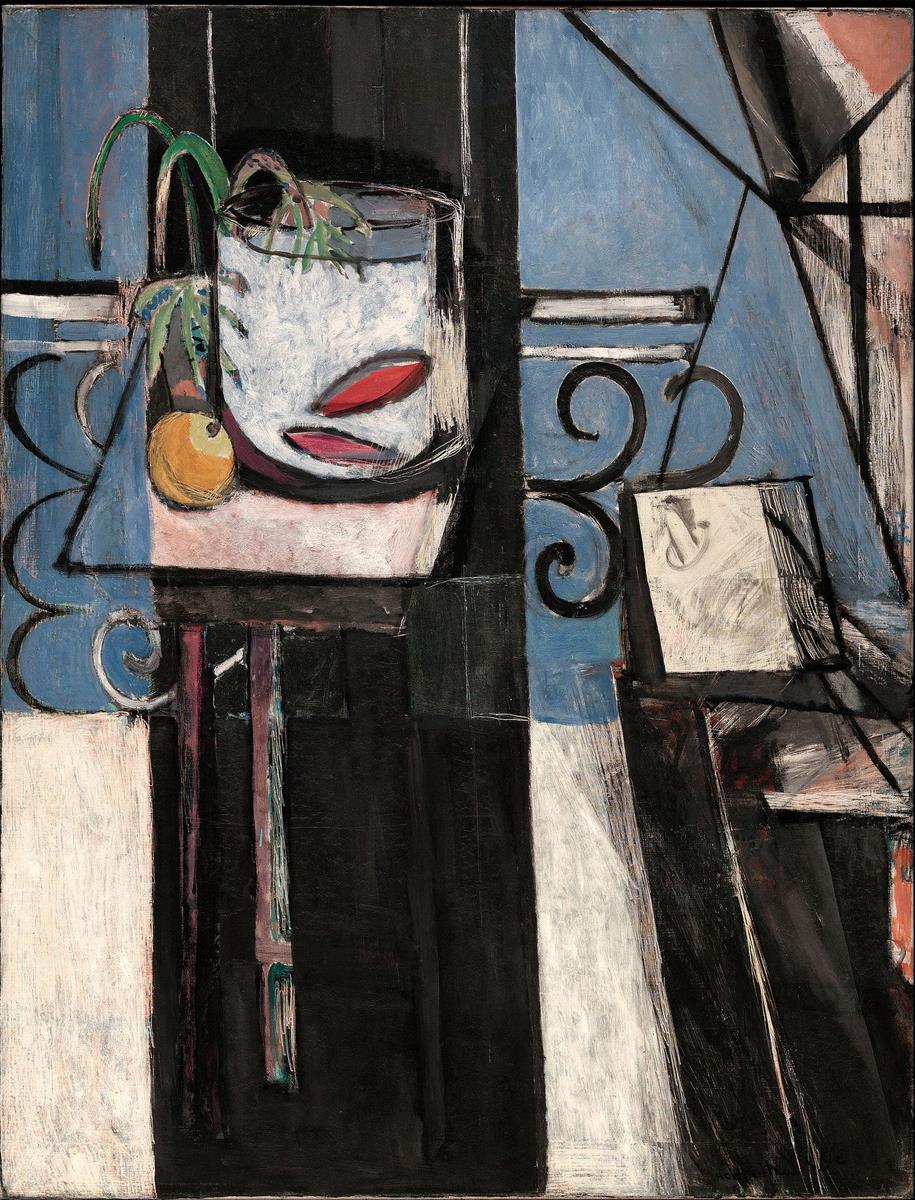
Henri Matisse’s “Goldfish and Palette” (1914) is one of the tautest statements of his prewar search for a modern pictorial grammar. A cylindrical bowl of red fish sits on a small table near an open French window. The wrought-iron balcony curls into clear, calligraphic S-shapes, and beyond them a cool band of blue stands in for the Paris sky. A lemon and a drooping spray of leaves crowd the tabletop. At the lower right a tilted painter’s palette enters the scene like a visiting actor. Everything is simplified into large planes, emphatic blacks, cool whites, and a few saturated accents. The result is both studio interior and abstract construction, an image that fuses the calm, contemplative goldfish motif with the self-reflexive sign of the artist’s trade.
Historical Context
The year 1914 was a hinge in Matisse’s career and in Europe’s history. Having returned from Morocco in 1913, Matisse began stripping his language to essentials: firm contours, broad color fields, a restricted palette, and a shallow space that preserved the surface’s decorative unity. In this season he produced the near-monochrome “French Window at Collioure,” the reduced “View of Notre-Dame,” the rigorous portraits of his family and friends, and several interiors anchored by aquaria. “Goldfish and Palette” fits squarely into this experimental suite. It reaches toward Cubism in its blocked architecture and incisive black scaffolding, but it never surrenders Matisse’s belief that color and ornament can carry a picture. The subject—goldfish before a window—was itself a cherished memory of the patient watchers he had seen in North Africa, people who could spend long minutes contemplating the slow turn of fish. Here, in a Paris studio on the eve of war, that quiet act of looking becomes the core of a demanding modern design.
First Impressions
From across the room the painting reads as a vertical grid of blacks and whites broken by a central square of action. The cylindrical bowl gleams with chalky light; two red fish glide like commas inside its milky blue; a yellow lemon presses against the left edge; a stringy green plant leans into the water like a signature flourish. The balcony rail’s dark scrolls bracket the central group, while angled bars at the right fracture the field and point toward the palette lying at the corner. The composition feels architectural and musical at once—columns, beams, and brackets supporting a rhythm of curves and diagonals.
Composition and Structure
Matisse organizes the painting around a cruciform structure. A black vertical pier runs down the center, splitting the window and the deep interior shadow. A horizontal lintel crosses at balcony height, where the wrought iron asserts its scroll. The bowl and table cluster at this crossing, literally and structurally the keystone of the picture. Below, a solid pillar of black anchors the composition; on the right, a counter-pillar of white pushes upward like a shaft of daylight. Diagonals slice through the upper right quadrant, tipping the space toward the palette. These strong vectors prevent the canvas from settling into symmetry and keep the eye circulating between bowl, balcony, and palette.
The Palette as a Picture About Painting
Few still lifes are as frank about their own making. By placing a tilted palette at the lower right, Matisse acknowledges the painting as an event in the studio. The palette is not a detailed still-life object; it is a brisk, tilted plane with a thumb-hole, a shorthand that says “this is the arena where color is mixed and decisions happen.” Its tilt echoes the diagonals above, so that the instrument of painting is woven structurally into the room. The palette’s pale ground recapitulates the bowl’s milky interior, and a brush-stroke arc at its edge whispers of the same curved ironwork outside. Studio, city, object, and act are folded into a single system.
Color, Temperature, and Light
The palette is restricted and strategic. Blacks and near-blacks articulate structure. Whites and cool grays speak for daylight, plaster, and glass. A quiet, clear blue carries the air beyond the window. Against this disciplined climate, accents flare: the red goldfish are the canvas’s warm heart; the lemon’s yellow is a small sun tucked at the edge; the plant’s mottled green supplies the lone note of vegetal life. Matisse builds the sense of light not by conventional modeling but by proportion: more white here than there, a blink of glare at the bowl’s rim, a chalky scumble across the table. The picture glows because the temperature relations are tuned, not because shadows are carefully rendered.
The Goldfish Motif
Matisse returned to goldfish again and again because they solved multiple pictorial problems. The bowl provides a circle within rectangles, a pure counter-shape to the window’s bars. Water invites translucency and the play of reflection; fish, as bright commas, become moving warm accents in a cool field. Culturally, the motif recorded his Tangier experience of unhurried contemplation. In the present canvas, the fish perform an architectural task: they magnetize the central square and hold it against the force of the surrounding blacks and whites. Psychologically they offer calm, a small self-contained world that steadies the geometries rushing around it.
Balcony, City, and Ornament
The wrought-iron balcony contributes both setting and rhythm. Its S-shaped curls anchor the middle register and humanize the black scaffold with ornament. Matisse’s decorative ideal—where every area of the surface participates as equal partner—finds a perfect instrument in that iron scroll. It repeats in the curve of the fish, the rim of the bowl, the lemon’s roundness, and the palette’s thumb-hole. At the same time, the ironwork marks the threshold between interior and exterior. We never see a detailed city; a cool band of blue stands for the world beyond. The balcony’s line declares that the real subject is the relation between inward and outward seeing.
Space Without Illusionism
Depth is shallow and deliberately inconsistent. The table is both a tilted plane and a stage; the black pillar reads as interior wall and as abstract stripe; the window beyond is both a slice of sky and a blue panel. Overlap establishes just enough depth to keep objects legible: the lemon sits in front of the bowl, the bowl in front of the balcony bar, the palette under diagonal slats. Instead of a single vanishing point, Matisse uses crossings and abutments to build a viable, modern space—a room one can believe in without relinquishing the painting’s flat order.
Drawing, Contour, and the Authority of Black
The drawing is decisive and varied. At the bowl’s rim, line is thick and emphatic, a dark ellipse pinning the cylinder to the surface. Around the plant and lemon, line thins and frays, letting the motif breathe. The balcony scrolls are written with a loaded brush that leaves ridges; their physical presence becomes part of the architecture. At the right, razor-like diagonals slice the plane, some filled with pale color, others left as skeletal beams. Black here is not merely outline; it is the picture’s carpentry, the beams by which color planes are attached to one another.
Texture and Process
The paint surface reveals how the picture was constructed. Milky passages inside the bowl are scumbled and dragged so that hints of undercolor show through, an apt analog for water’s clouded light. The blacks are layered: some passages are matte and absorbent; others gleam where the brush carried more oil. Pale areas at left and right show quick, broad brushing that refuses fuss and keeps the field alive. You can trace revisions in the central pillar and along the balcony: lines tried and moved, edges sharpened after the fact. Final clarity reads as the outcome of adjustments, not as a single stroke of certainty.
Comparisons Within the 1914 Suite
Set beside “Interior with a Bowl with Red Fish,” this painting appears more architectural and more starkly graphic. Where the earlier interior spread blues across the room and treated the water as an inner light, “Goldfish and Palette” counters that lyricism with a scaffold of black bars and compressed planes. Compared to “French Window at Collioure,” which nearly cancels the view, this canvas reintroduces the outside world via the balcony’s ornamental gate and the cool blue band. Relative to “View of Notre-Dame,” which dissolves the city into a pale rectangle, “Goldfish and Palette” plants the viewer back at the studio table, confronting the craft of painting itself through the emblem of the palette.
The Diagonals and the Drama of Looking
The right half of the painting is energized by angular diagonals, as if shards of light and wall were sliding across one another. Those diagonals are not descriptive alone; they act on the viewer, nudging the gaze down toward the palette and back up into the bowl. The eye experiences a triangulation—palette, balcony curl, fish—that repeats at different scales. This geometry turns looking into a physical event and ensures that the goldfish are not mere decoration but the center of a visual orbit.
The Lemon and the Plant
The lemon’s role is small but crucial. Tucked into the left edge, it provides a compact yellow sun that balances the red fish and warms the blue around it. Its firm circle outfits the composition with another rounded form, catching the light without the need for shadow. The plant is spare and slightly drooping, its thin, curved stem countering the thick ellipse of the bowl. Physiologically it hints at gravity and time; formally it adds a wiry line that echoes both balcony and palette marks. These organic notes keep the strict geometry from feeling cold.
Mood, Psychology, and Inwardness
Despite its architectural rigor, the picture is not hard. The goldfish move silently; the whites inside the bowl have the softness of breath on glass; the lemon’s warmth suggests home. The black scaffold feels protective rather than imprisoning, as if the studio’s structure were a frame for concentrated attention. Painted as Europe slid toward catastrophe, the canvas embodies a poised inwardness—a conviction that clarity and calm can be constructed in the midst of pressure.
How to Look
Begin at the bowl and let the red fish fix your eye. Then feel the central black pier drop through the picture like a plumb line. Drift outward to the balcony scrolls and register how their soft curves humanize the structure. Follow the diagonals at the right until you land on the palette; notice how its tilt returns you to the bowl. Step back and allow the cool blue beyond the window to settle as sky; step forward and observe how every area of white and black is modulated rather than flat. The painting teaches the pleasure of sustained looking by supplying a circuit with no dead ends.
Legacy and Influence
“Goldfish and Palette” is a pivotal document in the rise of modern interior painting. It demonstrates that a room can be built from color planes and decisive edges, that ornament can be structural, and that a limited palette can deliver rich optical life. Its balance of object, architecture, and self-reflexive signs influenced later painters who sought to keep the studio present within the image, from Léger’s machine interiors to the cool stagecraft of postwar abstraction. At the same time, the goldfish motif continued to ripple through Matisse’s work, culminating decades later in cut-paper compositions where fish and bowls become pure shapes.
Conclusion
Henri Matisse’s “Goldfish and Palette” compresses a studio, a city balcony, and the very tools of painting into a single lucid arrangement. With blacks as beams, whites as air, blues as cool distance, and a few hot accents for life, he constructs a modern space where contemplation and construction meet. The goldfish embody calm attention; the palette asserts the act of making; the balcony scrolls weave ornament into structure. More than a century later, the painting remains bracing and serene, a reminder that clarity is not the enemy of feeling and that a handful of tuned relations can hold an entire world.