Image source: wikiart.org
Introduction
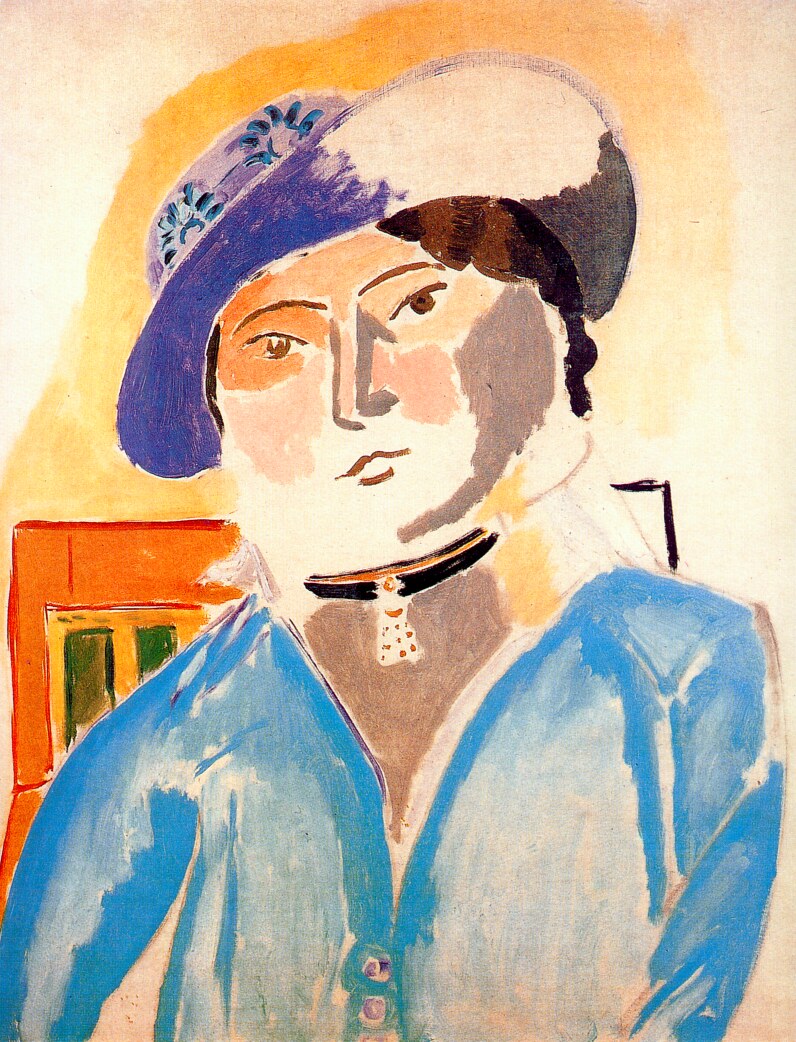
Henri Matisse’s “Marguerite in a Leather Hat” (1914) compresses a daughter’s likeness into a lucid system of color fields, calligraphic contour, and purposeful omissions. The head tilts slightly, the gaze is direct yet inward, and the broad brim of a lilac-blue hat shadows the forehead before flaring upward into a pale band of light. A slim black choker and small pendant punctuate the neck, while a sky-blue jacket opens in a soft V across the chest. Behind her, an orange-ochre rectangle with green panes hints at a chair back or window, and a veil of warm wash drifts over the upper ground like sunlight. The sense is of a portrait that breathes, not because it mimics naturalistic detail, but because it organizes sensation—warmth against cool, curve against angle, reserve against emphasis—into a poised whole.
Historical Moment and Subject
Painted in the tense months of 1914, the work belongs to Matisse’s concentrated prewar period, when he pared down his language while keeping color as the chief architect of form. The sitter is Marguerite Matisse, the artist’s daughter and one of his most frequent models from childhood into adulthood. She appears throughout his oeuvre in guises that mirror his evolving pictorial ideas—sometimes tender and descriptive, sometimes austere and mask-like. Here Matisse balances affection with experiment: he preserves Marguerite’s presence while testing how far simplification can go without cooling the portrait’s life.
First Impressions
Viewed across a room, the picture reads instantly. A pale face edged with dark accents floats within a field of creamy ground; a broad, cool hat and a cool jacket form two echoing ovals; a single, hot orange rectangle anchors the left. Come closer and the economy becomes daring. Flesh is largely the unpainted surface; modeling is achieved with a few deliberate planes of gray, rose, and ocher; features are abbreviated to signs. The portrait is not built from many parts but from a handful of large relations, which gives it poster clarity and surprising tenderness.
Composition and Framing
Matisse designs the portrait like a pyramid. The wide hat provides the base line, the head and shoulders taper toward a centered pendant, and the orange rectangle at left steadies the structure without overbalancing it. The slight tilt of Marguerite’s head prevents axial rigidity while preserving frontal authority. Cropping is bold: the brim runs off the upper edge, jacket shoulders press against the sides, and the chair or window is truncated. This close framing invites intimacy and keeps the image in the realm of designed surface rather than narrative scene.
Color Architecture
The palette hinges on a cool–warm dialogue. Cool notes—violet-blue in the hat, sky blue in the jacket, gray in shadows—establish calm. Warm notes—peachy flesh reserves and a honeyed halo behind the head—counter with quiet radiance. The orange-ochre block and its green panes supply the strongest temperature contrast, a chord that brings the figure forward and keeps the ground from dissolving into neutrality. Black contour and accents act as load-bearing beams. White is not filler; it is the painting’s brightest light, carefully left to vibrate between the other hues.
Light from the Ground
One of the portrait’s modern strengths is how much it relies on the bare support to play the role of light. Large areas of the face and blouse remain unpainted, allowing the ground to glow through. This is not a shortcut but a calculated choice that makes illumination seem internal, as if Marguerite were lit from within rather than by an external source. Where Matisse does add wash—along the jaw, under the brim, around the neckline—he does so sparingly, letting the smallest tonal differences turn a plane.
The Leather Hat and Costume
The hat is both emblem and architecture. Its violet crown, slate shadow, and pale brim establish a rhythm of three cools, while the sprigged band with blue blossoms lends a whisper of ornament. Calling it “leather” signals weight and modern fashion; Matisse paints its substance without fussing over texture, relying on tonal blocks and decisive edges. The jacket, reduced to lakes of blue with a few quick seams and buttons, becomes a portable sky that tempers the heat of the orange rectangle and the warm halo. Together hat and jacket stage the head, turning costume into structure rather than accessory.
Contour and Drawing
Matisse’s contour is succinct but expressive. A single unbroken line shapes the cheek and chin before climbing the jaw; a few dark strokes mark lids and brows; two concise curves define nostrils; a short horizontal for the mouth refuses theatrical expression. These lines are neither timid outlines nor academic modeling—they are sentences written with a brush, carrying meaning through rhythm and pressure. The drawing’s economy places the viewer’s attention on relationships: where a line thickens, the form turns; where it thins, light opens.
Brushwork and Surface
The surface remains open and breathable. Thin washes create misty transitions in the background; broader, more saturated strokes lay down the jacket and hat. In the orange block the paint sits slightly denser, encouraging the warm plane to advance. Edges are often soft, even fuzzy, so that forms grow from the field rather than being cut out of it. This softness is balanced by the firmness of the black accents—around the eyes, at the necklace, along the brim—preventing the image from losing definition.
The Role of the Orange Rectangle
That hot block at left is one of the picture’s masterstrokes. Whether chair back or window, it provides the essential counterweight to the cool figure. Its internal green rectangles echo the cool family while keeping their chroma warm, binding the two temperature worlds. It also introduces an architectural alignment; the block suggests vertical plumb lines and horizontal rails that measure the portrait like a quiet scaffolding.
Space, Depth, and Shallow Stage
“Marguerite in a Leather Hat” possesses depth without recourse to perspective. Space arises from value steps and overlap: the face sits in front of the jacket; the brim overlaps the forehead; the orange block sits behind the shoulder. The warm halo behind the head gently pushes it forward, while the cooler ground at the edges pulls away. The stage is shallow—exactly deep enough for a person to breathe—but it remains surface-true, consistent with Matisse’s decorative ideal.
Psychological Presence
Despite the radical simplification, the portrait reads as intimately human. The eyes look out with quiet steadiness; the mouth is closed, neither smiling nor stern; the tilt of the head suggests concentration more than pose. The pendant draws attention to the throat—a vulnerable point—yet the black choker also suggests composure and self-command. There is no anecdote to guide our interpretation; the mood is achieved through restraint, scale, and the poised meeting of warm and cool.
Dialogue with Fauvism and Cubism
The painting carries forward the Fauvist discovery that color can bear structural weight, but the brushwork is calmer than 1905’s eruptive vibrato. It also speaks, at a distance, to Cubism’s flattening of space and devotion to planar construction, though Matisse keeps the figure whole and readable. Where Cubism might break the hat into facets, here a few planes and a single, confident contour achieve the same modern clarity without fracture.
Kinship with Other Portraits of Marguerite
Compare this image with earlier portraits like “Green Stripe” (1905) and the drawing-led likenesses from 1906–1907. The 1914 canvas retains the earlier commitment to decisive structure, but now white reserve and open ground play a larger role. It also resonates with the same year’s portraits such as “Striped Jacket” and “Woman on a High Stool,” which share the poster-like frontality, the reliance on a few saturated chords, and the ethical quiet that replaces anecdote with presence. Marguerite becomes not only a subject but a touchstone for the painter’s changing grammar.
The Pendant and Choker Motif
The black ribbon and small, light-catching pendant are more than fashion. They perform critical compositional work: the ribbon is a dark horizon that stabilizes the head’s oval; the pendant is a bright, vertical counterpoint that drops toward the jacket’s V, locking head and torso together. They also sharpen the portrait’s pulse of contrasts—black against white, sparkle against matte, vertical against horizontal—keeping the image crisp.
Evidence of Process
Look closely and you’ll find pentimenti where brim meets background and near the shoulder seam, small signs of revision that testify to the picture’s negotiated nature. Matisse appears to have worked the whole at once, adjusting color temperatures in the ground in response to changes in the hat and jacket. The resulting surface keeps traces of uncertainty while projecting finality—a hallmark of his most convincing canvases.
Materiality and Scale
The near life-size scale of the head brings the viewer into conversational distance. Paint is generally thin, permitting the weave of the support to participate in the image; thicker in the orange block and at certain contours, where physical ridges catch light and keep accents vivid. This material economy keeps the portrait light on its feet, consistent with the sense of air and inwardness the image conveys.
The Role of Omission
Matisse’s refusals are as eloquent as his affirmations. He rejects detailed flesh modeling, patterned clothing, descriptive interior, and narrative accessories—all common props in portraiture. What remains are the structural essentials: head, hat, jacket, one anchoring block, and the tuned climate of the ground. By choosing so little, he lets each element carry more, and he invites viewers to complete the image through attention rather than through offered detail.
Reading the Painting Today
“Marguerite in a Leather Hat” still feels contemporary because it solves enduring problems with durable means: how to balance intimacy with design, how to let color and contour replace exhaustive description, how to use blankness as active light. It models a way to look at people—clear, respectful, poised—that resists spectacle and sentimental narrative alike. And it shows how far a painter can go with three families of color and a handful of lines when every choice is exact.
How to Look
Begin with the large chords: cool blues and violets against warm cream and ocher; the single orange counterplane. Trace the brim’s path and feel how its pressure changes. Let your eye jump between pendant and hat flower, then back to the eyes. Move in to watch the tiny adjustments in the gray planes of the cheek and nose; step back to feel how those planes cohere into a single, calm face. Notice how the unpainted ground remains luminous rather than empty. The portrait becomes a lesson in reading relations rather than inventories.
Conclusion
“Marguerite in a Leather Hat” is a portrait of equilibrium—between affection and analysis, warmth and coolness, contour and field. It keeps the human presence front and center while demonstrating the power of disciplined economy. Matisse’s daughter is not dramatized; she is honored with clarity. The painting holds its place in the 1914 suite as a keystone, showing how modern portraiture can be built from a few purposeful planes, a confident line, and the courage to leave light unpainted.