Image source: wikiart.org
Introduction
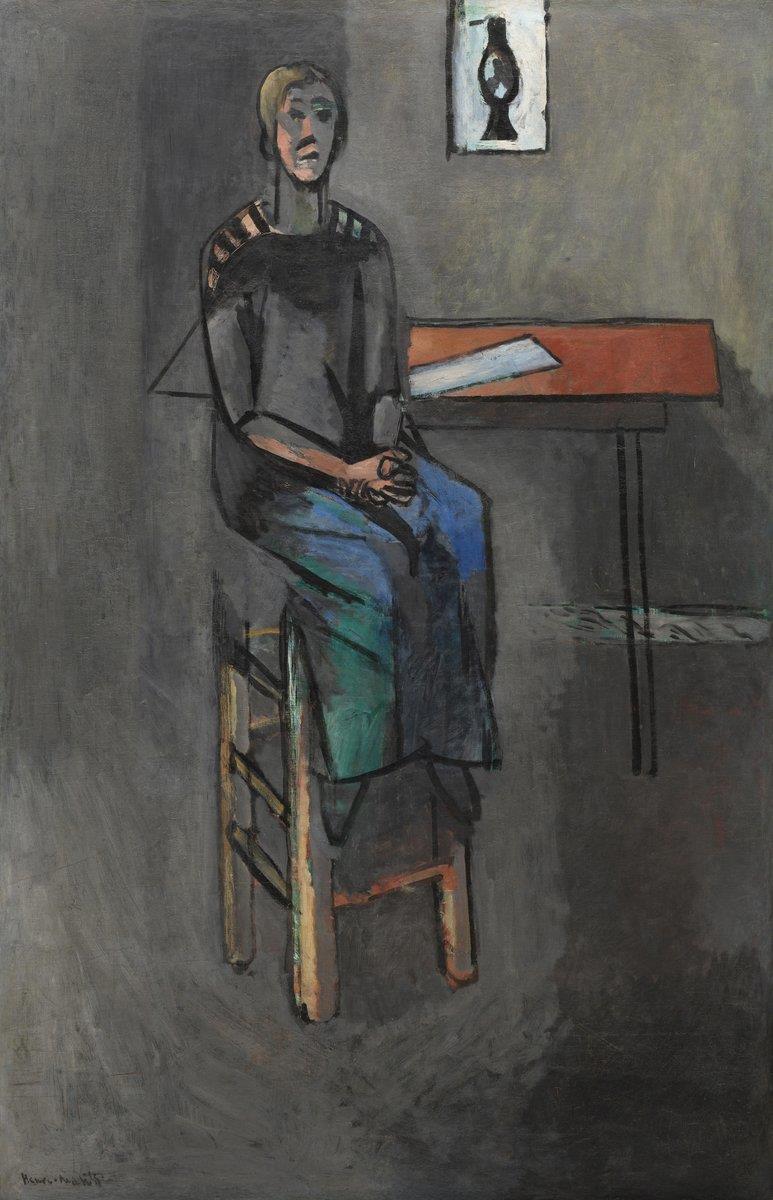
Henri Matisse’s “Woman on a High Stool” (1914) is one of the most concentrated, austere, and quietly radical portraits of his prewar years. A seated woman occupies an otherwise empty gray room. She perches on a tall stool, hands folded, a wedge of rust-red tabletop intruding from the right, and a small black silhouette picture pinned to the wall behind her. A cool blue-green skirt and a few ocher strokes on the stool legs are the only passages that break the prevailing climate of grays, blacks, and muted browns. The figure is locked together by strong black contours and simplified into planar, almost architectural masses. The result is a portrait that reads as much like a constructed ensemble of shapes as it does a likeness, a statement about how modern painting could hold poise, interiority, and formal rigor at once.
Historical Moment
The year 1914 was a hinge in Matisse’s career and in European history. Having returned from Morocco in 1913 with a renewed fascination for large color planes and decorative order, Matisse spent the months just before the First World War paring his language to essentials. Paintings from this season—among them “Bathers by a River” and “View of Notre-Dame”—adopt restrained palettes, assertive contours, and a new structural severity. “Woman on a High Stool” belongs to that crucible. The gaiety of Fauvism has been replaced with a disciplined modernism that weighs every mark. It is not a retreat from color but a decision to let color act as a structural beam rather than as surface fireworks.
Subject and Setting
The sitter is commonly identified as Germaine Raynal, a figure in Paris’s literary and artistic circles. Matisse treats her not as an occasion for anecdote but as an armature for pictorial thought. The room is stripped of any narrative comfort. A high stool presses her body upward; a table cuts sharply into the picture; a small wall image punctuates the void. This is a studio interior reimagined as a theater of relations: vertical figure, horizontal table, neutral field, and the minimal objects needed to stabilize the geometry.
First Impressions and Visual Walkthrough
The eye first registers an enveloping gray that modulates from dark on the left to slightly lighter on the right, creating a faint sense of space without conceding perspective. Within this field, a tall, roughly centered column appears: the woman’s body simplified into dark tunic and cool skirt. The stool’s legs describe a thin scaffold that touches the ground like a drawing. To the right, a rust-orange tabletop projects as a strong color plane; an angled white sheet sits on it like a pale wedge of light. Above, a small rectangular picture interrupts the wall, its black vase-like silhouette repeating the figure-ground logic at a reduced scale. The portrait’s power lies in how little it uses to command the entire surface.
Composition and Geometry
Matisse designs the painting as a cross of forces. The vertical of the body and stool rises from the floor while the table’s horizontal slashes through space to arrest it. The sitter’s arms, joined in front of her, form a compact knot at the central axis; her head, slightly lifted, caps the column like a keystone. Triangular cues reinforce stability: the wedge of the tunic’s hem, the triangular echo of shadow behind the back, and the slant of the paper on the table. The small wall picture is placed with surgical precision to balance the mass of the figure. These relationships allow the composition to read as a coherent diagram even before one recognizes a face or a hand.
Color and Tonal Architecture
The painting’s palette is severely reduced and exquisitely tuned. Grey dominates, laid in as broad, breathing passages that shift from charcoal to stone to smoky blue. Against this climate, Matisse deploys three decisive color events. The skirt delivers a cool blue-green that suggests weight and diffuses upward as if color were evaporating into shadow. The tabletop is a hot, rusty orange, a single warm chord that propels forward and keeps the portrait from sinking into a monochrome fog. The stool’s legs and the sitter’s hands and face carry touches of ocher and flesh that humanize the structure without sentimentalizing it. Black is used as a constructive outline and as tonal anchor; white appears sparingly as paper and as highlights, functioning like concentrated light. The chromatic restraint gives the picture its psychological pressure: each color decision matters.
The Role of the High Stool
The stool is more than furniture; it is a conceptual device. By lifting the sitter, the stool elongates the body, emphasizes verticality, and isolates the figure from the ground plane. The height also induces a particular carriage: knees together, feet barely touching, hands knit—a posture of gathered energy rather than ease. As a wooden scaffold drawn with ocher strokes and black bars, the stool also declares the painting’s armature. It is a visible skeleton on which the portrait hangs, a reminder that the image is built, not merely observed.
Contour, Brushwork, and Evidence of Process
Matisse’s contour is heavy, variable, and decisive. It thickens around shoulders and jaw, thins along forearms, and breaks momentarily where forms dissolve into the surrounding gray. These lines are not just edges; they are load-bearing beams that hold together otherwise airy planes. Brushwork in the ground is open and scumbled, leaving the weave of the canvas exposed and recording a sequence of adjustments. In the skirt, long strokes follow the fall of fabric; in the tunic, the paint lies flatter, signifying denser cloth. Small pentimenti—faint traces of earlier outlines—testify to revision. The painting keeps the history of its making visible, part of its sober honesty.
Space, Flatness, and Depth
The room is shallow and legible. There is no cast shadow under the stool, no perspectival box receding into the distance. Space is articulated by overlap and value changes: the figure blocks the wall, the table intersects the figure, the paper sits atop the table. The wall’s left-to-right gradient implies a light source without specifying it, and the slight halo around the head prevents the dark hair from sinking into the field. Matisse’s aim is not to deny space but to regulate it so tightly that the surface remains sovereign. The viewer moves through a modern, economical stage where every plane declares itself.
Objects as Signs
Each object functions like a glyph. The orange tabletop is a plane more than a piece of carpentry; it is a modernist slab that organizes space. The white sheet may be a letter or a folded paper; it reads as a clear, directional wedge that aims toward the figure and brightens the painting’s right side. The small framed image—a black vessel or lamp silhouette on a white ground—condenses the entire painting’s figure-ground dialectic into a miniature lesson. Even the triangular shadow behind the sitter reads as a sign, a geometric token for recession. Nothing is described; everything is declared.
Psychology and Mood
Despite its structural severity, the portrait carries quiet feeling. The sitter’s face is simplified into planes—greenish shadow along one cheek, ocher lights on brow and nose, dark bars for eyes—but the expression is unmistakably intent. Hands knit at the lap, shoulders level, mouth set, she appears self-contained, neither relaxed nor tense, as if occupying a pause between actions. The gray environment contributes to the mood: it is a room emptied of distraction, a place for concentration. The one vivid warm color, the orange tabletop, suggests an ember of life and thought amid neutrality. This is introspective modernity, not melancholy; steadiness under pressure rather than confession.
Dialogues with Fauvism and Cubism
“Woman on a High Stool” converses with the two dominant tendencies of its time without imitating either. From Fauvism it keeps the conviction that color is structural, here operating as disciplined chords rather than as saturated fireworks. From Cubism it borrows the flattening of space and the insistence on planar simplification, but it refuses radical fragmentation. The figure remains whole; the interior remains readable. Matisse’s alternative modernism stakes its claim on equilibrium—surface clarity married to human presence—achieved through the fewest necessary means.
Relations to Contemporary Works
Placed beside “Bathers by a River,” this portrait shares the cool palette, the emphasis on vertical slabs, and the sense of withheld narrative. Set against “View of Notre-Dame,” it echoes the desire to reduce architecture or figure to a concise scaffold of lines and planes. Within Matisse’s longer arc it foreshadows the serene clarity of the Nice interiors; the later odalisques would reclothe the figure in pattern and sun, but the backbone—the discipline of contour and the ordering of planes—was forged here.
Material Scale and the Studio
The painting’s scale contributes to its effect. The figure is nearly life-size, and the empty floor around the stool creates a buffer of silence. We feel the studio’s air, matte and gray, where every sound would be heard. The materials reinforce that sensation: oil thinned to a dry whisper on the wall; more body in the skirt and tabletop; black brushed on with the certainty of charcoal. Matisse lets the viewer occupy the painter’s interval—moments between strokes when the whole is weighed against the next decision.
How to Look
Begin by taking in the large cross of forces: vertical figure and stool, horizontal table. Then let the eye follow the contour of the tunic from shoulder to wrist, noticing how a line’s thickness changes to express pressure and turn. Attend to the gradations within the gray ground and how they guide attention without inventing deep space. Step to the right of the picture and watch the orange plane jump forward; step back and let it settle into balance. Return to the face and observe how little is needed—two dark notches, a bar of shadow, a ocher plane—for the sitter to look back. The painting teaches a way of seeing based on relations rather than details.
Legacy and Place in Matisse’s Oeuvre
“Woman on a High Stool” stands as a keystone of Matisse’s 1914 synthesis. It demonstrates how he could preserve the human figure’s dignity while pushing painting toward a flatter, more constructed surface. Its restraint gave later artists permission to use neutrality and emptiness as active components, not signs of absence. Within Matisse’s own development it anchors the transition from the intense experiments of 1913–1914 to the luminous order of the 1920s. It proves that serenity can be earned through discipline and that a portrait can be an architecture of thought.
Conclusion
In “Woman on a High Stool” Matisse stages a compact drama of vertical and horizontal, warm and cool, contour and plane. The sitter’s presence is secured not by descriptive richness but by decisive relations: a blue-green skirt against gray, a rust-red table against the void, a few black lines that bear the weight of the whole. The painting is quiet and uncompromising, both a likeness and a proposition about modern vision. It offers a room cleared for attention, a figure held upright by an armature of thought, and an image that continues to feel exact and necessary more than a century later.