Image source: wikiart.org
Introduction
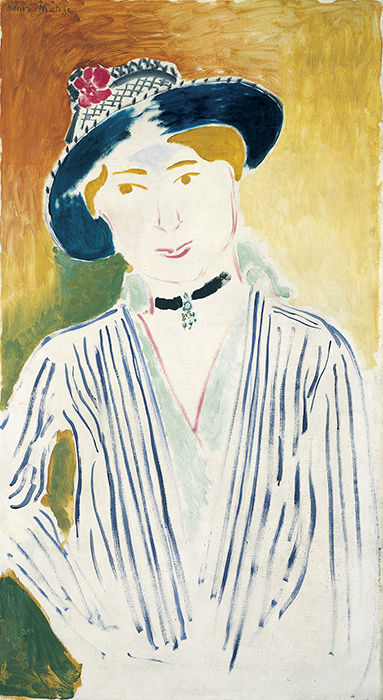
Henri Matisse’s “Striped Jacket” (1914) is a portrait that looks as if it were painted in a single exhale. A woman faces us with an easy, almost teasing poise, hands at her hips, a wide-brimmed hat tipped with a crimson rosette, a slim black choker glinting with a small pendant, and a jacket whose blue vertical stripes cascade like a quick melody. Vast areas of untouched ground serve as skin and light; a few unblended color planes create the room’s atmosphere. Rather than accumulating detail, Matisse subtracts until only the necessary remains—contour, color chord, rhythm, and attitude. What results is a portrait that feels both spontaneous and supremely deliberate, a statement of how modern painting can capture presence with astonishing economy.
Historical Moment
The year 1914 sits at a hinge in Matisse’s career. He had returned from his North African sojourns with a sharpened sense that light could be rendered as color fields rather than modeled shading. At the same time, he was developing a tougher studio language—firm contours, large reserves of bare ground, restricted palettes—that would feed directly into the clarity of the Nice period after the war. “Striped Jacket” belongs to this pre-war crucible. The picture distills lessons from Fauvism—color as structure—while discarding its earlier, flickering brushwork in favor of broad, unbroken notes. It also shows Matisse’s growing faith in the power of omission: the ability to leave areas unpainted and let the viewer’s eye supply volume and atmosphere.
First Impressions
“Striped Jacket” reads instantly from across a room. A tall, narrow format frames the sitter like a poster; the torso forms a white column animated by blue stripes; the hat’s dark oval anchors the top of the composition; a warm, amber background spreads to the right, transitioning to cooler greens and shadow to the left. Facial features are little more than signs—brows, a small smile, a suggestion of nose—yet the expression feels alive and specific. The jacket’s stripes, the choker’s neat punctuation, and the floral accent on the brim keep the surface lively without diluting the portrait’s structural calm.
Composition and the Architecture of the Figure
Matisse builds the portrait on a few strong axes. The sloping brim and the diagonal of the sitter’s right arm (on our left) set up a dynamic counter to the vertical run of stripes. Hands planted at the hips widen the silhouette and project confidence, while the V-shaped neckline draws the eye to the small pendant that functions as a visual knot, quietly tying head and torso. The figure occupies most of the field, cropped decisively at the edges, so the viewer does not observe her at a distance; we share her space. The composition feels poster-like—frontal, declarative, and designed to read quickly—yet subtle asymmetries prevent rigidity.
Color as Structure and Mood
The palette is reduced but precisely tuned. The background moves from an olive-green gray at the left to a honeyed ochre at the right, establishing a warm indoor air that gently silhouettes the figure. Hat and hair are deep blue-black, echoed by the jacket’s stripes and the choker so that the portrait is keyed to a cool-dark treble over a warm ground. The small rose on the hat adds the single saturated red accent, a spark that keeps the upper register from sinking into monotone. The face and blouse are largely the bare, pale ground of the support, warmed slightly by thin washes; this “non-color” is not absence but the painting’s strongest light, a deliberate decision that makes the figure feel illuminated from within.
The Authority of Contour
A few lines carry the weight of description. Matisse’s contour is flexible—bold along the brim, light and calligraphic at the cheek, intermittent at the jacket hem where the eye can finish what the brush suggests. These lines are not fencing in color; they are structuring movement. A slim curve articulates the smile; two arched strokes for brows are enough to set the expression. The jacket’s stripes are not perfectly parallel; they waver slightly, recording the hand’s speed and giving the cloth a living sway. Everywhere, line is treated as the sentence structure of the picture: concise, rhythmic, and clear.
The White of the Ground as Light
One of the portrait’s most modern features is its reliance on reserve. Matisse leaves large zones unpainted, allowing the support to serve as skin and as the bright interior of the blouse. Such reserve is not laziness; it is logic. By refusing to cover the ground with flesh tones, he preserves a vibrating clarity and keeps the figure from sinking into the background. Where he does add color—faint blush at the ear, soft greenish wash around the jacket lapels—it arrives like a whisper, just enough to suggest turning form. The white is thus active light, not empty paper.
The Jacket’s Stripes and the Aesthetics of Pattern
The striped jacket is both garment and pattern device. Verticals elongate the figure, set a steady tempo, and echo the tall canvas. Broken by the curve of the torso and the bend of the arms, the stripes become a map of the body’s volume without resorting to shading. They also place the portrait within modern fashion: a crisp, urban motif rather than a historical costume. Matisse often relied on textiles to organize pictures; here the jacket is the textile—portable architecture that unifies composition and character.
The Hat as Cornice and Character
The hat is a compositional cornice, a dark oval that caps the design and frames the face. Its blue-black note balances the density of the stripes below; its broad brim carves an elegant silhouette against the warm wall. The small red flower, set off by a gridlike ribbon, is a keynote of personality—playful but not frivolous. In a painting that minimizes facial detail, the hat carries much of the sitter’s attitude: poised, urbane, ready to step out into the city.
Gesture, Poise, and Psychological Presence
With the bare minimum of physiognomy, Matisse conveys a specific temperament. The slight head tilt, the almost imperceptible smile, and the hands-on-hips stance suggest self-possession and ease. The choker reads as a stylish choice, but it also acts psychologically: a dark, steady line at the throat that emphasizes calm and control. Nothing is theatrical; there is no staged narrative. The portrait’s intimacy emerges from its restraint: the sitter is present as poise rather than as story.
Background as Breathable Field
The background is a broad, breathing plane that does more than sit behind the figure. Its gradient from cool to warm creates a shallow sense of space, as if the sitter had stepped from shadow toward a sunlit wall. The brushwork remains visible—scumbles, thin drags, the weave of the support—so that the field retains life. Matisse avoids hard edges at the periphery, allowing tiny halos where figure meets ground; these soft transitions keep the portrait from feeling cut out while maintaining the clarity of the silhouette.
Materiality and Speed
Everything in “Striped Jacket” points to swiftness under pressure and to confidence born of long practice. Paint is laid thinly; changes in pressure communicate volume; edges show where the brush stopped and reloaded. The economy is disciplined, not hasty: each mark appears to be the last necessary mark rather than the first attempt. The result is a surface that keeps the evidence of its making in view, inviting the viewer to reconstruct the sequence of decisions and to enjoy the painter’s hand as part of the subject.
Dialogue with Modernism
Matisse’s portrait participates in the modern debates of its time without imitating any single camp. Unlike Cubism, it does not fracture the figure; unlike Expressionism, it does not dramatize torment through distortion. Instead, it presents frontality, flatness, and decorative order as sufficient modernity. The picture advances the argument that a painting can be both a window onto a person and a designed surface that lives as a thing in the room. In this sense, “Striped Jacket” stands with Matisse’s contemporaneous still lifes and interiors as a third path: clarity without coldness, pleasure without sentimentality.
Kinship Within Matisse’s Oeuvre
The portrait echoes earlier breakthroughs and foreshadows later ones. Its reduction of features recalls the famous “Green Stripe” portrait of 1905, but here the color contrasts are quieter and the reliance on reserve greater. Its airy background and stylish accessories anticipate the Nice interiors of the 1920s, where hats, shawls, and patterned screens play structural roles. The confident poster-like format also aligns the portrait with Matisse’s interest in prints and theater design—images meant to read with immediate force and lasting charm.
Fashion, Identity, and the Modern City
Clothes in this painting are not mere decorations; they define identity and time. The striped jacket, the choker, and the hat translate the sitter’s modernity into the painting’s language of stripes, lines, and ovals. These elements allow Matisse to explore pattern while keeping the figure contemporary rather than historical. They also invite viewers to read personality through design: crisp stripes as clarity, dark choker as steadiness, flower as wit. In a portrait that withholds facial particularity, fashion becomes eloquence.
How to Look at the Picture
The portrait rewards both scanning and lingering. From a distance, enjoy the poster clarity—the triad of hat, face, and jacket. Then move close and follow a single stripe from shoulder to hem, noticing how its thickness changes with pressure and how it curves over the body. Track the edge of the hat brim and how it shifts temperature as it crosses warm and cool passages. Observe the small pendant at the throat—a few dots and dashes that nonetheless sparkle—and how this tiny accent quietly anchors the composition. Finally, step back again and watch how the white of the support continues to read as light rather than emptiness.
The Decorative Ideal as Ethics
Matisse often described his aim as balance and serenity. In “Striped Jacket,” that aim carries an ethical undertone: the sitter is seen without invasion, adorned without objectification, presented with clarity but also with privacy. Decoration, in this view, is not prettiness; it is an order that makes room for a human presence to breathe. The painting’s restraint—its refusals as much as its declarations—models a respectful way of looking.
Legacy and Relevance
Over a century later, “Striped Jacket” still looks crisp and contemporary because it solves enduring problems with durable means. How little is enough to show a person? How can pattern and fashion serve structure rather than overwhelm it? How can a painting inhabit a room as calmly as furniture while remaining alive to the eye? Matisse’s answers—reserve, decisive contour, tuned color fields—continue to inform portraiture, illustration, and design.
Conclusion
“Striped Jacket” is a master class in concentrated means. A narrow format, a handful of colors, a few calligraphic lines, and the courage to leave much unspoken—these are the tools with which Matisse conjures a vivid, modern presence. The sitter’s poise, the hat’s elegant arc, the stripes’ flowing cadence, and the hush of the background all harmonize into an image that is both personal and emblematic. It is a portrait you can read in a heartbeat and live with for years, discovering each time how the simplest marks can still carry the richest sense of life.