Image source: wikiart.org
Introduction
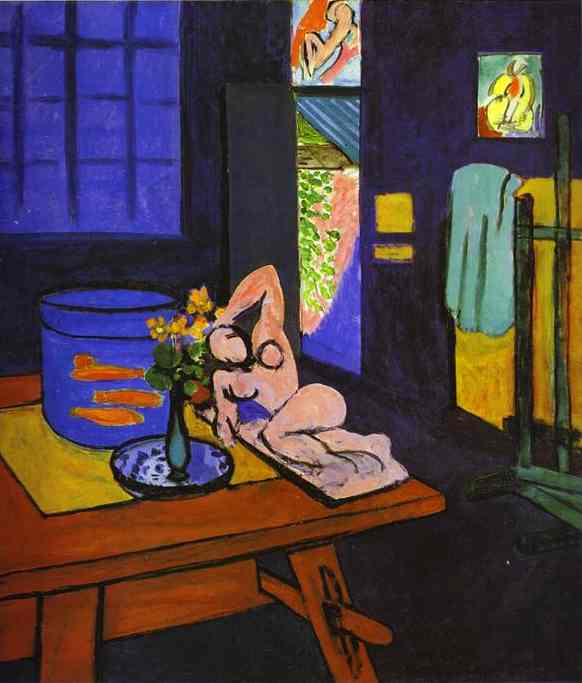
Henri Matisse’s “Red Fish in Interior” (1912) is a compact theater of color and looking. In a darkened studio, a bright wooden trestle table holds a round blue aquarium in which vivid orange fish drift like sparks. Beside it, a slim green vase and saucer support a few yellow blossoms, and a pale pink reclining sculpture leans languidly across a slab, its simplified contours echoing the painter’s own language of line. A deep ultramarine window, an open doorway onto a sunlit patchwork of green and rose, a towel hanging in a turquoise wash of color, and a vertical easel complete the scene. Matisse composes not a descriptive inventory but an orchestration of presences—living, carved, painted—balanced within an architecture of saturated blues, glowing yellows, and warm reds. The interior seems hushed; the colors hum.
Historical Context
The year 1912 is a hinge in Matisse’s development. He had recently returned from his first Moroccan sojourn, where harsh daylight simplified forms and color acted like architecture. Those experiences, combined with his long-standing fascination with the decorative unity of the studio, produced a series of interiors in which goldfish, vases, fabrics, and sculptures become actors on a stage of pure color. While Cubism fractured objects to explore perception, Matisse pursued clarity: large planes, decisive contours, and harmonies tuned like chords. “Red Fish in Interior” compresses that program into one room—part workshop, part sanctuary—where the phenomena of light, reflection, and material presence are translated into color intervals.
Subject and Setting
At the front left of the composition sits a sturdy, orange trestle table. Upon a square yellow mat rests a round blue fish tank, its curved side carrying the reflection of studio light and, within, several orange fish whose tapered bodies read as swift, calligraphic strokes. Near the tank, a dark green vase rises from a patterned saucer holding a small cluster of yellow flowers. Leaning across a plank is a pale reclining figure, a studio sculpture whose simplified limbs and sweeping profile feel both classical and newly minted.
The room around this still-life stage is deep violet and indigo, almost night-like. At the back opens a tall doorway onto an outdoor sliver: a vertical garden of green and pink, and above it a gray-blue strip of roof or sky. On the left a big window divides into dark panes; on the right a turquoise towel hangs against a yellow patch of wall, and a wooden easel stands in the corner. Two small framed images—miniature bursts of orange and cream—hang high, as if reminders of other paintings made here. Everything is reduced to essentials; everything is legible at a glance.
Composition and Structure
The design is built on two interlocking diagonals. One runs from the window at left through the table’s top and toward the door; the other runs from the easel and towel at right back to the fish tank. These diagonals cross at the cluster of still-life objects, making the table the composition’s hinge. The tank, vase, and sculpture form a tight, triangular group that projects forward, while the doorway pulls the eye back into space. A rectangle of yellow beneath the tank secures the tabletop like a glowing island within the dark interior. Matisse balances large blocks with agile lines: the rectangle of the window and the table’s top sit against the curve of the tank and the rolling contour of the reclining figure.
Color Architecture
Color in this painting is structural, not accessory. The room’s dominant note is a family of blues—from black-blue in the window grid to violet-blue in the walls and cobalt around the doorframe. Against these cool expanses, Matisse sets warm chords. The table is a concentrated orange-brown; the felt-like yellow square beneath the tank emits a soft heat; the small flowers burn a sharper lemon; the towel’s minty turquoise reads as cool-warm, a hinge between the heavy blues and the orange table. The fish themselves are the hottest notes of all—small, saturated streaks that animate the tank like embers.
These color relations accomplish the jobs that modeling and perspective once did. The yellow square pushes the table forward; the cold blues sink the walls back; the orange tank-lip and fish assert convexity and life. Instead of creating depth by diminishing scale and softening edges, Matisse layers space by orchestrating warm and cool.
Light, Reflection, and Glass
Matisse’s glass is always a site of invention. Here, the cylindrical tank is a deep, opaque blue, a paradox that reads instantly because the fish flare through it like cut fire. The tank lip is a lighter ring; a few vertical strokes on the water’s surface suggest reflection without fuss. The studio’s window, simplified into blue-black panes, becomes a luminous negative; it refuses to mimic bright daylight and instead acts as a cool wall of color, a foil to the yellow square and the warm table. In the doorway, daylight concentrates into a pale violet threshold and a strip of green-and-rose exterior mosaic, a reminder that the room’s darkness is chosen so that color can be heard.
Living, Carved, and Painted
The goldfish are living motion in a sealed world. The sculpture is motion arrested. The flowers are life cut for display. Around them hang two small paintings—life transformed into image. Matisse stages these categories so that they talk to one another. The reclining figure’s soft, rounded profile repeats the fish’s arcs. The vase’s narrow neck echoes the doorjamb. The small paintings on the wall, with their warm swirls, rhyme with the fish’s bodies and the sculpture’s curves. This web of echoes binds the studio’s diverse objects into a single rhythm.
The Doorway and the Promise of Outside
The open door functions as a carefully measured release. Most of the canvas is interior, tight, and dark; the outside is a narrow vertical of pink, green, and pale blue, cropped so closely that it behaves like a patterned textile hung in a frame. That outside is not scenic; it is chromatic. It introduces a vegetal green that does not appear elsewhere and, by contrast, confirms the studio’s identity as a color laboratory. The door is also a threshold in time: the inner room is devoted to patient looking, while the sliver beyond hints at sunlight and movement. The painting balances those tempos.
The Studio as Theater
Matisse’s studios are stages where the cast—objects, paintings, windows, bodies—performs relationships. Here, the trestle table is the proscenium; the yellow square is the spotlight; the fish and sculpture are actors; the easel stands like a backstage prop; the towel is a soft curtain. Nothing is incidental. The strange cross-brace beneath the table, rendered with sculptural clarity, tells us we are in the workshop of making, even as the harmonies of color encourage contemplation. The room is not just where a painter works; it is the subject that allows painting to think about itself.
Line and Brushwork
Drawing emerges at the seams where colors meet. The table’s edges are decisive black lines; the tank’s lip is a quick ellipse; the sculpture’s outline is a continuous, elastic contour that breathes. Within the dark walls, brushwork ranges from velvety layers to thin, stained passages that let undercolor show through. The yellow square is laid in as a flat, luminous plane; the vase and saucer are painted with small rhythmic touches that preserve their ceramic quality. The fish themselves are worked with confident, single gestures that leave ridges of paint, a physical presence equal to their optical one.
Rhythm and Balance
The painting’s rhythm is slow and steady. We move from the large blue window to the compact drama on the table, then to the door and its sliver of garden, across to the towel and easel, and back again to the fish tank’s glow. The small yellow blossoms act like pauses in the music. Balance is achieved without symmetry: the heavy window block is countered by the open door; the table’s mass is checked by the easel’s vertical; the warm cluster of objects is cooled by the surrounding blue. The eye never stalls; it circles.
Psychological Atmosphere
The mood is nocturne-like but not melancholy. The room’s darkness holds the warmth of the table and yellow square the way a velvet theater holds stage light. Silence seems to reign; nothing moves except the goldfish. The reclining sculpture, almost drowsy, mirrors the room’s quiet. And yet the painting is far from inert; its colors pulse. The effect is meditative: an invitation to linger, the way one might sit before a bowl of fish and watch time slow down.
Dialogues with 1912 Companions
“Red Fish in Interior” speaks to other works from the same year. The goldfish appear in multiple canvases as vehicles for looking and for testing how orange plays against blue. The nocturne palette and concentrated still-life cluster echo “Fish tank in the room,” while the sensation of threshold and cool/warm balance links the painting to Moroccan doorways and terraces. What distinguishes this interior is the density of studio references: framed paintings, easel, window, towel—the small daily facts of making staged within Matisse’s larger pursuit of harmony.
Material Surface and Evidence of Decisions
The surface bears traces of adjustment that keep the image alive. Along the doorframe one sees a thin violet overpaint where the edge was moved; the towel’s outline contains slight changes that found the right curve; the saucer under the vase shows a ghosted earlier position. These confirmations of choice make the painting feel discovered rather than preordained. Clarity is not a given; it is the result of tuning.
Why the Painting Matters
This canvas matters because it demonstrates how a painter can turn the humblest studio assemblage into a complete world. Matisse shows that the basic problems of painting—light, depth, motion, stillness, the relation of nature to art—can be addressed with a bowl of fish, a simple sculpture, a doorway, and a few strong colors. He refuses illusionistic tricks and finds, instead, a modern clarity where color does the carrying. The picture is both intimate and monumental: a tabletop drama that reads, from across a room, as a grand statement about the pleasures of looking.
Conclusion
“Red Fish in Interior” is a chamber piece that feels symphonic. Within four walls, Matisse arranges blue night and yellow flame, living fish and a sleeping figure, an inner table and the briefest glimpse of the outer world. The composition’s strength lies in how little it needs to persuade us: an orange table, a blue window, a cylinder of water, a pale sculpture, a vertical of day. From these tuned elements, the painting produces calm, focus, and the sense that color itself is a living presence. It is not a record of a room; it is the sensation of dwelling in a room made for seeing.