Image source: wikiart.org
Introduction
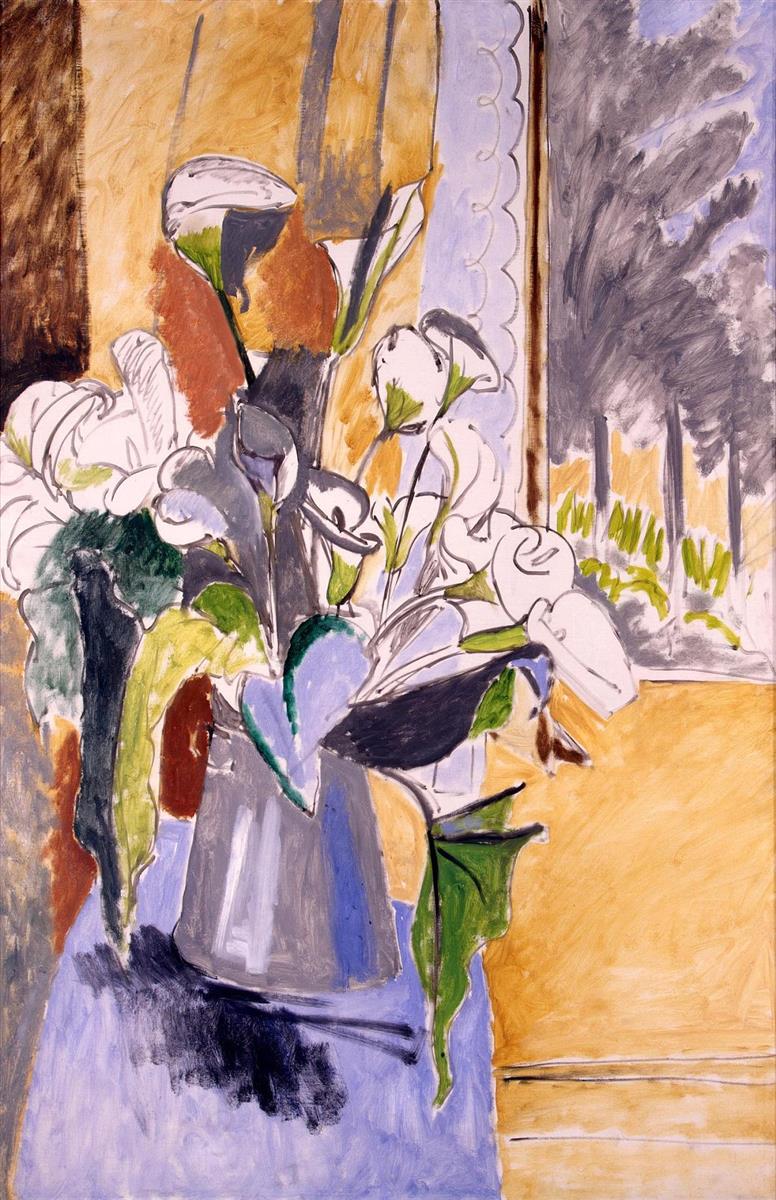
Henri Matisse’s “Bouquet of Flowers on a Veranda” (1912) is a radiant demonstration of how a still life can expand into a meditation on air, light, and the act of seeing. What begins as a vase of calla lilies near an open threshold quickly becomes a full orchestration of interior and exterior—cool lavenders and blues breathing against honeyed ochres, calligraphic contours activating large planes, and the veranda itself functioning as a hinge between private space and the animated world beyond. Painted in a year crowded with breakthroughs, the canvas clarifies Matisse’s central conviction that color and line are not afterthoughts to description; they are the very structure of experience.
First Impressions and the Pulse of the Motif
At first glance, the eye is seized by the shock of white blossoms, their horn-like forms flaring from a metal jug that sits on a blue tabletop. The table’s shadow is a charcoal cloud, quick and unblended, anchoring the bouquet without pinning it down. To the right, a vertical sheet of warm yellow opens like a door or blind, bordered by a scalloped strip of pale violet that reads as curtain, and beyond it a greyer, breezy view of trees and sky. The left edge is darker, a brown vertical that completes the frame. The whole scene breathes with immediacy: some flowers are realized with thick strokes; others remain almost diagrammatic, outlined and left white, as if Matisse wanted the energy of the sketch to live on inside the finished painting.
Subject and Setting: A Veranda as Threshold
The veranda is not merely a locale; it is the painting’s conceptual fulcrum. It is the architectural threshold where a bouquet—rooted in domestic ritual—meets the changing weather of the outside world. Matisse has long loved such thresholds. Windows and balconies recur throughout his work because they permit him to stage conversations between surface and depth, between the tactile reality of tabletop things and the trembling illusions of distant foliage. The veranda here acts as a pivot: the lilies belong to the interior, the trees to the exterior, and the verticals of doorframe and curtain stitch them together.
Composition as Architecture
The composition is a lattice of verticals and diagonals stabilized by two broad color fields. At the center, the bouquet forms a swelling triangle that pushes upward, while the tall door-like ochre panel rises beside it. The curtain’s scalloped edge introduces a chain of gentle semicircles, echoing the curves of the lilies’ mouths and leaves. The grey garden and upright tree trunks beyond supply a parallel rhythm of verticals that balance the weighty jug and the dark table shadow. Nothing is accidental: each line has been placed to continue another, so the eye moves in loops rather than dead-ends. The bouquet is not an isolated subject but a structural event inside a breathing architecture.
Color as Structure and Atmosphere
Matisse builds the picture entirely from a limited but eloquent palette. The interior leans cool—lavenders, slate blues, and icy whites—while the veranda’s sunlit panel is a warm honeyed ochre. The shock of contrast does the work that shadows might do in a more traditional painting: it gives the lilies volume, the jug weight, and the threshold depth. Green appears sparingly and with purpose—tips of leaves, edges of stems, small notes that cool the whites and magnetize the eye toward the bouquet’s center. A few earthy reds and browns send warmth through the cluster, preventing the whites from going chalky. The outdoor section is greyed and windy, ensuring that the interior colors carry the day while still acknowledging the weather beyond.
Drawing with the Brush
“Bouquet of Flowers on a Veranda” is a clinic in painted drawing. The dark contours that shape blossoms and leaves are not timid tracings; they are assertive strokes made with a loaded brush, thickening at turns and thinning along quick runs. Matisse often leaves a seam of ground beside a line, creating a faint halo that vibrates against the adjacent color. Many blossoms are rendered by contour alone, their interiors unpainted, which allows the white of the paint or prepared ground to act as light itself. This use of empty space within fully drawn shapes gives the bouquet a sensation of movement and of air flowing around petals.
Light by Adjacency Rather Than Illusion
Rather than describing light with modeling, Matisse generates luminosity by adjacency. A white calla beside lavender looks cooler; the same white beside ochre flashes warm. A leaf edged by a black line hardens and comes forward; when touched instead by a pale violet, it softens and recedes. The dark cloud of shadow under the jug is not a copy of observed darkness but a designed weight that lets the bouquet float without losing its connection to the table. In his hands, light is not a spotlight cast from somewhere offstage; it is the consequence of carefully tuned neighbors.
Time and Process Left on the Surface
The painting makes no attempt to hide its making. Passages of undercolor show through, and you can trace the order of decisions: broad fields of ochre and lavender laid in first, the jug and bouquet drawn over them, then returns with the background color to adjust edges, leaving small ridges where wet strokes meet dry. Some flowers remain incomplete, their outlines so lively that filling them would have cost the sensation of freshness. This transparency of process prevents the canvas from becoming mere depiction; it becomes instead a record of looking and choosing.
The Lilies as Living Calligraphy
Calla lilies suit Matisse not only because their flared trumpets and sleek leaves are beautiful but because their forms are inherently calligraphic. Each blossom can be written in a handful of curves, each leaf in a single swoop that thickens to blade-like width. In this sense the bouquet is a rehearsal of the arabesque—those flowing lines that would later define his cut-outs and the stained glass of the Chapelle du Rosaire. The lilies’ repeated S-curves and spirals give the picture its pulse and unify the interior and exterior rhythms.
Interior and Exterior as a Single Field
Matisse collapses the distinction between inside and outside by treating both as one painted field. The grey landscape beyond the opening is not meticulously distant; it is as flat and tactile as the jug and lilies. The veranda panel shares colors with the bouquet’s warmer passages. The curtain’s scallops echo petal edges. These echoes prevent the scene from splitting into two unrelated halves. Instead, the interior borrows the exterior’s breeze and the exterior borrows the interior’s clarity, so that the whole picture feels like one continuous climate.
The Role of the Veranda Panel
The ochre panel to the right holds the composition together. It is the largest unbroken color shape and functions like a reflector, bouncing warmth back into the cool bouquet. Its vertical edges are slightly varied—one crisp, one feathery—keeping the shape from becoming a dead block. Thin graphite-like lines suggest floorboards or the lower rail, barely indicating perspective while honoring the flatness of the panel. That balance between sign and surface is the painting’s governing ethic.
Spatial Mechanics Without Linear Perspective
Matisse evokes depth without resorting to converging lines and vanishing points. Overlaps do the work: leaves over jug, jug over table, table overlapping the veranda plane, veranda opening over the exterior. Value steps help too: the jug’s grey is darker than the lavender cloth; the exterior grey is lighter than the interior shadow. The result is a shallow, breathable space that never denies the rectangle of the canvas. One feels both the nearness of the bouquet and the spaciousness of the day beyond without the illusion becoming theatrical.
Decorative Intelligence as Structural Logic
Decoration in Matisse is never applied; it is structural. The scalloped curtain is not frill for its own sake—it mediates between jagged leaf edges and the straight verticals of doorframes and tree trunks. The table’s blue field is not a coloristic flourish but a cool plate against which whites can flare and greens can sing. Tiny patterned marks at leaf tips or petal throats prevent passages from going blank while keeping the painting’s tempo legato rather than staccato. Everything decorative also does work.
Relation to the Window Pictures
This painting belongs to the long line of Matisse’s window pictures—from the blazing “Open Window, Collioure” to the nocturnal “Blue Window” of 1911 and later views from Nice. Each time he returns to the motif, he refines a grammar: a near object staged against an opening, the room’s color pitched against the outside atmosphere, the framing architecture used as a stabilizing geometry. “Bouquet of Flowers on a Veranda” advances the series by letting the near object bloom into drawn emptiness and by letting the outside remain a suggestion, a gust rather than a description.
Connections to the Moroccan Year
The date places the painting among the Moroccan works, and echoes of that journey are audible: the heightened ochres, the disciplined economy of line, and the primacy of large planes over descriptive detail. Where the Moroccan portraits treat garments and bodies as nested fields, the present canvas treats bouquet and veranda the same way, with flat shapes that declare their independence from academic modeling. The outdoor grey with upright trees even hints at the simplified landscapes he made in Tangier, where trunks become calligraphy and hills roll into single tones.
Materiality and the Pleasure of Paint
One cannot overstate the pleasure of the paint itself. The jug is built with slashes of grey and violet that leave ridges catching light. The blue cloth is brushed in long, quick passes, then scumbled with darker blue to create a shadow that is physically different from its neighbors. Leaves are sometimes one loaded stroke dragged across dry ground, leaving a feathered tail where pigment thins. Such physical variety keeps the eye roaming and the mind alert to the act of making.
Rhythm, Tempo, and the Viewer’s Journey
The painting is scored like music. The bouquet’s tight cluster sets a lively allegro in the left-center. The veranda panel slows the tempo with its held, sustaining note. The scalloped curtain provides a staccato counter-rhythm, and the exterior returns to a breezier andante. As one looks, the eye circles from blossom to leaf to jug to shadow, then slides right to the opening, rises up the trees, and curls back along the scallops to the bouquet. This circular path is no accident; it is how Matisse keeps a still life from becoming still.
The Poetics of Incompletion
Some blossoms remain outlines, and a few leaves are merely blocked in. This incompletion is not neglect; it is poetics. By leaving parts open, Matisse allows the mind to enter and finish the forms, creating a collaboration between painter and viewer. It also prevents saturation. In a picture full of whites and pale colors, too much filling would dull the sparkle. The unpainted interiors let the canvas breathe and keep the lilies lit from within.
The Mood of the Day
The overall mood is luminous but not loud. The ochre suggests sun without glare; the lavender tablecloth cools the interior without chill; the view outside is breezy but not stormy. It feels like midmorning or late afternoon when light is soft and shapes are clear. Within that calm, the bouquet thrums with life, a bouquet that is less a cluster of individual flowers than a single bright event, like a chord struck on a piano.
Dialogues with Earlier Still Lifes
Compared with the saturated pattern fields of “Harmony in Red” or “Still Life with Blue Tablecloth,” this veranda painting is more breathable, less carpeted by ornament. It keeps the focus on the bouquet’s calligraphy and the architectural threshold, making it a crucial bridge between Matisse’s Fauvist interiors and the sparer, sunlit studio pictures of the next decade. He has not abandoned decorative richness; he has distilled it to a few powerful instruments.
Lessons for Looking and Making
For viewers, the painting teaches slow looking: how a returned stroke can soften an edge, how a scallop can balance a trumpet-shaped bloom, how a single warm panel can organize a cool room. For painters and designers, it models an ethic of economy: establish big relations first, let accents do targeted work, and trust the viewer to complete what is left open. It also argues for the power of thresholds—compositional and conceptual—as places where images come alive.
Conclusion
“Bouquet of Flowers on a Veranda” captures an everyday moment—flowers near an open door—and turns it into a lucid lesson in seeing. The veranda serves as a hinge between inside and out; color fields act as architecture; drawn contours keep the bouquet vibrating; incompletion preserves freshness; and light is built from relationships rather than theatrical effects. The result is a still life that feels at once immediate and timeless, a painting in which the pleasures of paint never eclipse the quietly radical intelligence that organizes them.