Image source: wikiart.org
Introduction
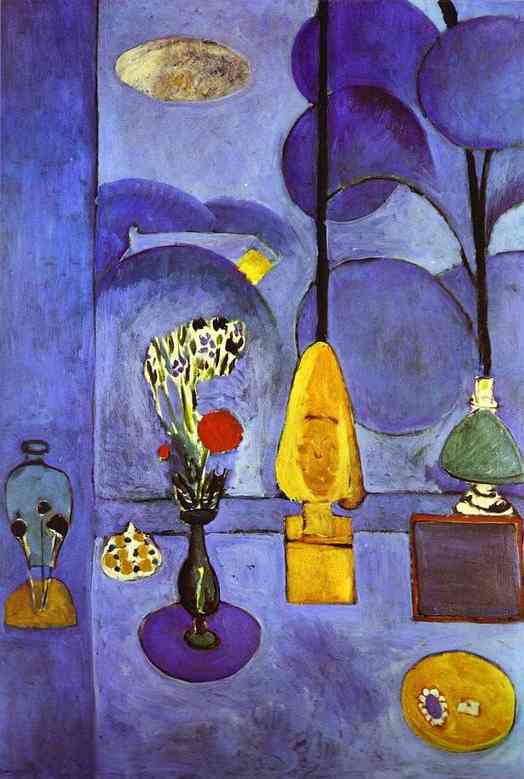
Henri Matisse’s “The Blue Window” (1911) is a nocturne in which color becomes both architecture and atmosphere. The painting stages a windowsill crowded with studio objects—a dark glass vase of patterned leaves and red pompons, a slender African or Oceanic figure rendered in a saturated yellow, a pale green lamp, a biomorphic bottle or mask, a seashell, and a small circular tray—against a view of trees and moonlight distilled into overlapping disks of blue. The result is neither a literal window nor a conventional still life. It is a complete climate, an interior and exterior fused by a single tonal family so persuasive that blue itself feels like the subject.
A Room Built From a Single Hue
The canvas advances Matisse’s great experiment of the early 1910s: can a dominant color organize space all by itself? Here blue performs that task. Warmed and cooled across the surface, it takes on multiple jobs—wall, night sky, window glass, tabletop, shadows, even the faint halos around objects. Rather than recede like a passive background, the blue breathes as a living field. Matisse modulates it from inky ultramarine to milkier, moonlit values; each shift signals a plane or a turn without resorting to traditional perspective. Where others would use architecture, he uses temperature.
The Window as Stage and Frame
“The Blue Window” is structured by a tall, upright frame that divides the surface into a central view and flanking bands. The left band contains a small shelf with a cool, mask-like bottle and an ocher pad beneath it; the right band receives a green lamp and a square block like a pedestal. Between them stretches the main window with its sill, on which Matisse arrays the key actors: a tall blackish vase, the yellow figure, a small shell, and the circular tray that echoes the moon above. The window’s muntins are barely stated; instead, changing blues suggest panes and distances. Through the glass, the world is transformed into simple shapes—tree canopies as stacked circles, a hillside as a quiet arc, the moon as a parchment oval—so that interior and exterior share one language.
Color Architecture and Complementary Sparks
The painting’s architecture is chromatic. Blue supplies the envelope; a compact set of complementary sparks ignite the space. The most intense is the golden yellow of the carved figure, which stands in poised contrast to the surrounding blues and immediately becomes a visual anchor. The lamp’s green, cool yet substantial, operates as a secondary protagonist, harmonizing with the blues but offering a distinct note. Red appears sparingly as two pompon blooms that act like punctuation next to the vase. Small pockets of warm ocher—under the mask-like vessel, in the lower right dish—introduce earth tones that keep the nocturne from floating away. Because these complements are isolated and precise, they read like stars against night, clarifying depth without a single cast shadow.
Still Life and Landscape Joined by Rhythm
Matisse solves the long-standing puzzle of how to allow still life and landscape to coexist without one dominating the other. He gives them the same rhythmic vocabulary. The curve of the vase’s foot echoes the curve of a distant hill; the round tray on the sill rhymes with the moon; the shell’s spiral repeats in the leafy rosettes that fill the vase; the yellow figure’s elongated oval head anticipates the disks of treetops outside. This chain of echoes binds object and view so that the window is less a threshold and more a hinge.
Objects as Characters, Not Specimens
Each object plays a clear role in the ensemble. The mask-like bottle at left suggests a studio curiosity, its cool blue-gray body punctuated by dark apertures that read as eyes, making it the picture’s quietest face. The vase is the room’s breath, a chimney of life whose white-gold patterned leaves flutter like moths against the blue. The two red pompons give pulse to that breath. The yellow figure is dignity and poise, a guardian who shares the window’s vertical energy. The green lamp brings domesticity and rest, a reminder that this is not a museum stage but a lived interior. The small shell is a soft whisper of the sea, while the round dish at lower right reflects the moon’s geometry, a grounded echo of the sky. Together these characters situate us in the human time of looking and arranging.
Depth Without Perspective Tricks
Matisse dispenses with conventional terms of depth and substitutes a grammar of overlap, scale, and temperature. The window is “deep” where blue is cooler and more transparent; it is “near” where the blue turns denser and warmer along the sill. The vase overlaps the figure; the figure treads the line of the sill; the lamp rests upon a block whose orange edge cuts forward. A small splash of yellow tucked within the distant blue acts like a folded corner of paper catching moonlight; it sharpens the sense of plane with a single angle. Because these cues are spare and decisive, the mind grasps the spatial order instantly while the eye remains on color relations.
Light Constructed by Adjacency
No theatrical shadow models the forms. Instead, light arises from adjacency. The yellow figure appears luminous because it stands inside a lagoon of cool blues; its contours are named not by shadow but by bordering hues. The vase glows where patterned leaves meet the darker interior of the glass; the red pompons ignite because they sit against their complement. Even the lamp glints not by a white highlight but by being a paler, grayer green than the blues around it. This strategy lets the painting read from across a room and also rewards close inspection, where small shifts of temperature whisper the turns of form.
The Night Outside: Trees as Disks, Moon as Paper
The exterior is one of Matisse’s most economical inventions. Trees are simplified to stacked circles, like paper cutouts shadowed one upon another; the sky is a veil of cooler blue; the moon is not an orb but an ocher oval with a fibrous texture, a scrap of parchment pasted to the night. This reduction of nature to essential forms does more than modernize the landscape; it aligns the world beyond the glass with the human-made objects inside. The viewer understands the scene as a single decorative continuum rather than a framed spectacle.
Brushwork and the Pleasure of Edges
“The Blue Window” is drawn with the brush. Lines swell and taper as they turn. Around the vase, a dark contour thickens at the foot and thins near the neck, a wrist rhythm one can feel. The yellow figure is cut with a firm outline, but within it Matisse lets the yellow shift, revealing touches of warmer and cooler passages that suggest the turning of volume. Where blues meet, he often leaves a small reserve—the undercolor breathing through—which halos the object and keeps the surface alive. These decisions allow the paint to remain paint even as it conjures glass, stone, leaf, and night.
Pattern and Scale
Pattern appears at several scales to organize the surface. The smallest is inside the vase, where flecked leaves and speckled petals dapple a compact zone. A middle scale appears in the lamp’s base and in the tiny shell—little bursts that keep the eye alert near the edges. The largest pattern is the exterior: disks of treetops, an economy of arcs that establishes the outside as a patterned field rather than an illusionistic vista. This hierarchy prevents monotony and distributes attention evenly.
A Conversation with Sister Interiors
Placed alongside Matisse’s “Red Studio” and “Harmony in Red,” this painting demonstrates the same conviction that a dominant field can unify a complex scene. Yet “The Blue Window” speaks in a different key. Where “Red Studio” suspends objects as outlines in a scarlet sea, the blue here is more atmospheric, saturating the glass and night rather than flattening the room. Where “Harmony in Red” overwhelms pattern with a single chord, “The Blue Window” allows complementary sparks—yellow, green, red—to move freely without breaking the nocturne. It also talks to the goldfish paintings from the same period: a vessel in front of a window, the world distilled by color, contemplation as subject.
Cultural Echoes and Modernist Synthesis
Matisse’s studio objects often carried global resonances: African and Oceanic sculptures, Mediterranean pottery, ornamental textiles. In this painting those echoes are present but integrated. The yellow figure retains a hint of the sacred or totemic, yet it functions primarily as a color and shape inside a modern composition. The mask-like vessel nods toward ritual, but it is also a lyrical oval with apertures that balance the nearby shell. Matisse acknowledges the world’s forms while insisting they belong to a new decorative synthesis governed by color relations.
Psychological Climate
Although the palette might suggest melancholy, the mood is contemplative rather than somber. The silence feels chosen, like the quiet of a studio late at night when the city has cooled and the last arrangement is set. The two red pompons are the painting’s small heartbeat. The moon is steady, the trees are still, the lamp is off. This is a painting about attention—about the kind of looking that gathers disparate things and holds them in equilibrium.
Evidence of Process and the Living Surface
Matisse leaves visible traces of the painting’s construction. In the deep blues of the wall and night, one can sense layered passes of pigment that thicken and thin, creating a clouded texture that substitutes for atmospheric perspective. The yellow figure’s pedestal shows both underlying orange and a paler veil on top, telling us that the color was tuned after placement. The little yellow scrap near the distant tree—a piece of shape that feels collaged—signals Matisse’s willingness to complete an optical sentence with the smallest possible word. Such evidence of adjustment makes the clarity of the final harmony more persuasive.
Lessons in Looking and Making
From “The Blue Window” a viewer can learn practical habits of seeing. Choose a climate color and let it do architectural work. Let complementary notes be sparing and strategic so they flare rather than shout. Build light by adjacency. Replace perspective systems with overlaps, temperature shifts, and scale. Permit the brush to draw so contours pulse with life. Use windows not as holes in the wall but as members of the decorative structure, places where interior and exterior share the same grammar.
Why the Painting Feels Contemporary
Over a century later, the canvas remains startlingly fresh. Its limited palette and bold complements anticipate modern graphic design; its reduction of landscape to essential disks foreshadows the cut-outs of Matisse’s late career and the language of flat color used by later painters and illustrators. Interiors today still borrow its lesson: a single hue can unify a room, and a handful of contrasting accents can make it sing. Most of all, the painting’s serenity—its refusal to clutter—feels contemporary in a world saturated with visual noise.
A Nocturne of Coherence
At its heart, “The Blue Window” is an argument that clarity is beautiful. A few objects, a single dominant color, a handful of contrasts, and a patient eye suffice to build a complete world. The window is not an escape but a meeting place; the night is not empty but inhabited by rhythm; the still life does not sit on the sill but conducts the room. Matisse offers not a view to look through, but a surface to live with—one that repays every return by revealing another bond among its blues, another whisper of light at the edge of an object, another rhyme between the human-made and the moonlit.
Conclusion
“The Blue Window” condenses Matisse’s early-1910s breakthroughs into a lucid nocturne. Color is structure, the window is stage, and objects are characters tuned to a single harmonic field. The moon outside, the vase within, the yellow figure, the green lamp, the shell, and the tray converse across the sill using the grammar of hue and rhythm rather than the mechanics of shadow. The result is a room that seems to breathe, a painting that is hospitable to long looking, and a statement that modern art can be both radical and restful.