Image source: wikiart.org
Introduction
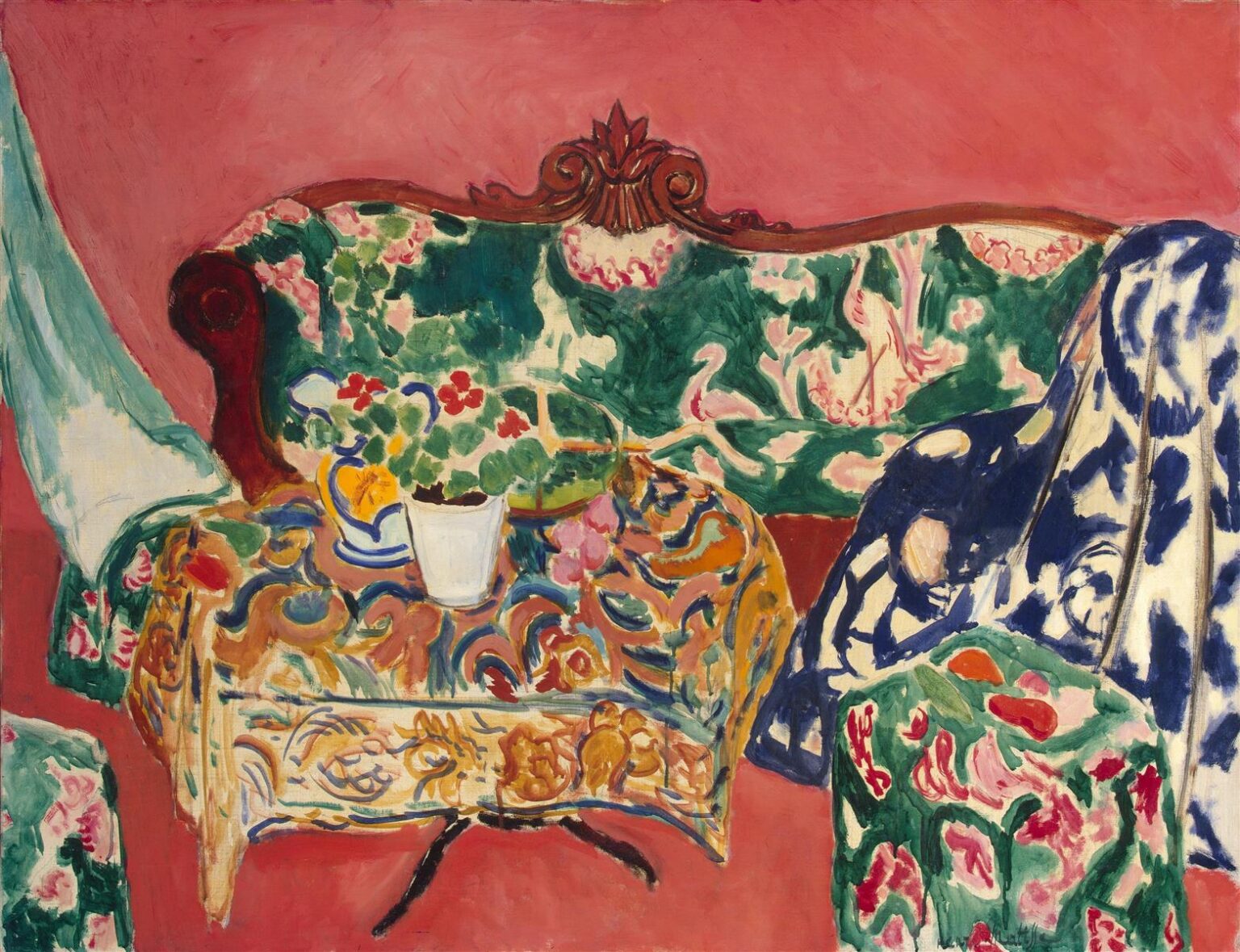
Henri Matisse’s “Seville Still Life” (1911) turns a corner of a room into an operatic stage where textiles sing, color does the work of architecture, and a humble bouquet becomes the conductor of the entire scene. A carved sofa upholstered with a green fabric patterned by pale swans sweeps across the background. In front of it, a small table is completely draped in an ocher-and-cerulean cloth whose arabesques feel as animated as water or music. Upon this cloth sit a white flowerpot and a lemon-yellow jug ringed in blue, their red and green blossoms flaring like notes. A boldly spotted, blue-and-white shawl cascades at the right, teasing the eye with its calligraphic blotches, while a small ottoman in the foreground repeats the floral fabric of the sofa. All of these things are set against a wall and floor saturated in coral and rose, a warm field that fuses space into one climate. The painting’s subject is ostensibly a tabletop arrangement, but what Matisse truly offers is a complete decorative logic: pattern as structure, color as depth, and ordinary objects elevated through rhythm.
Sevilla in the Studio: A Decorative Climate Rather Than a Place
The title suggests the Spanish city, yet the picture is not a postcard or a topographical view. “Seville Still Life” is Matisse’s Andalusian fantasy translated into paint: the swirl of Moorish ornament, the flamboyance of shawls and upholstery, the theatrically warm light. He distills these associations into textiles and color families. No window or street is needed. The coral wall provides climate; the carved crest of the sofa offers a flourish of craft; the shawl at the right introduces an improvisatory note of performance, as if recently shrugged from a dancer’s shoulders. Spain becomes a mode, not a map.
Composition Built from Curves and Curtains
The layout reads like a stage set arranged with three dominant forms. The sofa is a long, gently arcing horizon that lifts the eye and establishes the upper boundary of the action. The table, pulled close to the picture plane, is a compact oval—or rather, a sumptuous mound of cloth whose scalloping corners cascade toward the floor—holding the still life in a central pocket of energy. The draped shawl to the right is a vertical counterweight, its fall of blue spotted marks pressing down as the sofa crest rises up. In the near foreground, a small cube-like ottoman repeats the sofa’s green floral pattern, nudging the composition back into the viewer’s space and preventing recession from becoming too smooth. The result is a shallow room organized by textile masses, where furniture acts like props and fabric becomes architecture.
Color Architecture and Complementary Fire
Matisse constructs the scene from three color families. The first is the warm coral that unites wall and floor into a single atmospheric field. This red-pink is not a shout but a climate; it carries the memory of Andalusian terracotta and the heat of an interior at midday. The second family is green: the sofa’s deep malachite, the ottoman’s leafy repeats, and foliage in the bouquet. These greens cool the stage and supply the primary complement to the coral field, creating a stable tension that keeps the room glowing. The third family is blue: a cobalt that outlines the jug, animates the shawl’s spots, and snakes through the tablecloth’s arabesques. Set against the coral, that blue reads electric; braided with green, it becomes Mediterranean. Small accents—lemon yellow inside the pitcher, creamy whites in the flowerpot, blush pinks inside blossoms—act as highlights rather than modeled light, making the surface vivid without relying on shadow.
Pattern as Structure Rather Than Ornament
In Matisse’s hands, pattern is a load-bearing element. The sofa’s upholstery, with its pale swans floating on a green lake, gives breadth to the upper register and quietly echoes the curving silhouette of the sofa’s wooden crest. The tablecloth’s scrolling foliage is painted in thick, open strokes that leave corridors of coral ground showing through, so the cloth breathes rather than suffocates the space. The shawl at right is pattern at its most abstract: bold, dark ovals on white, like brush-written notes, calling attention to the act of painting itself. The ottoman’s floral repeats stabilize the lower right with a smaller scale echo. Because these patterns occur at different sizes—the sofa large, the tablecloth medium, the shawl’s spots huge, the ottoman’s bouquet tight—the eye is kept alert everywhere without losing the scene’s unity.
The Still Life as Conductor
The jug, pot, and flowers do not dominate by size, but by function. The bouquet gathers all color families into a single event: green leaves bridge the sofa and the ottoman; red blossoms resonate with the coral wall; yellow petals touch the jug and activate its interior glow; and the blue rim around the pitcher ties them back to the shawl and the arabesque cloth. The white pot is a pause—an area of concentrated rest—that allows the surrounding pattern to perform more audibly. Matisse has placed the still life near the composition’s center of gravity, just off the middle axis, so the bouquet exerts a musical pull without stiff symmetry.
Drawing with the Brush and the Pleasure of Edges
Contour in “Seville Still Life” is painted rather than penciled, and it varies in thickness according to speed and turn. The carved crest of the sofa is swept in one luxuriant motion then corrected with smaller bites; the pitcher’s blue rim is a continuous loop laid down with a confident hand; the shawl’s edge is a lively sawtooth where blue meets white. Frequently Matisse allows colors to meet imperfectly, producing thin haloes where coral peeks between green and blue. These reserves are not mistakes but marks of life. They make the edges hum and prevent the dense patterns from congealing.
Light Constructed by Adjacency
There is remarkably little modeling or cast shadow despite the scene’s abundance. The sense of illumination arises from proximity: pale pinks sparkle because they’re nested within deeper reds; the pitcher’s yellow seems luminous because its cavity is ringed by cobalt; leaves feel wet because cool greens sit against warmer ones; white notes lift wherever they border a saturated hue. Even the carved wood of the sofa reads as glossy not through highlights but through a choice of warmer brown amidst the surrounding greens. Matisse builds light by establishing the right neighbors, letting hue rather than tonal gradation carry the feeling of brightness.
Space Without Perspective Tricks
Depth is present but shallow, like a mural’s. Matisse does not bother with vanishing points or measured foreshortening. The table tilts up so that its cloth reads as a full tapestry; the sofa’s back is a painted screen; the shawl drops in the foreground with no cast shadow to anchor it. Overlap and scale do the work: the table overlaps the sofa and so stands in front; the ottoman overlaps the shawl and so moves nearer; the bouquet sits in the crook of the table’s drape, where its stem meets the cloth’s arabesque, so it belongs precisely in the center zone. Because spatial cues are few and decisive, the viewer experiences the room as a decorative relief rather than an illusionistic box.
Sevilla as Motif: Textiles, Dance, and Ornament
The painting’s Spanishness is coded in textiles rather than landmarks. Andalusia’s world of mantones de Manila, embroidered cushions, and Moorish scrollwork appears here as a cascade of patterns: swans, bouquets, arabesques, spots. The shawl’s bold spots suggest a dancer’s mantle thrown across a chair; the carved sofa crest nods toward woodcarving traditions; the tablecloth’s scrolling foliage reads like ceramic ornament enlarged and softened by fabric. Matisse embraces this cultural vocabulary not to exoticize, but to locate a modern decorative language with deep historical roots. Spain becomes a source of rhythm and surface intelligence.
The Rhythm of Repetition and Return
Look long and “Seville Still Life” reveals itself as a network of returns. The rounded head of the sofa’s wooden crest finds a cousin in the round blossoms of the bouquet and in the repetitions on the ottoman. The swans’ pale necks curve like the pitcher’s handle. The arabesques on the tablecloth coil in sympathy with the scrolled carving atop the sofa. Even the shawl’s sprawling spots, seemingly alien to everything else, rhyme with the negative shapes left where coral ground peeks through the tablecloth’s design. This web of repeating kinships is how Matisse keeps an explosive surface coherent.
The Evidence of Process and the Living Surface
Few painters leave their process so openly inscribed. In the coral field one can see earlier, cooler passes and warm corrections; at the edges of the sofa’s fabric, the painter has clearly blocked in large flat areas and then returned to draw swans and flowers on top; the jug’s yellow appears to have been laid in last, sitting crisply atop blues and greens. These layers give the painting depth without illusion. They also confer an honesty: the picture is not a copy of a room but a constructed harmony, the visible outcome of decisions.
Dialogues with Sister Interiors
“Seville Still Life” belongs to the same family as “Harmony in Red” and “Red Studio,” yet it offers its own solution to the challenge of unity. Where those canvases flood the entire room with one commanding hue, here the coral field gives way to a competing kingdom of pattern. The balance is more negotiated, the dialogue between plane and textile more intricate. At the same time, the central still life anticipates the compositional clarity of the “goldfish” pictures, where a single container or bouquet sets the pulse for the whole painting.
The Human Without the Figure
No person appears in the scene, yet the room feels unmistakably inhabited. The shawl draped across the right-hand chair suggests a recent sitter; the bouquet has been freshly arranged; the pitcher has a weight that implies habitual use. Matisse often speaks of creating a place where a viewer’s body can rest—an armchair for the mind. This canvas achieves that hospitality without literal figures: the furniture and fabrics play host, the color warms, the patterns give the mind something to count and follow.
Lessons for Seeing and Making
The painting contains practical counsel for painters, designers, and viewers. Start with a climate color and let it unify floor and wall. Introduce complementary families in large planes so that the room breathes. Deploy pattern at several scales—large on the sofa, medium on the table, small on the ottoman—so attention distributes evenly. Place a compact still life where lines and colors converge, and let it weave the families together. Draw with the brush so edges stay alive. Construct light by adjacency rather than shadow. Most of all, trust that textiles can be structure. When cloth carries architecture, the decor becomes the building.
Why the Picture Still Feels New
A century later, “Seville Still Life” remains fresh because its decisions are legible and generous. The coral field is modern in its flatness; the patterns are frank about their invention; the still life is humble and commanding at once. Contemporary interiors—from maximalist rooms layered with vintage fabric to restrained spaces animated by a single patterned textile—owe a debt to Matisse’s intuition that harmony can be built from repeats. The painting also feels new because it asks nothing theatrical. It offers clarity, warmth, and movement, qualities that never go out of date.
Conclusion
“Seville Still Life” is less a picture of things than a demonstration of how things can sing together. A sofa, a tablecloth, a shawl, a small bouquet, and a jug become instruments in a chamber orchestra of color. Coral supplies the air; green keeps the air cool; blue writes melody across that air; yellow throws sunlight into a jug. Pattern ceases to be décor and becomes architecture. The still life stops being an isolated arrangement and becomes the conductor of the whole room. Matisse’s canvas shows that a modern painting can be both sumptuous and lucid, both decorative and deeply structured—a place the eye can inhabit with pleasure and the mind can revisit for order.