Image source: wikiart.org
Introduction
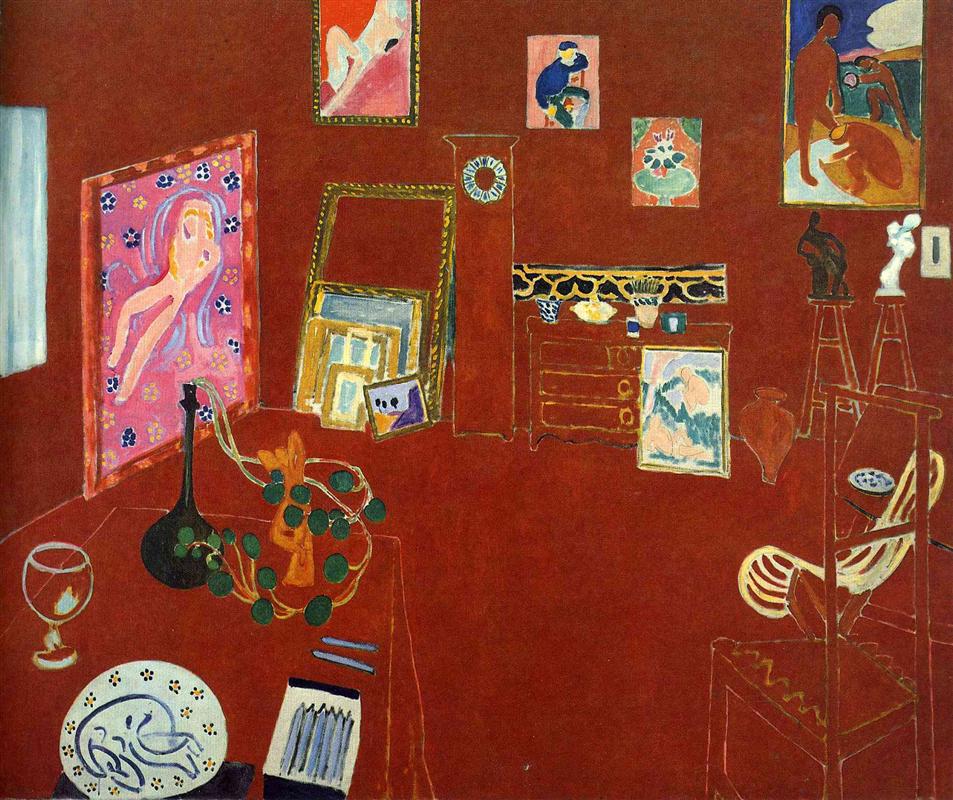
Henri Matisse’s “Red Studio” (1911) is one of the most radical rooms in the history of painting. It is a studio picture in which the usual hierarchies—people first, furniture second, walls last—are overturned. Instead, a single, saturated red becomes floor, wall, atmosphere, and idea, while the things that fill an artist’s working life—canvases, sculptures, chairs, clocks, vases, palettes, wine glasses, a chest of drawers—appear not as modeled objects but as crisp outlines and islands of color floating inside a vast chromatic sea. The result is at once intimate and monumental, a space that feels both real and dreamlike, where the painter’s daily tools and creations are suspended in a timeless field.
Why This Picture Matters
“Red Studio” crystallizes Matisse’s early-1910s transformation from Fauvist fireworks into a clear decorative order. It is a manifesto for color as architecture. By letting a single hue dominate, Matisse shows that color alone can build a room, carry depth, and generate calm. The painting is also a declaration about what a studio means: not merely a place with walls and windows, but a mental arena where artworks, materials, and furniture share equal dignity. In this sense the picture is a self-portrait without a figure; the artist is everywhere and nowhere, present through arrangements, choices, and the careful tuning of relations.
The Studio As Self-Portrait
No person stands in the room, yet the painter’s life is written in it. His works hang on the red walls and lean against the red floor. Two small sculptures perch on stools; framed canvases await a decision; a palette and box of brushes lie on the table; a wine glass sits with patient stillness. These are not props. They are the vocabulary of a working day, arranged as if thought had paused for a moment and the room itself continued to think. The studio becomes a portrait of mind—ordered, warm, and focused—where the red field functions as the artist’s temperament made visible.
Composition: A Room Drawn With Lines
The canvas is composed like a map. The corner where two red planes meet—floor and wall—runs diagonally across the surface, pushing the table, chairs, and cupboards to the foreground while still maintaining a measured depth. Matisse draws the room with a network of fine, yellow-gold lines: the edge of the tabletop, the rails of chairs, the doorjamb of a closet, the silhouette of a chest of drawers. These lines substitute for traditional modeling. They state where things are, how they turn, and how far they occupy the field, without describing weight or texture. Because the lines are even and continuous, the room reads as a single calm structure rather than a tangle of details.
The Red That Is Floor, Wall, and Air
The dominant red is not a neutral background; it is the picture’s central actor. It covers everything the way sunlight covers a field, yet it does not flatten the space. Its temperature changes subtly where the brush overlaps or thins. The small celadon and sky-colored passages—the window at left, the crockery, the pale objects on the dresser—glow against it, and the blues and pinks inside the framed pictures rise like cool islands from a warm sea. Because hue and value remain remarkably even across the red plane, the eye rests easily; agitation gives way to a deep, steady hum.
Figure–Ground Reversal And The Pleasure Of Reserves
A striking feature of “Red Studio” is the way objects are defined by reserves—thin gaps where the red stops and a lighter under-color peeks through—or by single lines of yellow paint. Instead of building up forms with shadow, Matisse cuts them out of the red, like shapes snipped from paper. This reversal turns the usual logic inside out: the room is a field first, and things occur within it. The approach gives the picture its floating serenity; objects appear unburdened by gravity, gently anchored by contour and by the faintest shadows of color.
Space Without Chiaroscuro
Depth in “Red Studio” is achieved through overlap, placement, and scale rather than through converging lines or cast shadows. The tabletop tilts upward to reveal its contents; frames rest against the wall at angles that imply distance; the chair at right presses close to the picture plane while the cupboard and small pedestal step back. The red is equal everywhere, so no passage recedes into darkness. Instead, depth emerges as a rhythm of nearness and farness, like chords struck in sequence across a piano.
The Inventory Of Things And Images
The left foreground collects the paraphernalia of making: a wine glass, a decorated plate, a bottle with a curling vine, a sheaf of brushes, and strips of blue that read as pencils or chalks. Along the rear wall, framed canvases hang or lean—reclining figures, seated figures, small still lifes—miniature worlds set within the larger red world. On the right, a chest of drawers supports cups and bowls; nearby, two little bronzes stand on stools, their dark silhouettes like punctuation marks. A large painting of a nude on a pink patterned ground flares at the left, mirroring the warmth of the studio while providing the brightest internal painting. This census of objects and images gives the room a heartbeat; they are the studio’s memory and current project at once.
Time Suspended
High on the slender standing cabinet Matisse paints a small circular clock without hands. The detail is quiet but decisive. In a room saturated by color, instruments for measuring hours would be an intrusion; here, time is held in abeyance. The studio is the place where concentration suspends chronology—a space the painter enters to work and from which he emerges with the day transfigured but uncounted. At the far left a narrow blue window band cools the edge of the canvas; it hints at outside time and weather while confirming that we are within a different order.
Process Visible On The Surface
The surface of “Red Studio” records its making. Beneath the red, cooler underlayers breathe through in places, creating halos around lines and giving the field a faint pulse. The red is laid broadly, not polished to anonymity. The yellow contours carry small tremors and adjustments: the edge of the table isn’t a ruler’s mark but a guided hand; chair rails change thickness as they turn. These traces are vital; they remind us that the serenity of the finished room was discovered by painting, not imposed by diagram.
Rhythm Across The Field
Although the painting is quiet, it is not static. Curves of the chair back at right, the diagonal sweep of the tabletop, the vertical of the tall cabinet, and the scattered rectangles of frames and canvases set up a rhythm that guides the eye. Repeating motifs—the ellipse of plate and wine glass, the small dots on the plate echoing the blossoms inside the big pink picture, the recurring gold frame edges—create beats within the red chord. The viewer’s gaze drifts, pauses, and resumes, much as one wanders around a studio, noticing and re-noticing.
Decoration As Structure
Matisse’s oft-misunderstood word “decorative” means coherence rather than frill. In “Red Studio” the decorative principle appears as an even distribution of attention. No single object dominates for long; the large pink nude might flare, but your eye soon returns to the quiet modules of the dresser or the lines of the chair. Pattern is structural, too: the scalloped band on the cupboard stabilizes the back wall; the patterned plate keeps the foreground from becoming empty; the patterned ground inside certain framed canvases echoes the studio’s own ornamental order. The painting offers rest not by removing complexity but by tuning it.
A Conversation With Earlier And Later Work
The picture belongs to the same family as Matisse’s immersive interiors—“Harmony in Red,” “The Cuckoos, Blue and Pink Carpet,” and the goldfish paintings—where a dominant color becomes climate and where pattern clarifies space. Yet “Red Studio” goes further by making the studio itself the subject and by stripping modeling to a minimum. It also foreshadows mid-century painting. The way a large, unbroken color field can carry feeling and space without persuasive illusion became foundational for later artists who explored expanses of hue. At the same time, the witty line drawing that floats across the field anticipates another current of modern art that sets drawing free from the job of describing mass.
Sculpture Inside A Painting
On two stools at the right stand small bronzes—dark, dense, and compact. Their presence matters because they are the only objects that suggest weight. They act like commas in the sentence of the red room, slowing the eye before it moves along the wall toward the large framed picture. They also demonstrate Matisse’s confidence in using translation: the sculptor’s volume is seen here through the painter’s contour, the three-dimensional compressed into an economical silhouette without losing its pride.
The Viewer’s Body In The Room
Although the perspective is shallow and the red uniform, the picture is calibrated to the viewer’s body. The table edge is at a height one might lean on; a chair stands ready for a sitter; frames rest against the wall at a scale familiar from any studio. Everything is near enough to touch, yet slightly flattened by the sovereign red. That nearness creates intimacy. We do not stand outside the artist’s life; we are quietly placed within it, given permission to look without anxiety.
The Emotion Of Color
Red in this painting is not a shout. It is a temperature. It suggests warmth, attention, and gathered energy. In the company of red, blues and whites look especially clear; greens, sparingly used in vines and small pots, feel cool and medicinal; pinks soften rather than ignite. The long look yields calm, not agitation. Matisse once spoke of wanting an art that would provide “a soothing, calming influence on the mind.” The particular red here—deep, slightly earthy, steady—fulfills that wish.
How To Look At “Red Studio”
The most rewarding way to see the painting is to let the red settle first, then track the lines. Begin with the table edge at lower left and follow it around, noticing how it defines a generous foreground. Let your eye climb the vertical of the standing cabinet to the clock without hands; cross to the right, where the little bronzes guard their stools; descend to the chair; and return to the table’s dark bottle and vine. Only then study the framed canvases, each a small painting inside the painting, each asserting that the studio contains multitudes. This slow circuit repeats, and with each pass the room’s stability grows.
Legacy And Influence
“Red Studio” has become a touchstone for painters who want color to do structural work. Its union of vast field and intimate line helped open paths for color-field abstraction as well as for artists who draw directly on painted grounds. Designers and architects continue to learn from its lesson: a single dominant hue can unify a complex interior and allow small details to sing. That the picture is also a studio scene—traditionally a site for virtuoso perspective tricks—makes its quiet revolution even more striking.
Conclusion
“Red Studio” converts a working room into a sustained chord of color. The things of the studio—tools, furniture, artworks—are present and recognizable, yet they serve a larger aim: to show how a painting can be built from essentials. A vast red becomes the atmosphere; thin lines become architecture; small islands of color become companions. Time is stilled; the artist’s presence is distributed across decisions rather than embodied in a figure. The room remains one of modern art’s clearest arguments that clarity itself can be profound.