Image source: wikiart.org
Introduction
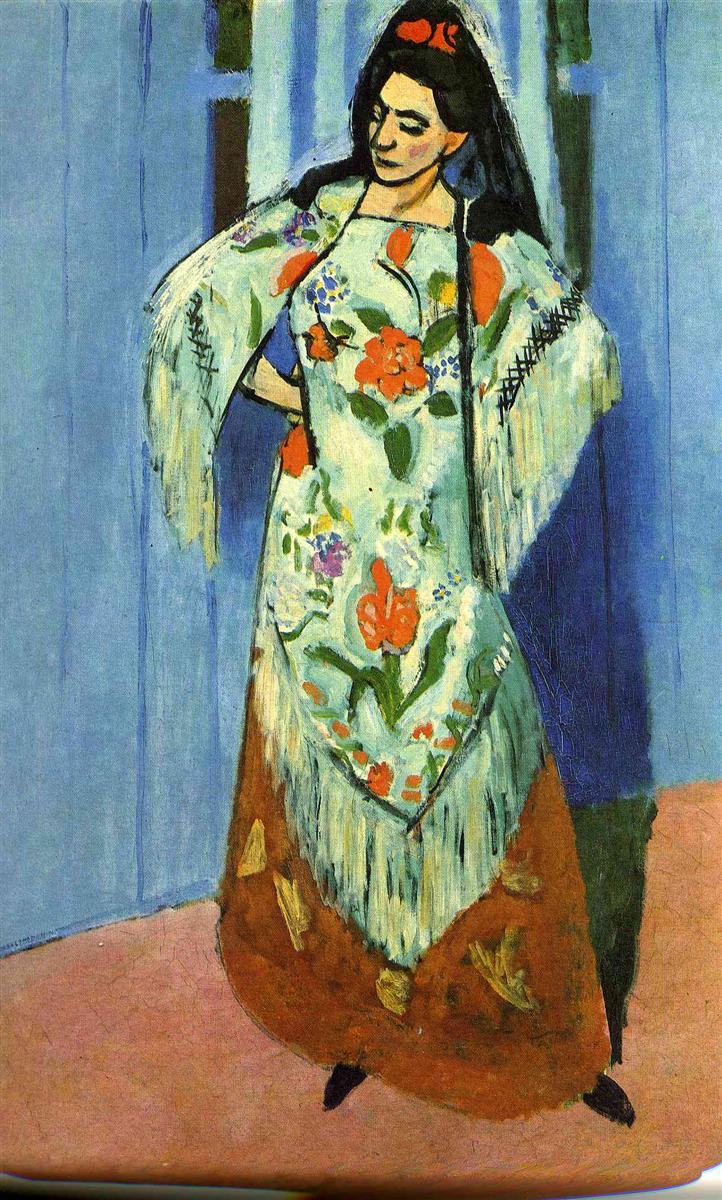
Henri Matisse’s “Manila Shawl” (1911) is a celebration of color, cloth, and poise—a portrait that turns a single garment into an entire world. A dark-haired woman stands in three-quarter view, her head slightly bowed, arms pressing the edges of a long, fringed shawl embroidered with exuberant flowers. Behind her rises a cool wall of blue panels; beneath her feet a warm salmon floor curves forward like a shallow stage. The figure is firmly outlined in dark, elastic brushstrokes, but the real protagonist is the textile: a pale aquamarine field charged with scarlet tulips, orange peonies, leafy arabesques, and cascading fringe that dissolves hard edges into rhythm. Matisse uses the shawl to fuse figure, costume, and space into one orchestration of color, proving how a decorative object can carry the weight of modern painting.
A Moment Of Consolidation In 1911
Painted in the year following his great interior panels, “Manila Shawl” belongs to Matisse’s crucial early-1910s phase when the blazing contrasts of Fauvism matured into an orderly decorative language. He had learned to strip scenes to essential planes, build light by adjacency rather than illusionistic shadow, and draw with the brush in declarative contours. In this canvas the lessons are clear. The background is a single, calm architecture of blues; the floor supplies a counter-climate of pink; the figure is assembled from a handful of flat color zones bounded by confident lines. Nothing distracts from the central thesis: that a garment’s pattern can be structure, and that human presence can be heightened—not masked—by decorative richness.
Composition As Stage And Sculpture
Matisse constructs the rectangle as a shallow proscenium. The wall’s vertical seams act like theater flats; the floor tilts forward to present the figure. The model’s stance is sculptural: weight primarily on the back foot, front foot pointed, head inclined to the right, arms pressing outward to display the shawl’s spread. This triangular pose stabilizes the composition and gives the fringe a role as architecture, a soft colonnade framing the body. The shawl narrows toward the hem into a neat point that anchors the figure while keeping the eye circulating around floral clusters. Across the lower field a warm, russet skirt echoes the earth while the shawl’s icy greens converse with the wall’s blues, maintaining equilibrium between warm and cool.
Color Architecture And Climatic Balance
The painting rests on two broad climates. Cool blues, teals, and aquamarines dominate the upper half—wall and shawl—creating an atmosphere of clear air. Warm russets and pinks—skirt and floor—occupy the lower field, adding human temperature. Between them the embroidered flowers flare in high-chroma reds and oranges that punctuate the surface like musical accents. The black of hair, outlines, and small shoe triangles acts as a binding agent that crispens edges and keeps the color chords in tune. Matisse relies on a narrow palette and lets hue carry form: cool against cool produces airy depth; warm against cool produces the sensation of light; hot accents keep the eye moving from motif to motif.
Pattern As Structure, Not Ornament
The Manila shawl—imported to Europe through Spanish trade and adopted into Iberian dress—allows Matisse to make pattern the backbone of the image. On the pale field, blossoms gather in rhythmic clusters that roughly mirror the body’s underlying anatomy: a large rosette at the chest acts like a medallion, smaller motifs mark the shoulders, a vertical tulip aligns with the torso, and scattered petals animate the hem. The fringe is not a mere decorative flourish; it softens contours where arm and garment meet, creating tremolo along the edges and visually “weaving” the figure into the room. Repetition at multiple scales—big center flower, mid-sized shoulder blooms, small sprigs in the corners—keeps the surface evenly active while preserving a clear center of gravity.
Drawing With The Brush
Matisse’s contour is frank and musical. Dark lines thicken along the outer arm, thin as they run over the cheek, and kink sharply where the shawl angles at the waist. Around the floral motifs, brush-drawn ovals and leaf-shaped strokes declare form without finicky modeling. The fringe is realized as quick, parallel pulls that vary in length and pressure, producing a living edge that quivers like light. Because the drawing is performed in paint rather than pencil, it carries the charge of immediate decision. The viewer senses the painter’s hand at full scale, guiding the eye while letting color breathe inside the lines.
The Face, Gesture, And Emotional Register
Although the garment dominates, the woman’s presence is unmistakable. Her head tilts downward with a soft, knowing smile; the eyes are shadowed but alert; the mouth is a small, warm accent. The black mass of hair and the red ornament perched atop it amplify the compositional keynote of dark contour versus bright color. The pose—one hand at the waist, the other hidden by shawl—communicates self-possession rather than display. She is not absorbed into the pattern; she commands it. By refusing needless facial detail and letting posture speak, Matisse achieves a mood of poised introspection.
Space As Shallow, Persuasive Plane
Depth is suggested with minimal means. The wall panels step back in cool gradations of blue; a darker vertical suggests a doorway or shadowed recess behind the head; the floor curves gently to meet the wall, announcing the edge where stage becomes backdrop. There are no cast shadows to anchor feet or fold. Instead, the sense of place arises from the tension between the monumental figure and the simplified room. The painting is relief-like: the model reads as a sculpted presence mounted on a flat architectural slab. This shallow staging keeps the decorative order intact and allows the shawl’s pattern to carry the spatial drama.
Light Built By Adjacency
Matisse avoids conventional chiaroscuro. The perception of light emerges from how colors touch. Aquamarine highlights along the shawl’s folds appear luminous because they lie beside darker teals and black seams. The warm floor glows by contrast with the cool panels rising behind it. Red flowers blaze because they sit within a cool sea and are ringed by pale stems. Even flesh—cheek, throat, and the triangles of hand—needs almost no modeling; it reads by virtue of its temperature relative to neighboring cools. The painting’s light is therefore legible at a glance and remains convincing at close range.
Textile As Cultural Sign And Modern Resource
The Manila shawl itself bears a history of exchange: woven in China, traded through Manila, embraced in Spain, and admired across Europe as a sign of flamenco culture and festive dress. Matisse draws on that layered identity, but he distills it into a modern syntax. The shawl’s floral vocabulary is generalized—no botanist could classify every bloom—because its purpose is structural rhythm, not ethnographic record. In a single garment he discovers a global object, a moving screen of color, and a device for reconciling figure and ground. The painting participates in the era’s fascination with textiles while refusing exoticism; the shawl is not a prop, but the logic of the picture.
Kinships With Contemporary Works
“Manila Shawl” converses with Matisse’s portraits and interiors from the same years. Like “The Cuckoos, Blue and Pink Carpet,” it relies on an enclosing wall of cool color and a dominant textile that sets the visual tempo. Like “Spanish Woman with a Tambourine,” it explores Iberian costume and stance while paring the figure to essentials. And, like “Goldfish,” it builds a world from a few color families whose relations do the work of light and depth. Yet this canvas is distinct in its frontal simplicity: a single figure framed by planes, the shawl acting as both costume and architecture.
The Role Of Fringe And Edge
Fringe matters. In Matisse’s hands, fringe becomes a mediator between hard contour and open field. Along the shoulders and hem it breaks the line into a thousand tiny verticals, echoing the panel seams behind and the downward pull of gravity. Near the arms, it confuses where garment ends and background begins, producing the soft “breathing” edges that keep the figure from feeling cut-out. This micro-rhythm counterbalances the large compositional triangles and reminds us how attentive Matisse is to scale: big shapes set the frame, small strokes keep it alive.
Evidence Of Process And The Living Surface
Look closely and the painting reveals its making. Around the cheek and hairline, small haloes show where Matisse adjusted the contour and let the earlier pass glimmer through. In the blue wall, broad strokes of differing saturation overlap, creating a faint vertical vibration. Some floral accents ride over their outlines, emphasizing that pattern is painted, not printed. The lower skirt contains patches of warm color that are loosely brushed, suggesting texture without description. These traces keep the surface candid; calm order coexists with visible work, an honesty that gives the picture its human temperature.
From Fauvism To Serenity
Though the color remains high, the mood is serene. The wildest Fauvist canvases sought shock; here, intensity is controlled and restorative. The shawl’s aquamarine field refuses harsh contrast; the wall’s blues remain lyrical; the red blossoms act as measured beats rather than alarms. Matisse’s pursuit is not drama but clarity, a state in which viewers can rest their eyes without boredom. The figure’s calm inward tilt embodies that intention. She invites contemplation of color relations the way a musician invites the ear to dwell on a chord.
The Body As Armature For Pattern
One of the painting’s subtler achievements is how the underlying body is sensed through the shawl without being anatomically mapped. A swelling at the chest, narrowing at the waist, and flare over the hips shape the floral currents. The shawl’s central tulip is placed where the torso aligns; a rosette near the heart acts as a quiet emblem. This marriage of body and pattern rescues the work from mere costume piece and secures it as a portrait—of a person and of a painterly idea about how form and textile can speak with one voice.
Lessons For Seeing And Making
“Manila Shawl” offers a method still useful to painters and designers. Begin with two climate planes that establish space and mood—cool wall, warm floor. Choose a primary actor—in this case a textile—whose pattern can structure the surface. Draw with the brush so contours remain living, not mechanical. Build light by adjacency rather than shadow. Use repetition at multiple scales to distribute interest evenly. Permit evidence of process to stay visible so the surface breathes. Above all, trust that clarity of relations—warm to cool, line to plane, large to small—can convey more humanity than a crowded inventory of details.
Why The Image Endures
Over a century later, “Manila Shawl” feels fresh because its decisions remain legible and generous. The palette is limited but resonant; the pose is timeless; the decorative has been made structural; and the painting reads instantly from afar while repaying close looking with a wealth of marks. It exemplifies Matisse’s conviction that a picture can be both modern and restful, that beauty can be rigorous, and that a garment—properly seen—can become a complete architecture for color and form.
Conclusion
In “Manila Shawl,” Matisse turns a standing woman into a column of color and a textile into architecture. The cool blues of the room set a lucid air; the salmon floor warms the stage; the shawl spreads like a bright, breathing façade; and the dark contour of hair and outline keeps everything in tune. Pattern carries structure. Fringe becomes rhythm. Light arises from color’s neighborliness. The result is a portrait that honors a person while articulating a way to build a painting from essentials. It is both a homage to craft and a manifesto of clarity—a work that invites the eye to rest and the mind to hum along with its measured music.