Image source: wikiart.org
Introduction
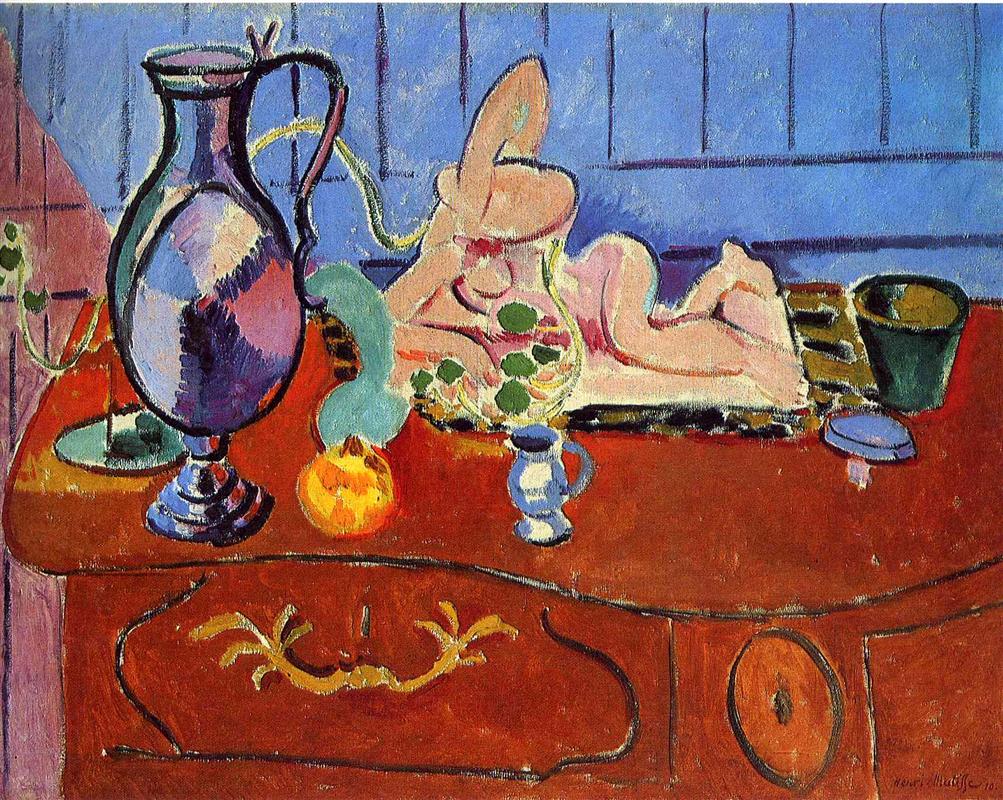
Henri Matisse’s “Still Life with a Pewter Jug and Pink Statuette” (1910) turns a tabletop into a full theater of relations—color against color, curve against curve, metal against flesh, painting against sculpture. A deep red commode top fills the foreground like a stage, ringed by decorative marquetry and emphatic black drawing. On it, a tall pewter ewer rises with cool, reflective planes; a reclining pink statuette lies diagonally across the center on a striped textile; a lemon-like fruit, a small candlestick, a green pail, and a compact or mirror punctuate the scene. Behind, a paneled wall in periwinkle blues and violets completes the shallow room. With only a handful of actors and a few harmonized chords, Matisse composes an image that feels at once casual and inevitable, intimate and monumental.
The 1910 Language: From Fauvist Heat to Decorative Order
The painting belongs to Matisse’s decisive years just after Fauvism’s blaze, when he refined raw chroma into a lucid, architectural system. Rather than pursue optical illusion or anecdotal description, he places large planes of saturated color into measured relationships, draws with the brush to declare form, and treats objects as actors in a shallow stage. The chroma remains strong—vermilion reds, lapis and lavender blues, apple greens, and shell pinks—but the shock has been harnessed into balance. “Still Life with a Pewter Jug and Pink Statuette” is a laboratory for that order: every hue has a job and every contour carries rhythm.
Composition: A Tabletop Turned Proscenium
Matisse tilts the commode’s top forward more than perspective would permit so its surface reads like a proscenium floor. The long oval lip of the furniture becomes a framing arc that keeps the eye inside the picture, while the carved motifs on the drawer front repeat the painting’s arabesques. The arrangement is orchestral: the pewter jug stands like a vertical soloist on the left; the pink statuette reclines horizontally across the center; small vessels and fruit keep time as bright percussion; a green pail and blue compact stabilize the right edge. The wall’s narrow boards climb upward in parallel, their cool stripes calming the intensity below and reinforcing the painting’s shallow, stage-like depth.
Color Architecture and Climatic Chords
The image rests on a limited but powerful chord: hot red for the plane of the table, cool blues for wall and metallic reflections, tender pink for the reclining figure, and green for counterpoint. Red provides the emotional engine—it is laid in with broad, loaded strokes that vary subtly in temperature, from orange-vermillion to deeper oxblood. Blue-violet tones pool in the jug’s reflections and the paneled background, cooling the climate and preventing the red from overwhelming the surface. Pink, used for the statuette, carries human temperature; it lifts the center with a soft, luminous note that glows against the surrounding primaries. Green—the coiling ribbon, the pail, the leaves painted on the statuette—acts as a refreshing interval, setting up conversations with both red and pink. Because the palette is contained, any small shift—one lighter patch on the jug, the yellow halo of the fruit—reads with crisp authority.
The Pewter Jug: Drawing with Reflections
The ewer on the left is a masterclass in how to draw form with reflection rather than modeling. Matisse uses a handful of cool notes—violet, cobalt, steel blue—to shape its belly. Instead of blending into a seamless illusion, he lets reflections stack in angled passages that follow the curvature of metal. The outline is decisive and elastic, swelling at the shoulder and snapping tight at the neck before looping into the handle. Highlights are economical: a couple of clean flares along the lip and belly are enough to suggest polish. The jug’s verticality opposes the reclining figure and, because it mirrors the room’s colors, it acts like a second painting within the painting—a silver screen where the palette replays in miniature.
The Pink Statuette: Painting Meets Sculpture
At center, the pale pink figure lies on a striped textile like a small odalisque. Whether or not the object corresponds to a specific studio sculpture, it operates as a proxy for Matisse’s sculptural practice at the time and as a seed for the odalisque theme he would develop in later decades. He paints the statuette without illusionistic sheen; instead, he edges it with quick dark lines and fills it with flat pinks modulated by warm whites. Patches of leafy green pattern play over the torso, collapsing distinctions between clothed and unclothed, painted object and painted surface. The figure is both image and thing—a reminder that painting can hold sculpture as one of its subjects while also absorbing it into the decorative order of the whole.
Counterpoint of Curves and Edges
The painting’s pleasure lies in its counterpoint. The jug’s tall S-curve plays against the statuette’s soft diagonal; the oval rim of the table echoes the oval compact; the round fruit near the center ties the large curves together. Straight elements—panel lines behind, striped textile beneath the figure—provide a necessary grid. Even the carved flourish on the drawer front contributes to the rhythm, its gold arabesque answering the ribbon-like green drape near the jug. Nothing is isolated; every edge seems to find its partner elsewhere on the surface, the way a melody finds harmony in a separate voice.
Pattern as Structure, Not Decoration
Pattern in Matisse is never mere embellishment. The striped rug under the statuette clarifies perspective and anchors the figure on the table; the painted leaves on the statuette echo the green ribbon and pail, distributing that hue across the stage; the marquetry on the furniture front repeats and enlarges the kinds of lines used elsewhere, turning craft detail into structural rhyme. Pattern keeps attention evenly distributed across the canvas, so that the surface remains alive from corner to corner.
Space as Shallow, Persuasive Stage
Depth is established by overlap more than by perspective. The jug occludes the fruit, which in turn overlaps the candlestick; the statuette lies partly behind the blue-white juglet; the pail presses into the back edge of the table. A thin, shadow-dark strip marks the far lip, but the space remains shallow—almost relief-like—so color and line can dominate. This shallowness is a principle, not a limitation. It keeps the decorative unity intact and ensures that objects behave as players in a coordinated surface rather than as props arranged in a photographically plausible room.
Light Built by Adjacency
There are no cast shadows carefully elaborated with gradients. Light is constructed by adjacency and temperature contrasts. The lemon glows because its yellow nestles in a red field and sits beside cool blue notes; the statuette gleams because its pinks are bordered by black accents and lie on dark stripes; the jug shines because small, crisp light patches sit within broader, darker blue reflections. Wherever a highlight appears, it is clear, placed, and unblended—a punctuation mark rather than a mist.
The Touch of the Brush and the Honest Surface
Matisse’s brushwork remains visible and frank. In the table’s red, long diagonal passages reveal the pressure and speed of the hand; in the background, softer lateral pulls describe the paneling without counting boards; within the jug, loaded strokes align with curvature so that paint application itself helps model form. Around several contours, you can see slight haloes where one color abuts another and remains unblended. These seams are not mistakes; they are the living edges of decisions. The painting’s ultimate calm is the outcome of those exposed operations.
The Table as a Living Body
The commode is not a neutral platform. Its swelling curves and ornamented front claim space as a character in the drama. By exaggerating the lip and drawing the marquetry with quick, graphic certainty, Matisse turns the furniture into a warm, breathing mass that supports and converses with the cooler jug and pink figure. The color of the wood—somewhere between lacquered cherry and burnt sienna—gives the whole image a sustained warmth that the blues and greens modulate rather than extinguish.
Small Actors With Big Jobs
The minor objects are exact. The tiny pewter or ceramic juglet near the center introduces a lighter metallic note that mediates between the large ewer and the statuette’s skin. The green pail on the right clamps the edge with a dark, cool weight and keeps the composition from sliding out of frame. The compact or hand mirror provides a cool, round counterpoint to the fruit and repeats the blue of the wall in a more saturated key. The lemon binds the warm and cool families: its yellow picks up the table’s heat while its flank reflects blue, hinting at the surrounding climate without the need for blended shadow.
Dialogue With Sister Works
This canvas speaks directly to Matisse’s still lifes of 1908–1911—“Harmony in Red,” “Still Life with Blue Tablecloth,” and the interiors staged with a painting inside the painting. In those works, wall and table can merge into a continuous patterned field. Here, the difference is the presence of a sculpted nude. The objects are not only things but also images of other arts: the reflective jug as a “mirror painting,” the statuette as painting’s sculptural cousin. The picture becomes a manifesto that painting can encompass and transform other mediums while maintaining its own decorative logic.
The Human Trace Without the Human Body
There’s no living figure in the room, yet the human presence is everywhere. The statuette carries the human form in symbolic scale; the ribbon-like green drape suggests a recently handled textile; the compact hints at grooming; the lemon and vessels imply use; the carved furniture implies a domestic setting. Matisse orchestrates these traces so that the absence of a person heightens attention to touch and arrangement—the very acts by which a room becomes human.
Psychological Temperature: Poise and Play
For all its saturated color, the painting is not frantic. The red table radiates a steady heat, but the blue wall cools the upper half; the jug’s reflective calm and the statuette’s playful posture keep the mood poised and gently joyful. The overall impression is of a mind at work with pleasure—someone testing intervals, savoring surfaces, and discovering kinships between disparate things until a single harmony emerges.
Lessons in Seeing
The picture offers an enduring method. Begin by assigning each color a structural role. Use a tilted stage so everything participates in the surface. Draw with the brush so line embodies movement and pressure. Let reflections describe metal and adjacency invent light. Repeat shapes at multiple scales so that every object finds a partner. Permit the process to show at edges, trusting that candid surfaces evoke trust and intimacy. These lessons work beyond painting, informing photography, design, and any art that must balance clarity with richness.
Why It Still Feels New
Over a century on, the painting feels contemporary because its decisions remain readable. We still recognize a believable jug formed by reflections, a room made of two planes, a harmony created by limited hues and confident lines. It does not lean on period furniture or narrative fashion; it relies on relations that remain fresh: warm against cool, vertical against horizontal, shiny against matte, figure against ground. That economy gives the image permanence.
Conclusion
“Still Life with a Pewter Jug and Pink Statuette” gathers a few humble objects and a small nude figure into an orchestration of color and contour that demonstrates Matisse’s 1910 clarity at full strength. The red table provides warmth and stage; the blue wall sets atmosphere; the pewter jug models itself with reflections; the pink statuette reconciles painting with sculpture; the minor objects tune the edges. Light is not mimed but built. Space is not excavated but staged. Pattern is not garnish but structure. The result is a still life that breathes like a figure and a decorative panel that holds like architecture—a picture that teaches, gently and decisively, how essentials can do the work of the world.