Image source: wikiart.org
Introduction
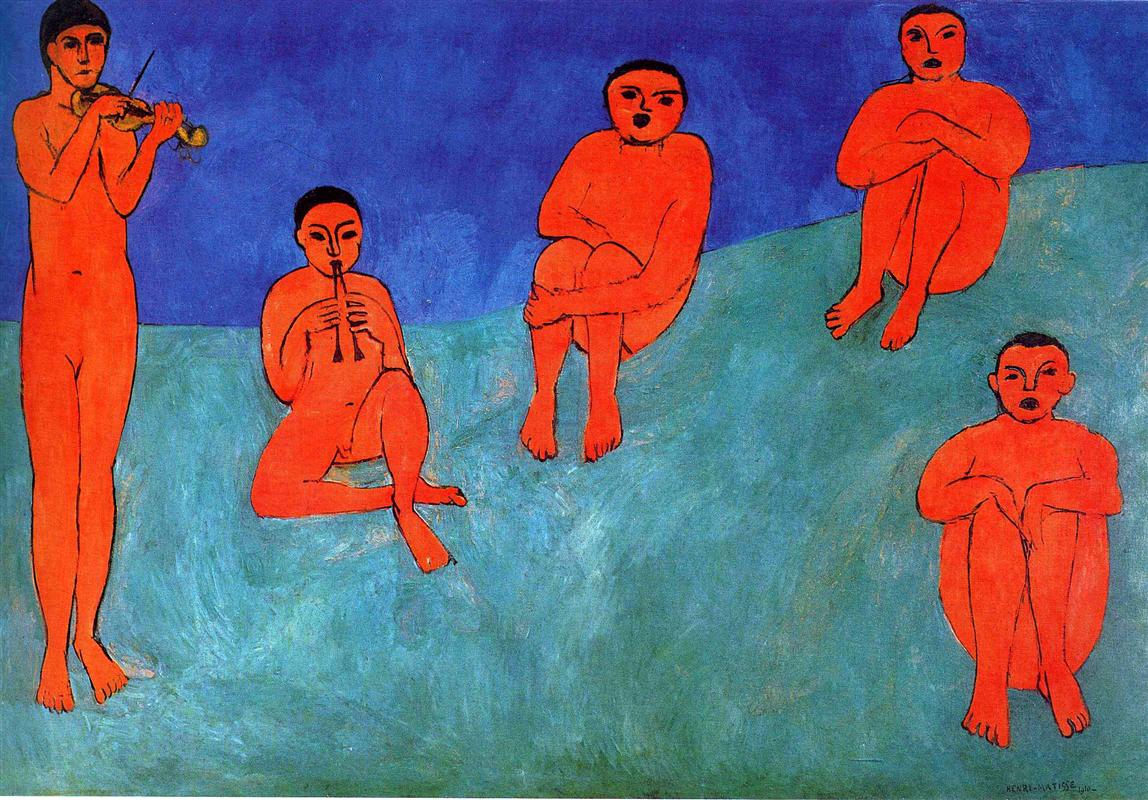
Henri Matisse’s “Music” (1910) is one of the clearest statements of his belief that painting can embody the power of art through the simplest possible means. Five scarlet figures occupy a shallow stage of green and blue. Three sit, two stand; two play instruments while the others listen in concentrated stillness. There are no props, no landscape detail, no cast shadows. The world has been reduced to three chords—red, green, and blue—conducted by firm black contours and paced by intervals of empty space. From this economy comes a resonant image that feels both archaic and startlingly modern, a frieze of humanity tuned to pure sound.
The Commission and the 1910 Breakthrough
“Music” was conceived alongside “Dance” as part of a pair of large decorative panels. In these canvases Matisse sought to forge a language suitable for architectural scale: bodies simplified to legible silhouettes, color deployed as structure rather than description, a shallow stage that reads immediately from afar. If the celebrated “Dance” embodies motion through linked bodies, “Music” pursues another universal theme—the making and receiving of sound—through stasis and attention. It stands at the threshold between Fauvism’s raw energy and the lucid, decorative order that would guide Matisse for decades.
Composition as Score
The composition unfolds like a musical staff. A low, undulating green band rises across the center, a ground that is neither hill nor floor but a broad stave on which the figures sit and stand. Above it, a blue field holds the upper register like an open sky. The five figures are distributed as notes and rests. At the far left, the standing violinist opens the phrase. A seated flutist follows, knees folded and elbows drawn in. At the midpoint a seated figure with clasped knees offers a fermata of stillness. On the right side, two more listeners echo the center’s pose at different scales, one perched higher on the ridge, one planted low in the extreme corner. The spacing between bodies is as important as their shapes; silence—those pools of blue—makes the music legible.
The Architecture of Color
Color carries the entire structure. The bodies are painted a saturated, almost vermilion red that holds steady across the panel. This red is not warmed by highlights or cooled by shadows; small modulations simply keep the planes breathing. The ground is a mixed green with lilting strokes of blue and yellow that suggest grass without naming it. The sky is an ultramarine field, steady and even. Red advances, green supports, blue recedes. The triad creates a climatic balance that is calm yet electric. Because the palette is so spare, any small shift—a darker outline of an arm, a speck of instrument brown—reads like a precise accent in a measured score.
Contour as Conductor
Matisse draws with the brush in lines that thicken and thin with the turn of form. The violinist’s arm is a long, confident arc; the flutist’s hands press the pipes with little hooked marks; knees and shoulders are simplified into rounded hinges; fingers compress into small wedges. These contours conduct the eye from figure to figure, keeping rhythm across the painting. The outlines never imprison the color; they allow it to blaze like stained glass held by lead. In places the line doubles, leaving a faint halo that records adjustment and keeps the surface alive.
Instruments, Gesture, and the Idea of Sound
The instruments—the violin at left and double pipes near center—are rendered with the fewest strokes necessary. They are not objects of craftsmanship but signs of action. Sound itself is invisible, so Matisse shows its origin and its reception. The players’ mouths are pursed and eyes alert; the listeners’ bodies coil inward, hands clasped over knees, faces turned with small, concentrated ovals of attention. Nothing exaggerates; there is no theatrical sway. The music exists in the tension between these held poses, as if the whole canvas were a resonating chamber.
The Psychology of Attention
By stripping away anecdote, Matisse allows the mood to emerge from posture. The five heads share a family resemblance—dark hair caps, simplified features, small mouths—which knits the group into a chorus rather than a portrait gallery. Each body is self-contained yet oriented toward the others. The violinist looks inward past his bow; the flutist’s gaze drops to the hands; the central sitter stares outward in mild astonishment; the upper right figure leans toward the sound; the lower right figure, smallest and closest to the viewer, closes the phrase with a concentrated hush. The effect is communal absorption, a modern Arcadia where pleasure arrives through listening rather than spectacle.
Shallow Space and Monumental Clarity
There is almost no depth. The green ridge tilts like a ramp and the blue field behaves like a wall. Overlap and scale are the only spatial cues. This shallowness is deliberate: it compresses figure and ground into a single decorative surface, ensuring that the image reads as a unified chord rather than a scene. The bodies become like relief sculpture—their roundness suggested by contour and flat color, their monumentality emerging from scale and placement rather than modeling.
Rhythm in the Intervals
“Music” is rhythmic not because limbs dance but because intervals are measured with care. The gap between violinist and flutist equals the distance between the central sitter and the upper right figure; the smallest listener at the lower right completes a descending cadence toward the corner. Repetition strengthens the rhythm: three seated figures clasp knees; two stand or nearly stand; four heads carry similar caps; five mouths are small, dark ovals. Variation prevents monotony: each angle of shin and forearm differs; each torso locks into a slightly different geometry; knees open or close by distinct degrees. The eye experiences these differences as syncopation across a steady beat.
Surface, Brushwork, and Evidence of Making
The large fields of green and blue are not flat plates. The brush sweeps in broad, directional arcs that leave faint ridges and patches of lighter undercolor. This subtle vibration prevents the ground from going inert and echoes the idea of air moved by sound. The red bodies are painted more opaquely, yet even they bear traces of the hand—small slants across a shin, a cooler patch on a shoulder, a slight overlap where contour was corrected. The painting shows its process without apology, a record of the artist testing intervals until the image carried.
Relation to “Dance” and the Decorative Program
“Music” and “Dance” are not twins but arguments in the same key. Where “Dance” is a continuous ring of motion, “Music” is a sequence of stations. Where “Dance” dissolves the individual into communal rhythm, “Music” emphasizes separate roles—two produce, three receive—while still binding the group through color and contour. Both panels demonstrate Matisse’s notion of the decorative: a surface that distributes interest evenly, sustains pleasure, and supports architectural space without becoming narrative illustration. They also announce his mature belief that painting can be “restful” while remaining intense, like the steady harmony of a sustained chord.
Antiquity, Modernity, and the Timeless Nude
The figures’ nudity is neither erotic nor allegorical. It is a way to step outside specific time and fashion, to connect with archaic friezes and Mediterranean reliefs while using a thoroughly modern language of color and flatness. The bodies are signs of humanity at its most general—listening, making, attending. Their faces, pared to a few features, read almost like masks. Yet the painting avoids cold abstraction because each pose has the weight of a living body and the warmth of the red chord.
The Ethics of Simplification
In “Music” Matisse practices an ethics of omission. He refuses distracting detail not to impoverish the scene but to clarify it. Every included element supports the central idea: the figures, the instruments, the ground, and the sky form one instrument. The choice to simplify is also a statement of trust in the viewer, who is invited to feel relations rather than inventory particulars. The painting asks for concentration similar to that of the figures it depicts; the reward is a pure, sustained pleasure.
Light as Temperature, Not Optics
There is no modeled sunlight or cast shadow. Light exists as the relationship between warm and cool. The red bodies glow because they sit within and against the green ground and blue air. On a small scale the paint sometimes shifts toward orange or brick, but these changes serve rhythm rather than description. The absence of conventional lighting keeps the panel flat and readable, a requirement for the decorative role it was meant to play.
Scale, Proportion, and Human Measure
The figures are almost life-size, which means the viewer’s body recognizes their scale instinctively. The wide format encourages lateral scanning as if reading a musical bar. Proportions are adjusted to the needs of the surface; hands and feet are simplified, torsos lengthened or compacted. The faces, though similar, vary just enough in distance between eye and brow, width of mouth, and curve of jaw to feel individual within a collective. These adjustments are not mistakes but calibrations in service of the whole.
Silence, Sound, and the Viewer’s Role
“Music” is paradoxically quiet. Nothing in the panel directly represents sound waves or the agitation of performance. Instead, Matisse has built an image that produces a musical sensation when seen. The eye moves through time from left to right; color chords sustain a key; repeated forms establish a beat; variation creates melody; and the gaps provide rests. The viewer completes the piece by reading it rhythmically. Looking becomes listening.
Kinships Beyond Matisse
The panel converses with other modern reimaginings of timeless themes. Its clarity echoes Cézanne’s bathers in their reduction of landscape to stage and body to architecture, yet Matisse’s color is more declarative. It prefigures aspects of mid-century abstraction, where vast fields of color hold the viewer with minimal figuration. It also resonates with non-Western frieze traditions—Egyptian processions, ancient Greek reliefs, and Asian scrolls—where repetition and interval tell a story of shared human action.
Why the Image Still Feels New
More than a century on, “Music” remains fresh because it trusts essential structures that do not date: a limited palette, bodies as clear silhouettes, space reduced to two planes, and rhythm achieved through spacing. Its boldness lies not in noise but in restraint. The panel shows that harmony can be radical, that serenity can be as modern as rupture, and that color itself can be the subject without ceasing to be human.
Lessons for Seeing and Making
The painting offers a durable method. Set a strong color ground that establishes climate. Place figures as intervals, not as anecdotes. Use contour to carry structure and let interior modeling stay minimal. Balance repetition and variation so the eye finds both stability and surprise. Trust large planes of color to do the work of light, and keep the stage shallow so the surface remains alive. Apply accents sparingly—the flick of a bow, the dark of a mouth—so they ring like small percussion against the main chord.
Conclusion
“Music” is a manifesto written in red, green, and blue. Five figures share a suspended moment in which sound is made and received, bodies are simplified to their eloquent essentials, and the painter’s language becomes as direct as a scale. The panel’s greatness lies in its ability to be monumental and intimate at once: architectural in design, human in feeling. In its calm, sustained harmony, it invites the viewer to pause, attend, and experience the visual equivalent of listening—an enduring lesson in what painting can be when it is tuned to the key of essentials.